
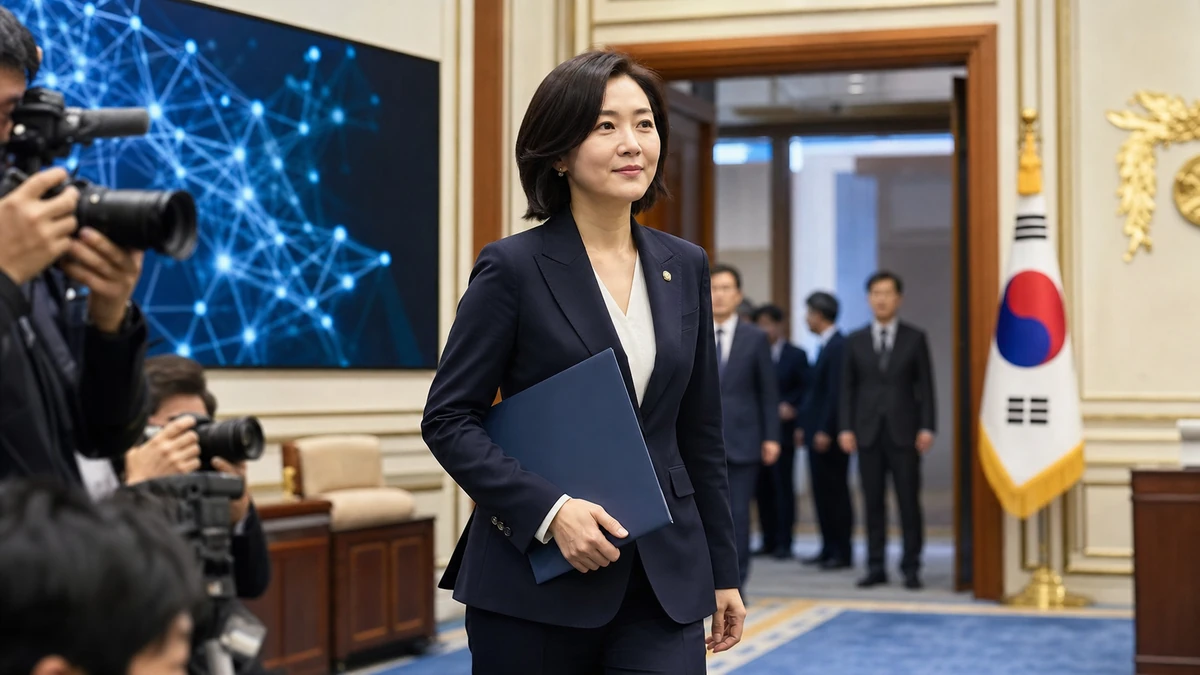
Image to help understand the article
South Korea moves AI from a policy niche to the president’s inner circle
South Korean President Lee Jae Myung’s decision to appoint lawmaker Lee Hae-min as senior presidential secretary for artificial intelligence and future planning is more than a personnel shuffle. It is a clear signal that artificial intelligence has moved out of the category of specialized tech policy and into the center of presidential power.
In the United States, the closest comparison would be a member of Congress leaving Capitol Hill to take a senior White House post focused on AI strategy, not as a symbolic adviser but as a core aide helping shape how government responds to a technology that is remaking industry, labor and public administration. That is the significance of Lee’s appointment in South Korea. It places AI not just inside a ministry or innovation agency, but inside the executive nerve center where political priorities are set and carried across government.
According to South Korean reports, Lee accepted the appointment publicly, saying she would keep working for the success of the Lee administration and for the success of South Korea. The presidential office announced the selection the same day. The move is notable partly because Lee is not simply a technocrat recruited from academia or the private sector. She is an active lawmaker, and her shift from the legislature to the presidential office suggests an effort to tighten the link between policymaking and policy execution at a moment when AI is being treated as both an industrial challenge and a kitchen-table issue.
That framing matters. In many countries, AI is still discussed in narrow terms: semiconductor supply, cloud infrastructure, regulation of large models or support for start-ups. But the language around this appointment suggests South Korea is thinking more broadly. The job title includes not only AI but also “future planning,” a phrase that in the Korean political context implies long-range state strategy. And allies in the broader progressive camp have explicitly described AI transformation as a matter of “livelihood,” meaning an issue tied to ordinary people’s daily economic security, not just to corporate competitiveness.
That is a consequential political shift. It suggests that in Seoul, AI is increasingly being treated the way inflation, housing or health care might be treated: as something with direct effects on family finances, jobs and the social contract. When a government starts talking about technology in those terms, the debate changes. The question is no longer whether AI matters. The question is who gets to shape how it matters.
Why this appointment stands out in South Korea’s political system
To outside readers, the mechanics of this move may seem obscure, but they reveal something important about how South Korean politics works. Lee Hae-min serves as a proportional representation lawmaker for the Rebuilding Korea Party, a smaller progressive party aligned with the broader camp around the current government but distinct from the main liberal Democratic Party. In South Korea’s proportional system, seats are allocated based on party lists rather than local districts. If a lawmaker holding one of those seats steps down, the next eligible person on the party list typically inherits the seat.
That means Lee’s move to the presidential office does not simply create a vacancy. It triggers a chain reaction. Reports indicate that Kim Hyeong-yeon, a top party official, is expected to succeed to the National Assembly seat. So one appointment in the presidential office is likely to reshape the composition of the legislature and, potentially, the internal balance of responsibilities inside a smaller party that is trying to cooperate with the government without losing its own identity.
For American readers, a rough analogy would be if a House member elected through a party-list system resigned for a White House policy post and was automatically replaced by the next candidate on the party’s slate, preserving the party’s overall seat count while shifting who exercises power. The individual change could affect the executive branch, Congress and the party organization all at once. That is part of what makes this appointment politically interesting.
It also highlights the different role that proportional representation can play in staffing government. In the United States, moving a sitting lawmaker into the executive branch usually raises immediate questions about a special election, partisan control of the seat and district-level representation. In South Korea, at least for proportional seats, the process can be more controlled and institutionally predictable. That lowers one political cost of moving specialized talent from Parliament into the presidential office.
The broader message is that South Korea appears willing to move experts across institutional boundaries when the presidency sees strategic value in doing so. In this case, the expertise in question is AI policy, and the destination is not a working-level bureau but a senior role close to the president. That alone says a great deal about how the Lee administration appears to rank the issue.
AI as a bread-and-butter issue, not just a tech industry agenda
One of the most revealing aspects of the reaction to Lee’s appointment came from the leadership of her party. Shin Jang-sik, leader of the Rebuilding Korea Party, described the AI transformation as part of “livelihood” politics and pledged cooperation. In South Korean political language, “livelihood” is a loaded term. It refers to practical issues that affect people’s day-to-day lives: wages, prices, work, family burdens and social stability. Calling AI a livelihood issue is a deliberate attempt to move the debate beyond elite conversations about innovation and toward questions of social impact.
That framing mirrors a broader global trend. In Washington, AI policy has increasingly expanded beyond Silicon Valley-style discussions of innovation into concerns about labor displacement, education, national security, disinformation and energy demand. Americans who might never use the phrase “foundation model” still understand worries about whether software will change office jobs, customer service work, entertainment, medicine and public schools. South Korea is now making a similar political move in more explicit terms.
The appointment suggests the government wants someone who can translate between the language of technology and the language of governance. A legislator brings one set of strengths to that task: experience with public debate, coalition management, lawmaking and political messaging. A senior presidential secretary, by contrast, must help coordinate ministries, advise the president and convert broad political intent into administrative action. The transition from one role to the other may be exactly the point. The administration appears to want AI policy that does not remain trapped in hearings, white papers or campaign rhetoric.
Still, the limits are equally important. The public materials described in South Korean coverage do not lay out a detailed policy agenda, legislative roadmap or timetable for implementation. There is no specific package yet, at least from the information provided, that would tell us whether this office will focus on industrial incentives, public-sector AI adoption, education, workforce retraining, content regulation or some combination of them. That means analysts should be careful not to overread the appointment. It is a strong signal of priority, but not yet a complete blueprint.
Even so, personnel can be policy. In every presidential system, hiring decisions tell officials where to focus and tell markets what a government believes matters. By elevating an active legislator to an AI-centered senior post, South Korea is indicating that the issue cuts across bureaucratic silos and deserves political management at the top. That is a step many democracies say they want to take, but fewer have made this directly.
A test of coalition politics on the Korean left
The appointment also sheds light on a second story unfolding alongside the AI agenda: the challenge of coalition management among progressive forces in South Korea. Lee Hae-min comes from a smaller party outside the main governing liberal party. Her selection therefore carries political meaning beyond the technology file. It suggests the presidential office is willing to draw from the wider pro-government camp when choosing key personnel, emphasizing expertise and working alignment over strict party boundaries.
That could be read as a sign of confidence, but it is also a test. Smaller allied parties often face a dilemma familiar to coalition politics around the world. If they cooperate too closely with the governing camp, they risk being absorbed or losing their reason for existing. If they stay too distant, they may sacrifice influence over real policy outcomes. Shin’s response reflected that tension clearly: cooperate on livelihood issues, compete on reform, and preserve party self-strengthening. In other words, help govern where interests align, but do not surrender political independence.
For U.S. readers, this may resemble the balancing act that ideological factions and adjacent parties face in parliamentary democracies, rather than anything typical in the American two-party system. But the underlying political logic is familiar. A government recruits talent from an allied camp, and everyone immediately asks two questions: Will the appointee deliver results? And who gets political credit if those results come?
That matters especially in AI, where success is difficult to define quickly. Governments can announce committees and strategies with relative ease. It is much harder to show that an AI initiative improved productivity, protected workers, modernized public services or strengthened national competitiveness without deepening inequality. If Lee succeeds in giving the administration a coherent AI direction, that success will likely reflect well on both the presidency and the smaller party that produced her. If the initiative stalls, both could feel the costs.
The same-day attention to another small-party figure, Basic Income Party lawmaker Yong Hye-in, who was nominated for a ministerial role, reinforces the point that the Lee administration appears to be adjusting its second-year governing lineup by drawing in figures from smaller allied groups and specialized policy backgrounds. Taken together, these moves suggest a government trying to broaden its talent pool while tightening strategic control over emerging priorities. Whether that approach creates a stronger governing coalition or sharper tensions will depend on execution.
What this means for the United States
For Americans, this appointment matters because South Korea is not a peripheral player in the AI race. It is a major U.S. ally, a technology power, a semiconductor heavyweight and a country whose policy choices often ripple across supply chains, digital markets and security cooperation. When Seoul elevates AI to the president’s inner circle, Washington, American companies and U.S. investors should pay attention.
Start with industry. South Korea is home to globally important chipmakers, electronics companies and digital platforms that are deeply tied to the American market. AI development depends on advanced semiconductors, data infrastructure, software ecosystems and industrial coordination. Any shift in how South Korea organizes its AI strategy could affect the competitive environment for U.S. firms operating in Korea, partnering with Korean companies or depending on Korean hardware and manufacturing capacity.
Then there is the policy relationship. The U.S. and South Korea already cooperate closely on economic security, advanced manufacturing and technology supply chains. AI is a natural next frontier in that partnership, especially as both countries weigh how to support innovation while addressing labor disruption, national security risks and the growing power of large technology companies. A more centralized AI strategy in Seoul could make South Korea a more active counterpart for Washington on questions such as standards, public-sector adoption, industrial policy and the governance of emerging technologies.
American audiences should also understand the cultural and economic overlap. South Korea’s global footprint in entertainment, consumer technology and digital culture means its AI choices will not stay confined to domestic policy. Korean entertainment companies, gaming firms, device makers and internet platforms all operate in spaces that matter to American consumers and creators. The same debates Americans are having about AI-generated media, intellectual property, workplace automation and online trust are increasingly relevant in Korea as well. A government that places AI under close presidential oversight may become more assertive in shaping those rules.
There is another lesson here for the United States. Washington often talks about AI as both a national-security issue and an economic issue, but the bureaucracy can still treat it as fragmented terrain divided among agencies, Congress and the private sector. South Korea’s move suggests one answer to that fragmentation: pull AI closer to the political center and give it direct presidential ownership. That does not guarantee success, but it does create clearer accountability. If AI is truly as transformative as leaders in both countries say, it is reasonable to ask whether more governments will conclude that it belongs at the top of the executive agenda, not scattered across the administrative map.
For American fans of Korean popular culture and for U.S. companies tied to Korean technology and media, this is also a reminder that the Korean Wave is increasingly connected to deeper structural shifts in Korean industry. The same country exporting K-pop, dramas and consumer electronics is also competing to define how AI is governed and deployed. Those are not separate stories anymore. They are becoming the same story.
What to watch next
The immediate question is not whether the appointment is symbolically important. It is. The harder question is what powers and priorities will actually follow. Because the available reporting does not yet specify a concrete policy package, the next clues will come from how the presidential office defines Lee’s portfolio in practice. Will her role focus on industrial strategy, public-service modernization, regulation, workforce transition or some mix of all four? How closely will she coordinate with line ministries, and how much authority will she have to cut through bureaucratic turf battles?
Another point to watch is the legislative-executive relationship. One reason this appointment stands out is that it brings someone with recent parliamentary experience into the president’s office. That could make it easier to align messaging and policy design across institutions. Or it could expose the gap between political ambition and administrative feasibility. AI policy tends to generate broad consensus at the slogan level and hard disagreement at the implementation level. Support for “AI innovation” is easy; deciding who pays for retraining, what rules govern data use and how to protect vulnerable workers is much harder.
The political effects inside the Rebuilding Korea Party also deserve attention. If Kim Hyeong-yeon takes over the proportional seat as expected, the party keeps its representation while sending one of its specialists into government. That is institutionally efficient. But it also raises strategic questions about how the party balances leadership duties, parliamentary work and its claim to independent relevance. The party’s own statements suggest it is aware of that challenge.
Finally, there is the larger trend line. Around the world, AI governance is moving from specialist circles into top-level politics. Governments are realizing that artificial intelligence is not only about inventing new tools. It is about economic structure, social trust, labor markets, public administration and geopolitical power. South Korea’s latest move fits that pattern, but in a particularly visible way: by turning an active legislator into a senior presidential aide for AI and future planning.
That makes this more than a one-day political story. It is an early indicator of how middle powers with advanced tech sectors may try to govern the AI era: by linking expertise, coalition politics and central executive authority more tightly than before. Whether that model works will depend on what comes next. But the message from Seoul is already clear enough. Artificial intelligence is no longer being treated as just another innovation portfolio. It is becoming a defining question of statecraft.


0 Comments