South Korea’s Box Office Is Becoming a Two-Movie Market — and That Has Big Implications Beyond Seoul
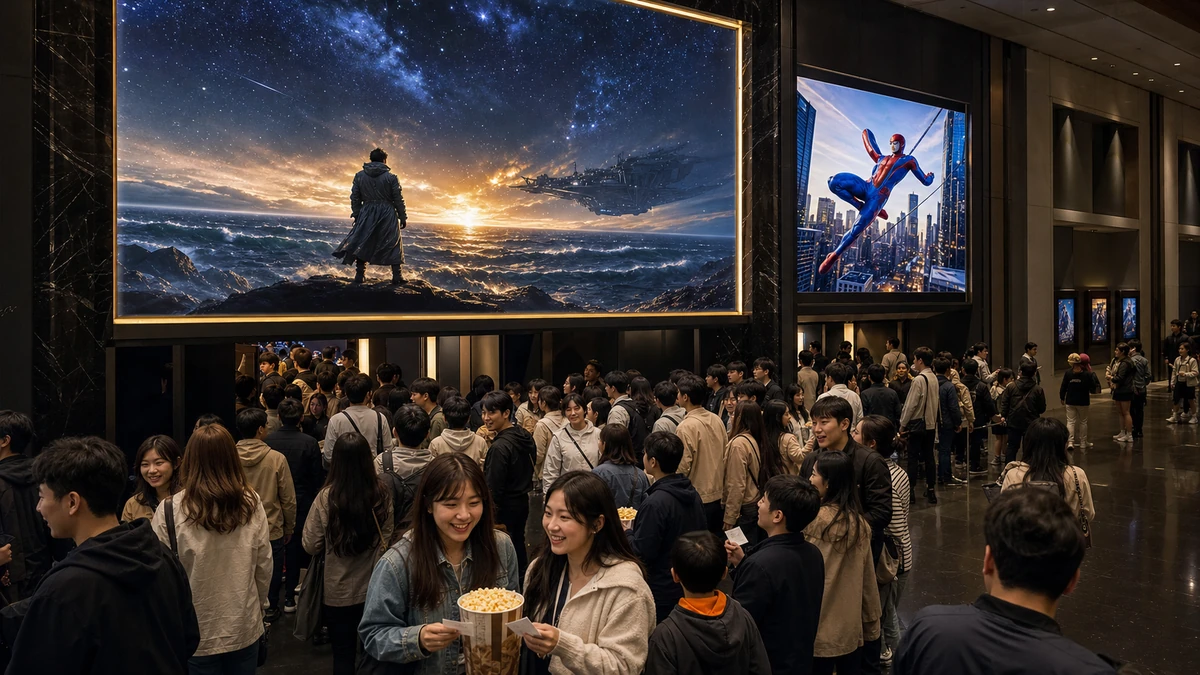
Image to help understand the article
A blockbuster duopoly is dominating South Korea’s theaters
South Korea’s movie business had a strikingly familiar look in the week of Aug. 17 through Aug. 23: two titles at the top and everyone else fighting over what was left. According to weekly box office data from the Korean Film Council, or KOFIC, “Odyssey” held on to the No. 1 spot for a second straight week, drawing about 2.57 million moviegoers during the period. The film accounted for 28.52 billion won in weekly ticket sales, good for a commanding 64.3% share of the market. Its cumulative audience climbed past 7.1 million since opening Aug. 5.
In second place, “Spider-Man: Brand New Day” stayed exactly where it was the week before, adding roughly 848,000 viewers and 8.85 billion won in revenue. That gave it a 19.9% market share and pushed its cumulative admissions above 8.12 million. Taken together, the top two films captured 84.2% of total weekly box office revenue in South Korea.
That number is the real story. It suggests not merely that two movies are popular, but that the theatrical marketplace has become unusually concentrated. For American readers, think of a weekend when one Disney tentpole and one superhero sequel absorb nearly all the oxygen at multiplexes, leaving specialty releases, family titles and local productions scrambling for showtimes. That is essentially what happened here, only on a nationwide scale measured over a full week.
South Korea is often discussed in the United States through the lens of K-pop, TV dramas and Oscar-winning films such as “Parasite.” But the country’s theatrical market is also one of the most sophisticated and closely watched in the world, with a moviegoing culture that has long punched above its population size. That is why this week’s numbers matter. They are not just a snapshot of winners and losers. They offer a window into how modern audiences behave when confronted with a handful of event films, aggressive screen allocation and rising competition for attention.
“Odyssey” led not only in audience but also in exhibition footprint, playing on 2,182 screens with more than 43,000 showings during the week. In other words, it was not simply a grassroots hit that spread by word of mouth. It was also given the kind of nationwide platform that allows a film to become unavoidable. In a box office environment like this, success feeds on itself. Bigger titles get more screens, more premium time slots and more visibility, which in turn makes it harder for smaller films to break through.
That dynamic should sound familiar to anyone who follows the U.S. film business. South Korea may have its own star system, release patterns and audience habits, but the math of theatrical concentration increasingly looks global.
Why these numbers matter more than a routine weekly ranking
Any weekly chart can tell you what movie won. A more revealing question is what kind of market produced that outcome. In this case, the answer is a top-heavy one. When the No. 1 and No. 2 films together take 84.2% of the revenue, the lower half of the top 10 is left competing within a narrow band of remaining demand.
The third-place film, the animated title “Love’s Hachuping: The Legend of the Whale Jewel,” drew about 154,700 viewers for a 3.3% revenue share. Fourth-place “Detective Conan: The Fallen Angel on the Highway” followed with roughly 130,200 viewers and a 3.0% share. Fifth-place “Okay Madam 2” took 2.2%, tied in revenue share with the newly opened horror release “Insidious: They Came Over,” which debuted in sixth. From there, the percentages drop to 1.0% or lower.
That cliff matters because it reveals just how quickly market power falls away after the top two films. In a healthier, more diversified theatrical week, the top title may still dominate, but the titles ranked No. 3 through No. 6 often retain enough room to sustain distinct audience lanes: family animation, horror, local comedy, anime, prestige drama and so on. Here, those lanes are compressed. A family movie can move up a spot, an anime film can slip a spot, and yet the overall market structure barely changes because the real contest is happening far above them.
There is also an important difference between popularity and availability. Big titles usually deserve credit for attracting crowds. But in any theater ecosystem, exhibition scale shapes the outcome. When “Odyssey” is screening more than 43,000 times in a week, it benefits from ubiquity. The film is easier to find, easier to plan around and more likely to occupy premium evening slots. Audiences may be choosing it enthusiastically, but they are also encountering a marketplace designed to funnel them there.
That does not mean there is anything improper about its success. It means the week’s rankings should be read as both a consumer preference story and an industry-structure story. The same is true in the United States, where studios, theater chains and release calendars all affect whether a film becomes a must-see event or an afterthought.
In South Korea, where box office reporting is detailed and closely tracked, weeks like this can become diagnostic. They help answer broader questions: Are audiences consolidating around event cinema? Are midsize movies losing their theatrical foothold? How much room is left for domestic variety when a small number of releases dominate screens and conversation? Those are not Korean-only questions. They define the post-pandemic movie business almost everywhere.
The middle of the chart shows a squeeze on everything else
The rest of South Korea’s top 10 reads like a study in survival under blockbuster pressure. “Love’s Hachuping: The Legend of the Whale Jewel” rose one position to No. 3, a notable gain even though it remained far behind the top two in overall market share. The “Hachuping” franchise, tied to children’s entertainment in Korea, is the sort of local family brand that might be unfamiliar to many Americans, but its function in the market is easy to recognize. Think of it as a domestically rooted kids property competing for parents’ attention in the same ecosystem where Hollywood franchises and imported animation already have huge advantages.
“Detective Conan: The Fallen Angel on the Highway,” part of the long-running Japanese anime mystery franchise known to many U.S. fans as “Case Closed,” dropped one spot to fourth. Interestingly, it played on slightly more screens and had more showings than the film above it, yet still attracted fewer weekly viewers. That suggests availability alone was not enough; audience demand may have been more concentrated among families and younger viewers who opted for “Hachuping,” or the “Conan” film may simply have reached a more limited but loyal fan base.
“Okay Madam 2” held steady at No. 5, while “Insidious: They Came Over” entered at No. 6 as the only new film in the top 10. For American readers, the “Insidious” name is immediately recognizable as part of a long-running horror brand, and its Korean performance underscores the portability of horror as a theatrical genre. Horror often functions as a counterprogramming category in many markets, appealing to younger audiences and groups seeking a different experience from family films or prestige blockbusters. But even a familiar horror title had limited room to maneuver in this particular week, opening below a local comedy sequel and well beneath the top pair.
Lower on the list, “Paw Patrol: The Dino Movie” remained at No. 7, another reminder that internationally recognizable children’s brands still have traction but may struggle when audience attention is already fragmented. “Hope,” which opened in mid-July, slipped to No. 8 but crossed 4.51 million cumulative admissions, suggesting a longer tail than its weekly position might imply. Meanwhile, Studio Ghibli’s “The Secret World of Arrietty,” first released in Korea in 2010, surged 22 places to No. 9. Reissues and repertory runs do not usually reshape a national market, but they can reveal something important: even in a highly concentrated week, there remains an appetite for familiar catalog titles, especially those with multigenerational appeal.
That jump for “Arrietty” also speaks to one of South Korea’s enduring exhibition strengths. Korean audiences are highly responsive not only to new releases but also to curated theatrical experiences, anniversary runs and revivals. American theaters have pursued similar strategies with titles from Studio Ghibli, “Star Wars,” “The Lord of the Rings” and concert films. When the new-release market gets crowded, repertory programming can still cut through by offering a different emotional promise: not novelty, but rediscovery.
The larger point is that the middle of the chart remains active, but it is active in a constrained way. These films are not absent. They are simply operating in a market where the top two have captured nearly all the leverage.
What this says about Korean moviegoing right now
South Korea has one of the most digitally transparent film markets in the world, and that makes it especially useful for spotting shifts in audience behavior. The current chart suggests at least three trends.
First, event viewing is still king. Audiences are willing to show up in huge numbers for the right title, even as global conversation about theaters often dwells on decline, streaming competition and changing consumer habits. More than 2.56 million weekly viewers for “Odyssey” is not the mark of a dying exhibition culture. It is the mark of a market in which people still go to theaters when a movie feels culturally central.
Second, concentration may be the new normal rather than a temporary distortion. Since the pandemic, many film markets, including the United States, have seen the hollowing out of the middle. The biggest titles do very well, niche titles can still find devoted audiences and everything in between faces a much tougher road. This week’s Korean rankings fit that pattern. Theaters are not empty, but the path to theatrical relevance is narrower unless a film arrives with franchise power, strong local branding or unusual momentum.
Third, release timing matters more than ever. “Odyssey” opened Aug. 5 and has now built a sizable cumulative audience in just a few weeks. “Spider-Man: Brand New Day,” which opened July 29, remains formidable enough to lock up second place even after the launch of a stronger rival. In other words, once a title establishes itself in the Korean market, later arrivals may find that they are not entering a neutral field. They are entering a battlefield whose territory has already been taken.
It is also worth explaining a cultural point for U.S. readers: South Korean box office is commonly discussed in terms of admissions, not just revenue. That focus on raw audience numbers can shape media narratives and public perception. In the United States, headlines often center on dollar totals because ticket prices vary widely and box office is treated as a financial performance story. In Korea, admissions remain a highly visible measure of social reach. Crossing a major audience milestone is not just a business achievement; it is often perceived as evidence of broad public recognition.
That matters when evaluating a film like “Odyssey.” Its dominance is not merely that of a lucrative release. It is becoming a mass-audience event. When admissions rise that quickly, the movie moves beyond cinephile circles and into general public conversation. That feedback loop can keep a film atop the chart longer, especially if word of mouth remains favorable and theaters continue to support it with premium scheduling.
What this means for the United States
For American audiences and entertainment companies, the Korean box office is no longer a distant curiosity. It is a meaningful piece of the global media economy. South Korea is one of Hollywood’s most important overseas markets, one of the most influential exporters of pop culture and a country whose consumers often help signal how internationally connected filmgoing has become.
The clearest takeaway for the United States is that the same structural pressures visible in American theaters are visible in Korea as well. Big franchises and major event titles can still create genuine urgency. But when they do, they often overwhelm the rest of the market. U.S. studios have relied heavily on that dynamic for years, from Marvel releases to animated sequels to branded tentpoles from Universal, Warner Bros. and Disney. The Korean data reinforces that a blockbuster-first strategy remains powerful abroad, especially when paired with wide screen access and strong fan anticipation.
That has implications for American companies beyond ticket sales. U.S. studios increasingly think globally from the start: casting, release calendars, marketing campaigns and franchise planning are all built around international performance. A Korean box office week in which a Hollywood superhero film remains No. 2 with more than 8.12 million cumulative admissions is a reminder that American intellectual property still travels well, even in one of Asia’s most dynamic local-content markets.
At the same time, the success of “Odyssey” is a warning against assuming Hollywood can own the field. Korean audiences have repeatedly shown that they will rally behind a film that feels urgent, accessible or culturally resonant, regardless of whether it comes from a U.S. brand machine. For Americans, the comparison may be the way domestic sleeper hits occasionally cut through a franchise-heavy landscape at home, though such cases have become rarer. In both countries, viewers are not rejecting original or locally resonant storytelling; they are demanding that it feel like an event.
There is also a fan culture dimension. American audiences now consume Korean entertainment across platforms: K-pop tours sell out U.S. arenas, Korean dramas dominate streaming recommendation lists and Korean filmmakers are no longer art-house exceptions in American conversation. That means U.S. viewers are increasingly primed to pay attention when a Korean release becomes a phenomenon. While not every Korean box office smash will cross over theatrically in the United States, the market signal matters to distributors, streamers and exhibitors deciding what to import, license or promote.
For U.S.-Korea cultural ties, this moment is another illustration of interdependence rather than one-way influence. Hollywood still commands major loyalty in Korea. Korea, meanwhile, continues to shape American entertainment tastes through music, television, fashion and film. The two industries are now in a constant conversation, competing and collaborating at the same time. A week like this, with a local giant and a Hollywood superhero title jointly consuming more than four-fifths of the market, is not evidence of one side replacing the other. It is evidence of a blended commercial ecosystem.
American theater owners and distributors should also pay attention to the squeeze below the top two. If Korea, a mature and movie-savvy market, is struggling to make space for the middle, that should raise questions in the U.S. about the future of theatrical diversity. Can family titles, anime releases, horror entries and midbudget comedies all coexist when blockbuster scheduling becomes so aggressive? That is not just a Korean problem. It is one of the central business questions facing U.S. exhibitors heading into every crowded season.
What to watch next in Korea’s theatrical race
The immediate question is simple: can “Odyssey” stay on top for a third week? Based on the current data, it has momentum, scale and an admissions total that suggests sustained public interest. But weekly charts can shift quickly if a major newcomer arrives or if the audience that rushed out early begins to taper off.
The second question is whether “Spider-Man: Brand New Day” can keep converting its large cumulative audience into staying power. In many markets, superhero movies are front-loaded, meaning they draw heavily in opening stretches before fading faster than family films or word-of-mouth dramas. Yet this title remains resilient in Korea, holding second place without collapsing. That may reflect franchise loyalty, continued family appeal or simply the benefit of strong release timing.
The most interesting race may be in the middle. The gap between No. 3 and No. 4 was only about 24,000 weekly viewers, and the gap between No. 5 and No. 6 was just 7,623. Those are small enough differences that one strong weekend, one promotional push or one favorable audience response could reshuffle the order. “Insidious: They Came Over,” in particular, may behave differently once it has a full week of play under its belt rather than a partial opening frame. Horror titles often benefit from social momentum if early viewers help frame the movie as a communal must-see.
Then there is the wild card effect of repertory and legacy content. “Arrietty” jumping 22 spots does not mean an older title is about to overtake current hits. It does, however, show that audience curiosity is not entirely monopolized by new releases. In a fragmented media environment, nostalgia can still organize an audience, especially when the title carries the kind of prestige and emotional familiarity associated with Studio Ghibli.
Stepping back, the next few weeks will help clarify whether this is simply a strong run for one film or a more durable pattern in which two or three titles repeatedly swallow most of the theatrical market. If it is the latter, Korean distributors and theater chains may face the same strategic dilemma their American counterparts know well: how to maximize revenue from event films without starving the broader ecosystem that keeps moviegoing varied, habitual and culturally rich.
A familiar global picture, seen through a Korean lens
It is tempting to read box office charts as scoreboards and stop there. But the Korean numbers from Aug. 17 to Aug. 23 tell a broader story about where theatrical exhibition stands in 2026. Theaters are still capable of producing massive communal experiences. Audiences still respond to scale, urgency and franchise recognition. Yet the market is increasingly lopsided, with a few films absorbing the vast majority of attention.
South Korea, because of its strong film culture and transparent data, offers one of the clearest illustrations of that tension. A dominant local release such as “Odyssey” can surge past 7.1 million admissions in a matter of weeks. A Hollywood superhero film can remain a formidable second-place force with more than 8.12 million cumulative viewers. But once those two titles claim the center, the rest of the market becomes a story of marginal gains, careful scheduling and audience niches fighting for visibility.
For Americans, the lesson is not that Korea is unusual. It is that Korea is recognizable. The same pressures shaping multiplexes in Los Angeles, Chicago and Atlanta are now plainly visible in Seoul and beyond: bigger bets, fewer guaranteed openings for midsize films and a theatrical business that increasingly depends on making certain titles feel indispensable. In that sense, this week’s Korean box office is not only a local report. It is a case study in the modern global movie economy.
And if that economy is becoming a two-movie market more often than the industry would like, then the challenge ahead is clear on both sides of the Pacific: finding a way to preserve breadth in a business increasingly built around concentration.
Comments
Post a Comment