South Korea expands free flu shots to 14-year-olds, offering a revealing look at how countries are rethinking school-age vaccination
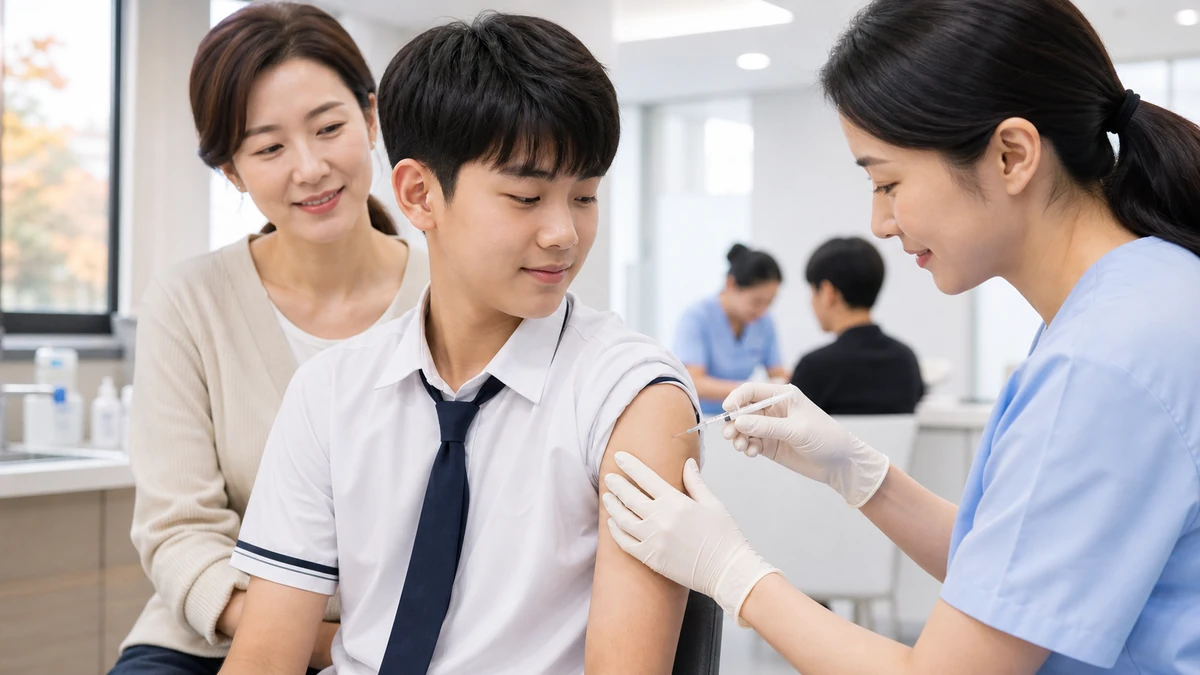
Image to help understand the article
South Korea’s flu policy just got slightly broader — and potentially much more consequential
South Korea is making what looks, at first glance, like a modest change to its national influenza vaccination program: beginning with the 2026-27 flu season, the government will expand free flu shots for children from ages 6 months through 13 to ages 6 months through 14. The campaign will run from Sept. 21, 2026, through April 30, 2027, and will continue to cover pregnant women and older adults, with vaccinations rolled out in stages by age group rather than all at once.
But as is often the case in public health, a one-year adjustment on paper can signal something bigger in practice. South Korea’s disease control agency says the aim is to slow the spread of influenza among school-age adolescents and strengthen what public health experts often call community protection — the idea that vaccination helps shield not only the person receiving the shot, but also classmates, relatives and others who share close indoor spaces.
That makes this more than a bureaucratic tweak. It is a policy choice that reflects how governments increasingly think about schools not just as places of learning, but as major hubs of transmission during respiratory virus season. For American readers, the Korean move is also a useful reminder that flu policy is about much more than individual risk. It is about who gets prioritized, who gets public support and how governments decide where a small expansion in coverage can have outsized effects.
In the Korean case, the newly covered group includes teenagers who would roughly correspond to middle school students. The government said eligibility for the children’s program will be determined by date of birth, covering those born between Jan. 1, 2012, and Aug. 31, 2026. That detail matters. Families are being told not to rely only on the shorthand of “14 years old,” because the actual cutoff depends on birth date, and because the vaccine campaign will open in phases depending on age and category.
For households, that means the headline is simple but the logistics are not. For policymakers, the opposite may be true: the logistics are routine, but the message is significant. South Korea is extending the public-health perimeter deeper into the adolescent school population.
Why age 14 matters more than it may sound
If this were only about adding one more birthday year to a benefits chart, it would not merit much attention outside Korea. The reason it does is that age 14 sits at a highly social stage of life. Teenagers that age typically spend long hours in classrooms, hallways, cafeterias, after-school programs and private tutoring environments. In South Korea, where education is highly competitive and students often spend substantial time in group settings, the logic behind school-centered disease control is especially clear.
That context matters for English-speaking readers who may be less familiar with the rhythms of Korean student life. South Korean teenagers often move through densely scheduled days that can include regular school, extracurricular activities and, in many cases, hagwon — private academies that are a major feature of the country’s education culture. Even without citing any one institution or neighborhood, the broader picture is easy to understand: adolescents are in repeated close contact with peers for hours at a time, which makes them important participants in the seasonal spread of respiratory illness.
The Korean government’s explanation reflects that reality. Officials said the policy expansion is intended to prevent influenza from spreading among school-age youth and to reinforce community-level protection. In plain terms, the government is betting that covering one more slice of the teenage population can help reduce outbreaks in classrooms and, by extension, in homes and the broader community.
That is a familiar argument in public health. Children and teenagers do not have to be the people at highest risk of severe complications in order to matter strategically. They can serve as efficient transmitters of infection, especially in high-contact settings. A vaccination policy that targets them is therefore not just about protecting children for their own sake, though that is part of it. It is also about limiting the path the virus takes to grandparents, pregnant women, siblings and teachers.
South Korea has not claimed in this announcement that the change will produce any specific numerical drop in infections or vaccination rates, and it would be wrong to promise a measurable outcome before the season unfolds. What the government has done is define its theory of prevention more clearly. By bringing 14-year-olds into the free-shot program, it is acknowledging that the boundary between “childhood vaccination” and “adolescent transmission control” is more porous than old age categories sometimes suggest.
How the Korean system frames flu vaccination as a public service
Another notable feature of this announcement is not the expansion itself, but the structure around it. South Korea’s national influenza program is not only for children. It also includes pregnant women and older adults, placing multiple life stages under one seasonal umbrella. The campaign for the 2026-27 season will last from early fall into the following spring, a long window designed to accommodate different groups, different schedules and staggered eligibility dates.
That long calendar highlights an important difference in how flu vaccination is communicated. In many news cycles, a flu shot announcement becomes a single date on the public calendar — the vaccine is available, the season has begun, people should go get it. South Korea’s messaging, at least in this case, emphasizes something more administrative but arguably more useful: not everyone starts on the same day, and families need to check category-specific timing and eligibility carefully.
That may sound dry, but it reveals a lot about how public health programs succeed or fail. A free benefit is only fully effective if people understand that they qualify, know when access opens and can navigate the rules without getting tripped up by assumptions from the previous year. Korean officials appear to recognize that families may mistakenly believe a child is still outside the free program because last season’s age limit stopped at 13, or may misunderstand the phrase “through age 14” without checking birth-date criteria.
In other words, the practical challenge is not simply funding doses. It is converting eligibility into uptake. That is a universal lesson, whether the policy is in Seoul, Chicago or Los Angeles. Public-health programs often live or die not on whether they exist, but on whether ordinary people can decode them.
There is also a broader political point embedded in this model. When a government publicly finances seasonal flu vaccination for selected groups, it is making a statement about who should not face economic or procedural barriers to preventive care. South Korea’s decision to widen eligibility for adolescents by one year suggests that the state sees this school-age bracket as important enough to include in its social protection framework, not just its medical guidance.
That does not mean South Korea is uniquely generous or uniquely strict; countries organize flu vaccination differently depending on their health systems, budgets and public-health priorities. But this case does show a government treating seasonal influenza not as a purely private health choice, but as something worthy of organized, recurring national intervention.
What this means in the United States
For American readers, South Korea’s announcement is interesting precisely because the United States approaches seasonal flu through a different mix of guidance, insurance coverage, pharmacy access and public messaging. In the U.S., the Centers for Disease Control and Prevention generally recommends annual flu vaccination for everyone 6 months and older. On paper, that is broader than South Korea’s free-shot categories. But recommendation and guaranteed public provision are not the same thing, and access in America often depends on a more fragmented landscape of private insurance, public programs, clinics, pediatric offices, pharmacies and local health departments.
That makes South Korea’s move worth watching not because it is more expansive than the U.S. on age recommendations, but because it is highly targeted and explicitly tied to school transmission. American public-health officials have long understood that schools are central to the spread of seasonal illness. Parents in the U.S. know the pattern well: one child gets sick, then a sibling, then a parent, then half the classroom seems to be absent by the following week. In that sense, the Korean rationale is immediately legible to an American audience.
The difference is in the policy design. Korea is using national eligibility rules and free access for defined groups to close what it sees as a vulnerability in the school-age chain of infection. The U.S., by contrast, often relies on broader recommendations alongside a patchwork delivery system. Many Americans can get a flu shot at a drugstore or supermarket pharmacy on a lunch break, which is a form of convenience Korea’s more centrally communicated eligibility model does not map onto exactly. But convenience is not the same as coherence, and a broad recommendation does not always produce broad uptake.
There is a second U.S. angle as well: the announcement offers a small but telling example of how South Korea handles preventive health as part of the larger U.S.-Korea relationship Americans increasingly pay attention to. For years, the bilateral story has centered on semiconductors, electric vehicles, defense ties and K-pop. Yet health systems and pandemic-era public-health management have quietly become another area where Americans watch Korea with interest. South Korea’s reputation for organized public-health communication, sharpened during the COVID-19 years, gives even incremental policy changes a wider relevance abroad.
For U.S. companies, especially those in health care, pharmacy retail and vaccine distribution, the Korean model is a reminder that demand is shaped not only by medical need but by state design. When governments define target groups clearly and pay for preventive care, they can influence behavior at scale. For American audiences, meanwhile, the policy underscores a recurring domestic question: if the U.S. already tells nearly everyone to get a flu shot, what are the remaining barriers that keep school-age vaccination from being as routine as officials would like?
South Korea’s decision does not answer that question for America. But it does sharpen it.
From individual protection to protecting the school community
One of the most striking aspects of the Korean announcement is the language around “community protection.” That concept can sound abstract, especially after years in which Americans have heard overlapping and sometimes politicized arguments about public health. Yet in this context, the basic idea is straightforward. A vaccination program can be designed not only to reduce a person’s own chances of getting sick, but also to lower the chances that a virus will ricochet through shared spaces.
Schools are the obvious example. A 14-year-old may be healthy, mobile and socially active, but those very traits make adolescence a consequential stage in the ecology of flu season. Students are in close contact for long periods. They go home to multigenerational families. They interact with teachers, staff, younger siblings and classmates with varying health conditions. A decision to widen coverage by one year is therefore also a decision to widen the shield around the institutions those teenagers inhabit.
That helps explain why the Korean announcement deserves to be read as a trend story, not just a one-day government notice. Across many countries, respiratory-virus policy is moving toward more careful attention to settings: schools, nursing homes, hospitals, public transit, dormitories. The question is no longer only who is medically vulnerable in the narrowest sense. It is also where transmission is most likely to intensify and which age groups connect the greatest number of social networks.
In South Korea, school life has special policy importance because education occupies such a central place in family schedules and social expectations. For Americans, an imperfect but understandable comparison might be the way U.S. officials think about flu season in K-12 schools after the return to in-person learning following the worst disruptions of the pandemic. Once schools are recognized as critical social infrastructure, absenteeism becomes not just a family inconvenience but an economic and public-health concern. Parents miss work. Classrooms lose continuity. Health care providers see seasonal surges. The burden spreads outward.
Seen that way, Korea’s policy change is not about one teenager’s free shot. It is about trying to make a common social environment slightly less efficient at spreading illness.
What families in Korea — and observers abroad — should watch next
The immediate takeaway for families in South Korea is practical. Parents need to confirm whether their child qualifies based on birth date, not just age, and they need to check when their category becomes eligible during the phased rollout. Pregnant women and older adults also remain part of the same seasonal program, so the overall timeline from Sept. 21, 2026, to April 30, 2027, should not be confused with universal same-day access.
For outside observers, including policymakers and health journalists in the United States, the more interesting question is what happens after implementation begins. Will the newly eligible 14-year-old group actually show up in significant numbers? Will schools and families treat the expansion as a meaningful new benefit or as a minor technical adjustment? And will Korea, over time, continue to push free flu-shot eligibility further into adolescence if it sees value in reducing transmission in school settings?
The current announcement does not provide evidence on those outcomes, so caution is warranted. Still, the policy is notable because it reveals where Korean public health officials believe intervention can matter most right now. They are not merely expanding a list. They are adjusting the map of collective protection around schools.
That is why this story resonates beyond Korea. In an era when health systems are under pressure to spend carefully but strategically, small expansions can carry big symbolic weight. They show how governments decide which populations are worth reaching proactively, which settings they see as epidemiologically important and how they balance universal aspirations with targeted execution.
For Americans used to thinking of the flu shot as an annual reminder from a doctor, pharmacy or school nurse, South Korea’s move offers a different lens. It suggests that the flu vaccine can also be understood as a tool of educational continuity, household stability and community-level risk management. That does not make the Korean model automatically transferable to the United States. The two countries have different health systems, different delivery channels and different public expectations. But it does make the Korean case a useful benchmark in a larger global conversation about what preventive care should be designed to do.
If there is one lesson here for English-speaking readers, it is that vaccination policy often reveals a country’s priorities more clearly than political rhetoric does. South Korea’s latest decision says that one more year of adolescence is worth bringing inside the public-health safety net — not only for the teenager receiving the shot, but for everyone sharing the room.
Comments
Post a Comment