Image to help understand the article
A tougher warning system arrives on the Korean market
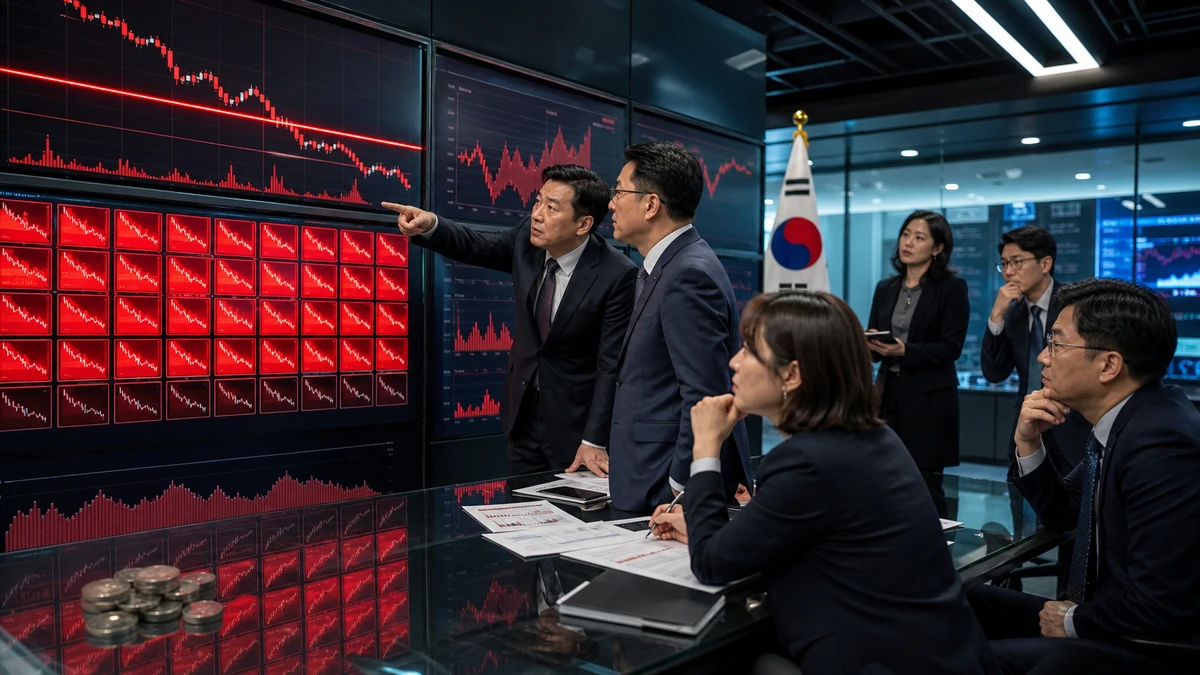
South Korea has taken a more aggressive step to police its stock market, flagging 36 listed companies for failing to meet new standards tied not only to business performance, but also to how the market values them. The move, announced by the Korea Exchange on June 12, marks one of the clearest signs yet that Seoul is trying to push its capital markets toward a model more familiar to global investors: fewer chronically weak companies lingering on public exchanges, more emphasis on market credibility, and greater pressure on executives to prove they deserve to stay listed.
The companies were designated as “managed stocks,” a Korean market status that does not mean immediate delisting but serves as a serious warning label. In practical terms, it tells investors and corporate managers alike that these businesses have unresolved issues that threaten their standing on the exchange. This time, the trigger was not limited to accounting problems or losses. Companies could be flagged if their shares stayed below 1,000 won — roughly the price of a cheap convenience-store item in South Korea, and less than 1 U.S. dollar — for 30 consecutive trading days, or if their market capitalization fell short of listing requirements.
For American readers, the closest comparison is not exact, but the logic resembles the way U.S. exchanges such as Nasdaq or the New York Stock Exchange can warn or delist companies that fall below minimum bid-price or market-value standards. In both cases, the concern is broader than a weak stock chart. Regulators and exchange officials worry that if too many barely surviving companies remain listed for years, investors may begin to distrust the market as a whole.
That concern has become more pressing in South Korea, where policymakers have spent the past year talking up the need to improve what is often called the “Korea discount” — the long-running tendency for Korean stocks to trade at lower valuations than peers in other advanced markets. Officials have promoted governance reform, shareholder-friendly policies and measures intended to make Korean equities more appealing to domestic and foreign investors. Tightening delisting and warning rules is part of that same campaign.
Of the 36 companies designated this week, 30 were newly added and six were already under managed-stock status but picked up additional warning reasons. Three are listed on the main KOSPI market, South Korea’s equivalent of a blue-chip board, while 21 were flagged on the tech-heavy KOSDAQ market because their share prices stayed below 1,000 won. The rest were cited for falling under market-capitalization thresholds. On paper, the numbers are modest. Symbolically, they are much bigger: the new regime is no longer theoretical. It is now affecting individual companies in real time.
Why “penny stocks” matter more in Seoul now
In Korean financial language, a stock trading below 1,000 won is often called a “dongjeonju,” literally a “coin stock.” The phrase carries some of the same baggage as “penny stock” in the United States. It suggests a company that has lost market confidence, faces weak liquidity, or risks becoming more speculative than investable. But the Korean threshold is not simply a nickname. It has now become part of the exchange’s formal screening system.
Beginning last month, the Korea Exchange started applying a rule under which a stock that remains under 1,000 won for 30 straight trading days can be designated as a managed stock the next day. The same applies to companies that remain below the minimum market capitalization needed to keep their listing. The idea is to distinguish between a temporary selloff and a prolonged failure to convince the market that a company has meaningful value.
That is a significant shift in how listing standards are understood. In the past, many investors thought of a stock exchange listing mainly as a gateway: a company met the requirements, went public, raised money and then stayed listed unless something went badly wrong in its books or operations. The new Korean approach underscores a different principle — that staying public is not a permanent right. It is an ongoing responsibility, and part of that responsibility includes maintaining a credible valuation and sufficient investor interest.
This matters because stock prices are not just vanity metrics. They affect whether companies can raise new capital, use shares in acquisitions, attract institutional investors and retain confidence among suppliers, lenders and employees. When a company’s price stays depressed for an extended period, the exchange is effectively saying the market may be sending a signal that cannot be ignored.
For retail investors, who remain a powerful force in South Korea’s stock market, the new rule also challenges a familiar way of thinking. Low-priced stocks can look tempting, especially to individual traders hunting for turnaround stories or betting on sharp rebounds. But the exchange’s intervention sends a message that “cheap” should not be confused with “undervalued.” A low price that persists may reflect structural weakness, not opportunity.
A test of South Korea’s campaign to upgrade market quality
The broader policy goal behind the change is to improve the quality of the Korean market, especially KOSDAQ, which has long played a role similar to a growth board for emerging companies. KOSDAQ is often compared to the Nasdaq of an earlier era: a place where smaller, faster-growing or more speculative firms can access public capital. That makes it important for innovation. It also makes it vulnerable to quality-control problems.
If too many struggling companies remain listed for too long, stronger businesses can get tarred by association. Investors may begin treating the market as a higher-risk venue overall, demanding a discount even from firms with solid products, decent profits and real growth prospects. In that sense, removing or pressuring noncompetitive companies is not just about punishing laggards. It is about making room for healthier companies to be valued more fairly.
That argument has become increasingly influential in South Korea’s financial industry. Bankers, fund managers and policy advisers have said that clearer exit rules could help channel capital toward firms that actually demonstrate performance and growth potential. Instead of leaving money tied up in long-stagnant names, the market could become better at distinguishing winners from losers. That, supporters argue, would make KOSDAQ more attractive and efficient over time.
The push also fits with a wider government effort to revitalize domestic capital markets. South Korean officials have spent months arguing that the country needs a more dynamic and trustworthy market environment if it wants to keep local investors engaged and attract more global capital. The challenge is especially important in a country where household participation in equities is high, but where frustration over governance, valuation gaps and market volatility has often run deep.
In this context, the latest designations are a kind of proof of enforcement. Many reform campaigns sound impressive when first announced but lose force when officials hesitate to apply them to actual companies. By moving 36 stocks into managed status, the exchange is signaling that it intends to enforce standards that go beyond rhetoric. Whether investors reward that seriousness remains to be seen, but the market now has a concrete example of policy turning into action.
The debate: market discipline or blunt instrument?
Not everyone is convinced the new system strikes the right balance. Critics argue that a rule based on share price or market capitalization can sometimes penalize companies that are still operating normally or even posting operating profits. In other words, a business may be generating revenue, making products and producing earnings, yet still face exchange sanctions because the market has not rewarded it with a high enough valuation.
That tension is hardly unique to South Korea. American investors have also seen cases in which a company’s market price appears disconnected, at least temporarily, from its business fundamentals. Sentiment, sector rotation, liquidity problems and macroeconomic fear can all weigh on a stock. A weak share price is not always proof of a broken business.
That is why some in Korea’s financial industry worry the rule may be too mechanical, especially for early-stage companies or thinly traded firms. A growth company that is still trying to win investor attention could end up pushed toward a formal warning track even if its underlying business is viable. For sectors that naturally go through long investment cycles — biotech is a common example in many markets — short-term market pessimism can coexist with longer-term potential.
Others say the issue is timing. Industry participants have argued that some companies have not had enough time to respond, and there is already speculation that the number of affected stocks could climb significantly in coming months. Some analysts in the industry have discussed the possibility that roughly 100 companies could eventually fall into the broader danger zone under the new criteria. That prospect raises the stakes for investors, executives and lawyers alike.
Indeed, the friction is no longer theoretical. According to industry accounts cited in Korean coverage, at least one company has already sought an unusual court injunction related to a managed-stock designation. More legal challenges could follow, particularly if companies believe the rules are being applied too rigidly or without adequate room for remediation. That points to a central reality of market reform: the principle can be popular while the implementation becomes contentious.
The Korean exchange will likely have to show not only firmness, but also predictability and transparency. Investors need confidence that warning labels are meaningful and consistently applied. Companies need confidence that there is a fair and understandable path to improvement. If those two goals fall out of balance, a cleanup campaign can begin to look arbitrary, and that would undermine the trust it is meant to build.
What this means for companies listed in Korea
For listed companies in South Korea, the new regime changes the job description of public-company management. It is no longer enough to focus only on operations, debt levels and formal reporting requirements. Executives are now under sharper pressure to manage how the market understands the company’s story, strategy and value. In effect, investor relations becomes more central to corporate survival.
That does not mean companies can simply talk their way out of trouble. If a stock languishes below the threshold for a month, the market is delivering a verdict that words alone may not reverse. But the rule does reinforce the idea that public companies need to communicate with shareholders consistently and credibly. They must explain not only what they are earning today, but why the market should believe in their future.
In the United States, that expectation is taken for granted among seasoned public companies. Quarterly calls, guidance practices, conference appearances and shareholder outreach are all part of maintaining market confidence. South Korean companies, particularly smaller listed firms, are now being pushed harder in that direction. The exchange’s message is that poor valuation over time is not just an unfortunate side effect. It can become a compliance problem.
For some firms, the likely response will be operational reform: cost cuts, business restructuring, asset sales or sharper focus on profitable lines. Others may consider reverse stock splits, capital measures or strategic partnerships designed to boost market value and stabilize their listing status. Still others may struggle simply because they lack the scale or investor following to recover quickly.
The effect could be especially pronounced on KOSDAQ, where companies often list earlier in their life cycle and rely more heavily on market confidence. The exchange has to walk a narrow line there. If standards are too loose, investor trust erodes. If standards are too harsh, the market may become less hospitable to younger companies that genuinely need public capital to grow. This week’s designations are, in that sense, the first major test of how South Korea intends to balance opportunity with accountability.
Why foreign investors are paying attention
For global investors, this story is about more than 36 obscure tickers. It is about whether South Korea is entering a new phase in the evolution of its capital markets — one in which quality, governance and accountability matter as much as scale. The country already occupies an outsized role in global portfolios because of its technology giants, auto makers, battery manufacturers and export-driven economy. But beneath those marquee names sits a much broader listed market whose reputation also affects how overseas money views Korea as an investment destination.
Foreign investors have often praised South Korea’s industrial strength while criticizing aspects of its market structure, including governance concerns, complexity and valuation inefficiencies. If Seoul can show that it is serious about maintaining higher standards for listed companies, that could support its argument that the market deserves greater trust and, eventually, better valuations.
At the same time, international investors will be watching how the rules are enforced. Global fund managers generally welcome credible listing standards. But they also prize consistency, due process and visibility into how companies can regain compliance. A market that appears to change rules abruptly or penalize viable businesses without clear off-ramps could create a different kind of risk premium.
That is why this first batch of managed-stock designations may be more important than the number itself suggests. It serves as an early case study in whether Korea can execute market reform in a way that is both disciplined and fair. If the process appears orderly and transparent, it could strengthen confidence. If it produces confusion, lawsuits or collateral damage to healthy firms, skeptics will say the cleanup was too blunt.
There is also a broader symbolic layer. South Korea has spent decades building world-class companies and deepening its financial system. As it matures as a market, the question is no longer just how many companies can list, but what standards those companies must continue to meet once they are public. That is a hallmark of a more developed market: not just opening the doors, but deciding who still belongs inside.
The bigger question: can trust become Korea’s next market advantage?
The most important takeaway from the exchange’s action may be that South Korea is trying to redefine competitiveness in its stock market. In an earlier phase of market development, success often meant expansion — more listings, more trading, more retail participation, more access to capital. Those goals still matter. But the emphasis now appears to be shifting toward quality control: making sure that the public market is populated by companies that can justify investor confidence.
That is an important distinction because trust is cumulative and fragile. Once investors begin to suspect that too many listed companies are effectively dead money, or that standards are weak and enforcement selective, they become harder to win back. By contrast, a market that clearly identifies risk and forces underperforming companies to respond can become more attractive over the long run, even if the near-term adjustment is uncomfortable.
For investors, the lesson is straightforward. A low share price in South Korea should no longer be viewed simply as a bargain-hunting signal. The duration of that low price, the company’s market capitalization and whether it has picked up a managed-stock warning now matter much more. In other words, the context around a cheap stock is becoming just as important as the price tag itself.
For companies, the lesson is more demanding. Maintaining a listing now requires not only operational competence, but also the ability to earn and sustain market recognition. That may sound harsh, especially for firms that feel misjudged by investors. But it reflects a modern public-market reality seen across advanced economies: if the market stops believing in a company for long enough, the consequences can extend beyond shareholder frustration.
And for South Korea itself, the deeper question is whether stronger standards can help narrow the gap between the country’s economic sophistication and the way its market is valued. If the answer is yes, then this week’s designation of 36 companies may be remembered as more than a compliance event. It may be seen as an early milestone in a broader attempt to persuade investors — at home and abroad — that Korean equities are becoming not just larger or more active, but more reliable.
That transformation will not be measured simply by how many companies are warned or eventually delisted. It will be judged by whether weak firms are identified accurately, whether viable firms are given a fair path to recover, and whether investors come away believing that the rules are clear and meaningful. In the end, the Korea Exchange’s latest action is a bet that trust itself can become a competitive asset. For a market long trying to shake off a discount, that may be the most consequential wager of all.
Comments
Post a Comment