South Korea Is Sending Homegrown AI Robots Into Power Plants, Betting on a New Kind of Industrial Automation
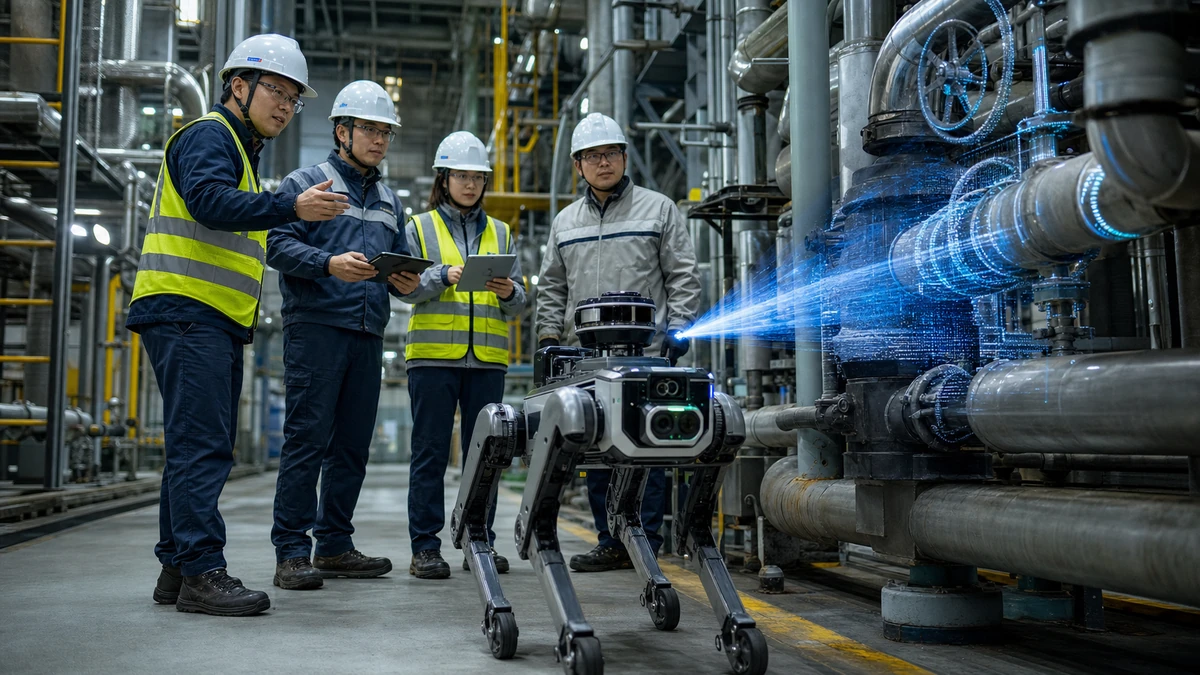
Image to help understand the article
A new AI test is moving off the screen and onto the factory floor
South Korea is taking another step in its high-stakes push to blend robotics, artificial intelligence and heavy industry — this time inside the maze-like interior of a working power plant.
Korea East-West Power, a state-run electricity producer, said it has signed an agreement with Loas, a South Korean industrial AI company, to develop and test what is often called “physical AI” using a domestically built robot platform. The goal is not simply to deploy a robot that can roll through a plant taking pictures or carrying tools. It is to build an operating system for real-world inspection: robots that can move through dense industrial spaces, interpret what they are seeing, map their surroundings in three dimensions, and connect that information to plant monitoring and control systems.
For American readers, it may help to think of the difference between a chatbot and a warehouse robot. Much of the AI conversation in the United States has centered on software — large language models, image generators and digital assistants that live on laptops and phones. Physical AI refers to the next step: AI embedded in machines that must perceive real environments, avoid obstacles, identify equipment conditions and make decisions in places where mistakes can have safety consequences.
That distinction matters in a power plant, where the environment is crowded with pipes, conveyors, motors and sensors, and where temperatures, dust, vibration and fire risk can complicate even routine inspection work. In such places, robotics is not a novelty demo. It is a test of whether AI can operate safely in the kind of unforgiving settings that keep modern economies running.
The South Korean project will be demonstrated at the Dangjin Power Complex on the country’s west coast, a major generation site in South Chungcheong Province. The specific areas selected for testing are not easy environments. They include a pulverizer room, where equipment wear and unstable operating conditions can drive frequent starts, stops and failures, and an indoor coal storage area, where the risk of spontaneous combustion makes constant monitoring especially important.
In other words, this is not South Korea showing off a shiny consumer robot in a trade-show booth. It is a real attempt to see whether homegrown AI and robotics can do useful, trusted work inside critical infrastructure.
Why South Korea cares so much about “homegrown” robots
One of the most important details in the announcement is right in the wording: the robot platform is domestic. In South Korea, the phrase “domestic technology” carries weight beyond simple branding. It reflects a long-running national push to build local capacity in strategically important sectors, from semiconductors and batteries to shipbuilding and advanced manufacturing.
That emphasis has only intensified in recent years as governments around the world have become more sensitive to supply-chain vulnerabilities, technology dependence and industrial security. For South Korea, a country whose economic model has been built on exporting sophisticated manufactured goods, proving that local companies can deliver critical robotics and AI systems is part competitiveness strategy, part industrial policy and part national resilience.
Korea East-West Power is not a startup experimenting in a garage. It is a public energy company that operates in a sector where reliability and regulation are central. Loas, by contrast, represents the kind of smaller technology firm that South Korea increasingly wants to bring into partnership with large institutions. The collaboration is notable because it combines the operational experience of a major public utility with the specialized AI and robotics capability of a domestic tech company.
That matters because in industrial settings, new technology often fails not because the core idea is bad, but because it never gets integrated into the routines, safety standards and data systems of the workplace. A robot can perform beautifully in a controlled lab and still be useless in a power station if it cannot navigate tight layouts, interpret equipment status accurately or feed findings into the systems plant workers actually use.
South Korean policymakers and corporate leaders have learned that lesson across multiple technology cycles. Flashy demonstrations attract headlines, but operational standards determine whether a system scales. That is why this agreement places as much emphasis on field validation and technical specifications as it does on the robot itself. The project is meant to answer not just whether a machine can move around a plant, but what kind of movement, sensing, monitoring and control protocols are needed to make robotic inspection dependable enough for everyday use.
To put it in American terms, this is closer to the gritty work of industrial deployment than to Silicon Valley-style product theater. It is less about a moonshot and more about whether a utility can write the playbook for using AI machines in one of the most complex workplaces imaginable.
What “physical AI” means in plain English
The term “physical AI” can sound abstract, especially since much of the global AI boom has focused on software that produces text, images or predictions. But the concept becomes clearer when translated into everyday industrial tasks.
Imagine a human inspector walking through a power plant. That worker knows where they are, which machine they are looking at, what normal sounds like, what abnormal heat patterns might signal and which areas demand extra caution. They can distinguish between a safe passage and a blocked route. They can also connect what they observe to a maintenance process — reporting an issue, triggering a check, escalating a hazard.
Physical AI tries to recreate parts of that chain inside a machine. The robot provides the body: the ability to move through space, carry sensors and position itself near equipment. AI provides the interpretation: identifying surroundings, creating a three-dimensional spatial map, recognizing equipment conditions and helping determine what matters. Together, those capabilities allow the machine to do more than gather raw data. They allow it to function as an active inspection system inside a changing environment.
That is a much harder problem than analyzing a spreadsheet or summarizing an email. Real industrial sites are messy. Lighting changes. Dust accumulates. Layouts are irregular. Equipment may be noisy, hot or partially obstructed. Routes may be narrow or temporarily blocked. Wireless connectivity may be inconsistent in some parts of the plant. Even telling whether a robot is standing in the exact right position to inspect a gauge, valve or conveyor can require a sophisticated combination of localization, mapping and sensor fusion.
The South Korean project is designed around that challenge. According to the agreement, the core technical objective is to connect device control and 3D spatial mapping into an actual operating system that can monitor equipment in the field. In practical terms, that means the robot is not just wandering around with a camera. It is expected to understand where it is, what it is seeing and how that information relates to plant operations.
This is one reason the selected test environments matter. A pulverizer room and an indoor coal yard are not controlled spaces. They present real variability, real hazard and real operational demands. If a physical AI system can prove useful there, it offers a more credible case for broader industrial use than a pilot conducted in a cleaner, simpler environment.
Why power plants are an especially tough proving ground
Power plants are among the most demanding settings for industrial automation. They are essential infrastructure, which means operators tend to be cautious about introducing unproven technology. Even small disruptions can carry outsized costs, whether in downtime, maintenance expenses or safety risk.
That is particularly true in thermal power facilities, where fuel handling, combustion systems and rotating machinery create layers of complexity. Coal-handling areas can present dust and fire hazards. Equipment rooms may be cramped and difficult to access. Maintenance cycles are tightly managed, and inspections often require coordination between human workers, sensors and central control systems.
The Dangjin demonstration appears aimed directly at those realities. The indoor coal storage area is especially significant because spontaneous combustion risk is a known concern in coal operations. Coal can generate heat internally under certain conditions, and if not monitored properly, that heat buildup can lead to smoldering or fire. Continuous inspection, early detection and rapid response are critical.
In the United States, utilities and industrial operators have also explored drones, thermal imaging, fixed sensors and robotic crawlers for inspection in dangerous or hard-to-reach areas. But many deployments remain narrow in scope. A device may detect heat, for example, without being deeply integrated into a broader operational workflow. What South Korea is trying to test here is a more connected model — one in which mobility, sensing, spatial awareness and system integration work together.
The pulverizer room offers another telling use case. These systems are central to coal-fired generation because they grind coal into fine particles for combustion. Frequent starts and stops, or increasingly variable operating conditions on the power grid, can increase stress on equipment and raise the need for close monitoring. In a world where grid demand can shift more rapidly and legacy infrastructure is asked to adapt, the ability to inspect such equipment more consistently may have real operational value.
That broader context is worth noting. South Korea, like many industrial economies, is navigating an energy transition without abandoning the need for stable baseload power and grid reliability. Even as countries invest in renewables, batteries and smarter grids, existing thermal infrastructure still has to be run safely and efficiently. That creates an opening for inspection technologies that promise to reduce risk, improve maintenance and support more flexible operation.
If the robot system succeeds, its appeal will not rest on novelty alone. It will rest on whether it helps answer familiar utility questions: Can it spot problems early? Can it reduce worker exposure to hazardous areas? Can it feed usable information into maintenance decisions? Can it do so reliably enough that operators trust it?
From gadget deployment to industrial standards
Perhaps the most consequential part of this initiative is that it is aimed at developing operating standards, not merely buying equipment.
That may sound bureaucratic, but it is often where industrial technology either becomes indispensable or stalls out. The same robot can perform very differently depending on whether it is deployed in a warehouse, an auto plant or a power station. The required mobility, sensor placement, inspection targets, communication links and control interfaces vary by environment. Without clear standards, each deployment becomes a custom project, which raises costs and limits scale.
The South Korean partners say they want to validate the technology in the field while organizing the specifications needed for stable and efficient operations in power plants. That suggests a practical, almost systems-engineering mindset: define what the robot must inspect, how it should navigate, how it should classify risk, how it should communicate with plant systems and what thresholds trigger action.
For U.S. readers, there is a useful parallel in the history of industrial automation and enterprise software. Many technologies become transformative only after industries agree on repeatable workflows, interface standards and compliance expectations. In hospitals, for example, digitization became far more useful once systems could exchange records in more standardized ways. In factories, robotics scaled faster when tasks and environments were structured around predictable integration. Power plants may be heading toward a similar turning point for AI-assisted inspection.
That is also why the partnership between a public utility and a smaller domestic AI company deserves attention. Large institutions can define real operational needs, provide the proving ground and help shape standards. Smaller technology firms can move faster in developing specialized tools. If the collaboration works, it could become a template for how South Korea commercializes advanced industrial AI: not by chasing consumer hype, but by solving hard problems in infrastructure.
The project’s backers have framed the effort as part of a broader move toward “smart power plants,” a term that typically refers to facilities where monitoring, analytics and automation are deeply embedded in operations. That vision has existed for years in various forms, but implementation has often lagged because the final mile is difficult. It is one thing to collect more data. It is another to translate that data into reliable, field-tested action inside a working plant. Physical AI is an attempt to bridge that gap.
A sign of where South Korean AI is heading next
The global image of South Korea is often tied to its cultural exports — K-pop, K-dramas, beauty brands and blockbuster entertainment — or to its consumer technology giants. But the country’s deeper economic identity is still rooted in industrial prowess: shipyards, steel, autos, batteries, semiconductors and complex manufacturing systems.
That is what makes this story more significant than it may first appear. It shows South Korea trying to extend its AI ambitions beyond the digital and consumer spheres into the physical backbone of the economy. Instead of treating AI primarily as a software product, the project treats it as an industrial capability that must work alongside machinery, energy infrastructure and safety systems.
That shift mirrors a broader global trend. Around the world, companies are moving from asking what AI can generate on a screen to asking what AI can do in warehouses, ports, factories, hospitals and utility networks. The next competitive frontier may be less about which country has the most impressive demo model and more about which can embed intelligence into real systems that move goods, produce power and manage risk.
South Korea has several advantages in that race. It has dense industrial clusters, strong engineering talent, sophisticated manufacturing ecosystems and a government that has long been willing to support strategic technology development. It also has a practical incentive: a shrinking workforce and rising labor costs create pressure for greater automation, especially in sectors where safety and consistency matter.
Still, there are reasons for caution. Industrial trust is hard won. A robot that performs well during a trial may still struggle over long operating periods. Maintenance demands, cybersecurity concerns, interoperability challenges and worker acceptance can all affect deployment. There is also a broader question facing every industrial AI effort: how much autonomy is appropriate in safety-sensitive environments, and where should human oversight remain firmly in control?
Those questions are not unique to South Korea. American utilities, manufacturers and logistics firms are wrestling with them too. But the Dangjin project is notable because it treats those challenges not as reasons to delay experimentation, but as the reason to conduct it in the first place. By choosing difficult plant environments and focusing on operational specifications, the project aims to test whether physical AI can earn credibility where it counts most.
What to watch as the pilot moves forward
The agreement announced this week does not yet provide detailed performance benchmarks or a timeline for large-scale deployment. That means the real measure of success will come later, in what the field tests show and whether the partners can translate those findings into repeatable operating rules.
Several questions will determine whether the project becomes a meaningful milestone or just another promising pilot. First, can the robot navigate continuously in dense industrial spaces without frequent manual intervention? Second, can the AI accurately interpret equipment conditions in ways that are useful for plant operators, rather than merely interesting from a technical standpoint? Third, can the system integrate smoothly with existing monitoring and maintenance workflows? And finally, can it do all of this reliably enough that a utility would consider expanding it beyond a test zone?
There is also a strategic question. If the project succeeds, will South Korea be able to export not just the robot hardware, but the operating model behind it? In many industries, the most valuable product is not the machine itself but the package of standards, software integration and use-case knowledge that makes deployment practical. A successful power-plant inspection framework could have relevance far beyond one utility or one country.
For now, the agreement is best understood as an early but serious step in industrial AI adoption. It reflects a sober recognition that real-world automation is not achieved by dropping a robot into a workplace and hoping for the best. It requires testing in messy environments, collaboration between operators and developers, and patience in building standards that others can reuse.
That may not be as glamorous as the AI arms race playing out in consumer apps and tech valuations. But it may be more important in the long run. If South Korea can show that domestically developed robots and AI systems can safely inspect high-risk equipment inside a power plant, it will have demonstrated something more durable than buzz: that advanced AI can become part of the hidden infrastructure that keeps modern life running.
And in an era when countries are searching for both technological edge and industrial resilience, that is the kind of proof that governments, utilities and manufacturers around the world will be watching closely.
Comments
Post a Comment