South Korea Rethinks How It Taxes One-Home Owners Living Elsewhere, Signaling a Broader Shift in Housing Policy
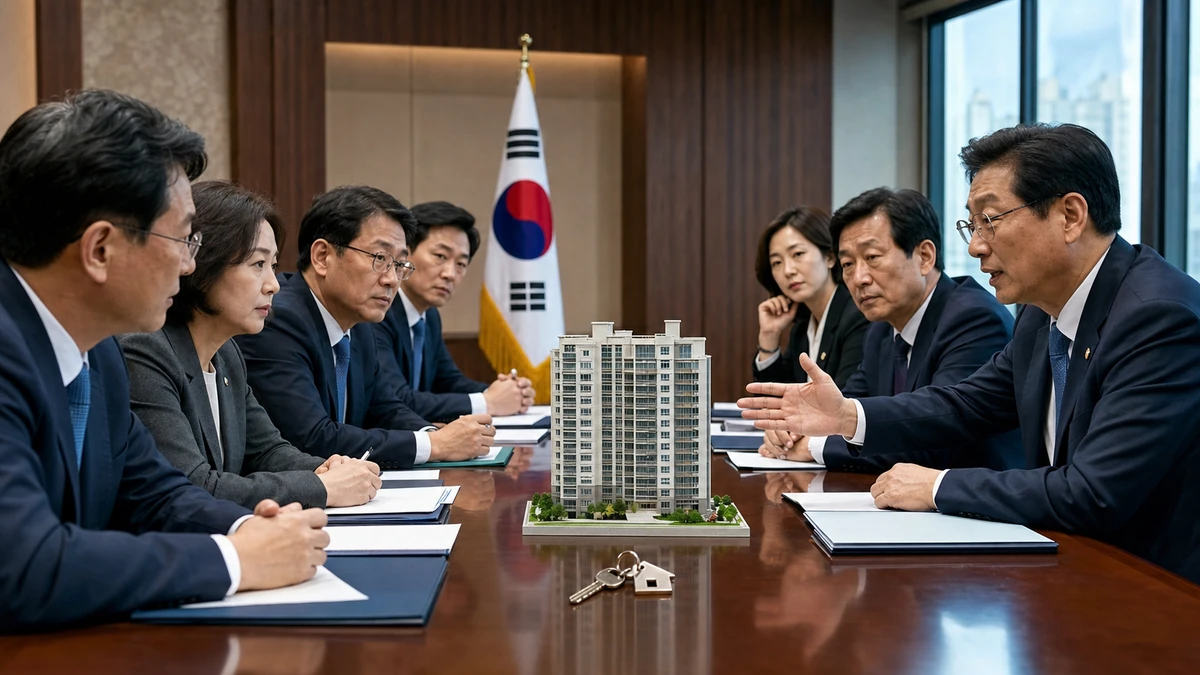
Image to help understand the article
A tax debate in Seoul that goes beyond one apartment
South Korea’s governing Democratic Party and the government have moved closer to easing how they treat some people who own just one home but do not actually live in it, according to a policy discussion disclosed this week. On its face, that may sound like a narrow tax question. In reality, it touches one of the most politically sensitive issues in South Korea: how to distinguish ordinary homeowners from speculators in a country where housing costs, especially in Seoul and its surrounding metro area, have become a defining source of economic anxiety.
The discussion is not yet a final law or even a completed policy package. What officials have publicly confirmed is more limited: the government and ruling party share a broad understanding that the definition of “recognized residency” should be expanded for one-home owners who are not living in their property for unavoidable reasons. The Democratic Party has also pressed the government more aggressively, urging it to stop distinguishing between resident and nonresident status altogether when applying South Korea’s comprehensive real estate holding tax to people who own only one home.
That distinction matters because South Korea’s real estate tax system has not only looked at how many homes a person owns, but in some cases whether the owner actually lives there. The new conversation suggests policymakers are reconsidering whether that line is too blunt, particularly for owners whose living arrangements reflect life circumstances rather than investment strategy.
For American readers, a rough comparison would be the difference between treating all owners of a single primary-type property the same and subjecting some of them to a heavier burden because they temporarily live elsewhere for work, family care, or other personal reasons. The comparison is imperfect; South Korea’s tax system, housing market structure and legal categories differ sharply from those in the United States. But the core policy question is familiar: when does a tax code designed to discourage speculation end up penalizing people whose housing situation is complicated but not opportunistic?
That is the pressure point now emerging in Seoul. And because real estate policy has repeatedly shaped elections, consumer sentiment and household wealth in South Korea, even a partial change in how the government defines a one-home owner can carry significance well beyond a single tax line.
What officials actually said — and what they did not
The most important point in this story is what has not yet been decided. South Korean officials did not announce new tax rates, new deduction thresholds, a start date, or a finalized legal amendment. They did not publish a detailed list of which personal circumstances would count as “unavoidable” reasons for not living in a sole owned home. They also did not say that every one-home owner who lives elsewhere will automatically be treated as an occupant.
Instead, the announcement reflects a policy consensus in principle. Park Sung-joon, the Democratic Party’s senior spokesperson, said the party and government had formed a consensus around expanding recognition for one-home owners who are not residing in their property for unavoidable reasons. That language is meaningful precisely because it leaves room for later interpretation. It points to a direction of travel, not a completed map.
At the same time, the Democratic Party signaled that it wants to go further. According to the summary of the meeting, the party strongly asked the government not to distinguish between resident and nonresident one-home owners when applying the comprehensive real estate holding tax. That is a broader idea than simply widening the list of acceptable exceptions. One approach preserves the distinction but softens it for hardship-like cases; the other effectively removes the distinction for all single-home owners.
Those are not the same policy. They would affect different groups, create different incentives and carry different political risks. A narrowly tailored exemption might be easier to defend as a fairness measure. A full removal of the resident-versus-nonresident distinction for one-home owners would be simpler to administer, but critics could argue that it weakens the principle that actual occupancy should matter in housing taxation.
In other words, the headline from Seoul is not that South Korea has overhauled its property tax code overnight. It is that the ruling party and government have publicly acknowledged discomfort with the current treatment of at least some one-home owners and have opened the door to a meaningful recalibration.
Why “one home” and “actual residence” collide in South Korea
To understand why this matters, it helps to understand the political weight of housing in South Korea. Real estate in the country is not just an economic asset. It is deeply tied to status, retirement planning, intergenerational wealth and public frustration over inequality. In Seoul, where apartments dominate the urban landscape much as single-family homes dominate the American suburban imagination, home prices have long functioned as a barometer of social mobility and political competence.
That is one reason South Korean governments have repeatedly drawn bright lines between owner-occupiers and investors. In theory, the distinction is intuitive. A household living in its only home is not the same as an investor holding multiple properties. But life is messier than clean policy categories. A person may own one apartment yet live elsewhere because of a job transfer, family obligations, education, temporary displacement or other circumstances the government might eventually define as unavoidable.
The unresolved question now is how much weight policymakers should give to those individual circumstances. If they define “unavoidable” too narrowly, many taxpayers may feel the reform is symbolic rather than real. If they define it too broadly, they risk blurring a tax distinction that was designed to reflect actual living arrangements and discourage abuse.
This tension is hardly unique to Korea. American lawmakers grapple with similar issues whenever tax, zoning or benefit rules rely on bright-line definitions of residency, occupancy or principal residence. Think of debates over homestead exemptions, capital gains treatment on primary homes, state residency for income tax purposes, or the classification of landlords versus homeowners. Administrative simplicity often collides with the complexity of modern life.
What gives the Korean case added intensity is the country’s long-running effort to curb speculation without appearing hostile to ordinary households. Over the past several years, South Korean property policy has often swung between crackdowns and corrections. Any proposal affecting homeowners, even a technical one, is therefore read not just as tax administration but as a signal about the government’s broader stance toward the housing market.
More than taxes: The government is pairing relief with supply-side reform
The same round of policy discussions also included a separate housing measure aimed at increasing supply, or at least speeding up the administrative process for creating it. Officials said they would pursue a plan to transfer permitting authority for redevelopment and reconstruction projects involving 500 units or fewer to heads of local district governments.
That may sound bureaucratic, but in dense cities bureaucratic changes can matter enormously. Redevelopment and reconstruction projects are central to how South Korea renews aging apartment stock and adds housing in built-up areas. Shifting approval power downward could, at least in theory, shorten timelines and make smaller projects easier to move. The proposal reportedly reflects demands from district leaders in Seoul.
There is a reason this matters alongside the tax debate. South Korea is signaling that it does not want housing policy reduced to one ideological frame. The government and ruling party are discussing both sides of a familiar policy equation: how to allocate tax burdens fairly among current owners, and how to increase or accelerate supply so that scarcity does not keep driving prices and social tension.
That pairing mirrors debates Americans know well. In U.S. cities from San Francisco to New York to Austin, arguments about housing affordability routinely break into two camps: those focused on taxing, regulating or discouraging speculation, and those focused on building more housing faster. South Korea’s current approach suggests its policymakers see these as linked rather than separate tracks.
But here too, caution is warranted. Just as the tax discussion remains incomplete, the supply-side proposal is still at the planning stage. The authority shift would require institutional changes and legislative action. No implementation timetable was disclosed in the summary. So while the political direction is visible, the practical effects remain to be tested.
What this means in the United States
For Americans, this debate matters less because it will directly affect U.S. taxpayers and more because it reveals how one of Washington’s closest Asian allies is adapting to a housing problem that has become global: how to preserve fairness for ordinary households while still deterring speculation and expanding supply.
The United States and South Korea are bound most visibly by security ties, technology supply chains and cultural exchange. But housing pressure is another area where the two countries increasingly share a policy vocabulary, even if the legal systems differ. In both countries, younger adults face affordability barriers that shape family formation, career choices and politics. In both, local and national leaders are under pressure to show that they understand the difference between investment behavior and ordinary household instability.
That matters for American companies and investors with a stake in South Korea’s broader economic climate. Housing policy affects consumer confidence, household debt, construction activity and urban development. U.S. financial firms, manufacturers, retailers and entertainment companies operating in Korea all function within an economy where real estate sentiment can influence spending and social mood. A policy shift that makes the tax system appear more predictable or more equitable for middle-class households can have effects that ripple beyond the property market.
There is also a lesson here for American policymakers. In the U.S., debates over housing often split into red-state and blue-state talking points: build more, tax vacancy, cut regulations, protect homeowners, punish speculators. South Korea’s discussion underscores that governments often end up doing several of these things at once. They try to calibrate tax treatment more carefully while also cutting approval bottlenecks. That does not guarantee success, but it reflects a growing recognition that housing systems fail in multiple ways at the same time.
For Korean Americans, U.S.-based investors in Korean assets, and American followers of Korean affairs, the story is also a reminder that South Korea’s domestic politics cannot be understood only through North Korea, semiconductors or K-pop. Bread-and-butter issues such as housing taxation and redevelopment are central to how Korean governments build or lose trust. If Seoul follows through with a policy that better distinguishes unavoidable life circumstances from speculative behavior, it could become one more example of the country trying to refine, rather than simply relax or tighten, a heavily politicized housing regime.
From event to trend: Why this debate is happening now
The bigger story is not a single meeting between party and government officials. It is the apparent shift in tone. South Korean policymakers seem increasingly willing to say that rigid tax classifications can produce unfair results even when their original purpose was defensible. That is not the same as abandoning anti-speculation policy. It is more a recognition that broad categories such as “nonresident owner” can conceal very different real-world situations.
Seen this way, the current debate reflects a broader maturation in housing policy. Early-stage crackdowns often rely on sharp rules because they are easier to communicate politically: one home versus many homes, resident versus nonresident, owner-occupier versus investor. Over time, those rules generate edge cases, pressure from constituents and doubts about fairness. Governments then face a classic policy dilemma: keep the rules simple and accept some injustice, or add nuance and risk complexity, loopholes and administrative burden.
South Korea now appears to be entering that second phase. The language of “unavoidable reasons” is a marker of that transition. It tells taxpayers that circumstances matter, but it also forces the state to define those circumstances clearly enough to be credible. If the eventual criteria are vague, the reform could create uncertainty and invite disputes. If the criteria are too mechanical, it could fail to solve the fairness problem that prompted the debate in the first place.
Another trend worth watching is political message discipline. The ruling party’s push to eliminate the resident-versus-nonresident distinction for all one-home owners goes further than the government’s publicly stated consensus on expanding recognition for unavoidable nonresidency. That gap suggests internal negotiation remains active. For observers of Korean politics, the key question is whether the final package leans toward a narrow technical fix, a broader symbolic reset for single-home owners, or a compromise that tries to do both.
Just as important, the government chose to discuss the tax issue alongside redevelopment and reconstruction approvals. That packaging suggests officials understand that housing frustration cannot be addressed solely by telling current owners they will pay a little more or a little less. Voters want signs that the state is tackling both equity and supply. In that sense, the meeting was not just about who qualifies for tax relief. It was about demonstrating a more balanced housing policy narrative.
What to watch next
The next stage of this story will turn on definitions. Which situations will count as unavoidable reasons for not living in a sole owned home? Will the final policy require an application process or documentary proof? Will there be time limits, income considerations or other conditions? And most importantly, will the government stop at expanding exceptions, or will it accept the ruling party’s stronger request to stop distinguishing between resident and nonresident one-home owners altogether under the comprehensive holding tax?
Clarity will be crucial. Tax policy works best when ordinary people can tell, without hiring a lawyer or accountant, whether they qualify. If the final rules are difficult to understand, South Korea may end up replacing one source of frustration with another. If they are clear and narrowly defensible, officials may be able to present the change as a modest but meaningful correction that protects fairness without diluting the broader logic of anti-speculation policy.
The supply-side proposal deserves close scrutiny as well. Delegating redevelopment and reconstruction approval authority for smaller projects to local district leaders could speed up housing delivery, but only if local governments have the capacity and political will to use that authority effectively. Americans familiar with fights over zoning boards, neighborhood opposition and permitting delays will recognize the challenge immediately. Cutting one layer of approval does not automatically produce homes, but it can change the pace and incentives of the system.
For now, the key takeaway is restraint. South Korea has not yet rewritten the rules. It has signaled where the debate is headed: toward a more refined view of who counts as a genuine one-home household, and toward a housing agenda that tries to balance tax fairness with supply-side pragmatism. In a country where real estate often serves as a proxy for broader concerns about inequality and opportunity, that is more than a technical adjustment. It is an attempt to redraw the moral boundaries of housing policy without pretending the politics have disappeared.
That is why this story matters outside Korea too. Whether in Seoul, Los Angeles or New York, governments are being forced to answer similar questions: How do you crack down on speculation without ensnaring ordinary households? How do you make room for exceptions without creating loopholes? And how do you persuade a frustrated public that the housing system is being governed with both rigor and common sense? South Korea does not yet have all the answers. But this week’s policy signal shows it is asking the right questions more openly than before.
Comments
Post a Comment