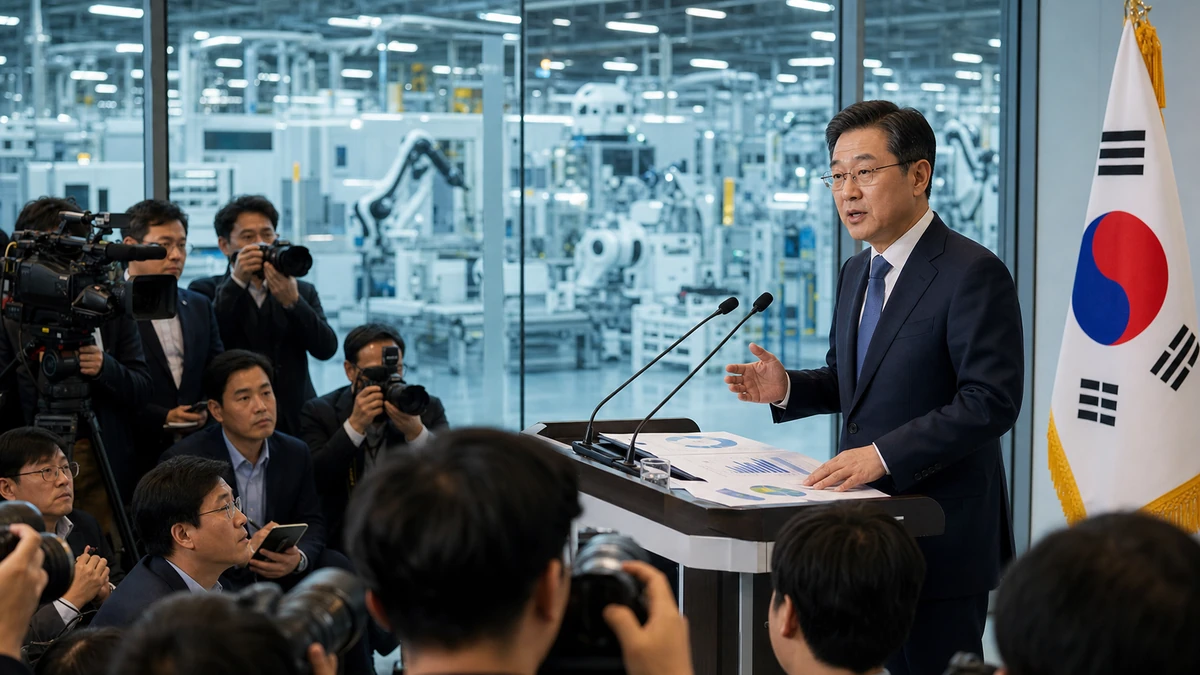
Why this tax proposal matters beyond Seoul
South Korea is moving to send a clearer message to manufacturers: If you build at home, especially in industries tied to advanced technology, the government wants to make that decision easier.
That was the broad takeaway this week after the Korea Enterprises Federation, one of the country’s most influential business lobbies, praised a proposed domestic production tax credit included in the government’s 2026 tax revision plan. The group said the measure could help strengthen South Korea’s production base and improve the competitiveness of high-tech industries at a time when export-driven economies are rethinking where things are made, how supply chains are secured and how governments should support strategic sectors.
For American readers, the closest comparison may be the way Washington has increasingly used tax incentives, subsidies and industrial policy to nudge companies to manufacture semiconductors, batteries and clean-energy equipment in the United States. In recent years, the U.S. CHIPS and Science Act and parts of the Inflation Reduction Act have reflected a bipartisan willingness to intervene more directly in the geography of production. South Korea, one of the world’s most trade-dependent advanced economies, appears to be sharpening a similar logic: It is no longer enough to support research and development in the abstract. Policymakers also want the factories, process know-how and manufacturing ecosystems that turn ideas into exports.
The proposal is still short on crucial details, including the size of the credit, which companies would qualify and precisely when and how the measure would be implemented. That means it is too early to say how powerful the incentive will be in practice. Still, the direction of travel is clear. South Korea is signaling that domestic production itself is a strategic asset, not just a private business choice.
That distinction matters in a country whose global economic identity has long been built on manufacturing powerhouses such as Samsung Electronics, SK hynix, Hyundai Motor and LG. South Korea’s rise was fueled not only by invention, branding and exports, but also by an intense concentration of industrial capacity, skilled labor and supplier networks. As geopolitical tensions deepen and competition for advanced manufacturing investment grows, preserving that base has become a national concern.
The federation’s statement framed the tax plan not merely as a reduction in corporate burdens, but as a broader industrial policy signal meant to improve conditions for companies that produce domestically and accumulate technology at home. In other words, Seoul is trying to connect the tax code to a bigger question: What kind of economy does South Korea want to be in the next decade?
A manufacturing superpower under new pressure
South Korea’s economy is unusually exposed to shifts in the global production landscape. The country is a major exporter of semiconductors, cars, batteries, ships, petrochemicals and electronics, and its biggest companies compete in markets where politics, trade and technology are increasingly intertwined. That leaves Korean policymakers watching more than consumer demand and innovation cycles. They are also watching U.S.-China tensions, wars and regional conflicts, trade restrictions, energy prices and the growing use of industrial subsidies by rival governments.
Lee Sang-ho, an executive at the Korea Enterprises Federation, said the proposed tax revision could help energize the Korean economy and expand future growth drivers amid geopolitical risks and slowing growth potential. The comment reflected a wider reality facing many boardrooms in Seoul: Corporate investment decisions are no longer shaped only by market size and engineering capability. They are also shaped by production costs, tax treatment, regulatory burdens and whether a government can offer a predictable environment for long-term capital spending.
That concern is especially acute in South Korea because the country’s economic model depends on staying technologically ahead while remaining cost-competitive enough to keep key operations at home. The pressure works in both directions. If Korean firms move too much production abroad, the country risks hollowing out the supplier ecosystems and skilled labor pools that support innovation. But if producing domestically becomes too expensive or administratively difficult, companies may see overseas expansion as the more rational choice.
This is why the proposed domestic production tax credit is getting attention even before the fine print is known. The phrase itself is unusually direct. Rather than focusing solely on investment spending or research activity, it suggests that the act of making goods inside South Korea could qualify for a tax benefit. That is significant because advanced manufacturing is not just about laboratories and patents. It is also about process engineering, yield management, quality control and the ability to adapt production lines quickly when market conditions change.
In sectors such as semiconductors and batteries, those production capabilities can be as strategically important as the underlying technology. A country that retains both the design and manufacturing stages of an industry has more resilience, more bargaining power and often more spillover benefits for smaller firms and workers. South Korea’s proposed policy appears to acknowledge that reality more explicitly.
At the same time, South Korea is not operating in a vacuum. Governments around the world are competing to attract capital-intensive projects through tax breaks, direct subsidies and local-content preferences. For Seoul, the risk is not only that Korean firms could build more abroad. It is also that foreign competitors, backed by their own governments, could outbid Korean industry in the race to dominate next-generation manufacturing.
Linking factory floors to cutting-edge technology
The Korea Enterprises Federation did not praise the domestic production tax credit in isolation. It also welcomed a proposed expansion in the scope of what South Korea classifies as national strategic technologies, suggesting the two policies should be viewed together.
That pairing is one of the most important parts of the story. In Korean policy debates, “national strategic technology” generally refers to fields the government sees as critical to the country’s long-term security and economic competitiveness. Depending on the legal framework, this can include semiconductors, secondary batteries, displays, biotechnology, aerospace, next-generation mobility, robotics and other sectors deemed central to future growth. Americans might think of it as a category similar to “critical technologies” or “strategic industries” in U.S. policy discussions.
By linking broader strategic-tech support with a domestic production incentive, Seoul seems to be making a larger argument: It is not enough to help companies invent the future if the production of that future migrates elsewhere. The development stage and the manufacturing stage are not cleanly separable in many advanced industries. Lessons learned on the factory floor often feed back into product improvement, cost reduction and next-generation design. When production moves, some of that tacit knowledge can move with it.
This is particularly true in industries where scale, precision and iteration matter. In semiconductor fabrication, for example, manufacturing is itself a form of technical mastery. In batteries, the ability to mass-produce cells consistently and safely is a competitive advantage, not just a logistical task. In biotech and advanced materials, production processes can determine whether research becomes commercially viable. South Korea’s business community appears to be telling policymakers that supporting one side of the equation without the other would be incomplete.
There is also a practical supply-chain dimension. If Korean firms can build technology and production capability together inside the country, they may be better positioned to expand abroad from a stronger base. A robust home manufacturing ecosystem can support exports, overseas investment and global market responsiveness. Conversely, if the policy is too narrow, too complicated or too restrictive, the incentive may fail to influence real investment decisions.
That caveat is important. Governments often announce strategic support with great fanfare, only to discover that the benefits are difficult to claim or apply only to a thin slice of actual business activity. The federation itself acknowledged that the eventual impact will depend heavily on which technologies and production activities qualify. In other words, design will determine whether this becomes a meaningful industrial tool or mostly a symbolic one.
The petrochemical angle and the politics of restructuring
One revealing part of the business federation’s response was its reference not only to high-tech sectors but also to petrochemicals, a cornerstone industry that is more mature and currently under pressure. The group said tax support for business restructuring could help revive the petrochemical sector, suggesting the government’s tax revision plan is meant to do two things at once: encourage new strategic industries and help older industries adapt.
That dual goal is a familiar challenge in industrial economies. Policymakers must invest in tomorrow’s growth engines without abruptly abandoning legacy sectors that still employ workers, support regional economies and anchor export earnings. In the United States, debates over steel, autos, fossil fuels and heavy industry often carry the same tension. How do you modernize an economy without creating a hard break between “future industries” and “old industries”?
South Korea’s petrochemical industry has been grappling with weak profitability, changing demand patterns and intensifying competition, especially from producers in China and the Middle East. Restructuring in such industries can mean consolidating facilities, changing product lines, rethinking investment priorities and reallocating capital toward more specialized or higher-value production. Those shifts are expensive and politically sensitive. Tax support cannot solve every structural problem, but it can lower some of the costs and uncertainty involved in reorganization.
That is why the federation’s praise for restructuring-related tax measures matters. It suggests the business community sees the proposed 2026 tax revision not simply as a high-tech policy, but as part of a broader attempt to manage industrial transition. South Korea is trying to preserve competitiveness across the economic spectrum: from frontier technologies that will define future growth to established sectors that still matter but need to change.
This is a subtle but important point for international readers. Industrial policy is often discussed as if it were only about glamorous sectors like artificial intelligence chips, electric vehicles or biotech. In reality, governments must also deal with the industries they already have. A successful transition usually requires both invention and adjustment — building new capacity while giving existing sectors tools to reorganize rather than simply decline.
That appears to be the broader philosophy emerging from Seoul’s tax package. Domestic production, advanced technology and legacy-sector restructuring are not being treated as separate policy silos. They are being woven into one competitiveness agenda. Whether the execution lives up to that ambition remains an open question.
The fine print could decide everything
For all the positive rhetoric, South Korea’s business lobby also issued a warning: The requirements attached to the domestic production tax credit may be so strict that many companies will struggle to use it.
That may end up being the most consequential part of the debate.
In policy design, incentives often look powerful on paper but lose force when eligibility rules become too narrow, compliance burdens too high or administrative guidance too vague. A company weighing a major production decision does not just ask whether a tax benefit exists. It asks whether the benefit is predictable, sizable, straightforward to claim and durable enough to factor into long-term planning. If the answer is no, the tax credit may have little impact on where real investment goes.
Lee said additional review is needed because the conditions for the domestic production tax credit are strict. That suggests businesses support the concept but worry that the threshold for qualifying may be too high. Without the official details, it is difficult to know whether the concern relates to definitions of domestic production, minimum investment levels, technology classifications, documentation burdens or other technical requirements. But the concern itself is familiar to anyone who has covered tax incentives in Washington, Brussels or Tokyo: Complexity can neutralize policy ambition.
There is also a balancing act for the government. If eligibility is too broad, the measure could become expensive and politically vulnerable, especially if critics argue it rewards activity that companies would have undertaken anyway. If eligibility is too narrow, it may fail to strengthen the production base it was meant to support. Policymakers must also guard against favoritism, loopholes and incentives that distort competition in unintended ways.
For South Korea, the stakes are amplified by the speed of industrial change. Companies in semiconductors, batteries, mobility and chemicals cannot wait years for rules to become clear. Capital allocation decisions happen on commercial timelines, and global rivals are moving aggressively. That is why predictability matters almost as much as generosity. Businesses need to know not only that a credit exists, but also that they can actually use it in the course of normal operations.
The federation’s critique points to a broader truth about modern industrial policy: Announcing support is the easy part. Designing it so firms can act on it is much harder. The success of South Korea’s proposal will likely depend less on the headline and more on the technical architecture hidden beneath it.
What this says about South Korea’s economic strategy
Viewed in full, the proposed 2026 tax revision offers a window into how South Korea sees its place in a more fragmented world economy. The country is trying to hold together several priorities at once: maintain domestic production, protect and expand advanced technology capabilities, help legacy sectors restructure and give companies enough certainty to keep investing at home.
That reflects a more muscular approach to industrial strategy than the one many governments favored a generation ago, when free trade, global efficiency and cross-border supply chains were often treated as ends in themselves. Today, resilience has become a policy goal in its own right. So has technological sovereignty, a term more common in Europe but increasingly relevant everywhere. South Korea, squeezed geographically and strategically between major powers, has particular reasons to worry about overdependence, supply disruptions and the offshoring of strategic capabilities.
For American readers, this should sound familiar. The United States, too, has shifted from a long era of relative faith in market-led globalization toward a more activist effort to shape where strategic production happens. What is different in South Korea is the degree to which manufacturing is already central to the national model. The question is not whether to rebuild an industrial base from decline, as some U.S. policymakers frame it. It is whether to preserve and upgrade one of the most sophisticated industrial ecosystems in the world before global competition and geopolitical risk erode it.
That makes the proposed domestic production tax credit more than a technical fiscal measure. It is a statement about what Korean policymakers increasingly believe generates national strength: not just intellectual property, not just exports and not just corporate scale, but the tight integration of technology, production and adaptability inside the country’s borders.
Still, caution is warranted. The business federation’s endorsement should not be mistaken for proof that the plan will work. Trade groups often welcome the direction of policy while continuing to push for looser rules, broader eligibility and larger benefits. The actual effectiveness of the measure will depend on how the government defines qualifying activities, how easy the credit is to claim and how it interacts with other parts of the tax and regulatory system.
Even so, the signal itself is noteworthy. South Korea appears to be recognizing that in an age of strategic competition, a nation’s edge is shaped not only by who invents the next breakthrough but also by who manufactures it, refines it and scales it at home. If Seoul can translate that insight into a usable policy framework, the proposal could become one piece of a larger effort to keep Korean industry globally competitive while anchoring more of its value creation domestically.
For the rest of the world, especially major U.S. allies and trading partners, that is the real significance of this moment. South Korea is not simply tweaking its tax code. It is sketching out a more integrated industrial doctrine — one that treats domestic production, advanced technology and economic restructuring as parts of the same strategic puzzle.
Comments
Post a Comment