Image to help understand the article
South Korea’s Arctic shipping trial is about much more than one ship
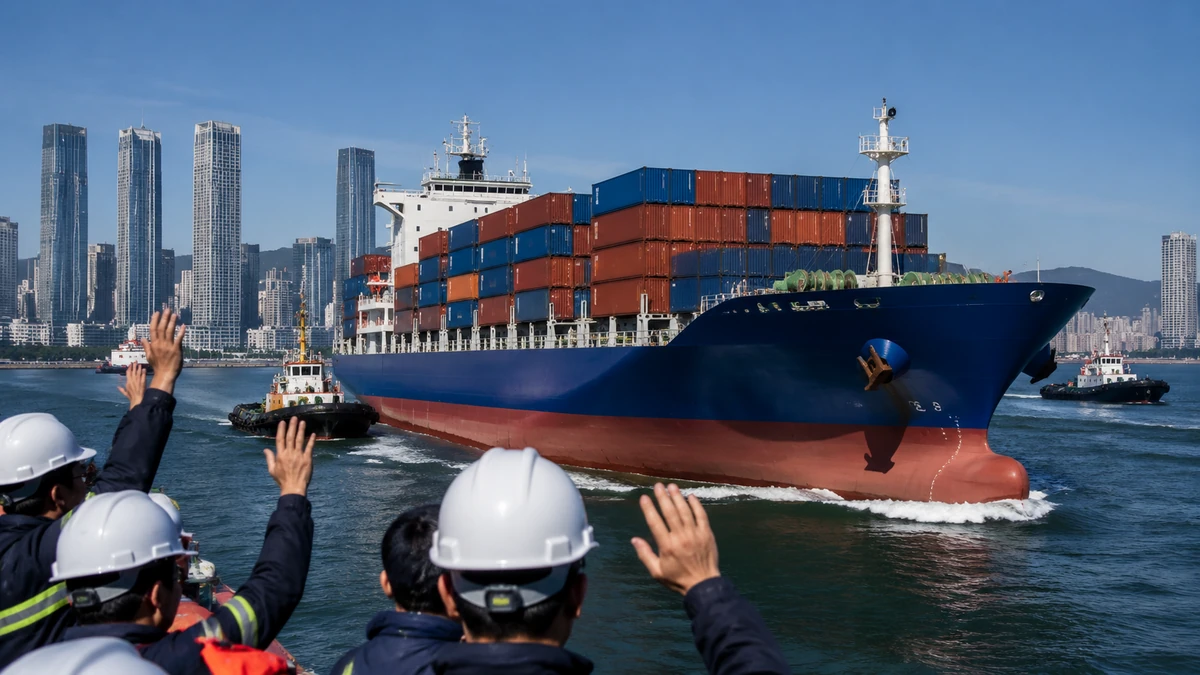
South Korea has launched what amounts to a real-world test of a long-discussed idea in global trade: whether the Arctic can become a commercially meaningful shipping corridor linking Asia and Europe. A container ship operated by Busan-based carrier PanStar Line Dot Com departed South Korea’s southeastern port city of Busan and is heading for Rotterdam in the Netherlands by way of the Bering Strait and the Arctic Ocean, according to the Korean news summary. The vessel, the PanStar Acro, has a capacity of 2,758 TEU, or twenty-foot equivalent units, the standard shipping measure for container cargo.
That may sound like a niche development in a faraway logistics sector. It is not. Shipping routes shape the cost and reliability of the modern economy, from auto parts and electronics to chemicals, industrial machinery and consumer goods. When a country like South Korea — one of the world’s major export powers and home to globally significant shipbuilders, ports and manufacturers — begins gathering hands-on operating data on an Arctic route, the implications extend well beyond Korean waters.
The voyage is significant because it is being framed not simply as a symbolic sail-through, but as a test of the entire transport chain. Korean reporting describes it as the first round-trip demonstration by a South Korean shipping company using a container ship carrying container cargo on the Arctic route. That distinction matters. The issue is not only whether a ship can physically pass through polar waters. It is whether cargo can be loaded, schedules managed, vessels adapted, ports coordinated and a commercially viable service repeated. In global shipping, one successful trip may attract headlines; repeatability is what attracts freight customers and investment.
The trial also marks a subtle but important shift in South Korea’s position. In 2018, the world’s first container ship demonstration voyage through the Arctic route by Denmark’s Maersk also departed from Busan, giving the Korean port symbolic importance in the conversation over future Arctic shipping. This time, however, a Korean company is not merely hosting a historic departure by a foreign carrier. It is conducting its own test with its own ship and cargo. That moves South Korea from observer to participant.
For American readers, the easiest comparison may be this: think of the difference between watching another company test a new freight rail corridor and running your own trains on it. The first proves the concept is worth following. The second begins building operational knowledge, negotiating leverage and industrial advantage.
Why the Arctic route keeps returning to the global trade conversation
The attraction of Arctic shipping is simple in theory. Korean reporting tied to this story notes that the route between Busan and Europe could be shortened by about 35%. Another related report cited a reduction of roughly 7,000 kilometers. In an industry where time at sea affects fuel costs, vessel availability, cargo turnover and supply-chain planning, those are not trivial numbers.
For decades, global shipping between East Asia and Europe has largely depended on southern routes through chokepoints such as the Strait of Malacca and the Suez Canal. Americans got an unusually vivid lesson in the fragility of those routes in 2021, when the Ever Given container ship blocked the Suez Canal and snarled global trade. That event helped drive home what shipping executives and strategists have long understood: when too much commerce depends on a small number of bottlenecks, any disruption can ripple across the world economy.
The Arctic route has therefore held enduring appeal as an alternative or supplemental corridor. But appeal and practicality are not the same thing. Polar waters bring severe weather, shifting ice conditions, limited rescue and repair infrastructure, specialized insurance questions, and operational constraints that do not exist, or do not exist to the same degree, on conventional sea lanes. That is why demonstration voyages matter. They generate evidence. Shipping lines, cargo owners and governments want to know not just how much shorter a route looks on a map, but how reliably it can be used in the real world.
That is the context for the PanStar Acro voyage. The Korean summary says the ship has ice-strengthened capabilities suited to polar operation. The practical test includes departure preparation, cargo loading, transit through the Arctic environment, arrival in Rotterdam and return operations. In other words, South Korea is not only asking whether the route exists. It is asking whether the route can support a shipping business.
That distinction is especially important at a time when global supply chains are being reconsidered through the lens of resilience, not only efficiency. After the pandemic, port congestion, factory shutdowns, shipping delays and geopolitical tensions pushed many governments and corporations to rethink what “just in time” should mean. A route that is somewhat complex but strategically useful can become more attractive when companies are looking for diversification, redundancy and greater control over risk.
Busan’s ambitions go beyond local pride
To understand why this voyage carries political and economic weight in South Korea, Americans need to understand Busan’s role. Busan is South Korea’s biggest port city and a major transshipment hub in Northeast Asia, meaning cargo often passes through it on the way to other destinations. In Korean policy debates, Busan is more than a local port; it is a national strategic asset.
The Korean summary says the South Korean government in May announced a policy direction aimed at activating the Arctic route while developing the Busan-Ulsan-South Gyeongsang region into a southern maritime economic hub. In plainer English, Seoul is not treating Arctic shipping as a stand-alone maritime experiment. It is connecting the idea to regional economic development, port infrastructure, shipping competitiveness and industrial policy.
That combination should sound familiar to Americans, even if the geography differs. In the United States, major ports such as Los Angeles, Long Beach, Savannah, Houston and New York-New Jersey are never just docking points. They sit at the center of wider ecosystems involving trucking, rail, warehousing, labor, manufacturing, technology and real estate. A port’s competitiveness depends not only on cranes and berths, but also on the ability to gather cargo, move it efficiently inland, support carriers and attract long-term commercial commitments.
The Korean reporting uses the industry term “first and last port” to describe the importance of a port that serves as a route’s key point of origin and return. Busan’s significance in Arctic route discussions stems partly from that idea. If Arctic shipping were ever to evolve from episodic testing into a viable logistics corridor, the question would not simply be which ships can sail there. It would also be which ports can organize the flow of cargo at scale.
That helps explain why Korean analysts are cautious. The reporting does not claim that the Arctic route has already proved its economic value. Instead, it emphasizes that South Korea is beginning to collect the operating experience needed to evaluate that value. That is a more sober and more important story. Shipping history is full of routes and infrastructure bets that looked promising in presentations but struggled under commercial conditions. Korea appears to be trying to avoid that mistake by testing the entire system rather than celebrating a theory.
There is also a competitive subtext. Busan has long sought to strengthen its role as a global transshipment hub, and competition among ports is intense. A new route, even a seasonal or limited one, can reshape how shippers think about network design. If Busan can establish itself early in the infrastructure, expertise and branding around Arctic operations, it could improve its standing in a crowded maritime landscape.
What this means for the United States
The most immediate reaction in the United States may be to view this as a Korea-Europe story. That would be too narrow. The U.S. has at least four reasons to pay close attention: supply chains, shipping competition, alliance economics and Arctic strategy.
First, American companies are deeply embedded in the same global logistics networks that South Korea uses. U.S. retailers, automakers, manufacturers, agricultural exporters and technology firms all depend on shipping reliability and cost. Even when a route does not directly touch an American port, it can alter freight rates, vessel deployment patterns, insurance calculations and port competition elsewhere. If an Arctic corridor becomes even marginally more feasible for certain seasons or cargo types, it could affect how carriers allocate ships between Asia-Europe and trans-Pacific trades. That matters to American importers and exporters.
Second, the United States has its own interest in resilient shipping networks and diversified maritime infrastructure. Americans saw during the pandemic that bottlenecks at one port or along one route can cause nationwide pain, from empty shelves to delayed industrial inputs. South Korea’s experiment reflects a wider global trend: governments and businesses are exploring alternatives before the next disruption forces their hand. In that sense, this is not just a Korean story. It is part of the global post-pandemic search for logistics resilience.
Third, U.S.-South Korea economic ties are already strong and increasingly strategic. South Korean companies are major investors in the United States across sectors including autos, batteries, semiconductors and heavy industry. American firms, in turn, rely on Korean suppliers, partners and shipping systems. When South Korea strengthens a port like Busan or develops new maritime capabilities, those moves can indirectly support broader bilateral commerce. If Korean exporters gain more route flexibility to Europe, that can change how they manage production networks that also involve the American market.
Fourth, the Arctic itself is no longer a distant policy abstraction for Washington. The United States is an Arctic nation through Alaska, and Arctic governance, trade routes, climate effects and security competition have all become more prominent in U.S. strategy discussions. South Korea is not an Arctic coastal state, but it is a technologically advanced maritime power with clear commercial interests in the region. Its actions show how middle powers are preparing for a future in which Arctic access, however limited or seasonal, could matter more.
There is also a business angle for U.S. shipping, logistics and port operators. If Asian and European players build operational familiarity around Arctic routes faster than American firms do, the U.S. could find itself reacting to changes rather than shaping them. That does not mean the U.S. should rush into imitation. It does mean American companies and policymakers should study the data that voyages like this produce. In logistics, being late to understand a structural shift can be expensive.
A climate opportunity wrapped in a climate paradox
Any serious discussion of Arctic shipping must also acknowledge the underlying paradox: the route is becoming more thinkable in part because climate change is altering the polar environment. That makes stories like this difficult to separate from the broader climate crisis. A shorter route may reduce distance, but the larger picture is not simply one of neat efficiency gains.
The Korean summary does not frame the voyage as an environmental success story, and it is wise not to do so prematurely. The real significance lies in the test of commercial possibility, not in any proven conclusion about long-term sustainability or operating economics. For global readers, however, the climate context is unavoidable. Arctic access is not occurring in a vacuum. It is part of a planet-scale transformation that brings commercial openings alongside environmental risk.
For American audiences, that tension resembles debates seen in Alaska, where economic development, environmental stewardship, Indigenous concerns, federal policy and strategic competition often intersect in complicated ways. The Arctic is not just a blank space on a map waiting to be “opened.” It is a sensitive region where commercial ambition can quickly collide with ecological reality and political scrutiny.
That is another reason South Korea’s trial matters as analysis rather than event. It shows how countries are beginning to operationalize possibilities that, until recently, often lived mostly in policy papers and speculative forecasts. Once companies invest in ships, routes and port upgrades, debates that once seemed theoretical become immediate. Questions about insurance, infrastructure, safety protocols, emergency response and commercial standards grow harder to postpone.
For the U.S., where debates over climate and industrial policy are often politically polarized, this Korean case offers a reminder that the rest of the world is not waiting for perfect consensus before testing future trade scenarios. Other countries are collecting evidence now.
What to watch next as South Korea moves from symbolism to data
The key question now is not whether the PanStar Acro can make headlines. It is what South Korea learns from the full round trip and how that learning shapes policy, infrastructure and business strategy. In that sense, the most important outcomes may be invisible to the general public: scheduling performance, cargo handling efficiency, operating costs, risk management and coordination across the supply chain.
If the voyage proceeds smoothly, Seoul may gain a stronger basis for expanding its policy push around the so-called southern maritime economic zone centered on Busan, Ulsan and South Gyeongsang. If it reveals major constraints, that information is valuable too. Negative or mixed findings can still help policymakers avoid costly overreach.
There are several signposts worth watching. One is whether more Korean carriers or logistics players join future demonstrations. Another is whether Busan accelerates investments aimed at strengthening its role as a transshipment and route-management hub. A third is whether cargo owners show sustained interest. Shipping lines can test routes on their own initiative, but large-scale adoption depends on shippers trusting that services will be reliable enough to build into contracts and production schedules.
International response will matter as well. Rotterdam is not just any destination; it is one of Europe’s signature ports and a gateway to the continent’s industrial heartland. If Arctic route testing begins to involve more regular engagement between Asian and European port systems, the discussion will broaden from one country’s maritime ambition to a larger redesign of logistics geography.
For Americans, the broader lesson is that the global shipping map is not fixed. Routes that seem permanent can be disrupted by geopolitics, engineering, climate shifts and commercial experimentation. South Korea’s Arctic voyage does not prove that a new era has arrived, but it does show that serious players are preparing for the possibility.
That may be the clearest way to understand this moment. South Korea is not declaring victory in a race for Arctic shipping. It is doing something arguably more consequential: building the firsthand experience needed to judge whether the route can become part of the future of trade. In a world where supply chains have become instruments of economic security as much as commerce, that is exactly the kind of quiet, technical move that can matter later in very public ways.
And for the United States, an ally whose economy is tightly woven into Asian manufacturing and global maritime networks, this is the sort of development worth watching early, before it moves from specialized shipping news to a wider story about trade power, infrastructure strategy and who gets to shape the next map of global commerce.
Comments
Post a Comment