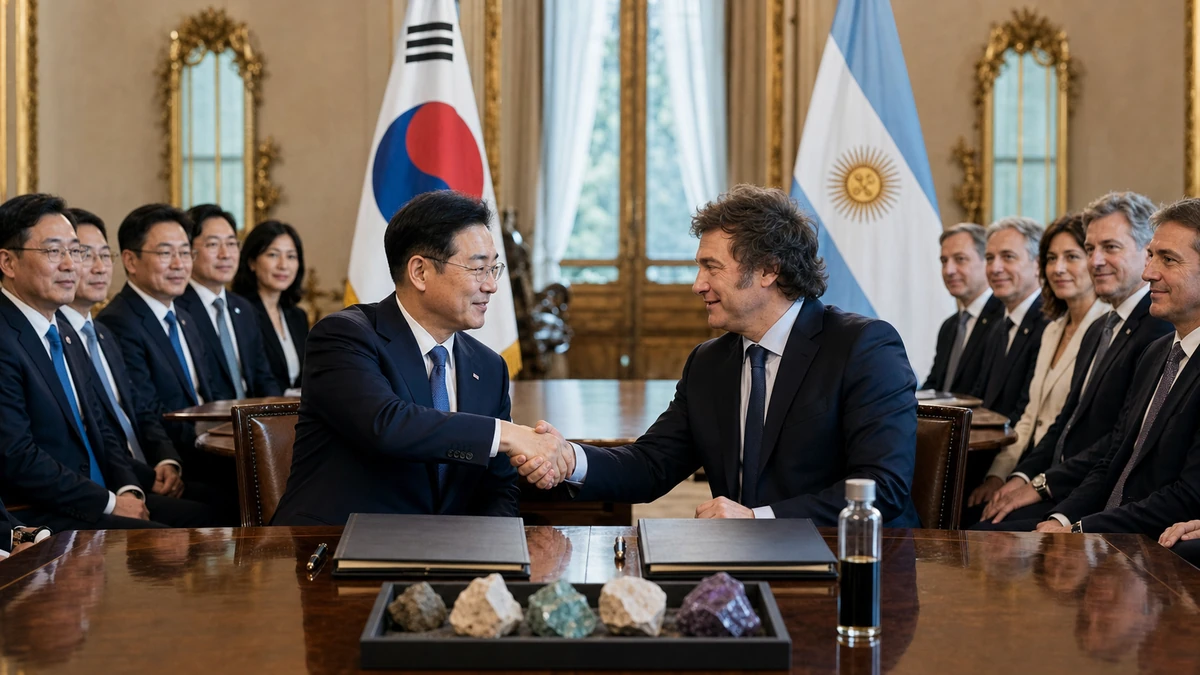
A summit with economic stakes beyond symbolism
South Korean President Lee Jae-myung used a visit to Buenos Aires this week to lock in two practical outcomes with Argentine President Javier Milei: South Korea plans to begin importing Argentine crude oil next year, and the two countries have finalized a double taxation avoidance agreement meant to make cross-border business less burdensome.
That may sound like dry policy language, but together the moves point to something larger in Seoul’s economic playbook. South Korea, one of the world’s biggest manufacturing powers and a major energy importer, is trying to reduce its exposure to disruptions in global supply chains while making it easier for its companies to operate abroad. In one meeting, the South Korean and Argentine governments addressed both problems at once: where resources will come from, and under what business rules companies will work.
According to the South Korean presidential office, Lee and Milei held a 25-minute preliminary conversation followed by a 58-minute formal summit on July 31 local time. The results were later explained to reporters in Buenos Aires by South Korea’s national security adviser. The headline items were straightforward: South Korea will add Argentina to its list of crude suppliers starting next year, and the two governments have reached a final agreement on preventing double taxation.
For American readers, the significance is easier to understand if you think about the way Washington talks about “friend-shoring,” strategic minerals and energy security. South Korea is doing something similar, though with its own set of constraints. It has a highly advanced industrial economy, a large export sector and heavy dependence on imported energy and raw materials. When global shipping routes tighten, commodity prices jump or geopolitical tensions rise, South Korean manufacturers feel it quickly. That makes diversification less of a diplomatic slogan than a matter of economic resilience.
The South Korea-Argentina summit did not produce the kind of flashy announcement that dominates cable news. There was no blockbuster defense pact, no immediate multibillion-dollar factory groundbreaking and no dramatic ideological reset. What emerged instead was something often more important in economic diplomacy: a framework that could make future trade and investment easier to execute in the real world.
Why Argentine oil matters to South Korea
South Korea has long depended on imported crude to keep its economy running. Oil feeds not only transportation and electricity-related systems but also refining, petrochemicals, shipping and the broader industrial chain that supports everything from plastics to manufacturing inputs. In a country where export competitiveness matters enormously, even modest changes in energy sourcing can carry strategic weight.
That is why the decision to begin importing crude from Argentina next year matters, even though officials did not disclose volumes, pricing structures or specific delivery mechanisms. The point, at least for now, is not that Argentina will suddenly replace the Middle East as a supplier to South Korea. It will not. The significance is that Seoul is adding another option to its energy map.
For years, governments and companies around the world have been rethinking the risks of relying too heavily on a narrow set of suppliers. The COVID-19 pandemic exposed bottlenecks in shipping and manufacturing. Russia’s war in Ukraine rattled commodity markets. Tensions involving the United States and China have pushed allies and partners to think more carefully about supply vulnerability. South Korea has been navigating all of those pressures while trying to protect the production networks that underpin its export economy.
Argentina enters this picture as a resource-rich country with long-term potential in both conventional and unconventional energy. For South Korea, bringing in Argentine crude could help widen its sourcing options geographically. A South American supplier does not solve all energy security problems, of course. Transportation logistics, pricing, refining compatibility and commercial contracts all matter. But in strategic terms, a broader supplier base gives importers more flexibility when markets become unstable.
There is also a signaling effect. When a government publicly says it will begin buying oil from a new country, it tells companies, traders and investors that the relationship is moving beyond ceremonial diplomacy. It says the two sides are serious enough to build real commercial flows. That matters in international business, where confidence often follows political clarity.
The talks also covered cooperation in critical minerals and energy, according to the South Korean side. Those discussions appear to be at an earlier stage than the oil announcement, with fewer public details. Still, their inclusion is notable. Critical minerals — a term American audiences increasingly hear in connection with electric vehicle batteries, semiconductors and clean energy technology — have become central to economic strategy worldwide. Countries that manufacture advanced goods want secure access to lithium, copper and other inputs that can determine industrial competitiveness for years to come.
Argentina is especially relevant in those conversations because of its place in South America’s so-called lithium triangle, a region that also includes Chile and Bolivia and holds some of the world’s largest lithium resources. South Korea, home to major battery makers and electronics giants, has strong reasons to deepen ties with countries that can help support future supply needs. The summit did not announce a new minerals contract, but it clearly placed the issue on the bilateral agenda.
The tax deal could matter as much as the oil
If the oil announcement is the visible part of the story, the tax agreement may prove just as consequential over time. The finalized double taxation avoidance agreement is designed to prevent the same income from being taxed twice in both countries, a problem that can discourage investment and complicate cross-border business.
To many readers, this may sound like a niche issue for accountants. In practice, it can shape whether companies decide to enter a market at all. When firms assess overseas expansion, they look beyond consumer demand and labor costs. They also ask basic questions: How will profits be taxed? Will dividends or royalties face overlapping claims? Are the rules clear enough to estimate long-term costs? If the answers are murky, projects become harder to justify.
That is where a tax treaty matters. It establishes rules for how income is treated, reduces the risk of duplicate tax burdens and creates a more predictable environment for investors, subsidiaries, service providers and sometimes even individual workers operating across borders. For South Korean companies considering Argentina — whether in energy, mining, logistics or industrial services — clearer tax treatment lowers a form of friction that does not make headlines but can quietly stall business activity.
American readers may think of these agreements as part of the plumbing of globalization. They are rarely glamorous. Yet without them, governments can announce cooperation while companies remain reluctant to move. The treaty, in that sense, is an attempt to connect diplomatic commitments with market behavior.
South Korean officials framed the agreement as a foundation for improving business conditions, and that description fits. Resource deals are easier to imagine when the legal and tax environment is not working against the companies expected to carry them out. If oil purchases and future minerals cooperation are the visible economic objectives, the tax treaty is part of the institutional scaffolding meant to support them.
There are still caveats. Publicly available information so far does not include the treaty’s detailed provisions, the timeline for implementation or the exact process for entry into force. That means it would be premature to predict an immediate flood of new investment. Businesses tend to respond not only to signed agreements but to how they are administered in practice. Even so, finalizing the treaty is a meaningful step because it removes at least one layer of uncertainty from the relationship.
What this says about South Korea’s economic diplomacy
South Korea’s presidential diplomacy is often viewed abroad through the lens of security — North Korea, the U.S. alliance, China competition or defense exports. Those issues remain central. But Seoul’s external strategy has always had a powerful economic dimension, and this week’s summit underlined that reality.
South Korea is unusually exposed to global economic turbulence because of the structure of its economy. It is a trade-dependent nation with globally recognized manufacturers in semiconductors, autos, batteries, shipbuilding, consumer electronics and heavy industry. That success brings vulnerability. The country must import much of the energy and many of the raw materials that help power those industries, then export finished goods into markets shaped by exchange rates, shipping costs, trade rules and geopolitical stress.
That is why South Korean presidents often use overseas visits not simply to strengthen diplomatic ties but to create conditions for business. In Korean political language, summit diplomacy can carry a strongly practical character: a head of state opens doors, signals priorities and helps establish frameworks that private companies can use later. It is less about pageantry than about reducing barriers and building channels.
For Americans unfamiliar with South Korean political culture, that emphasis on economic outcomes is worth noting. In Washington, foreign trips are frequently judged by alliance messaging, security announcements or domestic political optics. In Seoul, those things matter too, but there is often intense public and business interest in whether summit meetings produce tangible commercial benefits. An agreement on energy imports and taxation therefore fits well within the tradition of pragmatic statecraft.
The pairing of oil imports with a tax agreement also reflects a broader lesson from the post-pandemic economy: supply chains are not just about ships, ports and warehouses. They are also about law, taxation, regulation and political trust. A country can identify a new resource partner, but unless companies have confidence in how contracts, taxes and administrative procedures will work, diversification remains theoretical. Seoul appears to be trying to address both the material and institutional sides of economic security at the same time.
Why Argentina is an appealing partner right now
For Argentina, the summit offered a chance to position itself as more than a distant diplomatic acquaintance in Asia. The South American country has resources that global manufacturers increasingly want, especially as competition intensifies over energy supplies and critical minerals. It also has a government under Milei that has sought to recast Argentina’s image as a more open and reform-minded economy, even as it wrestles with severe domestic economic strains.
Argentina’s appeal lies partly in abundance. The country has major agricultural output, significant energy potential and globally important mineral reserves. In a world where supply security has become an organizing principle of policy, those assets make Argentina more strategically relevant than its recent economic volatility might suggest.
At the same time, that volatility is part of the story. Argentina has spent years grappling with inflation, debt crises, currency instability and regulatory unpredictability. Those problems have often made foreign investors cautious. That is one reason institutional arrangements such as a double taxation avoidance agreement matter. They do not erase macroeconomic risk, but they can make specific commercial relationships easier to structure and defend.
For Milei, attracting partnerships with industrialized economies like South Korea serves a political and economic purpose. It shows that Argentina can still draw serious foreign interest despite its domestic turbulence. It also helps diversify Argentina’s own external relationships at a time when governments around the world are trying to avoid overdependence on any single market or major power.
The partnership also has a practical complementarity. South Korea needs resources and reliable rules for its companies abroad. Argentina wants trade, investment and greater integration into high-value global supply chains. Those interests do not guarantee smooth cooperation, but they do create a logical basis for it.
What remains unknown — and what to watch next
As with many summit outcomes, the most important developments may come after the photo op. Officials have confirmed the broad direction of cooperation, but many details remain unclear. The scale of the planned crude imports has not been made public. Neither have the commercial terms, participating firms or shipping arrangements. In the critical minerals arena, the leaders discussed cooperation, but no specific projects have yet been announced publicly.
Those unknowns matter because implementation is where summit diplomacy often succeeds or stalls. Will South Korean refiners find Argentine crude commercially attractive at scale? Will logistics and pricing support a lasting relationship? Can the two governments translate general discussions on minerals into bankable ventures or long-term supply contracts? And how quickly will the tax agreement move from finalization to practical effect for companies operating in both countries?
There is also a bigger geopolitical question in the background. South Korea, like many middle powers, is trying to widen its economic options without becoming overly dependent on a narrow circle of partners. Building stronger ties with a South American resource producer fits that strategy. It is not an anti-anyone move so much as a hedge against concentration risk in an unsettled global economy.
For U.S. readers, that should sound familiar. American policymakers increasingly talk about resilient supply chains, strategic autonomy among allies and the need to secure access to energy and minerals critical to modern industry. South Korea’s moves with Argentina echo those concerns, even if they emerge from a different national context.
In the end, the significance of the Buenos Aires summit is not that it transformed the global economy overnight. It is that it offered a clear snapshot of how modern economic diplomacy works. Leaders are no longer just talking about friendship or broad trade promotion. They are trying to line up resources, legal frameworks and investment conditions in ways that give their economies more room to maneuver.
South Korea’s decision to begin importing Argentine crude next year and its finalization of a tax treaty with Buenos Aires are modest on the surface but strategically coherent together. One expands the menu of resource options. The other reduces the institutional friction that can inhibit cross-border business. In an era defined by supply chain anxiety and fierce competition for industrial inputs, that combination may be exactly the point.
Whether it leads to deeper trade, stronger corporate ties or wider cooperation in critical minerals will depend on the follow-through. But for now, Seoul and Buenos Aires have signaled that their relationship is moving beyond diplomatic pleasantries and toward the harder work of building an economic partnership that companies can actually use.
Comments
Post a Comment