Image to help understand the article
A housing plan that is shifting from promises to execution
South Korea’s government is preparing a fresh set of housing measures for the greater Seoul region, but the central question is no longer how big a number officials can put in a headline. It is whether the government can get homes built fast enough for people to notice.
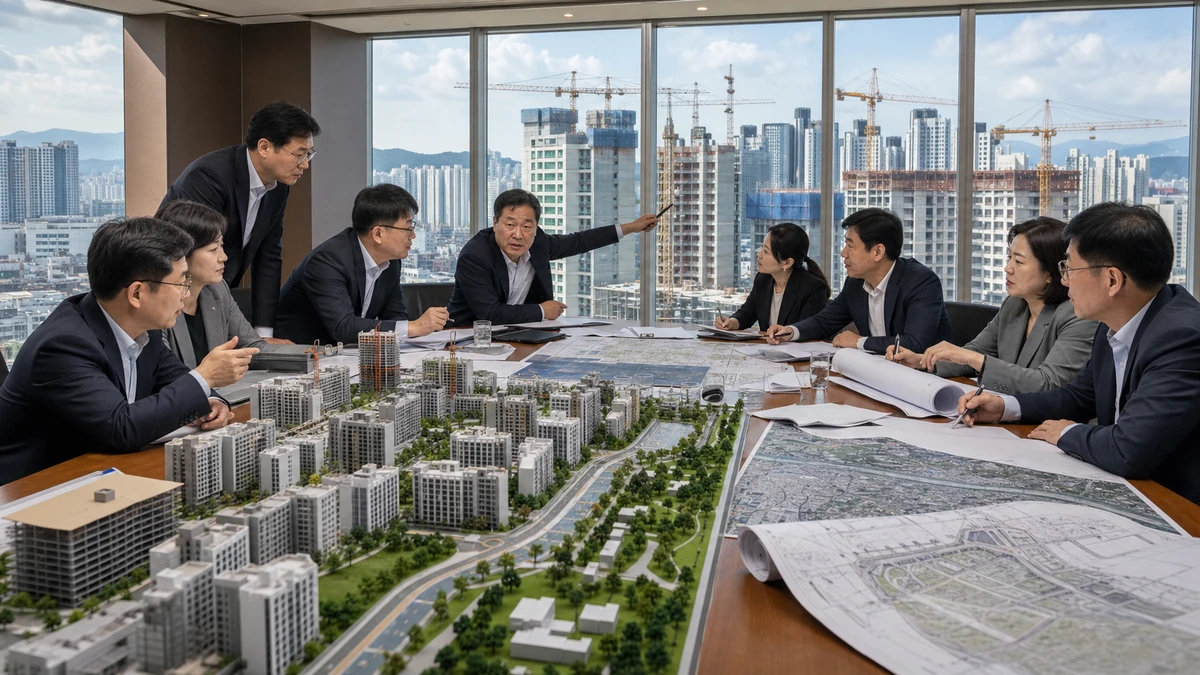
That was the message emerging from a second real estate policy review meeting chaired Aug. 8 by President Lee Jae-myung, according to the Korean news summary and local reporting. Officials are broadly reviewing ways to increase the supply of housing in the Seoul metropolitan area — home to roughly half the country’s population — while also shortening the long, often politically fraught process that stands between a government announcement and actual move-ins.
For American readers, the closest comparison may be the gap between a governor announcing an ambitious homebuilding target and local residents asking a year later: How many units are actually under construction, and when will anyone be able to live there? South Korea’s housing politics, especially in and around Seoul, have long turned on that same divide between plans on paper and apartments people can physically occupy.
In that sense, the government’s latest deliberations reflect a familiar problem in high-cost global cities. Officials can pledge more supply, identify possible land and sketch financing frameworks. But housing does not materialize when a news conference ends. It requires land assembly, permits, developer participation, loans, tax rules, infrastructure coordination and, in many cases, negotiations among multiple layers of government. South Korean officials now appear to be acknowledging that the country’s next housing debate will be won or lost not by announcing larger targets, but by removing the bottlenecks that slow projects already in the pipeline.
The administration had already laid out a broad supply framework last year, on Sept. 7, during its first year in office. But with criticism building that the public has not yet felt meaningful results, the emphasis is shifting from declaring policy to carrying it through. In practical terms, that means focusing less on the symbolism of a big supply figure and more on the mechanics of getting land secured, making projects financially viable, moving loans, approvals and tax treatment into alignment, and turning proposals into construction starts and eventual occupancy.
That may sound technocratic, but in South Korea it goes to the heart of one of the country’s most politically sensitive issues. Housing in the Seoul area is not simply an economic concern. It is tied to class mobility, marriage timing, family formation and perceptions of fairness in a country where homeownership remains a central aspiration and where price spikes have repeatedly dominated national politics.
Why Seoul’s housing market matters so much
To understand the significance of the government’s latest move, it helps to understand the role Seoul plays in South Korean life. Seoul is not just the capital. It is the unquestioned center of politics, finance, higher education, media and many of the country’s best-known corporate headquarters. The wider capital region, including Incheon and Gyeonggi Province, is where jobs, top schools and transportation networks are densely concentrated.
That concentration has made housing supply in the metropolitan area a recurring source of public anxiety. In the United States, a debate over housing supply might be spread across metro areas such as New York, Los Angeles, San Francisco, Boston and Washington. In South Korea, much of that pressure is compressed into one giant urban corridor centered on Seoul. When homes are scarce there, the consequences ripple across the national economy and across everyday life.
South Korea also has a distinctive housing culture that can be unfamiliar to overseas audiences. Apartment living is the norm for much of the middle class, and large apartment complexes carry social and financial significance beyond what many Americans might associate with a condo building or suburban subdivision. In Seoul, an apartment is often not just shelter but a family’s main store of wealth, a status marker and a key to access to neighborhood schools, transit and professional networks.
That helps explain why governments in Seoul are judged not only on whether they can cool speculative excess, but also on whether they can increase supply in places where people actually want to live. Promises to build homes far from job centers or in locations with weak transit may count on paper, yet do little to reassure people who want reasonable commutes and access to the urban core. The political premium is on delivering homes in or near the areas where demand is hottest.
For that reason, the government’s current review is heavily focused on the capital region rather than on national supply figures alone. According to the summary, ministries including the Ministry of Land, Infrastructure and Transport and the Financial Services Commission have been holding additional meetings with housing-related industries to hear about obstacles in the field. That suggests policymakers are trying to address housing as a chain of interconnected problems: land, taxes, development financing, construction viability and end-user loans.
That kind of whole-of-government approach matters because housing shortages in expensive metros are rarely solved by one ministry or one law. The same is true in the United States, where zoning, interest rates, tax incentives, labor shortages and local approvals can all shape whether housing gets built. South Korea’s latest effort seems designed around a similar recognition that supply depends on the weakest link in the chain.
What the government is considering, from green belts to non-apartment housing
Among the options under review are some of the most politically sensitive land-use tools in South Korea. One is the possible easing of restrictions on so-called green belts, protected development-limited zones around urban areas. For American readers, green belts are somewhat analogous to a mix of anti-sprawl protections, conservation buffers and growth boundaries. They are meant to limit disorderly expansion and preserve open land, but they also become flashpoints when cities run short on buildable housing sites.
No specific locations, supply numbers or implementation dates have been finalized, according to the summary. That distinction matters. In heated housing markets, even early discussion of releasing protected land can trigger speculation, local opposition and sharp political reactions. At this stage, the more accurate interpretation is that the government is surveying every plausible source of additional land and every legal tool that might speed supply, not that bulldozers are about to move into a designated area.
The review also extends beyond traditional apartment construction. Officials are examining ways to strengthen and accelerate non-apartment housing supply, another term that can carry more nuance in Korea than it might in the United States. In the Korean context, non-apartment housing can refer to a range of urban residential formats that do not fit the standard large apartment-complex model, potentially including smaller multi-family structures or other forms better suited to constrained city parcels.
That matters because Seoul’s land constraints are severe. In a city where developable land is limited and demand is intense, relying on one housing type alone can slow overall delivery. A more varied mix can allow governments and developers to use infill sites, smaller lots and urban locations where a giant apartment project may not be feasible.
For Americans who have watched cities debate duplexes, accessory dwelling units, transit-oriented development and “missing middle” housing, the Korean discussion may sound familiar. The underlying problem is the same: how to add more homes in already built-up places without depending entirely on massive greenfield projects. The difference is that in Seoul, density is already high, land is even scarcer and the political importance of apartments is stronger.
Officials say they are taking into account suggestions from industry players and from end users — what Korean policymakers often call real demand from actual home seekers rather than speculators. That includes trying to package apartment and non-apartment supply, tax support, financing assistance and buyer loan issues into a single plan. The final announcement date has not been set, and interagency coordination reportedly continued through the weekend, a sign that the details are still being negotiated.
In a housing market as sensitive as Seoul’s, those details may matter more than the headline number. If financing rules remain too tight, if tax burdens undermine project viability, or if permit timelines remain unpredictable, even well-publicized supply goals can stall. The new push appears to be aimed at precisely that problem.
The real strategy: speed up projects already on the books
One of the clearest signs of the government’s new emphasis is its focus on accelerating projects that have already been identified rather than simply unveiling an entirely new list of giant targets. That approach is visible in a housing initiative involving roughly 27,000 units in Seoul’s semindustrial zones, according to the summary.
Semindustrial zones can be difficult to explain outside Korea, but the basic idea is straightforward: they are mixed urban areas where industrial functions and residential functions exist side by side. Think of older city districts where light manufacturing, warehouses, workshops and housing overlap — places that are neither purely residential neighborhoods nor fully dedicated factory areas. Redeveloping or adding housing in such districts can unlock centrally located land, but it also requires careful balancing of jobs, logistics, neighborhood quality of life and city planning rules.
That is why the 27,000-unit effort is important. It illustrates the government’s apparent preference for execution over theater. Rather than trying to impress the market with a dramatically larger new number, officials are studying how to get already planned housing from the proposal stage to construction and occupancy faster. That can mean regulatory changes, financial support, tax adjustments or other tools that lower the time and risk between planning and completion.
In housing policy, time is often the hidden variable. A city can announce tens of thousands of future units, but if land negotiations drag on, financing weakens or approval processes stretch out, the real-world effect is minimal. Conversely, moving an existing project forward by one or two years can have a tangible impact on supply and public confidence. That seems to be the logic behind the government’s latest posture.
There is also a practical political reason for emphasizing projects already underway. New megaprojects can invite immediate conflict over location, environmental impact, traffic, school capacity and neighborhood character. Existing projects, while still contentious, have often already cleared some of those hurdles. Speeding them up can therefore produce faster returns than starting from scratch.
Still, even that is not simple. Government officials have acknowledged that semindustrial-zone housing expansion in Seoul cannot be dictated by the central government alone. It requires consultation with Seoul’s city government. That point is crucial because it highlights a dynamic seen in many countries, including the United States: national leaders may want more housing, but cities control key aspects of land use, planning and implementation.
The same is true for ideas involving new candidate sites in central Seoul through public housing complex projects. The review reportedly includes possibilities for more than 20,000 homes in Seoul, including in highly sought-after districts such as Gangnam, Seocho and Songpa — the so-called Gangnam 3 districts that many international audiences recognize from the phrase “Gangnam Style,” though in real estate terms they are better understood as some of the capital’s most expensive and prestigious neighborhoods.
Again, those sites are under consideration, not finalized. But their inclusion underscores how strongly the government wants to address demand where it is most concentrated, rather than pushing supply only to the outer edges of the metro area.
Why the politics of housing speed are so delicate
If the administration’s new approach sounds sensible, that is because it addresses a problem economists and urban planners often identify in supply-starved cities: housing policy can become obsessed with targets while neglecting the delivery machinery underneath them. But turning that insight into reality is politically difficult.
For one thing, every effort to speed housing tends to collide with another public interest. Environmental protections slow some projects but preserve open space. Local review can be cumbersome but gives residents a say. Tax policy can encourage development but also raise concerns about favoritism. Easier credit can support construction but increase financial risk. In that sense, “faster supply” is never just a technical fix. It is a series of tradeoffs.
That is especially true in South Korea, where housing debates can quickly become polarized. Measures seen as helping developers can face criticism if they are perceived as watering down regulation or subsidizing private profit. Measures aimed at increasing density can face resistance from existing residents worried about congestion, schools and neighborhood change. Any proposal to loosen green-belt rules can trigger environmental objections and speculation fears.
There is also the market psychology problem. If the government announces ambitious supply measures but leaves key details vague, some buyers may remain skeptical and prices may not respond much. If it announces too much land release too quickly, it can invite political backlash before the homes are anywhere near completion. Policymakers are trying to navigate between those risks.
That may help explain why officials appear to be bundling multiple support systems together. According to the summary, ministries are coordinating across financial, tax and lending areas to support project execution. The theory is that housing supply does not fail at one single point. It fails when several moderate frictions combine into a severe delay. If land is identified but project financing remains shaky, nothing gets built. If financing is available but taxes make a project unattractive, it slows down. If both are workable but approvals remain stuck, timelines still slip.
In the American context, this resembles a policy conversation that links zoning reform with tax incentives, infrastructure funding and lending conditions rather than treating each as a separate debate. Seoul’s challenge is arguably harder because the city is denser, the market more concentrated and the political stakes more intense.
Another reason the issue is delicate is that South Koreans are highly attuned to the difference between housing meant for actual occupancy and housing policy that mostly affects expectations. The government’s stated effort to support “real demand” reflects longstanding concern about speculation in the property market. In practical terms, that means officials must show that measures to improve project viability do not simply boost land prices or developer margins without producing homes people can afford or access.
What success would look like, and what to watch next
The most important takeaway from South Korea’s latest housing deliberations is that the measure of success is changing. The key question is not merely how many homes the government says it wants to build in the Seoul area. It is whether the country can manage the calendar of housing production — the period from site identification to approval to financing to groundbreaking to move-in — more effectively than it has in the past.
That may sound less dramatic than announcing a massive construction target, but it is likely the more meaningful test. In expensive metropolitan markets around the world, the shortage is often not a lack of policy declarations. It is a lack of systems that can convert those declarations into homes on a reliable timeline.
For global urban policymakers, Seoul offers a particularly revealing case study. The city is one of the world’s densest and most economically dynamic capitals, with land scarcity, high demand and enormous political sensitivity around housing. If the Korean government can show that coordinating land policy, development finance, tax treatment and local government negotiations produces faster supply, it may offer lessons beyond Korea.
Still, much remains unsettled. The government has not fixed an announcement date for the follow-up package. Specific green-belt areas have not been named. New candidate sites in core Seoul are not final. The scale and design of support for non-apartment housing remain under review. And many of the tools being discussed will require not only ministry-level coordination but also cooperation with Seoul city officials and, in some cases, broader political buy-in.
That means observers should be careful not to confuse a broad menu of options with a final blueprint. The immediate significance of the current review is that it signals where the administration thinks the problem lies. The bottleneck is not simply a shortage of rhetoric or a lack of theoretical supply goals. It is the slow conversion of policy into built housing.
For households in and around Seoul, that distinction matters enormously. A newly married couple deciding whether they can afford to stay near work, parents trying to live within reach of top schools, or renters wondering whether relief is coming do not experience housing policy as a spreadsheet. They experience it through monthly payments, commute times and the availability of homes in neighborhoods linked to jobs and transit.
In the coming weeks, the most useful things to watch will be concrete ones: whether the government identifies specific projects that can move faster; whether financing or tax measures clearly improve project viability; whether Seoul city officials support additions in semindustrial or central-city locations; and whether the administration can provide enough detail to persuade the public that this is more than another round of aspirational planning.
If it can, South Korea may begin to shift its housing policy from what critics often see as a cycle of announcement and disappointment toward something more durable: a model centered on execution. In a city like Seoul, where every parcel of land is contested and every year of delay carries a social cost, that may be the only housing metric that truly matters.
Comments
Post a Comment