South Korean and U.S. Army leaders use Seoul meeting to underscore alliance readiness — and a longer-term military partnership
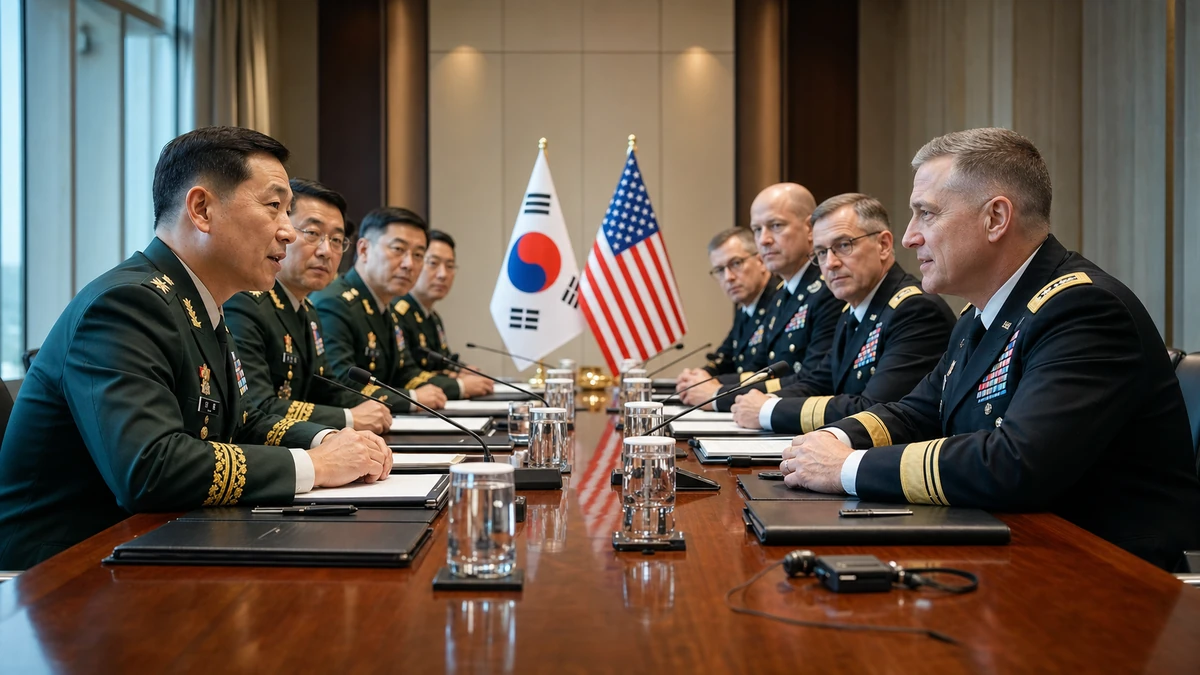
Image to help understand the article
A routine meeting with strategic weight
South Korea’s top Army officer met in Seoul this week with the acting chief of staff of the U.S. Army, using what might look like a routine military engagement to send a broader message: The U.S.-South Korea alliance is focused not only on deterring war on the Korean Peninsula today, but also on building the habits, relationships and planning systems that will shape how the two militaries work together in the years ahead.
Gen. Kim Gyu-ha, South Korea’s Army chief of staff, sat down on July 11 with Gen. Christopher LaNeve, the acting U.S. Army chief of staff, during LaNeve’s visit to South Korea. According to South Korea’s Army and local media reports, the two discussed ways to strengthen the allies’ combined defense posture and agreed to continue developing cooperation between the two armies on the foundation of what both sides described as a firm joint defense stance.
The meeting took place at the ROKAUS Hotel in Seoul’s Yongsan district, an area long associated with the U.S.-South Korea security relationship. For Americans, the significance of that setting is not unlike holding a high-level Pentagon conversation within sight of a symbolically important military command center. Yongsan has for decades been one of the best-known physical markers of the U.S. military presence in South Korea, even as parts of that footprint have evolved and relocated over time.
There was no dramatic new policy announcement, no unveiling of a fresh defense pact and no public description of a major new weapons package. But in alliances, especially military alliances, significance often lies less in headline-grabbing declarations than in repetition, continuity and process. This meeting appears to fall squarely into that category: a reaffirmation that the two countries want their militaries in close alignment not just in moments of crisis, but as a matter of routine planning and sustained engagement.
That matters because the U.S.-South Korea alliance is built as much on operational familiarity as on diplomatic language. Political leaders can declare solidarity, but armies need regular contact to turn solidarity into practical coordination. That means meetings among top officers, exchanges among senior commanders, shared planning and joint exercises that help each side understand how the other makes decisions, communicates risk and prepares for a fast-moving security environment.
In that sense, the Seoul meeting was less about spectacle than about maintenance — and in military affairs, maintenance is often what keeps deterrence credible. The underlying point from both sides was that the alliance cannot depend only on formal treaties or summit statements. It must be reinforced through continuous interaction between the institutions that would actually carry out a defense mission if tensions rose or conflict broke out.
Why the Korean Peninsula still demands close coordination
For American readers, the backdrop to any senior-level U.S.-South Korea military meeting begins with North Korea. The Korean War ended in 1953 with an armistice, not a peace treaty, meaning the two Koreas remain technically at war. That unresolved conflict is not just a historical footnote. It continues to shape force posture, planning assumptions and the day-to-day logic of the alliance between Washington and Seoul.
Roughly 28,500 U.S. troops are stationed in South Korea, a deployment that has long served as both a practical and symbolic guarantee of American commitment to South Korea’s defense. Over the decades, the alliance has evolved well beyond a simple arrangement in which the United States protects a vulnerable partner. South Korea now fields one of the world’s most capable militaries, with advanced technology, a large standing force and growing defense industrial strength. Still, the possibility of North Korean provocation — whether through missile launches, artillery threats, cyber activity or other forms of coercion — keeps combined readiness at the center of bilateral military planning.
That is why the phrase “combined defense posture,” often used in South Korean and U.S. military statements, carries substantial meaning. It refers to the readiness, coordination and interoperability of allied forces operating together. In plainer American terms, it means making sure the two militaries can fight as a team if necessary: that communications systems match, command relationships are clear, logistics are workable and training has prepared soldiers and commanders for real-world contingencies.
But the threat picture is not limited to North Korea. Officials on both sides increasingly frame their cooperation in terms of broader regional stability. In the Korean summary of the meeting, both peace on the Korean Peninsula and stability in the wider region were cited as key concerns. That reflects a strategic reality familiar to U.S. policymakers: Northeast Asia is one of the world’s most militarily dense regions, where developments involving China, Japan, North Korea, Russia and the United States can quickly overlap.
For Seoul, that balancing act can be delicate. South Korea’s immediate security challenge is still the North, and its public debate often treats the alliance primarily through that lens. At the same time, South Korea is playing a larger role in regional and global security conversations, from defense technology and munitions production to Indo-Pacific strategy. When U.S. military leaders publicly praise South Korea’s Army for its role in peninsula peace and regional stability, they are acknowledging that Seoul is not simply a defended state on the front line — it is also an increasingly consequential security actor in its own right.
That evolution is important for American audiences accustomed to older Cold War-era images of South Korea as mainly a beneficiary of U.S. power. Today’s South Korea is better understood as a heavily armed treaty ally with its own strategic weight, domestic political debates and expanding regional role. Meetings like this one reflect that shift. The message is no longer just that Washington stands by Seoul. It is that both armies are preparing together as partners with shared responsibilities.
From deterrence to future planning
One of the more revealing aspects of the Seoul talks was the way both sides linked current readiness with future-oriented military cooperation. According to the South Korean account, the core idea was that a strong defense posture and long-term collaboration are not separate agendas. Rather, one supports the other.
That logic is familiar to anyone who has watched how the U.S. military manages alliances. Immediate readiness depends on systems and relationships built over time, while future cooperation is easier to deepen when today’s deterrence framework is stable and trusted. In practical terms, that means joint exercises, officer exchanges and recurring high-level meetings do more than fill calendars. They produce institutional memory. They help commanders on each side understand how their counterparts think, what assumptions they bring and how quickly they can align during a crisis.
Kim, according to South Korean military officials, pointed to several concrete avenues for that ongoing cooperation: a U.S.-South Korea Army conference scheduled for November, exchanges of senior personnel and combined exercises. None of those items amounts to a dramatic policy shift by itself. But taken together, they point to a structure of alliance management that depends on regularized contact rather than one-off symbolism.
That may sound bureaucratic, but bureaucratic mechanisms are often what make alliances durable. Americans can think of it as the difference between praising a friendship and actually staying in touch. An alliance sustained only by political rhetoric can fray when leadership changes or when domestic priorities shift. An alliance with established channels — annual meetings, recurring exercises, personnel exchanges and habitual consultation — is more resilient because it is embedded not only in speeches, but also in organizations and routines.
There is another reason future planning matters now. Military technology, doctrine and the nature of threat environments are changing quickly. Armies today must think about drones, missile defense, cyber vulnerabilities, electronic warfare, data sharing and rapid decision-making under conditions of compressed time. Even if the Korean Peninsula remains the most immediate focus, the methods of deterrence and defense are not frozen in the 20th century. A future-ready alliance must adapt to those changes together, not separately.
That helps explain why senior military leaders increasingly emphasize exchanges and cooperation even when they are not announcing a new weapons system or operational plan. The object is not merely to preserve the alliance as it existed in the past, but to keep it credible under new conditions. In the Korean summary, this was framed as “preparing for the future” of both armies. For American readers, a fair translation of that idea is that the allies are trying to ensure they remain interoperable, aligned and strategically relevant as security challenges evolve.
What the U.S. praise of South Korea’s Army really signals
LaNeve’s reported praise for the role of South Korea’s Army in maintaining peace on the peninsula and contributing to regional stability deserves attention, even if it came without a new policy announcement attached. In military diplomacy, public praise is not empty courtesy. It is often a way of signaling confidence, recognizing burden-sharing and framing the relationship in terms both publics can understand.
For years, burden-sharing has been a recurring theme in U.S.-South Korea relations. In Washington, debates periodically surface over alliance costs, troop commitments and whether allies are contributing enough to common defense. In Seoul, there is sometimes concern about whether the United States remains fully committed amid shifting global priorities. Against that backdrop, an American military leader highlighting South Korea’s role serves several purposes at once.
First, it underscores that South Korea is not a passive recipient of security guarantees. Its military is central to deterrence on the peninsula. Second, it reassures South Korean audiences that Washington recognizes the scale and seriousness of Seoul’s contribution. And third, it frames the alliance as a collaborative undertaking built on shared effort rather than unilateral protection.
That framing has become increasingly important as South Korea’s defense profile grows. The country has expanded its defense exports, invested heavily in modernization and sought a larger voice in regional security discussions. It is also a democracy with vigorous domestic debate, where public support for the alliance remains strong but is not detached from questions of sovereignty, self-reliance and national pride.
Americans sometimes miss how sensitive those themes can be in South Korea. The alliance is broadly valued, but so is the idea that South Korea is defending itself, not simply being defended. So when U.S. officials publicly commend the South Korean military’s role, they are speaking into a political and cultural landscape where recognition of South Korea’s agency matters.
There is also a strategic dimension. As the United States asks allies across Asia and Europe to contribute more actively to collective security, public acknowledgment becomes a form of alliance management. It reinforces the legitimacy of cooperation and helps build domestic backing for continued engagement. That does not mean the statement commits South Korea to a new mission or new regional posture. The Korean reporting specifically suggests the remarks reaffirmed the importance of cooperation rather than unveiling a detailed plan. Still, even without specifics, the praise helps define how Washington wants the partnership to be understood: as one of mutual responsibility and long-term preparation.
Why meetings, exchanges and drills matter more than they sound
To outside readers, references to regular meetings, senior-level personnel exchanges and combined exercises can sound procedural, even dull. But that routine is precisely what gives military alliances staying power. The Seoul talks highlighted three mechanisms in particular: a bilateral Army meeting later this year, high-level personnel exchanges and joint training. Together, they form a kind of alliance infrastructure.
The first mechanism, recurring formal meetings, helps the two sides coordinate priorities and compare assessments. In any alliance, even close partners will see some issues differently. Regular meetings create structured opportunities to narrow those gaps and maintain alignment. They also provide continuity when governments change, which is especially important in democracies where elections can alter tone and emphasis even when core commitments remain intact.
The second mechanism, personnel exchanges, may be less visible to the public but can be especially valuable. When officers and senior leaders spend time interacting across institutions, they build familiarity that can pay off during crises. In military affairs, trust is not just a political concept; it is operational. If leaders know their counterparts, understand their procedures and have established working relationships, they can move faster and with more confidence when time matters.
The third mechanism, combined exercises, is where theory meets practice. Exercises test whether plans actually work. They expose weaknesses in communication, logistics and command arrangements that might not appear in briefing papers. They also send a message to adversaries that the alliance is not merely rhetorical. In the U.S.-South Korea context, combined training has long served as one of the most visible demonstrations of deterrence.
Kim’s decision to mention all three in the same breath suggests South Korea’s military leadership sees them as connected rather than separate. Meetings shape shared understanding; exchanges deepen personal trust; exercises translate that trust into operational readiness. The cumulative effect is a more durable alliance, one less vulnerable to misunderstanding or drift.
That may be the most important takeaway from the Seoul meeting. Not every consequential alliance development comes in the form of a treaty revision, a presidential summit or a major weapons announcement. Sometimes it comes through sustained procedural habits that make cooperation more automatic, more predictable and more credible over time.
The wider message for Washington and the region
The Seoul meeting also lands at a time when U.S. alliances in Asia are receiving renewed attention. Washington has spent the past several years reinforcing networks with allies and partners across the Indo-Pacific, including Japan, Australia and the Philippines, while emphasizing that deterrence depends on both capability and cohesion. In that broader strategic picture, the U.S.-South Korea alliance remains one of America’s most militarily significant relationships.
For U.S. policymakers, the message from this latest meeting is reassuringly consistent: South Korea is engaged, institutional channels are active and the military-to-military relationship remains focused on both present readiness and future adaptation. That continuity matters as Washington balances challenges across multiple theaters, including Europe and the Middle East. A dependable alliance in Northeast Asia reduces uncertainty in one of the world’s most sensitive security environments.
For regional observers, the meeting signals that the alliance remains grounded in practical cooperation rather than symbolic posturing alone. That may not change the strategic calculations of adversaries overnight, but it contributes to a pattern of steadiness. In security policy, steadiness is itself a message. It tells other actors that the alliance is functioning, that its leaders are in contact and that its institutions are planning beyond the next news cycle.
There is, of course, a limit to what can be read into a single meeting. The Korean account makes clear that no detailed new action plan was disclosed. Much will depend on whether the channels mentioned — top-level talks, personnel exchanges and combined exercises — continue at a regular pace and produce visible follow-through. Alliances are judged not by how often leaders invoke them, but by whether coordination persists over time.
Still, this week’s talks in Seoul offer a useful snapshot of how the U.S.-South Korea alliance currently presents itself. It is not framed solely as a Cold War holdover or a narrow insurance policy against North Korean aggression. It is increasingly described as a structured, future-facing military partnership anchored in shared responsibility, repeated consultation and practical readiness.
For American readers, that is the larger story. In a region where rhetoric often escalates quickly and security headlines can be dominated by missile tests or summit politics, the quieter work of alliance maintenance is easy to overlook. But it is often that quieter work — the meetings, the exchanges, the drills, the reaffirmations among commanders — that determines whether deterrence holds and whether diplomacy rests on a credible foundation. The Seoul meeting between Kim and LaNeve did not produce a dramatic new doctrine. What it did produce was something more understated and, in many ways, more durable: another layer of institutional reinforcement for one of America’s most important alliances in Asia.
Comments
Post a Comment