South Korean Defender Lee Han-beom Lands at Club Brugge, Signaling a Bigger European Stage for Korea’s Next Soccer Export
A move that says more than the price tag
South Korean defender Lee Han-beom has completed a transfer to Belgian powerhouse Club Brugge, a move that looks on paper like a routine step within Europe’s crowded soccer marketplace but carries broader significance for Korean soccer and for the way clubs on the continent increasingly value talent developed in Asia.
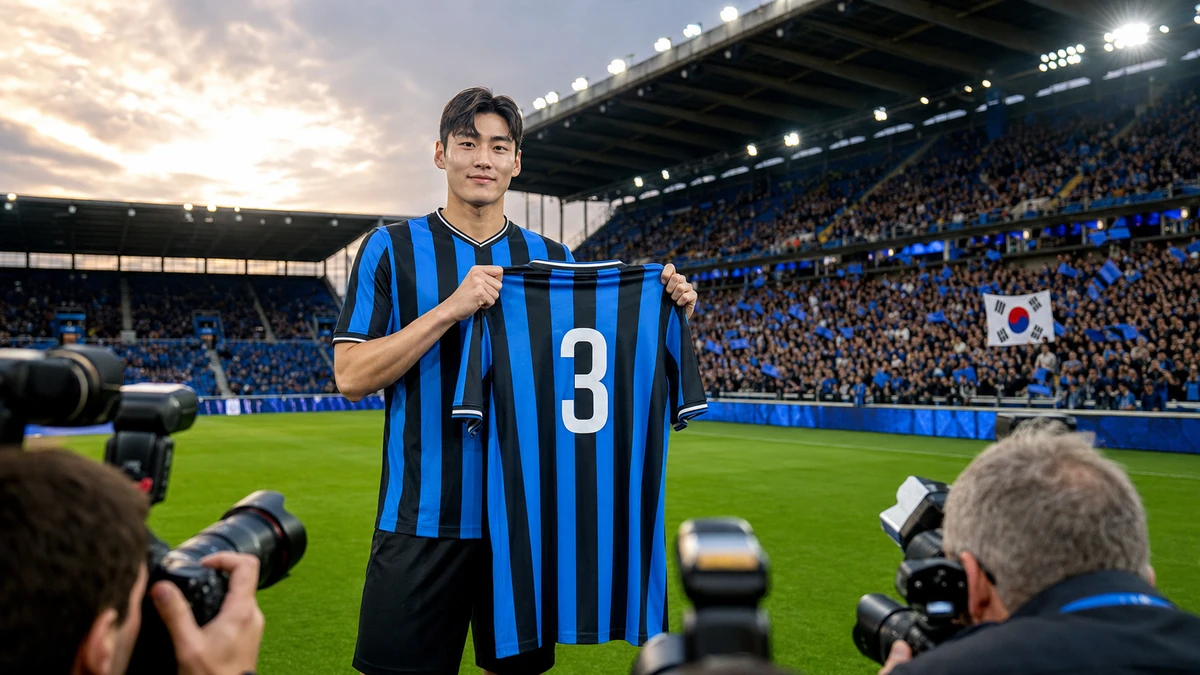
Lee, 24, leaves Danish club Midtjylland for Brugge on a deal reportedly worth 10.5 million euros, or roughly $11.4 million at current exchange rates. Korean reports, citing European media, said he signed through 2029 and will wear the No. 3 shirt, a number traditionally associated with central defenders and one that often carries a certain symbolic weight in the sport. For American readers more familiar with NFL jersey-number traditions or the prestige attached to a baseball franchise handing a prized number to a newcomer, the assignment is not a guarantee of status, but it is a signal that the club sees Lee in a role closely tied to its defensive identity.
The headline number matters. When Lee left FC Seoul, one of the better-known clubs in South Korea’s top-flight K League 1, for Midtjylland, the reported fee was 1.5 million euros. The jump from 1.5 million to 10.5 million euros represents a sevenfold rise in value in a relatively short period. Transfer fees are not a pure measurement of talent. They reflect age, contract length, team need, market inflation, resale potential and timing. But even with those caveats, the increase is striking. It suggests Lee did more than simply survive his first European stop. He became a player another ambitious club was willing to invest in for the medium term.
That distinction matters because not every move abroad is equal. In South Korea, as in many soccer-producing countries, fans often celebrate a player heading to Europe as an achievement in itself. But the harder part comes next: staying, adapting, earning minutes and then taking another step up. Lee’s transfer is important not only because he is changing clubs, but because he is moving from a smaller stepping-stone league to one of Belgium’s signature institutions, a team expected to contend for titles and appear regularly in European competition.
For American audiences used to seeing international soccer careers mapped through a series of increasingly competitive leagues, Lee’s path may feel familiar. Think of a talented college player who earns a chance in a developmental environment, improves quickly and then gets picked up by a franchise that expects to win right away. The analogy is imperfect because the global transfer market functions very differently from American sports, but the principle is similar: development is one thing, proving you belong at a higher rung is another.
Why Club Brugge is a meaningful destination
Club Brugge is not just another Belgian team. It is one of the country’s historic clubs, with a trophy case and expectations to match. The team has won the Belgian league 20 times, according to the Korean summary of the move, and has long been part of the country’s traditional soccer elite. Only Anderlecht has more domestic league titles. In practical terms, that means Lee is not arriving at a club content to finish in the middle of the table and develop players quietly. He is joining an organization where every defensive mistake is magnified because the expectation is to win.
That pressure is especially acute for a central defender. Forwards can go quiet for stretches and still draw praise when they score a late winner. Midfielders can disappear into the rhythm of a game and still be judged by their passing range or work rate. Center backs are often judged in harsher terms. One missed clearance, one lost aerial duel, one misread through ball can define a night. If a striker fails three times and scores once, he may be the hero. If a defender is solid for 89 minutes and slips once, he may shoulder the blame.
That is part of why the size of Brugge’s investment stands out. Spending more than 10 million euros on a 24-year-old Korean center back is not a casual experiment. It reflects a belief that Lee can help immediately while still offering room to grow. The length of the deal reinforces that point. A contract through 2029 tells observers Brugge is not treating him like a short-term patch or squad filler. The club appears to see him as a player worth integrating into its system over several seasons.
In Europe’s transfer economy, Belgium occupies an intriguing middle space. It is not the Premier League, La Liga or the Bundesliga in terms of global reach or spending power. But it has become a highly respected proving ground, a league where clubs scout aggressively, develop talent and sell onward. For players from outside Europe, it can be a place where technical quality and tactical demands are high enough to sharpen a career, while the spotlight is manageable compared with the all-consuming scrutiny at the continent’s richest clubs.
That is one reason this move will draw attention beyond Korea. Brugge is a club with history, pressure and visibility. If Lee succeeds there, he will not simply be another Korean player abroad. He will become part of a larger story about how Asian defenders, not just attackers or creative midfielders, are earning more serious evaluations in European recruitment.
From Seoul to Denmark to Belgium
Lee’s trajectory also says something about how Korean players increasingly build careers overseas. He began at FC Seoul, a flagship K League club in the capital city and one of the more recognizable brands in South Korean domestic soccer. For readers unfamiliar with Korea’s soccer landscape, the K League 1 is the country’s top division and has served as the launching pad for a number of national team players. It is competitive, tactically organized and physically demanding, even if it does not carry the week-to-week global profile of Europe’s bigger leagues.
South Korean soccer fans have long lived with a dual reality: deep pride in their domestic league and a strong awareness that Europe remains the benchmark for elite competition and financial reward. That dynamic is not unique to Korea. It resembles the way many basketball fans abroad view the NBA or how baseball stars from Asia and Latin America often measure themselves against Major League Baseball. Domestic success matters, but a move abroad is often seen as the test that can elevate a player into a different bracket of recognition.
Lee’s first European stop, Midtjylland in Denmark, fit a familiar pattern. Denmark’s league does not command the global attention of England, Spain or Italy, but it has become a valuable bridge for emerging players. Clubs there are known for modern scouting, structured development and a willingness to trust younger talent. For a player arriving from Korea, it can offer a more realistic runway than leaping directly into one of Europe’s wealthiest leagues.
The transfer to Brugge suggests Lee used that runway well. A sevenfold rise in fee does not happen by accident. It usually means a player improved, adapted and convinced evaluators that his upside justified a larger investment. In Lee’s case, that is particularly noteworthy because he plays a position that can be harder to market. Goal scorers generate highlight reels. Wingers bring viral clips. Center backs build value in subtler ways: anticipation, positioning, timing, aerial command, calm in possession and the ability to handle pressure.
That quieter skill set can make a defender’s rise less visible to casual fans, especially outside the countries closely following him. Yet clubs pay attention to those details because strong teams need reliable central defenders as badly as they need scorers. If a forward is the flashy purchase that sells jerseys, a center back is often the investment that stabilizes seasons. Brugge’s fee suggests Lee has moved into that category of player who is evaluated not just for potential but for how he can anchor a project.
What this means for Korean soccer
In South Korea, this transfer is likely to be read as more than a personal milestone. It is another data point in the evolution of Korean soccer’s export pipeline, and an especially interesting one because Lee is a defender. Korean players who have drawn the most global attention in recent years have often been attackers or attack-minded midfielders. Son Heung-min, of course, remains the defining example, a global star whose success at Tottenham Hotspur has made him one of the most recognizable Asian athletes in the world. Hwang Hee-chan has built a profile in England. Lee Kang-in has become a high-profile creative talent. Those players shape perception.
Defenders, by contrast, tend to receive less international attention unless they reach the very top of the sport. That is why Lee’s move matters. It helps broaden the image of what kind of Korean player European clubs are willing to buy, develop and trust. The Korean summary of the story notes that Belgium is not unfamiliar territory for South Korean players. Earlier generations, including Seol Ki-hyeon, and more recent names such as Hong Hyun-seok and Oh Hyeon-gyu have been tied to the Belgian route before moving on. But Lee is carving out a version of that pathway from central defense, which gives the move added significance.
That matters at home, where fans and development systems pay close attention to precedent. Every successful overseas transfer creates a template. Young players, agents, clubs and families all study those templates. They ask which leagues offer the best first move, which clubs provide playing time, and which positions are most portable. When a Korean center back commands an eight-figure euro fee from one European club to another, it becomes easier for people inside the game to imagine similar careers for future defenders.
There is also a national team angle. Korea has long been respected for organization, endurance and tactical discipline, qualities often associated with its midfielders and fullbacks. But sustained international success requires depth across the spine of the team, including central defense. A defender playing in a title-chasing European environment can be valuable not only because of the minutes he logs, but because of the decision-making and poise he acquires under pressure. Those qualities can translate to World Cup qualifying and other international competitions, where margins are thin and one defensive lapse can decide a result.
For Korean fans, then, Lee’s move is part aspiration, part validation. It suggests that a player developed domestically can leave the K League, handle the adjustment to Europe, and then be revalued upward in a meaningful way. In a soccer culture that takes pride in both local development and international competitiveness, that is exactly the kind of arc supporters like to see.
The cultural context behind the excitement
To understand why a transfer like this generates excitement in South Korea, it helps to understand the broader place of overseas achievement in Korean sports culture. Korea’s domestic leagues are deeply followed, but there is also enormous prestige attached to succeeding on major international stages. That impulse is visible across sports, from baseball players heading to MLB to golfers winning on the LPGA Tour to soccer players making names for themselves in Europe. Overseas success is often framed not just as an individual accomplishment, but as evidence that Korean training, discipline and talent can stand up in the world’s most competitive arenas.
That outlook is reinforced by the country’s modern sports history. South Korea’s run to the World Cup semifinals in 2002 remains a touchstone, one of the most important moments in the country’s modern sporting identity. In the years since, Korean soccer has produced star individuals, but the idea of building credibility at the highest levels of the European club game still resonates strongly. Fans do not simply want to see players go abroad; they want to see them matter once they get there.
There is also a practical component. European leagues remain the most influential job market in global soccer. If a player proves himself there, the effect ripples outward. His market value rises. His profile with the national team grows. Young prospects back home receive more attention from scouts. Even domestic clubs can benefit when successful transfers create larger fees and stronger reputations for player development.
That is why the reported 10.5 million-euro figure has become such a central part of the story. In the United States, fans might latch onto a contract number in free agency as shorthand for how a player is viewed around the league. In global soccer, the transfer fee often plays a similar role. It is not the whole story, but it is a public signal of belief. For Korean supporters, the fact that Lee’s fee reportedly jumped seven times from his FC Seoul exit to his Brugge arrival offers concrete evidence that his stock rose in Europe, not just in theory but in the market itself.
And then there is the shirt number. The No. 3 shirt, while not mystical, has a long association with defenders. In a sport where symbolism still matters to many fans, that detail adds texture. It suggests a player is not just passing through but being handed a number that fits the role he is expected to play. For supporters, those cues matter. They help transform a transaction into a narrative.
The challenge ahead
Still, a transfer fee is only the opening chapter. The harder part begins now. Brugge’s history means patience will not be unlimited. Lee will be judged by how quickly he adapts to the speed of the league, the physical demands of duels, the tactical expectations of a winning side and the mental burden of defending for a club expected to take initiative in most matches.
There are practical hurdles too. Every move across borders in European soccer brings layers of adjustment: language, coaching style, dressing-room culture and the subtle differences in how leagues are officiated and played. A defender has to build chemistry with teammates, especially his center-back partner and goalkeeper. He has to learn when to step, when to hold, how aggressively to defend crosses and how the team wants to build from the back. These are not glamorous storylines, but they often determine whether an expensive move becomes a success.
For Lee, age works in his favor. At 24, he is young enough to keep improving but old enough that clubs expect more than abstract potential. Brugge is likely buying both the present and the future: a player who can contribute now and still develop into something more valuable later. That dual expectation can be demanding, but it is also the reason the move is so significant. Lee is no longer merely a prospect trying Europe on for size. He is entering a phase where his performances will be weighed against real competitive ambitions.
If he handles the jump, the implications could be larger than one season in Belgium. Strong performances at Brugge can attract interest from bigger leagues, boost his standing with the South Korean national team and deepen Europe’s confidence in recruiting Korean defenders. If the move proves difficult, it will serve as a reminder of how unforgiving the ladder can be. Either way, the stakes are real.
For now, though, the transfer stands as one of the more intriguing Korean soccer stories of the moment. It captures the modern path of a player whose reputation has grown not through hype alone, but through a measurable rise in market value and a carefully escalated European career. From FC Seoul to Midtjylland to Club Brugge, Lee Han-beom’s route reflects the increasingly global, increasingly interconnected journey of Korean talent.
And for American readers who may know South Korean soccer mostly through marquee names like Son, Lee’s move is a useful reminder that the country’s influence in the sport runs deeper than its stars. Sometimes the clearest sign of a soccer nation’s maturity is not one celebrity forward but a 24-year-old center back commanding a multimillion-euro fee on the strength of steady development, tactical trust and the belief that he can help a storied club win now.
Comments
Post a Comment