
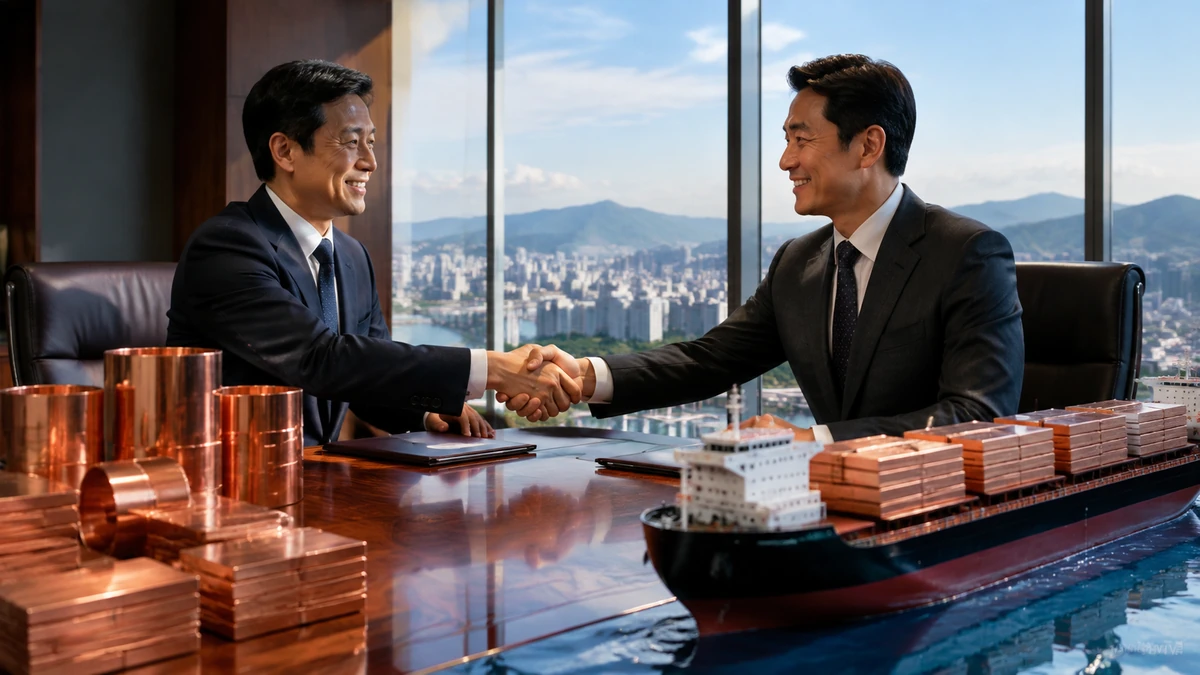
Image to help understand the article
South Korea turns to finance to lock in a metal that modern industry cannot live without
South Korea’s state-run Export-Import Bank of Korea has committed $1 billion in financing to the global commodities giant Glencore, a move designed to help ensure a steady supply of copper for Korean companies at a moment when governments and manufacturers around the world are treating industrial metals less like ordinary commodities and more like strategic assets.
On its face, the deal looks technical: a policy bank extends operating funds to a Swiss-based resource company with the understanding that Korean firms will receive stable copper supplies during the loan period. But the broader significance is easier to grasp in American terms. Imagine a government-backed lender helping secure access to a critical input for U.S. automakers, electric utilities, chip producers and defense contractors, not by buying mines outright, but by using capital as leverage in a tightening global supply chain. That is essentially what Seoul is doing.
The move reflects a larger shift in how industrial powers think about economic security. For years, supply-chain strategy in advanced economies focused heavily on finished goods: semiconductors, batteries, autos, pharmaceuticals. Increasingly, the focus has moved upstream, toward the raw materials that make those products possible. Copper sits near the center of that conversation because it is essential to electric vehicles, power grids, data centers, consumer electronics and industrial machinery. If semiconductors are the brains of the modern economy, copper is part of the wiring and circulatory system.
South Korea is especially exposed to that reality. It is a manufacturing powerhouse with globally competitive companies in electronics, batteries, automobiles, shipbuilding and heavy industry, but it lacks the natural resource base to feed all of that production at home. That has long forced Korean policymakers and companies to think internationally about energy and materials security. In recent years, as trade tensions, wars, inflation and geopolitical rivalry have made supply disruptions feel less theoretical, those concerns have become more urgent.
The financing for Glencore, according to the Korean account of the arrangement, is meant not simply to support a large multinational resource company, but to create the conditions for stable copper shipments to Korean firms over the life of the loan. In other words, Seoul is using financial policy to reduce industrial vulnerability. It is a reminder that in the current global economy, supply chains are no longer just logistics networks. They are arenas of statecraft.
Why copper matters so much now
Copper does not always command the same public attention as oil, rare earths or advanced chips, but it has become one of the most consequential materials in the world economy. Its conductivity, durability and versatility make it indispensable for electrification. Electric vehicles require more copper than conventional internal-combustion cars. Renewable energy systems rely on it. Expanding transmission infrastructure depends on it. So do telecom equipment, household appliances and the server farms powering the artificial intelligence boom.
That matters because many of the industries expected to define the next decade are copper-intensive. Every country pursuing cleaner energy, more resilient grids and more domestic manufacturing is effectively increasing its demand for the same metal. The result is a growing tension between long-term demand expectations and the practical difficulty of bringing new supply online. Mining projects take years to finance, permit, build and operate. Smelting and refining capacity is also geographically concentrated and capital-intensive. Even when markets are functioning normally, supply can be vulnerable to labor disputes, political instability, environmental restrictions and transport bottlenecks.
For export-driven economies like South Korea, that combination creates a strategic problem. Korean companies can be world leaders in making batteries, EV components, electronics or industrial systems, but they cannot manufacture around a missing input. Stable access to copper becomes part of national competitiveness. That is why a financing arrangement that might once have been seen as routine now carries geopolitical and industrial significance.
The logic is familiar to Americans who have watched Washington adopt a more interventionist approach to semiconductors, batteries and clean-energy manufacturing. In the United States, the Biden administration’s industrial policy, including the CHIPS and Science Act and clean-energy incentives, helped normalize the idea that governments should actively shape supply chains in sectors considered vital. South Korea has been moving in a similar direction, though with tools adapted to its own system, including policy banks and export-credit institutions.
Copper also occupies a distinct place in the critical minerals conversation because it straddles old and new industry. Lithium, cobalt and rare earths are often discussed as future-facing materials, tied to battery technology and high-tech manufacturing. Copper is both foundational and futuristic. It is just as necessary for a traditional factory as for an EV charging network or a next-generation grid. That gives it unusual strategic weight: shortages or price volatility can ripple across the entire industrial base.
What Seoul’s Glencore deal says about the new rules of industrial competition
The most revealing aspect of South Korea’s move may be the instrument it chose. The Export-Import Bank of Korea is not merely functioning as a passive lender. It is acting as a strategic arm of industrial policy, using finance to support access to raw materials that Korean manufacturers need. That approach signals how the boundaries between trade policy, banking and national competitiveness are blurring.
In earlier eras of globalization, the dominant assumption was that open markets and diversified sourcing would, over time, deliver efficiency and stability. Companies optimized for cost, kept inventories lean and trusted global markets to supply what they needed. The shocks of the past several years have weakened that confidence. The pandemic exposed vulnerabilities in just-in-time production. Russia’s invasion of Ukraine showed how war can scramble commodity markets. U.S.-China tensions demonstrated that strategic competition can affect technology and trade flows far beyond the battlefield. Red Sea disruptions and other transport shocks reinforced that fragility.
Against that backdrop, governments are reconsidering what counts as prudent economic management. South Korea’s financing for Glencore fits a pattern in which states no longer wait for private markets to solve strategic bottlenecks. Instead, they try to shape outcomes directly, whether through subsidies, export controls, public lending, stockpiling or targeted partnerships with major suppliers.
That does not mean Seoul is abandoning markets. Glencore remains a private global resource company with operations across multiple minerals including copper, zinc and nickel. But the arrangement suggests that access to supply can be strengthened through structured relationships, not just spot-market purchases. For Korean firms, that may reduce some uncertainty in procurement planning. For the Korean government, it creates a tool to support industrial resilience without building a full state-led resource system.
It also speaks to a broader reality about competition among advanced manufacturing economies. Countries are not only competing to invent better chips, batteries and vehicles. They are competing to secure the inputs that make those products possible. In that environment, a policy bank loan can matter nearly as much as a new factory announcement because one determines whether the other can run at full capacity.
There is also an important symbolic message. By stepping into the supply-chain conversation at this scale, Seoul is signaling that raw-material security belongs at the center of economic policy. That is likely to resonate with Korean firms that have spent years managing price swings, shipping delays and geopolitical uncertainty across global markets.
What this means for the United States
For American readers, the South Korean move is worth watching not because it directly changes U.S. copper supplies, but because it highlights the kind of competition now unfolding among U.S. allies and industrial peers. The United States and South Korea are close security partners, major trading partners and increasingly important collaborators in advanced manufacturing. Korean companies are deeply embedded in the American economy, especially in autos, batteries, electronics and clean-energy supply chains. When Seoul moves to strengthen access to a key industrial metal, the effects can ripple into sectors that matter in the United States as well.
That is especially true because Korean firms have become more visible players in U.S. manufacturing. Companies such as Hyundai, Kia, LG Energy Solution, Samsung and SK have expanded or announced major investments in the United States, from EV and battery plants to semiconductor facilities. Those investments are often discussed in terms of jobs, technology and industrial policy. Less visible, but just as important, is the raw-material pipeline behind them. A battery plant in Georgia, a chip facility in Texas or an EV assembly operation in the Southeast cannot function competitively if upstream metals become scarce, delayed or prohibitively expensive.
In that sense, South Korea’s copper strategy aligns with a central U.S. concern: how to build resilient domestic and allied production networks without controlling every stage of the supply chain at home. Washington has pushed “friend-shoring,” the idea that critical production should be concentrated among trusted partners rather than geopolitical rivals. South Korea is one of the clearest examples of that model in action. If Seoul can better secure copper for its industrial base, some of the benefits may indirectly support allied manufacturing ecosystems that include the United States.
There is also a competitive lesson here for American policymakers and companies. U.S. debate over critical minerals often focuses on opening mines, reforming permitting or reducing dependence on China. Those are important issues, but South Korea’s approach underscores another method: using financial institutions to lock in relationships with global suppliers. For Americans, a rough comparison might be the role the U.S. Export-Import Bank, the Development Finance Corporation or other public financing tools can play in advancing strategic economic interests abroad. The details differ, but the core idea is similar. Capital can be a supply-chain instrument.
American companies and investors may also recognize a familiar tension in the Glencore angle itself. Glencore is not a niche player. It is one of the world’s major commodity traders and producers, with a global footprint that makes it a natural partner for countries seeking scale and reliability. In the U.S. context, this resembles the way major industrial consumers seek long-term offtake agreements or financing ties with large resource suppliers when markets tighten. The difference is that in South Korea’s case, a state-backed lender is helping structure the relationship in service of national industrial strategy.
For U.S.-Korea relations, the move reinforces a larger trend: the alliance is no longer defined only by defense and diplomacy. It increasingly involves coordination across semiconductors, batteries, clean energy and strategic materials. As Washington and Seoul try to reduce vulnerabilities in critical supply chains, expect more policies that look less like old-fashioned free trade and more like managed resilience among allies.
A familiar Korean playbook: strategic vulnerability, export dependence and state support
To understand why this matters in Seoul, it helps to understand a recurring feature of the South Korean economy. South Korea became an industrial powerhouse despite limited natural resources, a divided peninsula and heavy dependence on global trade. That history produced a policymaking culture that is acutely sensitive to external shocks. Korean leaders know that a disruption in shipping lanes, commodity supplies or foreign demand can quickly hit an economy built on manufacturing and exports.
That sensitivity has long shaped Korean industrial strategy. The country’s rise was powered not only by private-sector giants, often called chaebol, but also by coordinated state support through finance, trade promotion and targeted industrial policy. For American readers unfamiliar with the term, chaebol refers to the large, family-influenced conglomerates such as Samsung, Hyundai and SK that have played an outsized role in South Korea’s economic development. Their global scale gives South Korea clout, but it also means the country has strong incentives to protect the production networks those firms depend on.
In that light, the Export-Import Bank of Korea’s financing for Glencore is not an outlier. It fits a longstanding Korean habit of using public or quasi-public institutions to reinforce private-sector competitiveness in strategically important areas. What is changing is the target. In earlier decades, support often focused on export expansion, shipbuilding, steel, heavy industry or overseas market entry. Now the emphasis increasingly includes supply-chain resilience, critical minerals and upstream access to raw materials.
That evolution mirrors a broader change in what governments consider economically strategic. It is no longer enough to have world-class factories and engineers. Policymakers also worry about the mine, the smelter, the shipping route and the financing terms behind the product. A Korean battery may be assembled with high-end manufacturing expertise, but if the needed materials are unavailable, that expertise does not create output on its own.
For South Korea, the challenge is intensified by geography and industrial concentration. It cannot simply assume domestic self-sufficiency in key minerals. Instead, it must build webs of trust, contracts and financing across borders. A deal like this one with Glencore is part of that web: a pragmatic response to the reality that strategic autonomy, for resource-poor manufacturing economies, often means securing dependable interdependence rather than chasing impossible self-reliance.
The benefits, and the limits, of using finance as a supply-chain shield
There are clear advantages to South Korea’s approach. Financing can be deployed faster than building new mines. It can support relationships with established suppliers that already have operational scale. It can also offer flexibility, allowing governments to target vulnerabilities without creating wholly new bureaucracies or national champions in resource extraction. For industries that need dependable volumes of copper now, that matters.
At the same time, financing is not a magic solution. Copper markets remain exposed to global price swings, political instability in producing regions, labor disputes, weather disruptions and shifting regulatory conditions. A supply relationship may improve reliability, but it cannot erase the structural volatility of commodity markets. If demand surges faster than global output, even favored buyers may face tighter conditions.
There are also broader questions about how far governments should go in shaping commercial relationships. Supporters would argue that strategic industries require strategic tools, especially in a world where rivals are already intervening aggressively. Critics may worry about market distortion, favoritism or public exposure to commodity-sector risks. Those debates are not unique to South Korea. Americans have had them over everything from semiconductor subsidies to clean-energy tax credits and defense procurement.
Another limit is that stable access to one material does not solve the full supply-chain equation. Copper is crucial, but modern manufacturing depends on a wide range of other inputs, from nickel and lithium to specialized gases and processing equipment. A resilient industrial strategy requires a portfolio approach rather than a single headline deal. South Korea’s agreement with Glencore may be significant, but it is best understood as one move in a larger contest over industrial preparedness.
That larger contest will likely become more visible as countries pursue electrification and digital expansion simultaneously. Building EVs, data centers, renewable energy systems and modernized power infrastructure all at once means more pressure on metals supply. In that setting, expect more governments to imitate elements of this approach, combining public finance, diplomatic outreach and commercial partnerships to secure upstream resources.
What to watch next in Korea, the U.S. and the wider minerals race
The immediate takeaway from South Korea’s $1 billion financing for Glencore is straightforward: Seoul is trying to improve supply security for a metal that underpins much of its industrial economy. The bigger story is that this is likely not the last such move, either from South Korea or from other advanced economies trying to protect manufacturing strength in a more fragmented world.
One question to watch is whether this financing model expands beyond copper. Glencore produces other industrial minerals, including zinc and nickel, both of which are relevant to sectors where Korean companies are active. If the current arrangement is seen as effective, it could encourage similar strategies tied to other raw materials that carry strategic weight.
Another question is whether allied countries, including the United States, deepen coordination around raw-material access rather than simply competing for bilateral deals. In theory, Washington and Seoul share an interest in more resilient non-adversarial supply chains. In practice, industrial policy often creates tensions among friends as well as rivals, especially when subsidies, local-content rules and procurement priorities collide. The next phase of U.S.-Korea economic cooperation may depend on whether both governments can align national strategy with allied coordination.
It is also worth watching how companies respond. If manufacturers see greater value in finance-backed resource relationships, they may push for more government involvement in securing inputs, not less. That would mark a deeper departure from the era when firms largely treated commodity procurement as a commercial function rather than a policy matter.
For American readers, the South Korean move offers a useful lens on where the global economy is headed. The race for industrial leadership is no longer just about who designs the best products or builds the most advanced factories. It is also about who can keep those factories supplied, affordably and consistently, in an age of geopolitical stress. Copper may not inspire the same headlines as artificial intelligence or cutting-edge chips, but without it, many of the technologies shaping the future do not scale.
That is why a seemingly dry financing announcement from Seoul deserves attention far beyond Korea. It is a case study in how governments are rewriting the rules of economic security: not by retreating from globalization altogether, but by trying to engineer sturdier terms within it. For South Korea, that means using a state-backed bank to shore up a vital industrial input. For the United States, it is another reminder that allies are adapting quickly to a world in which supply chains have become strategy, and strategy increasingly depends on who controls the flow of essential materials.


0 Comments