Image to help understand the article
From headline numbers to actual construction
South Korea’s presidential office is making a notable shift in how it talks about housing: not just how many homes can be planned, proposed or announced, but how many can actually break ground while the current administration is still in office.
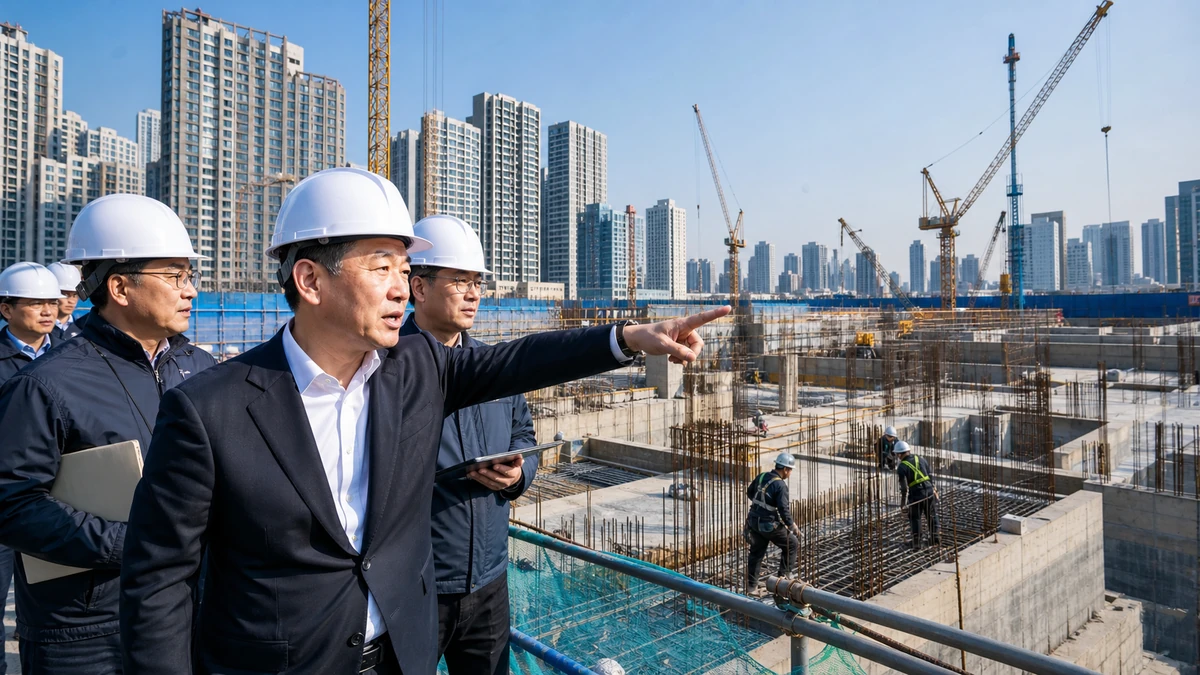
Ha Joon-kyung, a senior presidential adviser on economic growth, said this week that if the government’s previously announced housing programs are combined, roughly 1.5 million homes could begin construction during the administration’s term. In South Korea’s policy language, that matters. Governments in Seoul, like governments in many crowded and expensive global cities, have often drawn attention to big supply targets. But the phrase that stands out here is “start construction.” That is a more concrete benchmark, one that suggests the government wants to be judged less on blueprints and more on whether cranes actually go up.
For American readers, the distinction is familiar. In the United States, local officials often tout housing units that are “approved,” “entitled” or “in the pipeline.” But anyone who follows housing debates in places like Los Angeles, New York, San Francisco or Washington knows those labels can obscure a long, uncertain path between announcement and occupancy. Financing can collapse. Zoning disputes can drag on. Neighborhood opposition can intensify. Environmental reviews can stretch for years. A unit that exists on paper is not the same thing as a unit under construction, and a unit under construction is not the same thing as a home a family can move into.
That is why Ha’s framing is significant beyond a one-day political talking point. It suggests the South Korean government is trying to shift the center of gravity in housing policy away from raw headline totals and toward execution. In a country where housing costs are deeply tied to household finances, consumer sentiment, construction investment and even political legitimacy, that is not a minor rhetorical adjustment. It is an attempt to tell the market that the state wants to accelerate the point at which promised supply becomes visible and credible.
The government has said that out of a newly announced 230,000-home package, about 120,000 homes plus additional units could move relatively quickly into construction. Ha tied that to larger housing plans unveiled last September and again in late January, producing the estimate of about 1.5 million starts during the current term. The number itself is large, but its economic meaning depends on what comes next: permits, land-use decisions, negotiations between agencies, and cooperation from local governments that do not always share the central government’s priorities.
In that sense, South Korea is confronting the same hard truth facing many advanced economies: the housing crisis is no longer mainly about whether policymakers know supply is needed. It is about whether institutions can deliver it fast enough to matter.
Why “housing starts” matter in South Korea’s economy
Housing occupies a uniquely powerful place in South Korean life. Home prices are not just a real estate issue; they sit at the intersection of class mobility, marriage, child-rearing, retirement security and regional inequality. In Seoul and its surrounding metro area, where a large share of the country’s population and economic activity is concentrated, the cost of housing has become one of the clearest markers of social pressure.
That pressure is amplified by Korea’s urban geography. Seoul is one of the world’s densest major cities, and developable land in prime areas is scarce. Unlike in many American metro areas where suburban sprawl can, at least in theory, stretch outward, the Seoul region faces tighter physical and political constraints. Public transit is excellent, demand for central access is intense, and the economic pull of the capital remains overwhelming. As a result, land-use decisions carry unusually high stakes.
That helps explain why the administration is framing housing supply as a broader economic policy, not just a real estate measure. More construction can affect household housing costs, developer activity, land values, lending conditions and confidence in the financial system. If buyers and renters believe future supply is real, that can influence price expectations today. If they believe announcements are mostly symbolic, the effect is weaker.
There is also a credibility issue. In housing policy, markets often react less to the size of a target than to the likelihood of delivery. That is true in Seoul just as it is in Boston or Austin. A promise of 1.5 million starts can reassure households only if the administrative machinery behind it appears capable of turning state-owned land, approvals and local agreements into active projects. A mismatch between national ambition and on-the-ground execution can have the opposite effect, reinforcing skepticism that politicians use large numbers to buy time while supply bottlenecks remain unresolved.
South Korea’s housing market has also long been shaped by a mix of supply measures and tax policy, which often send intertwined signals. If the government wants households and investors to believe that a more stable market is ahead, it cannot rely on construction plans alone. It also has to offer a coherent explanation of how taxes, holding costs, exemptions and ownership rules fit together. Otherwise, the market may treat policy as inconsistent, encouraging delay rather than long-term decisions.
That is one reason Ha’s comments resonate beyond a technical discussion of starts. They imply that the government understands a deeper problem: confidence in housing policy depends not just on announcing a lot of units, but on convincing the public that the state can coordinate the many institutions standing between a press conference and a finished apartment building.
The Yongsan question: Parkland, public space and the price of urban land
The most politically and symbolically loaded part of the discussion may be Ha’s suggestion that South Korea should at least debate whether parts of Yongsan Park in central Seoul could be used for housing. He did not say a housing project there had been decided. He said the site is large, located in the heart of the city and worth discussing in light of housing needs.
For readers in the United States, Yongsan requires some context. The area has long carried strategic and historical weight because of the former U.S. military presence there. The broader Yongsan Park vision has been tied to the idea of converting a rare expanse of central land into a major public space, somewhat comparable in political symbolism, if not exact scale or history, to debates Americans might recognize around preserving parkland, redeveloping former federal land or rethinking underused urban assets in high-cost cities.
That is why the issue is so sensitive. In a city starved for space, an open tract in the center is not just a parcel on a planner’s map. It is a statement about what urban land is for. Should scarce central land serve as public green space, a civic amenity and ecological asset? Or should some of it be mobilized to address the acute shortage of housing? In practice, governments often try to balance those values. Politically, however, they can come into direct conflict.
Seoul Mayor Oh Se-hoon opposes using the site for housing, underscoring a larger tension between central government urgency and city-level control over urban planning priorities. That tension is familiar in the United States as well. Federal, state and city officials often agree in principle that more housing is needed, yet clash over where it should go, who decides, and what tradeoffs are acceptable. A vacant or underused site can be interpreted in radically different ways depending on whether the priority is environmental quality, neighborhood character, public access or housing affordability.
What makes the Yongsan discussion important is not that a final plan exists. It is that South Korea’s housing debate has advanced to a stage where even highly symbolic urban land is being pulled into the conversation. That tells us something about the severity of the pressure. When governments start revisiting land that had been associated with park space, heritage or public use, they are signaling that the housing shortage is pressing enough to reopen questions once considered settled.
Still, there are risks in framing the issue too narrowly. Economists can argue that leaving central land undeveloped imposes an opportunity cost in a city with expensive housing. That is true. But public space also has long-term social and health value that markets do not always price cleanly. Once green or civic land is converted, it is rarely easy to recover. For that reason, the Yongsan debate is best understood not as a simple choice between homes and parks, but as a test of whether Seoul can define the public interest broadly enough to include both livability and housing access.
What the backlash in Gwacheon reveals about the limits of speed
If Yongsan represents the symbolic politics of land, the city of Gwacheon illustrates the procedural and institutional obstacles that can slow even determined housing campaigns. The central government announced plans to supply about 9,800 homes on land including the Gwacheon horse racing park and a military counterintelligence site. Gwacheon officials quickly criticized the plan as a one-way decision and called for a full review.
The dispute is a reminder that identifying land is not the same as securing consent. Major housing projects require more than state authority over maps and numbers. They also require negotiations over existing land uses, transportation, infrastructure, school capacity, environmental effects and the daily lives of nearby residents. Local governments are often the arena where those conflicts become concrete.
Again, the comparison to the United States is straightforward. In American housing politics, there is a well-known gap between national or statewide pro-housing rhetoric and local resistance to specific projects. Governors, mayors and federal officials may all call for more supply in the abstract. But when the question becomes whether a racetrack, parking lot, industrial site, former military property or low-density neighborhood should be redeveloped, consensus quickly frays. The Korean case shows a similar dynamic: speed from the center can provoke pushback at the local level if consultation is perceived as insufficient.
That does not mean the answer is simply to slow down. South Korea’s housing affordability pressures are too intense for leisurely process alone to solve them. Rather, it suggests that speed must be designed, not merely demanded. If the administration wants the 1.5 million-start benchmark to be credible, it has to reduce the chances that local opposition, agency disputes or late-stage planning conflicts derail projects after they are announced. That requires clarity early: who controls the land, which institutions must sign off, what benefits local communities receive, and how tradeoffs are justified.
There is a lesson here for housing reformers everywhere. The faster governments try to move, the more important procedural legitimacy becomes. A top-down strategy can generate momentum, but it can also generate backlash if people feel plans are being imposed rather than negotiated. In political systems that combine strong central authority with active local stakeholders, execution often hinges on whether governments can convert necessity into consent.
For South Korea, the real test may be whether it can preserve urgency while building enough transparency to avoid repeated political collisions. The success of the housing push will be measured not just by how much land is named, but by how many projects survive the planning process intact.
What this means for the United States
For Americans, this story is worth following not because U.S. buyers are about to shop for apartments in Seoul, but because South Korea is wrestling with a version of the same housing dilemma haunting many U.S. metropolitan areas: abundant demand, limited well-located land, and a widening gap between policy promises and homes that actually get built.
The most relevant lesson for the United States is the focus on construction starts as a measure of credibility. In American housing debates, elected officials frequently cite approvals, rezonings and long-range targets. Those steps matter, but they often fail to reassure households because they do not guarantee delivery. Korea’s shift toward emphasizing starts reflects a more execution-oriented mindset, one that American policymakers may increasingly need to adopt if they want skeptical voters to believe supply efforts are real.
The U.S. also has a direct stake in South Korea’s housing and urban policy through the broader bilateral relationship. South Korea is a major U.S. ally, a critical economic partner and home to globally significant companies in construction, finance, technology and manufacturing. A more stable Korean housing market could shape consumer spending, investment sentiment and urban development patterns in one of Asia’s most important economies. That matters for American firms doing business in Korea and for investors watching the country’s growth prospects.
There is also a subtler cultural and commercial dimension. The Korean Wave, or Hallyu, has familiarized American audiences with Seoul as more than a distant capital. Through K-dramas, K-pop, Korean film and food culture, Americans increasingly see Seoul as a global city with its own style, aspirations and social tensions. Housing, often portrayed in Korean entertainment through cramped studios, aspirational high-rise apartments and sharp class contrasts, has become part of that image. As American audiences consume more Korean media, they are also absorbing a portrait of housing pressure as a defining feature of contemporary urban Korea.
That cultural visibility creates a wider audience for policy developments that might once have seemed too local or technical for American interest. It also invites comparison. The pressure felt by a young professional in Seoul trying to find an affordable place near jobs and transit is not identical to the experience of someone in Brooklyn or Santa Monica, but the emotional and economic logic is recognizable. Delayed family formation, inequality between owners and renters, and political frustration over slow-building systems are no longer niche policy concerns; they are central stories in advanced economies.
Finally, American policymakers and planners should pay attention to the land-use questions Korea is surfacing. Debates over whether rare urban parcels should be preserved as open space, used for public institutions or converted into housing are playing out across the U.S. as well. The Korean case does not offer an easy blueprint, but it does illustrate how housing scarcity can force governments to revisit assumptions about what kinds of land are untouchable. That is likely to become a more common feature of urban politics on both sides of the Pacific.
Taxes, trust and the broader trend to watch
The housing push is unfolding alongside debate in South Korea over property taxes, especially rules affecting very expensive or nonresident-owned homes. Experts at a recent policy forum argued for adjustments, including raising the threshold for what counts as a high-priced home and easing some exceptions for nonresidents. There was also discussion about whether benefits tied to long-term ownership should be partly preserved even if broader tax preferences are reduced.
To outside readers, these may sound like technical details. They are not. Housing supply policy and tax policy function together as a signal system. Supply affects expectations about future availability. Tax rules affect the behavior of current owners, investors and would-be buyers. If one side of the system says more housing is coming but the other side sends confusing or shifting incentives, households may hesitate, waiting for clearer rules before making major financial decisions.
That is why the deeper trend here is not just the 1.5 million figure. It is the effort to restore policy coherence in a market where confidence is fragile. Governments in high-cost cities increasingly understand that housing crises are sustained not only by insufficient supply, but by institutional mistrust. Residents have heard promises before. Investors have seen policy reversals before. Local governments have resisted central directives before. The result is a market in which everyone waits for everyone else.
South Korea appears to be trying to break that pattern by moving the policy conversation closer to observable execution: land identification, faster starts, sharper debate over urban land priorities and a clearer relationship between supply and taxes. Whether it succeeds remains uncertain. The administration still faces the difficult politics of local consent, the symbolic fight over Yongsan, and the complex sequencing needed to turn aggregate targets into real projects.
But the story matters because it reflects a broader global shift. Housing policy is moving from the era of easy diagnosis into the era of difficult delivery. Most major cities already know they need more homes. The unresolved question is whether their political systems can align enough actors to build them, especially in the most contested and valuable parts of the city.
For South Korea, the answer will shape more than the property market. It will influence household stability, intergenerational mobility and confidence in the state’s ability to manage urban change. For the United States, it offers a useful mirror. America’s housing crisis differs in geography, law and scale, but the core challenge is strikingly similar: not how to count demand, but how to turn political agreement that housing is scarce into the physical reality of more doors, more keys and more people able to afford a place to live.
That is why this is more than a Korean domestic policy story. It is a case study in how advanced economies are being forced to rethink the relationship between land, politics and social stability. The governments that matter most in the next decade may be the ones that can move housing policy from promise to construction without losing public trust along the way.
Comments
Post a Comment