
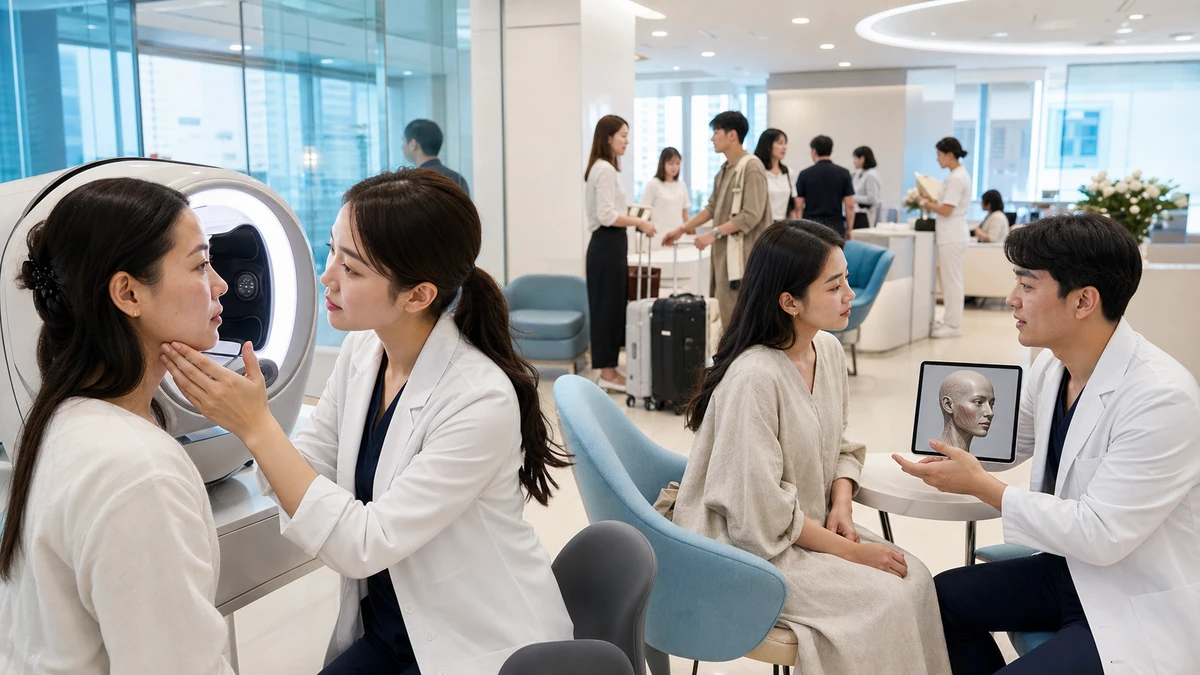
Image to help understand the article
South Korea’s medical tourism boom is getting bigger — and more complicated
South Korea crossed a symbolic threshold last year: More than 2 million foreign patients used Korean medical institutions for the first time, according to a new analysis by the Korea Health Industry Development Institute. The total, 2,011,822, was up 71.9% from a year earlier. On its face, the number confirms what many Americans already associate with modern South Korea: a country that has turned expertise in beauty, technology and high-end consumer services into global demand.
But the story underneath the headline is more nuanced than the familiar image of “K-beauty” or Gangnam plastic surgery clinics. The data show that foreign patients are not all coming for the same reasons, and they are not all choosing the same specialties. Chinese patients most heavily favored dermatology, while Japanese patients most often sought plastic surgery. At the same time, patients from countries including Kazakhstan, Canada and Mongolia were more likely to travel to Korea for serious treatment, including cancer care. Others came for vision correction procedures such as LASIK and LASEK, or for spinal conditions including disk surgery.
That matters because it pushes South Korea’s medical tourism industry into a different category. This is no longer just a niche business built around cosmetic procedures and social media-driven beauty standards, even if that remains a major engine of growth. It is increasingly a hybrid market: part elective, image-conscious consumer service; part high-skill, treatment-focused health destination. In American terms, Korea’s rise in this sector now looks less like a single-industry fad and more like a broad health services export model, one that combines the appeal of Beverly Hills-style aesthetic medicine with the clinical ambition of world-class specialty hospitals.
For years, South Korea has marketed itself as a place where advanced medicine and trend-sensitive beauty culture overlap. The country’s global influence through K-pop, K-dramas and skincare has helped create an ecosystem in which appearance-related medicine is not just normalized but internationally branded. Yet the latest numbers suggest foreign demand is maturing. Some patients are chasing smoother skin or a more refined cosmetic result; others are seeking treatment decisions that involve cancer, surgery, vision or long-term care planning. Those are very different types of medical journeys, with different risks, timelines and expectations.
That distinction is easy to lose when big numbers dominate the conversation. Two million patients sounds like one story. In reality, it is several markets moving at once. South Korea’s challenge now is not only how to keep growing, but how to manage a foreign patient base whose needs range from same-day dermatology appointments to complex, life-altering treatment plans.
Why nationality matters in Korea’s health care marketplace
One of the most revealing findings in the Korean analysis is that preferences differed sharply by nationality. Chinese patients were the biggest users of dermatology. Japanese patients accounted for the largest share in plastic surgery. In nearby Asian markets such as Japan, Taiwan, China, Singapore and Thailand, demand for dermatology and cosmetic surgery was especially high.
That pattern says something important about how South Korea is perceived abroad. “Korean medicine” is not really a single product. It is a bundle of reputations. For some consumers, Korea means advanced skincare, cosmetic precision and trend leadership. For others, it means tertiary hospitals, specialized surgery and confidence in clinical expertise. Those reputations can coexist, but they are not interchangeable.
For Americans unfamiliar with the Korean context, it helps to understand how closely beauty, medicine and consumer culture can intersect in South Korea. Dermatology clinics in Korea often operate in a space that can feel more integrated with mainstream beauty culture than many U.S. consumers might expect. Treatments that Americans might associate with luxury med spas, boutique cosmetic practices or influencer-backed skincare trends can exist in Korea as a more normalized part of urban consumer life. Plastic surgery, too, occupies a different cultural place than it does in much of the United States: still debated, certainly, but also more visibly woven into discussions about style, self-presentation and career competitiveness.
That does not mean Korea is uniquely obsessed with appearance. Americans hardly lack their own cosmetic economy, from Los Angeles injectables to New York dermatology practices to a booming market for elective procedures fueled by Instagram, TikTok and celebrity culture. The difference is that South Korea has been unusually effective at turning that domestic ecosystem into an international export industry. It has done for aesthetic medicine something Hollywood and Silicon Valley have long done for entertainment and tech: made local expertise feel globally aspirational.
Nationality-specific preferences also suggest practical differences. Japanese patients seeking plastic surgery may be responding to convenience, travel proximity, pricing, perceived technical strengths or familiarity with Korean beauty standards spread through media. Chinese patients choosing dermatology may reflect Korea’s long-cultivated prestige in skincare, lasers and noninvasive treatments. None of that can be reduced to a single explanation, but the pattern underscores a larger point: medical tourism follows culture as much as it follows medicine.
In other words, patients are not merely shopping for hospitals. They are shopping for trust, image, social proof and outcomes that make sense in their own cultural and consumer environments. That is especially true in elective medicine, where perception can matter almost as much as clinical credentials. Korea’s industry has grown because it understands that reality better than many competitors.
Beyond beauty: The quieter demand for cancer care, surgery and vision correction
If the cosmetic side of Korea’s foreign patient market is the most visible, the treatment side may be more consequential over time. The Korean report and related comments from health officials indicate that foreign patients seeking care for serious conditions have remained a steady part of the market. Roughly 60,000 to 70,000 patients a year have consistently traveled to Korea for severe illnesses, including cancer treatment.
That number is far smaller than the overall foreign patient total, so beauty-related care still appears to be driving expansion in headline terms. But the presence of a durable treatment segment is significant. It means South Korea is not simply attracting travelers who want elective procedures during a short visit. It is also attracting patients making weightier decisions about where to undergo surgery, manage disease and navigate difficult diagnoses.
That has implications for how the country’s medical tourism sector should be understood. Elective dermatology and cosmetic surgery typically depend on scheduling flexibility, branding, visible before-and-after results and a relatively straightforward service path. Serious illness does not work that way. Cancer treatment, spinal surgery and other complex interventions require continuity of care, clear communication, follow-up planning and confidence in the full treatment process rather than just the procedure itself.
For foreign patients, that raises a very different set of questions. Who coordinates records across borders? What happens after a patient returns home? How are language barriers handled when the stakes are not cosmetic satisfaction but long-term survival or recovery? How do families weigh cost, distance and quality when care is urgent rather than optional?
Those questions are familiar in the United States, where patients routinely navigate fragmented systems even without crossing national borders. Americans who travel domestically for cancer centers, orthopedic procedures or specialty neurology care already know that the best medical destination is not always the nearest one. South Korea is increasingly entering that same competitive logic on an international level: not just as a place for cosmetic upgrades, but as a place some patients believe can offer sophisticated treatment worth traveling for.
The mention of Canadian patients in the Korean analysis is particularly striking. Canada is a wealthy, advanced health care country, but it also faces chronic wait-time pressures in some parts of the system. That does not mean Canadian patients are broadly abandoning domestic care, and the Korean report does not claim that. But even a modest flow of patients from advanced systems suggests Korea’s appeal cannot be explained only by lower costs or tourism packaging. In at least some cases, it is also about access, specialization or patient confidence in certain procedures.
This is where South Korea begins to resemble other major international medical hubs. Countries such as Singapore and Thailand have long competed for regional health travelers, each with different strengths. Korea’s version of that model increasingly looks like a premium blend of cosmetic prestige, technical medicine and dense urban infrastructure. The result is a market that can appeal to both the medically necessary and the highly discretionary — a rare and powerful combination.
What this means for the United States
For Americans, the rise of Korean medical tourism matters on more than a cultural level. It is part of a broader shift in how health care, consumer branding and cross-border services are being globalized. The United States is still home to some of the world’s top hospitals, research centers and medical device companies. But in areas such as elective procedures, dermatology, cosmetic surgery and patient-facing service design, foreign competitors are getting better at building international brands that travel well online.
American audiences have already seen this pattern in other sectors shaped by the Korean Wave, or Hallyu — the global spread of Korean popular culture. Korean skincare products won shelf space in U.S. retailers. Korean entertainment became a mainstream force on Netflix, YouTube and Billboard charts. Korean consumer electronics and autos became household names. Medical services may be harder to export than sheet masks or television dramas, but the same soft-power machinery is clearly helping. When American consumers think of South Korea, many already associate it with beauty innovation, tech sophistication and meticulous service. That is a strong foundation for trust in elective medical offerings.
There are also business implications. U.S. beauty companies, hospital systems, medical travel facilitators and insurers have reason to watch Korea’s rise closely. If Korean providers continue to gain recognition in dermatology, vision correction and specialty procedures, American companies may face growing competition not just in products but in patient loyalty and treatment journeys. The U.S. medical market is enormous, but it is not insulated from global comparison — especially in elective categories where patients are price-sensitive, image-sensitive and willing to travel.
At the same time, Korea’s growth opens doors for collaboration rather than simple rivalry. American medical technology firms, health platforms and pharmaceutical companies could benefit from partnerships with Korean hospitals and clinics serving international patients. There is also room for knowledge-sharing in digital health, concierge patient services and multilingual care management. South Korea’s ability to package medicine as an internationally legible consumer experience may be one of the aspects U.S. providers study most closely.
For U.S.-Korea relations, this trend fits into a larger economic story. The alliance between Washington and Seoul is often discussed in terms of defense, semiconductors, autos and geopolitical strategy. But health services are another form of national competitiveness. When Korea attracts millions of foreign patients, it is exporting expertise, building influence and reinforcing its global brand in ways that complement its political and cultural reach. That matters in a bilateral relationship increasingly defined not only by military ties, but by innovation, trade and people-to-people exchange.
American patients themselves are a more delicate question. The Korean summary does not say Americans make up a major portion of this market, so it would be wrong to suggest a wave of U.S. patients is already heading to Seoul. Still, the underlying conditions that fuel medical travel in the United States — high costs, long waits in some specialties, dissatisfaction with insurer restrictions and a growing comfort with researching treatment options online — are well established. If Korea’s international profile continues to rise, it is not hard to imagine more American consumers considering it for elective procedures or highly specific treatments, particularly if those services can be bundled with transparent pricing and strong post-care coordination.
In that sense, Korea’s health care boom is not only a Korean story. It is also a reminder that the U.S. health sector now operates in a world where medical reputation can be built transnationally, amplified digitally and consumed much like any other premium service. That is a significant shift for American providers used to competing mostly at home.
Big growth, but also a warning sign: Seoul dominates the market
The same Korean data that show rapid growth also point to a structural imbalance. More than 80% of foreign medical spending was concentrated in Seoul, according to the Korea Tourism Organization’s tourism data platform. In July alone, foreign visitors’ medical spending in Korea reached about 213.1 billion won, up 66.5% from a year earlier, and monthly spending above 200 billion won continued for a fifth straight month. The money is rising along with patient volume. But it is flowing overwhelmingly into the capital.
That concentration is not surprising. Seoul is South Korea’s largest city, its transportation hub and the center of much of its elite hospital infrastructure, luxury retail, hospitality and international branding. If a foreign patient is flying in for cosmetic surgery, advanced cancer care or vision correction, Seoul offers convenience and recognition in a way that smaller cities may not.
Still, geographic concentration creates vulnerabilities. It can produce bottlenecks, widen regional disparities and make a national industry look broader than it really is. If the benefits of medical tourism accrue mainly to Seoul, then the sector’s expansion does not automatically translate into a more balanced national health economy. It may simply reinforce the capital’s dominance.
Americans will recognize the pattern. The U.S. also concentrates prestige medicine in a handful of cities and institutions: Boston for academic medicine, Houston for specialty care, Rochester for Mayo, New York and Los Angeles for elite private practices. That can drive excellence, but it can also create unequal access and regional dependence. South Korea appears to be facing a version of the same dilemma. A medical tourism industry can look nationally successful while remaining heavily localized in practice.
This matters because the next phase of growth may depend less on headline numbers than on system design. Can Korea diversify services by region? Can it match patients more effectively with the right specialty rather than the most famous district? Can it support both short-stay cosmetic travelers and longer-term treatment patients without letting one category crowd out the other?
The 2 million mark is impressive, but it does not answer those questions. In fact, it makes them more urgent. The larger and more diverse the foreign patient base becomes, the less useful it is to treat medical tourism as a single market with a single playbook. A patient flying in for a same-week dermatology package is not using the system the same way as someone arriving for oncology care. If policy and marketing fail to recognize that, growth could become harder to sustain.
What to watch next in Korea’s global health strategy
The most important takeaway from the new figures is not simply that South Korea’s medical tourism sector is bigger. It is that it is evolving. The old shorthand — Korea equals cosmetic medicine — is now too narrow. Beauty care remains central, especially for nearby Asian consumers, but the market has widened into something more layered and potentially more resilient.
Several questions will shape what happens next. First, can Korea maintain trust across very different patient categories? Elective cosmetic care thrives on trend leadership and customer experience. Serious treatment depends on transparency, continuity and clinical credibility. Success in one area does not automatically guarantee success in the other.
Second, will Korea’s international patient mix broaden further? The current data highlight sharp differences by nationality, which suggests targeted strategies are already at work. Future growth may depend on whether Korean institutions can build durable reputations in markets that are farther away, less culturally connected or more accustomed to looking to the United States, Singapore or Europe for care.
Third, can Korea sustain the soft-power advantage that helps drive demand? Korean culture has given the country a rare brand halo in beauty and lifestyle. But soft power can be volatile. Trends shift. Consumer trust can be fragile. The challenge for Korea is to convert cultural visibility into institutional credibility that lasts beyond the current popularity of any one wave of entertainment or aesthetics.
For American readers, the broader lesson is that health care is becoming part of the same global competition that has already transformed media, fashion, technology and education. Patients are behaving more like international consumers, even when the product is serious medical care. They compare options online, absorb cultural signals, follow peer recommendations and weigh travel against cost and quality. South Korea has positioned itself effectively at that intersection.
The 2 million-patient milestone, then, is less a finish line than a signpost. It marks South Korea’s arrival as a major international health destination, but it also reveals the complexity of the market it has built: one shaped by beauty demand, clinical specialization, regional concentration and highly differentiated patient motives. For the United States, that is worth watching closely. It says something about Korea’s growing global influence, but it also says something about the future of medicine itself — more branded, more mobile, more consumer-aware and more international than many health systems were designed to handle.
That may be the real story behind the numbers. South Korea is not just treating more foreign patients. It is helping redefine what a medical destination can be in the 21st century.


0 Comments