Image to help understand the article
South Korea Raises Growth Outlook as Semiconductor Industry Drives Recovery
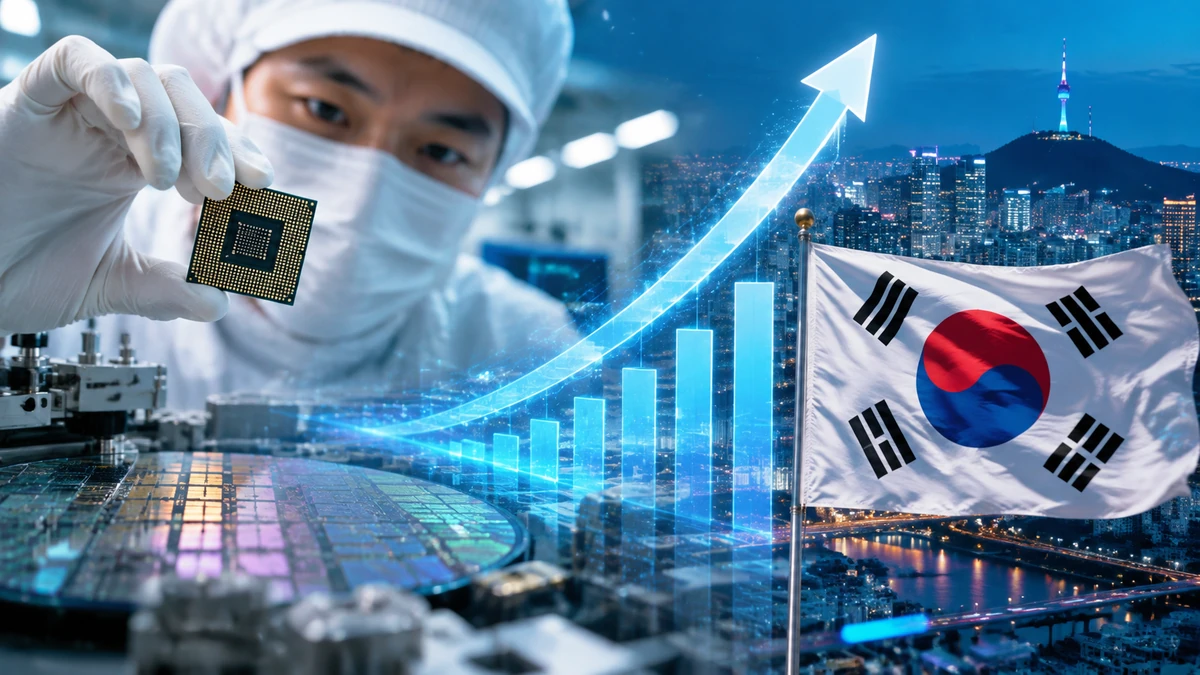
South Korea’s economy is receiving a boost from one of the defining forces of the global technology race: artificial intelligence. The Korea Development Institute (KDI), one of the country’s leading economic research organizations, raised its 2026 economic growth forecast to 3.2%, an increase of 0.7 percentage points from its previous estimate.
The revision reflects a powerful rebound in South Korea’s semiconductor sector, which has become central to the country’s economic performance. KDI said that most of the improvement came from semiconductor-related exports and investment in production facilities, highlighting how the global AI boom is reshaping the outlook for Asia’s fourth-largest economy.
For Americans watching the rapid expansion of artificial intelligence, South Korea’s position may be familiar. Much like the United States’ focus on advanced chips, cloud computing and AI infrastructure, South Korea has built its economic strategy around maintaining a critical role in the technology supply chain. The difference is that semiconductors are not simply one industry among many in South Korea — they are a foundation of national economic competitiveness.
Why AI Demand Is Changing South Korea’s Economic Landscape
The driving force behind the stronger forecast is the worldwide race to build more powerful AI systems. Artificial intelligence applications require enormous computing capacity, creating demand for advanced memory chips and semiconductor manufacturing equipment.
South Korea is home to some of the world’s largest semiconductor companies, including Samsung Electronics and SK hynix, which play major roles in the global memory chip market. These companies supply technologies used in data centers, smartphones, computers and emerging AI systems.
The KDI assessment suggests that the semiconductor industry’s impact extends far beyond export figures. Increased chip production requires factory construction, equipment investment, engineering jobs and a broader network of suppliers. In other words, a rise in semiconductor demand can spread through multiple parts of the economy.
This reflects a broader global trend: advanced manufacturing capacity has become a strategic asset. Governments in the United States, South Korea, Japan and Europe have all increased attention on semiconductor security following supply chain disruptions during the COVID-19 pandemic and growing competition in advanced technologies.
For South Korea, maintaining leadership in chips is closely tied to its economic identity. The country transformed itself from a manufacturing-based developing economy into a global technology powerhouse within several decades. Semiconductor success has become one of the clearest symbols of that transformation.
Growth Numbers Rise, but Many South Koreans May Not Feel the Recovery Yet
Despite the improved growth outlook, KDI also warned that the benefits of the recovery may not immediately reach households. The organization noted that consumer spending and employment conditions are expected to improve more slowly than export-driven industries.
This gap between economic statistics and daily experience is a familiar challenge in many advanced economies. A country can record strong growth because of major corporate investments and international trade while consumers continue to face pressure from living costs, housing expenses or slower wage growth.
South Korea’s economy has long depended heavily on exports, especially from large industrial companies known as “chaebol,” the family-controlled conglomerates that include some of the nation’s biggest corporations. These companies have helped South Korea become globally competitive, but economic policymakers continue to face questions about how growth can be distributed more broadly.
The semiconductor boom illustrates this challenge. A new chip factory can represent billions of dollars in investment and create highly skilled jobs, but the economic benefits may take time to spread to small businesses, service workers and households outside major industrial regions.
As a result, the key question for South Korea is not only whether AI-driven growth continues, but whether that growth creates a wider economic recovery. The country’s next economic phase will depend on connecting advanced manufacturing success with stronger domestic demand.
What South Korea’s Chip Strategy Means for the United States
The semiconductor-driven recovery has direct implications for the United States because American technology companies rely heavily on global chip supply chains. The growth of AI has intensified competition for advanced semiconductor capacity, making partnerships between Washington and Seoul increasingly important.
South Korea and the United States have strengthened cooperation in technology and supply chain resilience as both countries seek stable access to advanced chips. American companies are leaders in AI software, semiconductor design and computing platforms, while South Korean companies have major strengths in semiconductor manufacturing and memory technology.
The relationship reflects a division of expertise across the global technology ecosystem. Companies in Silicon Valley often develop AI models and computing architectures, while Asian manufacturers provide much of the specialized hardware needed to operate those systems at scale.
For American consumers and businesses, South Korea’s semiconductor performance matters because AI growth depends on reliable access to advanced components. From cloud services to electric vehicles and consumer electronics, chips produced through global partnerships influence products and services used every day in the United States.
The South Korean experience also offers lessons for American industrial policy. The United States has been working to expand domestic semiconductor production, but building advanced manufacturing capacity requires significant investment, skilled workers and long-term planning. South Korea’s decades-long semiconductor strategy demonstrates how industrial expertise is developed over time.
A New Phase of Competition in the Global AI Economy
KDI’s forecast reflects more than a short-term economic improvement. It points to a structural shift in which artificial intelligence is reshaping the importance of technology industries around the world.
Countries with strong semiconductor capabilities are positioning themselves at the center of the AI revolution. South Korea’s advantage comes from decades of investment in manufacturing expertise, research and global supply chain integration.
However, maintaining that advantage will require continued innovation. The semiconductor industry moves quickly, and leadership can change as companies compete in areas such as AI processors, advanced packaging and next-generation memory technologies.
South Korea also faces domestic challenges. An economy heavily influenced by technology exports remains vulnerable to global market changes, and policymakers must balance industrial competitiveness with broader economic stability.
The country’s future growth story will likely depend on whether AI-related investment creates a sustainable ecosystem rather than a temporary export boom. That means expanding opportunities for smaller companies, strengthening the workforce and ensuring that technological progress benefits more parts of society.
Why Global Markets Should Watch South Korea’s Economic Signals
South Korea’s upgraded growth forecast is a reminder that the AI revolution is not only a story about American technology companies. It is also about the global network of manufacturers, suppliers and economies supporting the next generation of computing.
For investors, businesses and policymakers, South Korea provides an important indicator of the health of the global semiconductor market. Strong chip demand can signal continued AI investment, while weakness in the sector could reveal broader challenges facing technology spending.
For ordinary consumers, the impact may be less immediate. A stronger growth forecast does not automatically translate into lower prices or higher household incomes. The next stage of South Korea’s economic journey will be measured not only by export records and factory investment, but by whether people across the country experience meaningful improvements in their daily lives.
As artificial intelligence continues to transform industries worldwide, South Korea’s semiconductor-powered recovery represents one of the clearest examples of how technology competition is reshaping national economies. The country’s success or challenges will offer lessons far beyond Asia, including for the United States as it navigates its own AI-driven economic future.
Comments
Post a Comment