South Korea’s biotech surge is no longer a one-company story — and the U.S. has reason to pay attention
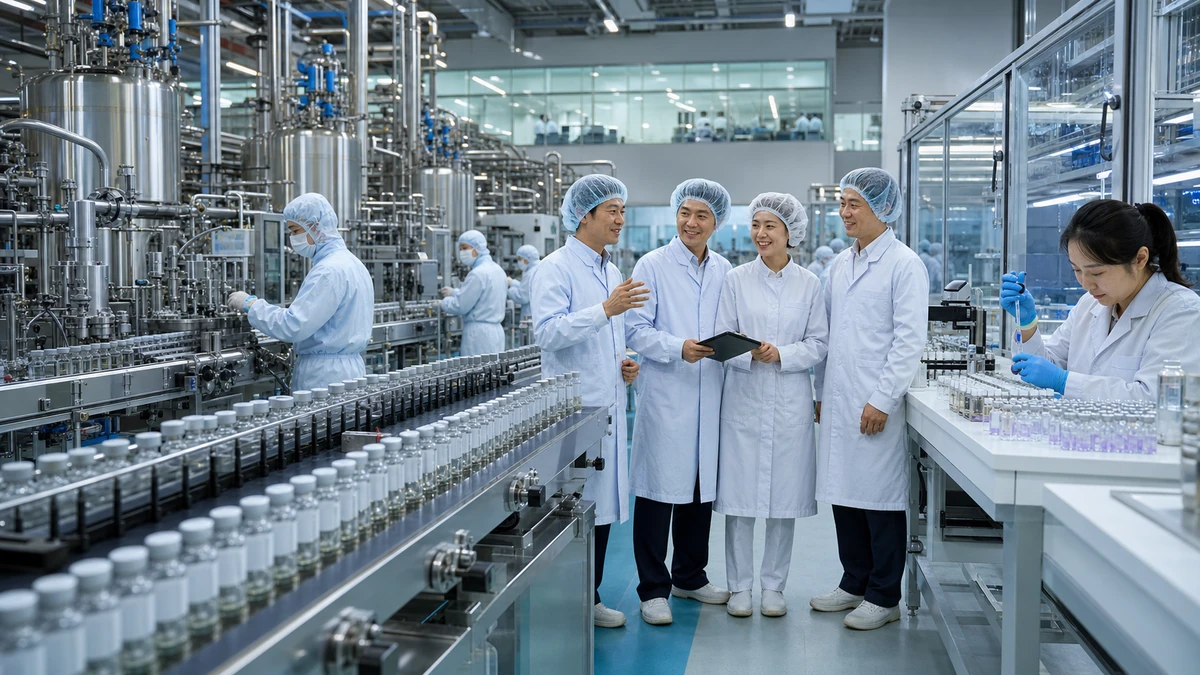
Image to help understand the article
South Korea’s biotech industry is showing breadth, not just headline wins
South Korea’s pharmaceutical and biotech sector has spent years trying to prove that it is more than a promising upstart in the global drug business. This quarter, a cluster of strong earnings from some of the country’s biggest players suggests it is moving closer to that goal. The important takeaway is not simply that a few companies posted better results. It is that several Korean firms, using very different business models, are turning scientific know-how and manufacturing muscle into real revenue at the same time.
That distinction matters for readers in the United States, where investors, drugmakers and patients increasingly live in a world shaped by global supply chains, cross-border licensing deals and competition over lower-cost biologic medicines. In South Korea, Samsung Biologics and Celltrion each reported record quarterly sales, while Yuhan Corp. and Hanmi Pharmaceutical saw earnings strengthened by technology licensing, a business model that allows companies to monetize research by partnering with outside drugmakers. Daewoong Pharmaceutical, meanwhile, posted double-digit sales growth driven by its own medicines and botulinum toxin products.
Put simply, South Korea’s biotech industry is showing multiple ways to win. One company can grow by manufacturing biologic drugs for others. Another can expand by selling biosimilars, the lower-cost near-copies of complex biologic medicines. Others can turn research into cash through licensing agreements, or grow branded products in specialized therapeutic areas. That variety is what makes this moment notable. It suggests the country is building an ecosystem, not relying on a single national champion or one blockbuster product to carry the sector.
For years, discussions about Korea’s biotech ambitions often centered on potential: promising pipelines, large research spending, and hopes that Korean firms could move up the value chain beyond making generic products or contract manufacturing. What is changing now is that those capabilities are appearing more clearly in quarterly results. Potential is becoming revenue. R&D is becoming licensing income. Manufacturing scale is becoming record sales. In a sector where breakthroughs are often discussed long before they are commercialized, that shift is meaningful.
The timing is also important. Biotech around the world has faced a tougher financing environment, higher scrutiny from investors and payers, and rising pressure to demonstrate that innovation can produce durable returns. Against that backdrop, Korea’s latest quarter reads less like a one-off bright spot and more like evidence that its drug industry is maturing into something more resilient.
Why record sales at Samsung Biologics and Celltrion matter
The fact that Samsung Biologics and Celltrion both reached record quarterly revenue in the same period is especially significant because the two companies are not doing the same thing. Samsung Biologics is best known as a large-scale contract manufacturer of biologic medicines, the kind of company that helps global drugmakers produce highly complex therapies. Celltrion, by contrast, has built much of its identity around biosimilars, which are often described in the United States as a cost-saving alternative once expensive biologic drugs lose exclusivity.
In other words, these are different lanes of the same highway. One company’s strength lies in industrial-scale production and the ability to serve multinational clients. The other’s lies more directly in product commercialization and the expanding market for biosimilar medicines. When both are growing at once, it becomes harder to explain Korea’s biotech rise as the product of a single niche or a temporary boom in one product category.
For American readers, a useful comparison would be the difference between a company that helps manufacture advanced therapies behind the scenes and one that competes in the market with lower-cost versions of complex medicines. The United States has major players in both kinds of activity, but it is unusual for one country to gain visible momentum across both at the same time. That is what makes the Korean story worth watching.
Biologic drugs are among the most sophisticated and expensive products in modern medicine. They include treatments for cancer, autoimmune disease and other serious conditions, and they are far more complicated to make than standard pills. Success in this field usually requires not only strong science, but also exacting manufacturing standards, regulatory discipline and commercial reach. If Korean companies are posting record sales in this arena, it suggests they are strengthening in the parts of the business that global drugmakers and health systems care most about: reliability, scale and the ability to compete internationally.
It also points to a broader shift in how Korea participates in the life sciences economy. The country is not confined to one role. It can be a place where drugs are manufactured for the world, where biosimilars are sold into global markets, and where research can be turned into partnerships. That diversification may prove just as important as any single quarter’s revenue line, because it gives the industry more than one engine for future growth.
Licensing income shows that research can pay off before a drug reaches the market
One of the clearest lessons from the quarter is that research itself can become a business, not just an expense. That is the story highlighted by the results at Yuhan and Hanmi, where technology export — better understood in English-language industry coverage as licensing out drug candidates or platforms — helped lift performance. In practical terms, a company develops a promising therapy or technology, then signs a deal with an outside partner that provides upfront payments, milestones or other financial terms in exchange for rights to develop or commercialize it.
This matters because drug development is usually long, risky and expensive. A company can spend years working on a new treatment without ever reaching approval or strong sales. Licensing allows part of that value to be recognized earlier. It gives firms a way to convert scientific progress into cash flow before the final product is fully commercialized. That does not eliminate the underlying risk of research, but it does make R&D feel less like a pure cost center and more like a strategic asset.
For Korean biotech, that is an important sign of maturation. Industries at an earlier stage often depend heavily on hopes around future products or on one-time successes. More developed sectors tend to build mechanisms for extracting value at different stages of the innovation cycle. Licensing is one of those mechanisms. It says a company’s science is good enough that someone else is willing to pay for access to it.
American readers will recognize this model from the U.S. biotech industry, where smaller and midsize firms often partner with large pharmaceutical companies that have deeper clinical-development budgets, global regulatory expertise and commercial networks. South Korea’s growing use of this playbook suggests its biotech firms are becoming more integrated into the same global partnership model that has long shaped the U.S. market.
It also reflects an increasingly important truth about the modern drug business: value does not begin only when a pill reaches pharmacy shelves or an injection reaches hospitals. Value can be created in the lab, in intellectual property, in clinical data and in platform technologies. That is especially relevant in a world where advanced medicines often emerge from highly specialized science and where large pharmaceutical companies routinely look outside their own walls for innovation.
If Korean firms can repeatedly generate licensing income while also strengthening product sales and manufacturing, they will be less dependent on a single path to growth. That kind of balance tends to be what separates industries with staying power from industries built on bursts of excitement.
More than manufacturing: Korea is building a layered biotech model
The strongest analytical point from these earnings is that South Korea’s drug sector appears to be developing in layers. Manufacturing, biosimilars, proprietary drugs, licensing deals and specialty products all contributed to performance. That may sound technical, but it is actually the central business story.
Many countries would like a bigger biotech industry. Far fewer manage to build one that spans several profit models at once. Some become strong in manufacturing but weak in innovation. Others have good academic science but struggle to turn discoveries into companies. Still others produce a few standout firms but do not create a broader industrial base. The Korean case now looks more multifaceted than before.
Samsung Biologics represents large-scale biopharmaceutical production capacity. Celltrion represents commercialization in biosimilars, one of the most strategically important segments in global health care because of the pressure to lower the cost of treatment. Yuhan and Hanmi represent the monetization of R&D through external partnerships. Daewoong’s growth, driven by its own new drugs and botulinum toxin products, shows that even within a single company, multiple product groups can contribute to expansion.
That layering is important because it can make growth more durable. An industry built around only one type of success is vulnerable when that channel slows. A licensing-heavy sector can suffer if dealmaking dries up. A manufacturing-focused sector can be hit by pricing pressure or changing client demand. A biosimilar-driven sector can face fierce competition once rivals enter. But when several channels work at once, the system has more resilience.
None of this guarantees long-term success, and it would be premature to declare a permanent transformation based on one quarter. Sustained growth will still depend on continued product demand, strong execution, future clinical results, and the ability to compete in regulated overseas markets. But the direction is notable. The Korean industry is looking less like a narrow export story and more like a diversified life-sciences platform.
That matters strategically because global pharmaceutical competition is no longer just about inventing a molecule. It is about managing a web of capabilities: research, intellectual property, manufacturing quality, regulatory strategy, commercial partnerships and international market access. South Korea’s recent results suggest it is strengthening across several of those capabilities at once.
What this means for the United States
For the United States, Korea’s biotech momentum is not a distant regional business story. It has direct relevance to American patients, health care companies, investors and policymakers. The U.S. remains the world’s most important pharmaceutical market, the largest stage for biosimilars and branded biologics, and a critical destination for cross-border partnerships. When Korean companies improve their performance and global reach, the effects are likely to show up in the American market sooner or later.
First, there is the question of drug costs. Biosimilars have long been promoted in the United States as a way to inject more competition into expensive biologic categories, from autoimmune disease treatments to oncology. Adoption in the U.S. has been slower and more uneven than many reformers once hoped, partly because the system is complicated and deeply shaped by insurers, pharmacy benefit managers and provider incentives. Still, every credible global biosimilar player matters in a market where the central promise is lower prices through more competition. Celltrion’s strength is therefore relevant beyond Korea; it feeds into the broader global contest over who can supply high-quality alternatives in one of the most economically important corners of medicine.
Second, Korean manufacturing capacity matters to U.S. drugmakers. American pharmaceutical companies routinely rely on international partners for production, especially in complex biologics where scale, quality control and speed can create competitive advantages. A stronger Samsung Biologics can mean more options for U.S. companies looking to manufacture treatments efficiently and reliably. In an era when Washington talks frequently about supply-chain resilience, trusted overseas production partners remain part of the real-world equation, even as the U.S. seeks to expand domestic capabilities.
Third, licensing deals and research partnerships are directly tied to the American innovation economy. U.S. pharmaceutical companies are constantly scouting for promising science outside their own labs. Korean firms that can produce licensable assets become more relevant not only as exporters, but as partners in the U.S.-led global biotech marketplace. That can bring more dealmaking, more collaboration, and potentially more Korean-origin science entering the U.S. clinical and commercial pipeline.
Fourth, the rise of Korean biotech fits into a broader pattern Americans already know from culture and technology: South Korea has become increasingly adept at moving from domestic success to global scale. American audiences first felt that vividly through K-pop, Korean film, television dramas and beauty products. Biotech is obviously a very different sector, and it should not be reduced to pop-culture branding. But there is a familiar strategic pattern here: deep investment, export orientation, polished execution and a willingness to compete globally rather than regionally.
For Washington, this also adds another layer to the U.S.-South Korea relationship. The alliance is usually discussed through security terms, semiconductors or trade. Health and biotechnology deserve a larger place in that conversation. A more capable Korean biotech sector can be a commercial rival in some areas, a partner in others, and an increasingly important node in the broader health-security landscape, from medicine manufacturing to therapeutic innovation.
The historical subtext in Korea — and why foreign readers should notice it
The original Korean coverage also places some of these business results alongside a historical reference that may not be obvious to U.S. readers: the significance of Liberation Day, the national holiday marking Korea’s freedom from Japanese colonial rule at the end of World War II. In that context, the renewed attention on companies such as Yuhan and Dongwha, and on the legacy of Yuhan founder Yu Il-han, carries symbolic weight beyond earnings reports.
To an American audience, the closest parallel might be the way U.S. companies sometimes invoke wartime manufacturing legacies, public-health missions or civic purpose as part of their institutional identity. In Korea, the phrase roughly translated as “serving the nation through pharmaceuticals” reflects an older idea that building a domestic drug industry was not only a commercial project but a matter of national self-strengthening and public welfare.
That history helps explain why biotech and pharmaceuticals can carry unusual emotional and political resonance in South Korea. For some Korean observers, the rise of homegrown drugmakers is not just about stock performance or industrial policy. It also reflects a longer national arc: from dependence and rebuilding to technological self-confidence and global competitiveness.
That does not mean investors or consumers should romanticize the industry. Drug development remains a hard business everywhere, and patriotic narratives do not substitute for commercial discipline or scientific rigor. But the historical layer does help explain why strong earnings from Korean pharma companies can resonate as more than routine corporate news. They tap into a larger story about national capability, modernization and global standing.
For American readers trying to make sense of Korea beyond entertainment exports and geopolitical headlines, this is a useful reminder that the country’s global influence is broadening. The same society that built internationally competitive electronics, batteries and cultural products is trying to do the same in advanced medicine. That ambition is no longer abstract.
What to watch next
The larger trend to watch is whether South Korea can sustain this multi-track biotech growth beyond a favorable quarter. The key question is not whether one company can set another sales record, but whether the country can keep producing evidence of scale across manufacturing, biosimilars, research partnerships and proprietary medicines. If it can, Korea’s place in the global biotech hierarchy will look more durable and less episodic.
Several signs will matter. One is whether licensing income continues to appear as a meaningful contributor for research-driven firms, which would suggest that Korean science is attracting sustained outside interest rather than isolated dealmaking. Another is whether biosimilar sales growth remains strong as competition intensifies in overseas markets. A third is whether manufacturing leaders can continue to attract and retain major global clients in a business where quality, reliability and capacity are everything.
Investors and industry analysts will also want to see whether Korean companies can translate current momentum into longer-term innovation, including the development of original new medicines that succeed not only in licensing talks but in major global markets. That is a harder test and one that takes years, not quarters. The move from being a strong manufacturer or biosimilar supplier to being a consistent creator of globally competitive novel drugs is one of the steepest climbs in the pharmaceutical world.
Still, the latest results suggest South Korea is climbing with more than one rope. That may be the most important development of all. A country once viewed as an ambitious secondary player in biotech is showing signs of building a broader, more sophisticated industry — one that can manufacture, partner, sell and innovate in parallel.
For American readers, that is the right way to understand the story. This is not just a quarterly earnings roundup from abroad. It is a window into how another U.S. ally is strengthening its position in one of the world’s most strategic industries. As pressure mounts everywhere to lower drug costs, secure medical supply chains and find the next generation of therapies, South Korea’s biotech rise looks less like a local business development and more like a global trend with real implications for the United States.
Comments
Post a Comment