South Korea’s broad Cabinet reshuffle signals Lee Jae-myung wants faster execution at home — and steadier messages to Washington
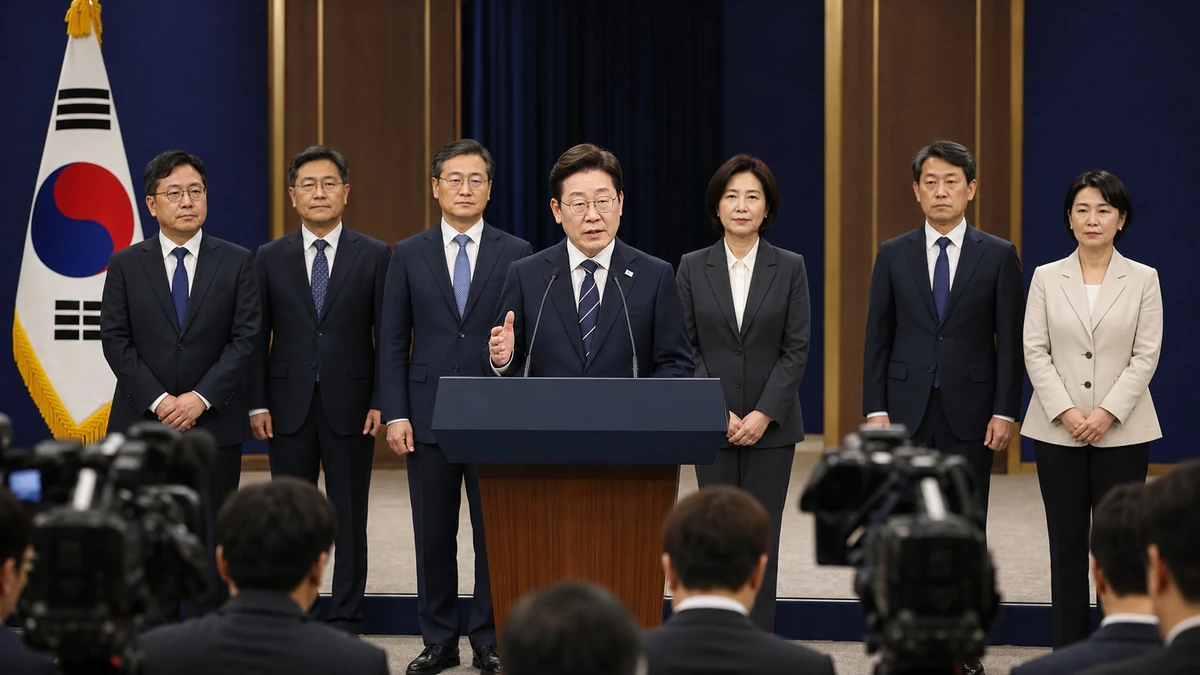
Image to help understand the article
A second-year reset with unusually high stakes
South Korean President Lee Jae-myung’s decision to nominate six Cabinet ministers at once is more than a personnel announcement. It is an early signal about how he intends to govern in the second year of his presidency: move quickly, compress political pain into a shorter window and try to clear the deck for policy fights that touch nearly every part of daily life in South Korea, from apartment prices to military readiness.
For American readers, the closest comparison is not a routine agency staffing change in Washington but a White House deciding to remake several major departments in one stroke — Treasury, Justice, Defense, Housing and Small Business among them — rather than spreading those battles out over months. In South Korea’s presidential system, Cabinet nominations are always politically charged, but the timing and concentration matter. By opting for a broad reshuffle instead of staggered changes, Lee is making a bet familiar to leaders in any democracy: it is sometimes better to take one big hit now than suffer smaller political wounds over a longer period while policy drifts.
The nominations announced Tuesday cover the ministries responsible for finance and the economy, justice, national defense, land and transport, gender equality and family, and small and medium-sized businesses and startups. In practical terms, that means Lee is reorganizing the command structure for the economy, housing, legal policy, military affairs, social policy and entrepreneurship all at once. In political terms, he is trying to define what his administration’s next phase will look like before the fall legislative session turns into a prolonged referendum on personnel.
South Korean politics often moves at a speed that can surprise outsiders. Cabinet appointments are subject to legislative confirmation hearings, and those hearings can become intense public tests of ethics, competence and ideology. That makes a reshuffle like this both risky and revealing. Lee is effectively saying that the cost of concentrated scrutiny is worth paying if it allows his government to stop talking about staffing and start talking about results.
The move also suggests that the presidential office believes the public will judge this reshuffle less by the drama of the hearings and more by whether the new team can deliver on persistent problems. Those problems are not abstract. Housing affordability, weak confidence in economic management, legal and prosecutorial reform, gender policy and support for smaller firms all sit close to voters’ everyday concerns. So does defense, especially in a country that remains technically at war with North Korea and relies on a deep alliance with the United States.
Why an all-at-once reshuffle matters in Seoul
The most important feature of this announcement is not simply who was nominated, but the fact that Lee chose a collective reset instead of the more incremental approach many in Seoul had expected. Political observers had anticipated that he might first fill vacant posts, especially at the justice and small business ministries, and then address the rest after key events in the regular National Assembly session. That would have spread out the political burden. Instead, he accelerated the calendar.
That matters because South Korean presidents, like American presidents, can lose momentum when vacancies and personnel fights drag on. A one-by-one approach — what some in Korean politics describe as a “salami-style” reshuffle — can reduce the heat around any one nominee. But it also keeps the administration stuck in an almost permanent confirmation season. Every new nomination restarts scrutiny. Every delay leaves ministries partly in wait-and-see mode. Every controversy competes with the government’s policy message.
Lee appears to have concluded that prolonged uncertainty is the bigger threat. If that reading is right, the reshuffle is designed to shorten the life span of the personnel story. The president’s office absorbs a larger burst of criticism now, then tries to move quickly into governing with a more settled team. That is especially significant because some of the ministries included here are central to issues voters feel most directly: tax and financial policy, the housing market and the cost and availability of homes.
South Korea’s housing politics deserve special explanation for American audiences. Real estate, particularly apartment prices in and around Seoul, is not just a pocketbook issue. It is one of the most emotionally and politically charged topics in the country, closer to a blend of the U.S. housing affordability crisis, local zoning battles and the role that home ownership plays in family wealth and social mobility. A president who promises to crack down on speculation, expand supply and use finance and tax policy more aggressively is stepping into one of the hardest policy arenas in Korean politics.
That helps explain why the finance and land ministries are so important in this reshuffle. Including both suggests the administration sees economic management and housing policy as linked challenges rather than separate files. The political message is that Lee wants a coordinated push, not isolated adjustments. The administrative message is that he wants people in place who can execute quickly.
There is a second reason the one-shot approach matters. It is a test of confidence. Leaders only consolidate several difficult fights into one moment when they believe either that the opposition cannot stop them, or that the public will reward decisiveness more than it punishes risk. Either way, it shows Lee is not governing as if he wants to merely survive the next few months. He is trying to shape the terms of debate heading into a crucial legislative season.
The nominees reflect a blended governing strategy
The six nominations show a deliberate mix of bureaucratic continuity, political management and security expertise. That combination may be the clearest clue to what Lee thinks his second-year government needs.
For finance and for land and transport, Lee chose senior officials already serving inside those ministries: Lee Hyeong-il, currently a vice finance minister, and Hong Ji-seon, currently a vice minister at the land ministry. In any system, that kind of pick usually signals two things at once. First, the president wants fewer onboarding delays. Second, he wants to retain institutional memory while changing the top line of authority. These are not outsider insurgent choices meant to shock the bureaucracy. They are insider choices meant to move files faster.
That is especially telling in the context of economic policy. South Korea faces many of the same tensions confronting other advanced economies: sluggish household confidence, uneven growth, pressure on small businesses and persistent sensitivity around debt, prices and the property market. Elevating career officials who already know the machinery can be read as a preference for operational control over ideological theater. It does not guarantee policy success, but it reduces transition friction.
For justice, gender equality and family, and small business and startups, Lee turned to sitting lawmakers: Kim Seung-won, Yong Hye-in and Lee So-young. That choice speaks to a different need. These ministries sit at the crossroads of lawmaking and administration. A politician can sometimes be more effective than a technocrat when the job requires defending controversial legislation, negotiating with lawmakers or translating campaign values into programs.
For American readers, the gender equality and family portfolio may need special context. South Korea’s Ministry of Gender Equality and Family has long been a flashpoint in culture-war politics. It deals with policies involving gender equity, family support and related social issues, and it has often become a symbolic battleground for broader anxieties about feminism, demographics and generational conflict. Appointing Yong, a lawmaker from the Basic Income Party, carries meaning beyond one ministry. It suggests Lee is willing to include figures from a wider progressive camp and use Cabinet appointments to strengthen alliances inside the broader governing bloc.
The small business and startup portfolio is equally important in a different way. South Korea is globally famous for conglomerates like Samsung, Hyundai and LG. But the country’s economic debate is also shaped by concern over whether smaller firms, young founders and regional businesses have enough room to grow in a system dominated by giant corporate groups, known as chaebol. Naming a lawmaker to that post suggests the administration sees entrepreneurship policy as politically important, not merely administrative.
Then there is defense. Lee nominated Kang Shin-chul, a former four-star general who served as deputy commander of the U.S.-South Korea Combined Forces Command and is now South Korea’s ambassador to Saudi Arabia. That background stands out. While some civilian governments prefer a politically aligned defense chief, this pick emphasizes professional military command experience and firsthand familiarity with the alliance structure that anchors South Korea’s deterrence posture.
That matters because South Korea’s defense agenda is not limited to North Korea’s missile and nuclear threat. It also includes questions about wartime operational control, force structure and how Seoul balances alliance coordination with longer-term aspirations for greater military autonomy. Choosing a former top commander with combined-forces experience sends a reassuring signal of continuity at a sensitive moment.
What this means for the United States
For Washington, American companies and U.S. audiences that follow Korea beyond K-pop and Korean dramas, the reshuffle matters because several of the ministries involved shape the daily workings of one of America’s closest Asian allies. South Korea is not only a treaty ally but also a major investor in the United States, a crucial technology and manufacturing partner, and an increasingly important player in supply chains tied to semiconductors, batteries, autos and artificial intelligence.
The defense nomination is the most direct U.S. link. Kang’s experience in the U.S.-South Korea Combined Forces Command is the kind of credential American officials pay attention to immediately. It points to institutional fluency with alliance management, interoperability and the operational culture that underpins joint deterrence on the peninsula. At a time when Washington is managing simultaneous security burdens in Europe, the Middle East and the Indo-Pacific, predictability in Seoul’s defense leadership is not a small matter.
Just as important, the economic and housing appointments could shape the environment for American investors and firms watching South Korea’s domestic stability. A government that believes it must reassert control over property speculation, tax policy and supply-side housing measures is responding to pressures that affect consumer sentiment and political confidence. In an export-heavy economy closely connected to the U.S. market, those domestic conditions can influence business confidence more broadly.
The small business and startup ministry also deserves American attention. U.S. venture capital firms, technology partnerships and multinational companies increasingly see South Korea not just as a consumer market but as a laboratory for advanced manufacturing, digital services, gaming, AI and platform business. If the ministry under new leadership pushes harder to support startups and smaller innovators, that could affect how American capital and companies engage with Korean partners outside the orbit of the biggest conglomerates.
The justice portfolio may be less legible to casual U.S. readers, but it also has broader implications. Legal policy in South Korea often intersects with questions of business regulation, prosecutorial power and institutional trust. For American observers used to fierce debate over the Justice Department, independent prosecutions and the political meaning of legal reform, there is a recognizable pattern here: battles over legal institutions are also battles over how power is exercised and constrained.
Finally, there is a softer but still important U.S. connection. Korean politics increasingly lands in the American information space because South Korea is no longer a niche interest. It is a major cultural exporter, a strategic ally and a business partner whose policy shifts draw attention from investors, defense analysts, students and a large base of American fans of Korean culture. That means cabinet politics in Seoul, once seen abroad as specialist material, now have a broader audience — especially when they affect security ties, tech cooperation and the domestic stability of a country central to U.S. Asia policy.
Housing, economic anxiety and the politics of execution
If there is one domestic issue likely to define whether this reshuffle succeeds, it is the economy as people feel it in their own lives. In South Korea, that often means housing first. Lee said the government would work to root out real estate speculation and mobilize state capacity around financial and tax reform, housing supply expansion and faster delivery. Those are not casual talking points. They imply a government trying to convince the public that it understands both the anger and the urgency around the housing market.
American readers can think of this as a hybrid of debates over mortgage affordability, investor-driven housing pressure, first-time homebuyer frustration and the politics of supply constraints. But South Korea’s case has some distinct features. The concentration of economic opportunity in greater Seoul, the symbolic status of apartment ownership and the way real estate can shape family wealth and marriage prospects all magnify the issue. Housing policy in South Korea is therefore also family policy, inequality policy and, in some ways, generational policy.
That is why putting new leadership in both finance and land is so consequential. It creates the possibility of a more unified push on credit, taxes, supply and anti-speculation measures. It also raises the political stakes. If the administration says it has reset the chain of command and then fails to improve affordability or confidence, the reshuffle itself becomes evidence against the government’s governing strategy.
The same execution test applies to support for small businesses and startups. South Korea has world-class global brands, but ordinary economic stress is often felt most acutely by smaller firms, self-employed workers and young people trying to build careers outside traditional corporate ladders. In the United States, politicians regularly promise to champion Main Street while also courting Silicon Valley or Fortune 500 giants. South Korea has its own version of that balancing act, except the shadow cast by its large conglomerates is even more structurally embedded.
So the new team will be measured not just by whether it announces reform, but by whether policy reaches the parts of the economy that voters experience most personally. That is one reason Lee may have decided speed matters more than the tactical advantage of spacing out nominations. He appears to want a Cabinet that can begin operating as a coordinated political and administrative unit before economic frustration hardens further.
The hearings ahead will test more than the nominees
The announcement may have compressed the reshuffle stage, but it did not eliminate the political battle. It simply moved that battle into the next arena: National Assembly confirmation hearings during a busy fall session expected to include legislative fights over housing supply and next year’s budget.
That setup all but guarantees a season of high political tension. The governing side will argue that the nominees represent professionalism, practical experience and a renewed focus on people’s livelihoods. The opposition has already criticized the direction of the reshuffle, arguing it does not match the economic and bread-and-butter emphasis the administration claims. Those arguments are likely to intensify once nominees are questioned over records, statements, finances and policy positions.
In this respect, South Korea’s hearings can resemble a compressed version of U.S. confirmation politics: part vetting exercise, part televised political narrative, part proxy war over the president’s agenda. The difference is that in South Korea, multiple major nominations landing together can create a denser, more fast-moving drama. If even one or two nominees become engulfed in controversy, the political cost can spread across the entire reset. If most clear the process with limited damage, Lee will be able to argue that his gamble worked.
There is also a subtler institutional test at work. Because Lee has accepted the short-term burden of concentrated scrutiny, he has made future performance inseparable from the reshuffle itself. If the Cabinet is approved and then struggles to deliver on housing, economic coordination, legal reform or social policy, critics will say the White House-style “big reset” was mostly stagecraft. If the ministers move quickly and show visible execution, supporters will point to this moment as the point when the administration stopped treading water and started governing with more coherence.
That is why the hearings matter beyond personalities. They are the gateway to the administration’s larger argument that concentrated political risk now can produce more stable policy later. Whether that argument holds will depend less on the headlines of confirmation week than on what happens after the cameras move on.
A broader signal about where South Korea is headed
Seen from a wider angle, the reshuffle offers a snapshot of the pressures shaping South Korea at this moment. It is a country trying to manage economic unease, a still-sensitive housing market, unresolved debates over legal institutions, demographic and gender tensions, startup ambitions and a demanding security environment — all while playing a larger role globally than it did a decade ago.
That global role matters for how this story should be understood outside Korea. South Korea is no longer only a middle power with a strong export economy and a difficult northern neighbor. It is also a major cultural force, a strategic node in U.S. Indo-Pacific planning and a country whose domestic policy choices affect supply chains, investment flows and alliance politics. When its president reorganizes the ministries at the center of those questions, the implications travel well beyond Seoul.
Lee’s choices suggest he wants his second-year government to be judged on execution, not just ideology. The blend of career officials, politicians and a senior military figure shows an administration trying to combine bureaucratic continuity, legislative muscle and alliance reassurance. It is a pragmatic mix, even if every element of it will be contested by opponents.
Whether that pragmatism pays off is another matter. The logic behind the reshuffle is clear enough: shorten the personnel drama, install a new team quickly and focus on policy output. But there is a reason leaders do not always choose that route. If the hearings go badly or the new ministers fail to produce visible results, the concentrated gamble becomes a concentrated liability.
For now, though, the more important point is what changed. South Korea’s president had the option to manage personnel risk incrementally. He chose instead to speed up the political calendar and reframe the next phase of his presidency around simultaneous control of the economy, housing, justice, defense, gender policy and startup growth. In a political system where tempo often signals intent, that is the headline.
American readers should watch what follows with that in mind. The immediate story is about six nominees. The larger story is about whether one of the United States’ most important allies believes it must move faster — and more forcefully — to show that government can still deliver on the issues people feel most directly.
Comments
Post a Comment