South Korea’s chip boom is doing more than lifting exports. It may be pulling the broader economy with it.
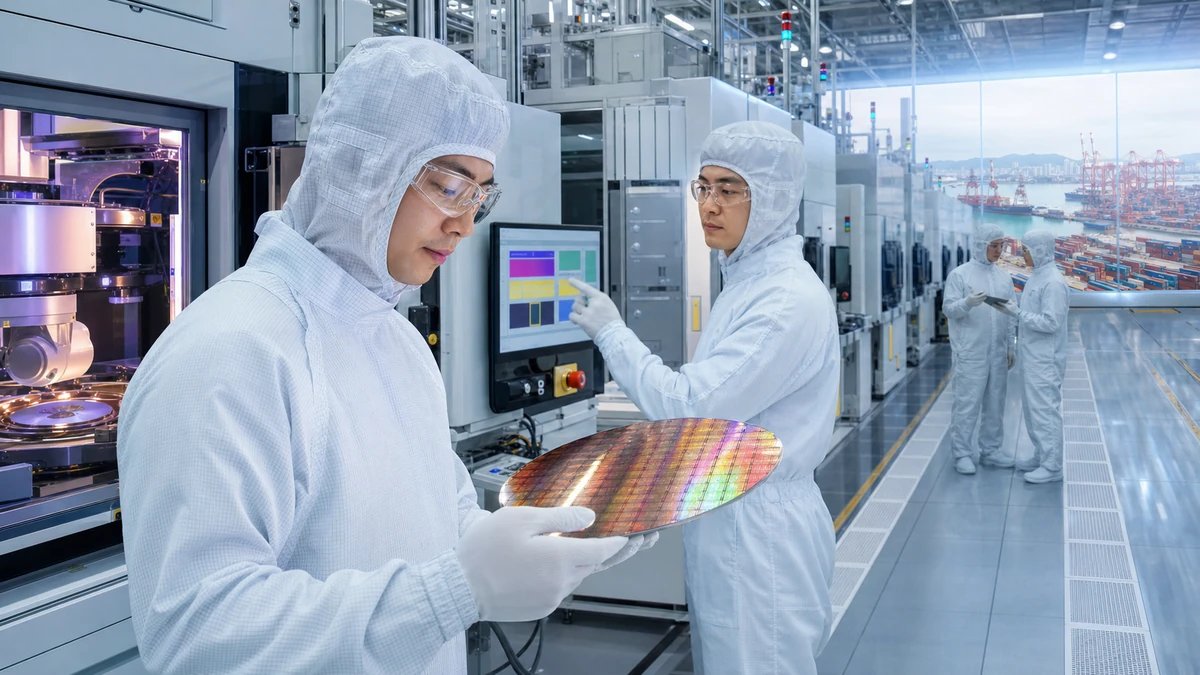
Image to help understand the article
Semiconductors are once again leading South Korea’s recovery
South Korea’s economy is showing stronger signs of improvement, and the biggest reason is a familiar one: semiconductors. A new assessment from the Korea Development Institute, or KDI, a state-run think tank that closely tracks the country’s economy, says the rebound is broadening as chip exports and corporate investment in equipment continue to rise sharply.
That matters well beyond South Korea. For American readers, South Korea is not just another export-driven economy in Asia. It is one of the world’s most important technology manufacturing hubs, home to global giants such as Samsung Electronics and SK Hynix, whose memory chips end up in everything from smartphones and laptops to artificial intelligence servers and cars. When South Korea’s semiconductor sector accelerates, the effects can ripple through global supply chains in ways that touch U.S. businesses, consumers and investors alike.
KDI’s latest diagnosis suggests that South Korea’s recovery is no longer confined to a narrow slice of the economy. The institute said gains centered on semiconductors are now feeding into factory investment and, to some degree, consumer spending. That is a meaningful distinction. A temporary export jump can be encouraging, but it does not necessarily signal a durable recovery. When companies start spending heavily on machinery, fabrication equipment and production capacity, economists often read that as a stronger vote of confidence in future demand.
In other words, this is not just about selling more chips this quarter. It is about companies betting that the next several quarters, and perhaps years, will require even more production. In a country where exports are a central engine of growth, that can become a powerful force for the wider economy.
The report also arrives at a time when the global tech industry is undergoing another major buildout, fueled by AI-related demand, data center expansion and a broader race among governments and corporations to secure high-end computing capacity. South Korea is deeply embedded in that race, and its economic fortunes are increasingly tied to how long the semiconductor upcycle lasts.
Why South Korea’s chip sector carries outsized weight
To understand why KDI’s remarks are drawing attention, it helps to understand how central semiconductors are to South Korea’s economic model. In the United States, the economy is large and diversified enough that a boom in one industry, even a crucial one, may not immediately define the whole national picture. South Korea is different. It is a mid-sized economy that depends heavily on trade, and a handful of globally competitive industries can have an outsize effect on jobs, investment, the currency and the country’s trade balance.
Semiconductors sit at the top of that list. South Korea has long been a world leader in memory chips, especially DRAM and NAND flash, key components used to store and process data. Over the past several decades, the country built an industrial ecosystem around advanced manufacturing, precision engineering, export logistics and deep coordination between major corporations, suppliers and policymakers. That structure has made chips one of South Korea’s signature industries in much the way aerospace matters to parts of the U.S. economy or autos matter to the industrial Midwest.
When chip exports surge, the benefits do not stop at the companies directly making semiconductors. Equipment manufacturers, chemical suppliers, logistics firms, parts makers and industrial construction companies also feel the lift. Industrial electricity usage rises. Ports get busier. Business investment often follows because companies need more clean-room facilities, more advanced production tools and more infrastructure to meet current and expected orders.
That is the larger story KDI appears to be highlighting. South Korea’s recovery is gaining strength because semiconductors are not acting as a single isolated bright spot. They are setting off a chain reaction. More exports lead to more production. More production leads to more equipment spending. More investment can support related industries and, if momentum holds, can eventually support household spending as well.
For a country that has spent much of the past two years navigating weak global demand, high borrowing costs and uneven domestic consumption, that kind of spillover is important. It suggests the economy may be shifting from a fragile recovery into something sturdier, though not yet fully secure.
From exports to factory floors to household spending
One of the most notable parts of KDI’s assessment is that it did not stop at export growth. The institute also pointed to a strong increase in facilities investment, a category that refers broadly to corporate spending on productive assets such as machinery, semiconductor tools and other equipment used to expand or upgrade production.
That is a crucial signal because business investment is often a better indicator of confidence than sales alone. A company can enjoy a short-lived jump in exports because prices rise or customers restock inventories. But when executives authorize major capital expenditures, they are making a more durable commitment. They are effectively saying they expect demand to persist long enough to justify expensive, forward-looking investment.
In the semiconductor business, these decisions are especially consequential. Chip manufacturing is among the most capital-intensive industries in the world. Building or upgrading advanced production lines can cost billions of dollars. The tools involved are extraordinarily complex, and competitive advantage depends not just on having factories, but on having the newest and most efficient ones. When Korean chipmakers increase facilities investment, it signals they are trying not only to capture today’s demand but also to protect their position in tomorrow’s technology race.
KDI also said consumer spending has shown a wider increase, particularly in durable goods. For American readers, durable goods are items meant to last for years, such as cars, appliances, electronics and furniture. Economists pay close attention to them because households usually postpone those purchases when they feel uncertain about income, jobs or inflation. When spending on durable goods rises, it can indicate greater consumer confidence, or at least less anxiety than before.
That does not mean South Korean consumers are suddenly carefree. Far from it. But if export gains are beginning to coincide with steadier spending at home, that is one sign the recovery may be spreading beyond corporate balance sheets. In policy terms, that kind of linkage matters a great deal. South Korea has long wrestled with the challenge of translating export strength into a recovery that households actually feel. If semiconductors are now helping support investment and consumption at the same time, the rebound may be broadening in a way officials have been hoping for.
Still, economists will want to see whether that pattern lasts. Durable goods purchases can be lumpy, and consumer sentiment can change quickly if inflation remains high or labor market conditions worsen. For now, though, KDI’s message is that the channels connecting exports, investment and consumption are becoming more active.
A trade surplus offers another sign of resilience
The semiconductor rebound is also showing up in South Korea’s external accounts. According to data released by the Bank of Korea, the country maintained a current account surplus in June, with the goods balance improving as exports, led by semiconductors, increased significantly.
That might sound technical, but the idea is straightforward. A current account surplus means the country is, broadly speaking, earning more from its trade and overseas income flows than it is paying out. For an export-heavy economy like South Korea, that can be an important cushion. It can support financial stability, help bolster confidence in the currency and give policymakers more room to maneuver during periods of global volatility.
The goods balance, in particular, is a useful window into the competitiveness of the manufacturing sector. When that surplus widens because of stronger high-value exports, it suggests the country is not merely selling more low-margin products. It is generating global demand in industries where technological capability and production sophistication matter. In South Korea’s case, semiconductors are perhaps the clearest example of that dynamic.
For American readers, there is a familiar parallel here. U.S. officials have spent years emphasizing semiconductor capacity as a matter of economic competitiveness and national security, culminating in major industrial policy efforts such as the CHIPS and Science Act. South Korea has long lived with a version of that reality. Its semiconductor sector is not only a profit center. It is a strategic pillar that helps anchor the country’s place in global trade.
That is one reason a stronger current account matters. It suggests the chip sector’s gains are not confined to quarterly earnings reports from large corporations. They are large enough to influence national indicators that economists and markets watch closely. When a single advanced-manufacturing industry helps drive exports, investment and the goods balance at the same time, it reinforces the perception that the sector is doing much of the heavy lifting for the broader economy.
There is, however, a flip side. Heavy reliance on semiconductors also means the country remains vulnerable to swings in the global tech cycle. If chip prices soften, AI demand cools or geopolitical tensions disrupt trade routes and investment decisions, the same concentration that powers growth can also amplify risk.
The recovery is real, but so are the risks
KDI’s assessment was optimistic, but it was not celebratory. The institute also flagged several risks that could limit how far this recovery spreads, including persistent inflation, softer employment conditions, U.S. tariff measures and instability in the Middle East.
Those concerns are significant. Inflation, even if it has eased from its worst peaks, can still weigh heavily on households. In South Korea, as in the United States, consumers tend to judge the economy less by export volumes or capital spending than by grocery bills, housing costs and what is happening to their paychecks. A country can post strong trade numbers while many households still feel squeezed.
KDI’s warning about employment is especially important. South Korea’s labor market has its own structural features, including a divide between large conglomerates and smaller firms, generational strains in hiring and long-running concerns about the quality of jobs available to younger workers. If job growth slows, any gains in consumer spending could prove fragile. Households may pull back quickly if they become more uncertain about income prospects.
External risks are also hard to ignore. U.S. tariff actions can affect the broader global trading environment even when they do not target South Korea directly. American trade policy toward China, in particular, matters because South Korea sits in the middle of major Asian supply chains, selling components and intermediate goods that can be affected by changing rules, demand shifts and strategic realignments. Washington’s efforts to reduce dependence on certain foreign technology inputs have created both opportunities and complications for Korean companies.
Then there is the Middle East, where instability can drive up energy costs and create new uncertainty for shipping and manufacturing. South Korea imports most of its energy, making it sensitive to oil price spikes and disruptions in maritime trade. Higher energy costs can squeeze manufacturers and consumers at the same time, which is one reason policymakers there watch regional tensions closely even when the conflict is geographically distant.
Put simply, South Korea may have found a strong growth engine in semiconductors, but engines still need favorable road conditions. Inflation, jobs and external shocks will help determine whether the current improvement becomes a sustained expansion or remains a sector-led rebound with limited reach.
Why this matters far beyond Seoul
This story matters internationally because South Korea occupies a central place in the modern technology economy. It is one of a small number of countries capable of operating at the highest levels of advanced semiconductor manufacturing. That makes its domestic economic trends relevant to everyone from Wall Street analysts and Silicon Valley executives to automakers in Detroit and policymakers in Washington.
If Korean semiconductor exports remain strong and companies keep investing aggressively, that could support global supplies of critical components used in data centers, consumer electronics and industrial equipment. It could also intensify competition in the worldwide race to build the infrastructure behind AI. For U.S. firms that depend on Korean suppliers, a healthier South Korean manufacturing sector can be good news, especially after years of supply chain disruptions exposed the risks of bottlenecks in key technologies.
At the same time, South Korea’s experience offers a case study in what a high-tech recovery looks like in a trade-dependent democracy. Much like the United States, South Korea is trying to balance industrial competitiveness, inflation control, consumer well-being and geopolitical risk all at once. The difference is that those tensions tend to show up faster and more sharply in a smaller, more export-oriented economy.
There is also a broader lesson in the way KDI framed the data. The institute did not simply say exports are up, therefore the economy is better. It emphasized the links between exports, capital spending and consumption. That is the real test of whether a sector-led rally can become a national recovery. Economists everywhere, including in the United States, ask versions of the same question: Are gains at the top filtering through to factories, workers and households?
In South Korea, the answer appears to be moving, cautiously, in the right direction. Semiconductors are doing what policymakers hope a globally competitive industry will do: create momentum that extends beyond the export ledger and into investment decisions, trade balances and domestic demand. Whether that momentum endures will depend on forces both inside and outside the country’s control.
The bigger question: Can South Korea spread the gains?
For now, the clearest takeaway is that South Korea’s semiconductor strength is no longer just an industry story. It is shaping the trajectory of the national economy. KDI’s latest assessment suggests the country’s recovery path is widening because chip exports are feeding into business investment and, at least tentatively, into household spending as well.
That is encouraging, but it also raises the next big question: Can South Korea broaden this improvement beyond semiconductors? A healthy economy ultimately needs more than one star sector, no matter how successful that sector may be. It needs durable job creation, manageable prices, resilient consumer demand and enough diversity to withstand downturns in any single industry.
South Korea has some advantages going into that test. It remains highly competitive in advanced manufacturing, has globally recognized technology firms and has shown a consistent ability to adapt to shifts in international markets. But it also faces structural pressures familiar to many developed economies, including demographic challenges, household debt concerns and the difficulty of ensuring that corporate success translates into broad-based prosperity.
For American readers, it is worth watching South Korea not only because it makes many of the chips the world depends on, but because it offers an early signal of how the next phase of the global tech economy may unfold. If semiconductors can lift exports, investment and consumption in one of the world’s most strategically important manufacturing countries, that says something meaningful about where demand is heading. If the rebound falters because inflation, jobs or geopolitics get in the way, that would be just as revealing.
At the moment, the evidence points to a stronger recovery led by one of South Korea’s most vital industries. The challenge now is turning that industrial momentum into something broader, steadier and more resilient. In an interconnected global economy, that is not just South Korea’s story. It is everyone’s.
Comments
Post a Comment