South Korea’s Crackdown on ‘Corporate Homes’ Reveals a Bigger Fight Over Privilege, Property and Tax Fairness
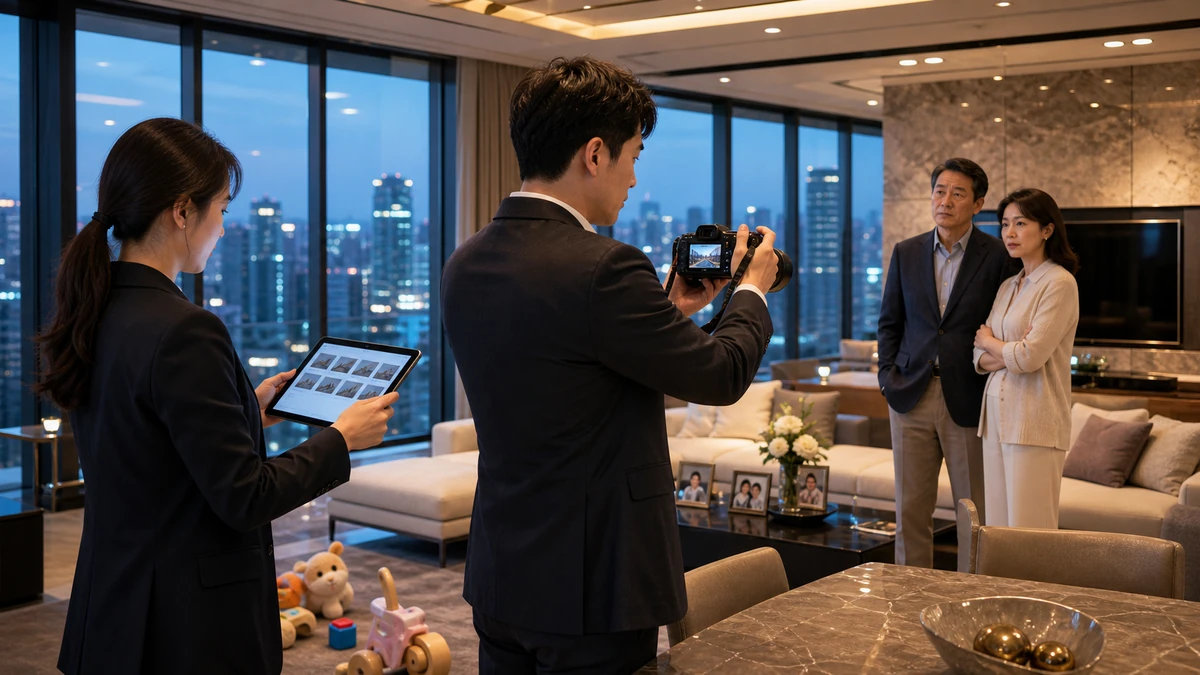
Image to help understand the article
South Korea’s tax authorities are targeting a familiar gray zone in corporate power
South Korea’s latest tax crackdown is nominally about expensive housing, but the deeper issue is one Americans will immediately recognize: whether wealthy business owners are using company assets as personal perks while ordinary salaried workers play by a very different set of rules.
The National Tax Service, South Korea’s tax agency, said it reviewed 2,639 high-value homes owned under corporate names and found that 42% were being used privately by controlling shareholders’ families. The homes examined were not just any company-owned residences. They were properties above the size of what Korea classifies as “national housing,” and with an officially assessed value exceeding 900 million won, roughly the threshold the government uses to identify high-end assets subject to comprehensive real estate taxation. According to the agency, the most expensive home it identified was worth more than 20 billion won, or well over $14 million at current exchange rates.
In Korea, the phrase officials are using is “hwangje satak,” often rendered as “imperial residences” or “emperor-style company housing.” The label is pointed and political. It refers to homes that are held in a corporation’s name and defended as necessary for business operations or employee welfare, but are in reality reserved for an owner’s family or a small circle of executives. In practical terms, it means the company is the legal owner on paper while the benefits flow to private individuals.
That distinction matters because company housing is not inherently suspect in South Korea. As in the United States, businesses may provide residences in certain circumstances, especially for employees who must relocate, work irregular hours, remain near critical facilities or live temporarily in expensive markets. Korean companies have long offered forms of housing support as part of compensation and welfare packages, particularly in a country where home prices in Seoul can be punishingly high. What the tax service is challenging is not the idea of company-owned housing itself, but the mismatch between stated purpose and actual use.
That makes this story less about luxury real estate alone than about governance, transparency and the treatment of corporate assets. The emerging standard in South Korea is that ownership structure is no longer enough. Regulators are asking who actually uses the property, whether ordinary employees have meaningful access, and whether the real beneficiary matches the business rationale that justified the purchase in the first place.
Why this investigation matters beyond one day’s headlines
The immediate numbers are striking, but the significance lies in what they say about a shift in enforcement. South Korea’s tax service did not describe this as a handful of symbolic examples. It said it conducted a full review of the relevant high-end category: 2,639 corporate-owned homes subject to the country’s comprehensive real estate tax rules. That matters because it turns the issue from anecdote into pattern.
For years, one of the recurring tensions in South Korean society has been the gap between formal rules and elite practice. Korea is a technologically advanced, globally connected economy with highly disciplined tax administration and a large middle class that is acutely sensitive to questions of fairness. Wage earners, whose taxes are largely withheld at the source, often have little room to maneuver. That helps explain the populist force of remarks from National Tax Service Commissioner Lim Kwang-hyun, who criticized the idea that business owners could privately use corporate assets while office workers face tight scrutiny over even routine expenses and automatic tax withholding.
To an American audience, this may sound like a Korean version of a familiar complaint: one set of rules for executives and another for everyone else. In the United States, public anger over tax avoidance often intensifies when legal form appears to shield personal consumption, whether the asset in question is a corporate jet, a luxury car, a vacation property or loosely justified “business” entertainment. Korea’s current housing probe fits squarely in that moral and political territory.
The investigation also reflects the central role real estate plays in Korean life. In South Korea, property is not simply an investment category. It is a core marker of class position, household security and intergenerational mobility. Seoul’s housing market, especially in neighborhoods tied to prestige school districts, river views or elite access, occupies a place in public debate similar to the symbolic role that Manhattan, Silicon Valley or parts of Los Angeles play in the United States. When a corporation buys a premium home and says it exists for employees, but the actual residents are the owner’s children or close relatives, the controversy becomes larger than accounting. It touches raw concerns about privilege, access and unequal treatment.
That is why the agency’s findings are resonating in the property market even though the homes involved represent only a niche at the top end. The question now is not simply how expensive a residence is, but whether the stated purpose of ownership can withstand scrutiny. In a high-end market that often markets itself on exclusivity, regulators are signaling that exclusivity cannot be disguised as employee welfare.
The cultural context: what “company housing” means in Korea, and why “emperor residences” hit a nerve
Some Korean workplace customs can be confusing to foreign readers unless they are placed in context. Company-provided housing in South Korea has roots in a corporate culture that historically emphasized paternalism, long working hours and the employer’s broad role in an employee’s daily life. Especially during the country’s rapid industrial rise, large companies often provided dormitories, subsidized apartments or relocation assistance as a way to attract and manage workers. Even today, housing support can be a meaningful and legitimate part of compensation.
But there is a critical difference between a residence meant to serve employees broadly and one that functions as a private mansion with a corporate title deed. That is the distinction Korean authorities are drawing. In the cases highlighted by the tax service, some luxury condominiums reportedly worth more than 10 billion won were obtained in the name of employee welfare, only to be used in practice by owner families or select executives. The gap between the paper explanation and the lived reality is what transforms a fringe practice into a public scandal.
The term “hwangje satak” is effective because it invokes more than extravagance. It suggests hierarchy so extreme that normal corporate logic no longer applies. In the Korean political lexicon, terms like that carry strong implications of feudal privilege inside a modern capitalist structure. South Koreans are especially sensitive to such language because the country’s postwar success story was built on sacrifice, education and the promise that hard work would be rewarded inside a disciplined, rules-based system. When elites appear to treat corporate assets like family property, it strikes at that civic bargain.
There is also a governance angle that should not be overlooked. South Korean business has long wrestled with questions surrounding owner-controlled conglomerates, or chaebol, and the extent to which family interests are intertwined with corporate decision-making. Not every company involved in the housing review is a major conglomerate, and the available facts do not identify individual firms. Still, the controversy fits a broader Korean conversation about whether formal corporate structures sufficiently restrain the private interests of powerful insiders.
In that sense, the housing probe is part of a larger trend. Regulators, investors and the public increasingly want proof that a company asset is being used for the company. That sounds obvious, but in systems where family ownership and managerial control overlap heavily, proving the line between corporate and personal benefit can be much harder than it looks on a balance sheet.
What this means for the United States
For Americans, this is not a distant real estate curiosity. It is a revealing case study in how one of the United States’ closest Asian allies is confronting corporate privilege in an era of intense scrutiny over fairness, transparency and executive excess.
The United States and South Korea are deeply intertwined economically, culturally and strategically. Korean companies are major employers and investors in America, from automakers and battery makers to semiconductor firms, consumer electronics brands and entertainment groups. American investors also watch Korean corporate governance closely, especially as more Korean firms expand globally and pitch themselves as transparent, world-class businesses. When Korean regulators crack down on the private use of corporate housing, U.S. investors and business partners are likely to read it as part of a broader governance signal.
There is also a direct cultural resonance for American audiences. U.S. readers have seen repeated debates over whether corporate resources are being used to subsidize elite lifestyles. The details vary by industry, but the underlying concern is familiar: perks presented as business necessities can become channels for private benefit unless someone looks closely at who actually uses them. South Korea’s housing review underscores a point that applies on both sides of the Pacific: the issue is not only the asset’s legal classification, but also whether its real-world use matches the explanation given to regulators, shareholders and taxpayers.
For American companies doing business in Korea, the message is practical as well as political. Compliance expectations are rising around executive benefits, housing allowances and the use of corporate-owned residences. Multinational firms already operating under U.S. anti-corruption, disclosure and internal controls standards may not be surprised by that trajectory, but the Korean enforcement mood suggests that local authorities are becoming more attentive to substance over form in the real estate arena.
American fans of Korean culture may also recognize a broader theme. South Korea’s global image is often shaped by its success stories: K-pop, streaming hits, beauty brands, luxury retail growth and premium urban development. But beneath that polished exterior, domestic debates about inequality, housing pressure and insider privilege are every bit as intense as those in the United States. If anything, they can be sharper, because home ownership in Seoul has become such a defining economic fault line. For Americans trying to understand modern Korea beyond its exports, this episode offers a more grounded view of the social tensions inside one of America’s most important partners.
Luxury housing is only part of the story; transparency is the real market signal
One reason this case deserves attention is that it may change how Korea’s luxury property market is evaluated. Traditionally, top-tier residential real estate is discussed in terms Americans would readily recognize: location, exclusivity, design, service, views and scarcity. In Seoul, riverfront towers, elite neighborhoods and branded residences carry the same cachet that trophy properties do in New York, Miami or Beverly Hills. Yet the tax service’s findings suggest that in Korea’s premium market, transparency around ownership purpose and actual use may become a factor almost as important as price.
That is especially true because the reviewed homes were not randomly selected. The government focused on a clearly defined asset class: large, high-value corporate-owned residences above the threshold for comprehensive property taxation. Within that group, the finding that 42% were used privately by owner families is likely to sharpen scrutiny of any corporate claim that a luxury residence exists for employee welfare or business convenience.
That does not mean every corporate-owned residence is suspect. The summary provided by Korean media makes clear that there are legitimate cases in which companies may need housing for operations or employee support. The point is that those claims now appear more likely to be tested against facts on the ground: who stays there, how often, under what policy, with what access, and for whose benefit. In other words, the burden is shifting from narrative to evidence.
That shift could matter for developers, corporate buyers, tax planners and institutional stakeholders alike. If the reputational and regulatory risks of loosely justified corporate housing rise, companies may have to formalize eligibility rules, strengthen documentation and rethink whether certain assets belong on corporate books at all. For the high-end market, that could mean a future in which clean governance becomes part of the value proposition, not just an afterthought.
It also complicates the global perception of luxury in Korea. Premium real estate often projects success, modernity and international sophistication. But if ownership structures are viewed as tools for masking private benefit, the same assets can start to symbolize opacity instead. That is why this investigation is more than a tax story. It is about which standards define legitimacy in Korea’s upper-end property market at a time when domestic inequality remains politically charged.
What changed, and why Seoul is acting now
The available facts do not provide a full account of internal policymaking, so it would be risky to claim a single trigger. Still, the public framing from Korean authorities points to a clear change in emphasis. The government is moving beyond the old question of whether a company legally owns a residence and toward the harder question of whether the asset is truly serving a corporate purpose.
That is a meaningful change because formal ownership has often been the easiest part to document. Substance is harder. It requires review of access, occupancy, internal policies and patterns of benefit. In tax enforcement, that is where many disputes become politically potent, because the public can understand the difference intuitively. A residence cannot realistically be both a broadly available employee welfare facility and, in practice, a private home for a controlling family.
The commissioner’s rhetoric suggests the agency understands the symbolic power of this distinction. By framing the issue through the eyes of regular wage earners, the tax service is presenting itself as a defender of horizontal fairness, the principle that similarly situated taxpayers should be treated similarly. In both Korea and the United States, that idea can be more politically persuasive than abstract arguments about efficiency or compliance rates.
There may also be a timing element related to broader social frustration with high housing costs. Even when enforcement is aimed at a small slice of the top end, actions against perceived abuse can carry broader appeal in a country where younger households often feel locked out of home ownership and where property has become a measure of structural inequality. Going after “emperor residences” allows the government to show that scrutiny is not reserved for ordinary people alone.
That does not guarantee a lasting transformation. Enforcement campaigns can fade, and headline numbers do not automatically translate into systemic reform. The summary available so far does not detail what specific penalties, reassessments or follow-up actions individual cases will face. But as a public signal, the review is unmistakable. Korean authorities are telling companies that the old defenses may no longer be enough if the facts suggest a private household benefit hidden inside a corporate wrapper.
What to watch next in Korea, and what global readers should take away
The next phase will matter more than the initial headline. The most important question is whether the tax service converts this review into durable enforcement standards. If it does, the Korean market could see tighter documentation around corporate housing, more aggressive tax treatment of private-use cases and a broader expectation that companies prove the operational necessity of residential assets they hold under their own names.
Another issue to watch is whether this scrutiny remains confined to high-end housing or expands conceptually to other corporate assets that can blur into personal consumption. Once regulators establish the principle that legal ownership does not settle the question of business purpose, the logic can travel. That does not mean a sweeping campaign is guaranteed. It means the framework has been articulated in a way that could support broader examinations later.
For international audiences, the most important takeaway is that modern South Korea is wrestling with many of the same questions facing affluent democracies elsewhere: how to maintain trust in markets, how to police the boundary between company and owner, and how to reassure ordinary taxpayers that wealth does not purchase a separate set of rules. This is part of the same Korea that exports music, films, beauty trends and technology to the world. Its domestic debates are not peripheral to that success. They are central to understanding the pressures inside a fast-moving, high-achieving society.
In the end, the story is not that luxury housing exists or that corporations can never own it. The story is that South Korea’s authorities are insisting price alone is no longer the main measure of concern. The more urgent question is who benefits. In that sense, the tax service’s review of 2,639 corporate-owned homes marks a broader turning point: in Korea’s premium property market, the issue is increasingly not just how expensive an asset is, but whether its ownership story matches its lived reality.
Comments
Post a Comment