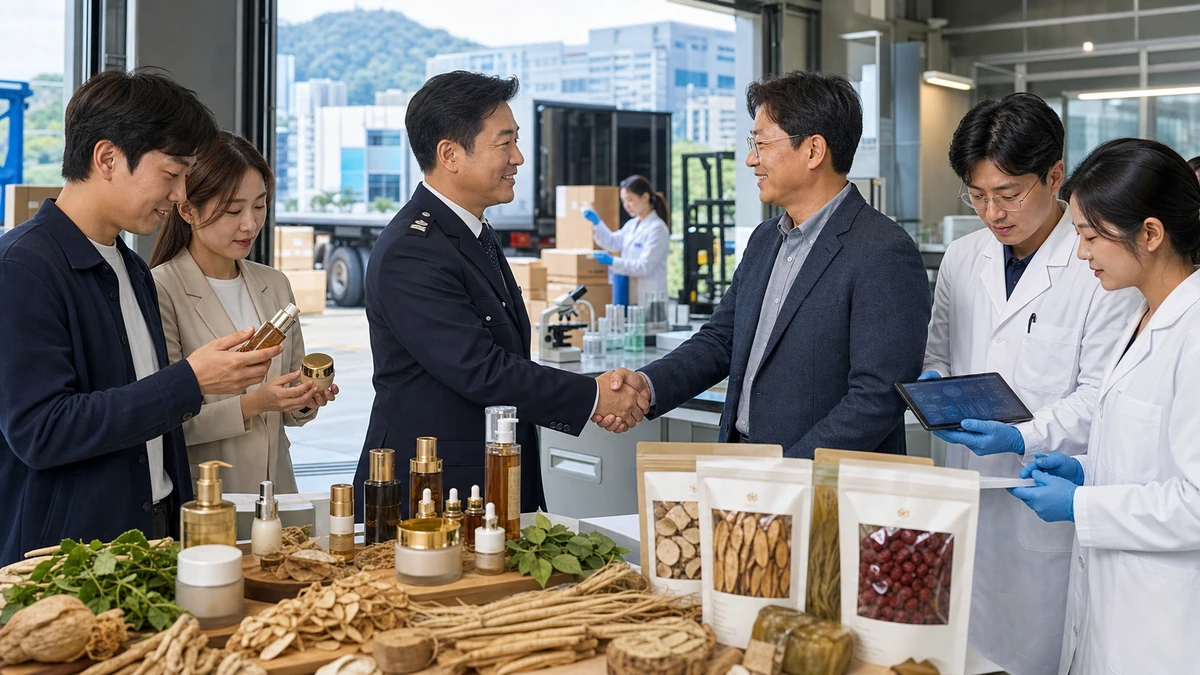
Image to help understand the article
Daegu Initiative Seeks to Turn Korean Traditional Medicine Into Export Products
South Korea is looking beyond its major technology companies and entertainment exports to build new global industries around a different kind of national asset: traditional medicine. In the southeastern city of Daegu, a new partnership between the Daegu Main Customs Office and Daegu Haany University aims to help local small and midsize companies bring Korean-inspired health and wellness products to overseas consumers.
The cooperation centers on the university’s “K-Medi Silk Road Project,” an initiative designed to combine Korean traditional medicine, biotechnology and digital technology into products that can compete in international markets. The partnership reflects a broader South Korean strategy of helping regional businesses move from domestic production toward global branding and exports.
For many Americans, the term “K-Medi” may be unfamiliar. It refers broadly to Korean medicine-related industries based on traditional Korean medical knowledge, including herbal ingredients, wellness products and related technologies. While traditional Korean medicine has roots stretching back centuries, South Korean companies are increasingly attempting to modernize these concepts through scientific research, digital tools and consumer products.
The Daegu project is not simply about preserving historical practices. Its goal is to transform traditional knowledge into modern products, particularly in areas such as cosmetics and food, where Korean companies have already built international recognition through the wider popularity of K-beauty and Korean lifestyle brands.
From Ancient Practices to Modern Consumer Products
The project’s central idea is that traditional Korean medicine can become part of a modern global wellness economy. In recent years, consumers around the world have shown growing interest in products connected to natural ingredients, preventive health and personalized wellness. South Korean companies are attempting to position K-Medi products within that global trend.
Daegu Haany University is working with regional businesses to combine traditional medicine concepts with biotechnology and digital technologies. The university’s role is to provide research capabilities and educational expertise, while companies develop products that can reach consumers.
The partnership highlights an important shift in South Korea’s regional economic model. Instead of individual small businesses attempting to enter foreign markets alone, universities, government agencies and companies are creating shared systems that can reduce the barriers of international expansion.
For overseas consumers, Korean traditional medicine may require additional explanation. Unlike South Korea’s globally familiar entertainment exports such as K-pop and Korean dramas, traditional medicine is not yet widely understood in many Western markets. Companies seeking international success will need to explain their ingredients, research methods and product benefits clearly while navigating different regulations and consumer expectations.
That challenge also represents an opportunity. A product connected to Korean cultural heritage can offer a stronger identity than a generic health or beauty product. Similar to how Japanese skincare, Mediterranean diets and Scandinavian wellness concepts have developed recognizable global images, Korean companies hope to build a distinctive identity around K-Medi.
Why Customs Officials Are Part of the Export Strategy
The involvement of the Daegu Main Customs Office is a notable part of the initiative. Customs agencies are typically associated with border inspections and trade administration, but in South Korea they also provide support programs designed to help businesses participate in international commerce.
Under this cooperation, the customs office will assist companies involved in the project as they prepare for overseas expansion. While specific programs, target countries and export figures have not been announced, the partnership shows an effort to connect product development with the practical realities of global trade.
For small and midsize companies, creating a competitive product is only one step in entering foreign markets. Businesses must also understand export documentation, customs procedures, international regulations and market-specific requirements. These challenges can be especially difficult for smaller firms without large international teams.
The partnership creates a structure where each participant contributes different expertise. The university supports research and innovation, businesses develop commercial products and customs officials help connect those products with international trade systems.
The success of the project will depend on whether these ideas lead to actual products, overseas sales and sustainable business growth. At this stage, the announcement represents the creation of an export support framework rather than evidence of completed commercial success.
What South Korea’s K-Medi Strategy Means for the United States
The United States is one of the world’s largest consumer markets for beauty, wellness and health-related products, making it a potentially important destination for Korean companies exploring K-Medi exports. American consumers have already become familiar with Korean products through the rise of K-beauty, Korean food trends and the global popularity of Korean culture.
The expansion of K-Medi could represent another stage in the evolution of the Korean Wave, or “Hallyu,” the term used to describe the worldwide spread of Korean cultural influence. While early international attention focused heavily on music and television, South Korea has increasingly promoted a broader lifestyle ecosystem that includes food, cosmetics, tourism and wellness.
In the United States, Korean beauty brands have gained attention among consumers interested in skincare routines, innovative ingredients and new approaches to personal care. A K-Medi export strategy could attempt to build on that existing awareness by introducing products connected to Korean herbal traditions and wellness concepts.
However, entering the U.S. market also presents challenges. American consumers and regulators often require clear information about ingredients, scientific evidence and product claims. Companies promoting traditional medicine-based products must carefully communicate the difference between cultural heritage, wellness concepts and medical claims subject to regulatory review.
The U.S. market also has strong competition from domestic wellness companies, global beauty corporations and other international brands. For Korean businesses, success may depend not only on the uniqueness of their cultural background but also on product quality, transparency and effective branding.
The Daegu initiative reflects a trend that American industries have also experienced: universities and research institutions increasingly working with small companies to commercialize new ideas. Similar partnerships exist across the United States in fields ranging from biotechnology to consumer technology, where academic research becomes the foundation for market products.
For U.S. businesses, the development of K-Medi could create opportunities for partnerships, distribution agreements and cross-border innovation. Korean companies looking abroad may seek American retail channels, research collaboration or regulatory expertise as they expand.
Regional Growth and the Future of Korea’s Export Economy
The Daegu partnership is also part of a larger effort by South Korea to strengthen regional economies. For decades, South Korea’s global economic image has been dominated by large corporations headquartered in Seoul and other major cities. Companies such as Samsung, Hyundai and LG have shaped the country’s reputation as an industrial and technological powerhouse.
But policymakers have increasingly focused on helping smaller regional companies participate in global markets. Local universities can serve as innovation centers, while government agencies can provide support that individual businesses may not have the resources to develop themselves.
Daegu’s approach uses the city’s existing connection to traditional Korean medicine as a foundation for new industries. By combining cultural heritage with modern science, the project attempts to create products that are both locally rooted and internationally relevant.
Other Korean regions are pursuing similar strategies in different industries. Some focus on food exports, others on cosmetics, tourism or advanced manufacturing. The common goal is to create regional brands that can compete beyond South Korea’s domestic market.
The comparison with the United States is useful because American economic growth has often relied on regional innovation hubs. Cities and states develop specialized industries based on local strengths, whether biotechnology in Boston, entertainment in Los Angeles or technology in Silicon Valley. South Korea’s regional export efforts are attempting to build similar connections between local expertise and global demand.
A New Test for Korean Cultural and Business Soft Power
The K-Medi Silk Road Project represents a broader question facing South Korea: how can the country continue expanding its global influence beyond entertainment?
K-pop and Korean dramas have introduced millions of people worldwide to Korean culture. The next phase of the Korean Wave may involve products and industries that connect cultural identity with everyday consumer experiences.
Traditional medicine-based cosmetics, food products and wellness items could become another way for international consumers to engage with Korea. But unlike a song or television series, these products must compete directly in markets where consumers demand measurable value, safety and consistency.
The Daegu partnership does not guarantee global success, and many details about future products and export destinations remain unknown. Yet it demonstrates an important experiment: using universities, government support and local businesses together to transform cultural knowledge into modern economic opportunities.
For American consumers and companies watching Korea’s next export ambitions, K-Medi offers a glimpse into how the country is seeking to redefine its global identity. The future of Korean exports may not only be found in electronics, entertainment or automobiles, but also in the intersection of heritage, science and wellness.
Comments
Post a Comment