South Korea’s Latest AI Agriculture Contest Shows How Public Data Is Becoming Startup Fuel — and Why the U.S. Should Pay Attention
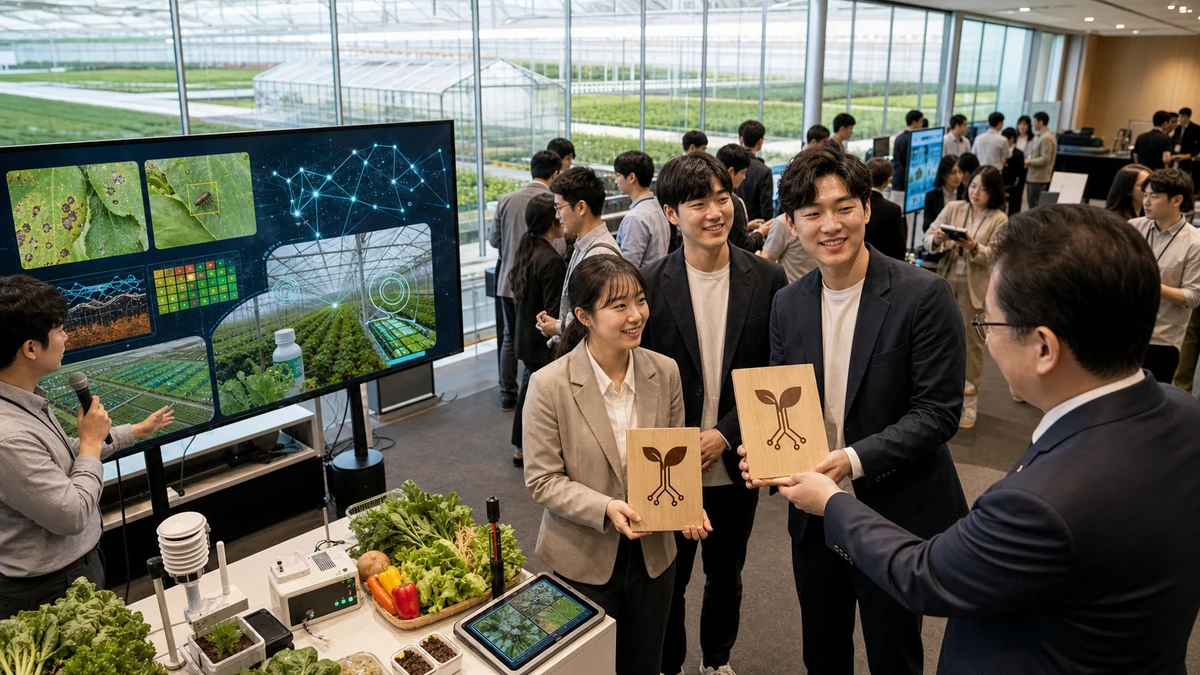
Image to help understand the article
South Korea’s farm sector is being recast as a data business
South Korea’s Rural Development Administration, a government agency that plays a central role in agricultural research and extension, said it selected 18 winners in its 11th annual startup competition focused on agricultural and rural public data and artificial intelligence. On paper, that may sound like a niche government contest. In practice, it offers a revealing snapshot of a much bigger shift underway in one of America’s closest allies: agriculture is no longer being treated only as a traditional production industry, but increasingly as a market for software, machine learning and data-driven services.
The numbers are what make the story noteworthy. The competition drew 290 teams this year, up from 185 a year earlier — a jump of 56.8%. Of those, 190 teams entered the idea-planning category and 100 entered the product-and-service development category. That mix matters. It suggests not only that developers and entrepreneurs see opportunities in Korean agriculture, but that the pipeline runs from rough concepts to more commercialized offerings. In other words, this is not simply a university-research exercise or a one-off government showcase. It is evidence of an emerging startup ecosystem around farming technology.
For American readers, the closest comparison may be the way Silicon Valley and U.S. agribusiness gradually converged over the past decade around precision agriculture, remote sensing, farm management platforms and predictive analytics. In the United States, companies have long tried to turn weather data, satellite imagery and equipment telemetry into tools that help farmers decide when to plant, irrigate, spray or harvest. South Korea appears to be accelerating a similar transition, but with a particularly strong role for government-held public data.
That is significant because farming, whether in Iowa or in rural South Korea, generates decision-heavy work. Growers have to make repeated judgments about soil conditions, pests, disease pressure, chemical safety, crop timing and greenhouse management. Those decisions are often fragmented across different information sources and shaped by local conditions. When public datasets can be organized and paired with AI tools, that scattered information becomes something entrepreneurs can actually build on. The Korean contest’s growth suggests more founders are now trying to do exactly that.
The agency’s announcement also points to something broader than a single awards ceremony. Competitions like this often function as a barometer. They do not prove which startup will become a viable business, and they do not guarantee that a wave of entries will turn into lasting companies. But they do show where talent is gathering, where institutional support is increasing and where government believes innovation can be commercialized. In that sense, this contest says something important about how South Korea sees the future of its agricultural economy.
Why public data matters more than the prize list
The most telling detail may be that nine of the 18 winning entries — exactly half — used public data from the Rural Development Administration. Those datasets included information tied to farming techniques, pest and disease management, pesticide safety, soil environments and smart farming. In agriculture, those are not trivial inputs. They are the kinds of information that can be costly, slow or nearly impossible for a startup to assemble from scratch at meaningful scale.
That is why public data policy matters here as much as AI. Government agencies often talk about “open data” in abstract terms, but the real test is whether that information becomes economically useful. South Korea’s results suggest that some of its agricultural data is beginning to move from administrative storage into the startup economy. That is the crucial transition. Data does not create much value by sitting in a portal. It becomes valuable when founders can turn it into a service that solves an actual problem in the field.
For example, soil and crop-environment data can support recommendation tools that help growers make better production decisions. Pest and disease information can feed early-warning systems or risk-management apps. Pesticide safety data can underpin tools that help farmers or agribusiness operators comply with regulations and reduce errors. Smart-farm data — a term that in Korea generally refers to digitally managed agricultural operations, often including sensor-equipped greenhouses and automated systems — can be used to optimize production conditions and improve decision-making during cultivation.
American readers will recognize the same logic from other sectors. Public weather data from the U.S. government helped power private weather apps and forecasting businesses. Public GPS infrastructure became the backbone of huge commercial industries. Publicly funded health research regularly becomes the starting point for private-sector innovation. South Korea’s agricultural case fits that pattern: the state builds and maintains data resources that individual startups could not easily replicate, and private founders build practical products on top of them.
That does not mean every startup built on public datasets will succeed. The contest itself underlines that point. Out of 290 teams, only 18 won awards. That low selection rate shows that access to data is only one part of the equation. The more difficult challenge is creating something farmers or rural businesses actually want to use. In agriculture, solutions often fail when they are technologically elegant but poorly matched to on-the-ground realities. The Korean competition’s judging process, at least in theory, is meant to identify teams that combine technical ability with field relevance.
What the jump in entries says about the AI moment in agriculture
The rise from 185 teams to 290 in just one year is not just a larger turnout; it is a sign of changing market psychology. Startup founders usually go where they think the next viable opportunity may be. A 56.8% increase suggests that more entrepreneurs now see agriculture and rural services as a place where AI can be applied, funded and potentially commercialized. That is notable in a country where global attention tends to focus much more on semiconductors, autos, shipbuilding, beauty products and K-pop than on farming.
One reason may be that AI has widened the range of problems people think software can tackle. In earlier waves of agricultural technology, some tools required expensive hardware, large enterprise customers or long adoption cycles. Today, founders can build models and decision tools that sit on top of existing datasets and deliver narrower but highly practical uses. The Korean summary makes clear that this year’s entries were not confined to one slice of agriculture. They extended across farming techniques, pest and disease control, pesticide safety, soil conditions and smart-farm operations. That spread matters because it suggests the market is broadening, not clustering around one fashionable niche.
It is also telling that 100 teams entered the product-and-service development category, not just the idea category. That means a substantial number of participants came with something closer to implementation than to a slide deck. In startup ecosystems, that is often where the real signal lies. Plenty of people can imagine how AI might reshape an industry. Fewer can build a product, test it against users and present it as something that could survive in a commercial market. The balance between 190 idea-stage teams and 100 development-stage teams suggests South Korea is cultivating both ends of the pipeline.
Still, the moment calls for caution as well as enthusiasm. The AI label can attract attention faster than it produces durable businesses. Agriculture is especially unforgiving in that respect. Farmers usually adopt new tools when they save time, reduce risk, improve yields, help with compliance or lower costs. They do not adopt them because the technology sounds futuristic. So the real question is not whether Korean startups can generate interest, but whether they can create repeatable value in the field. The contest winners may become leading examples, but they are still only early indicators.
Even so, the broader trend is hard to ignore. When a country’s agricultural agency can draw hundreds of teams into a contest built around data and AI, it suggests the mental map of the sector is changing. Agriculture is no longer being viewed only as land, labor and machinery. It is increasingly being treated as an information environment — one where the quality, accessibility and usability of data may shape competitiveness as much as traditional inputs do.
Why this matters in the United States
For the United States, this story lands at the intersection of food security, technology competition and the deepening economic relationship with South Korea. Americans already know South Korea as a cultural and industrial heavyweight — home to Samsung, Hyundai, Oscar-winning cinema, globally dominant pop acts and one of the world’s most digitally connected societies. What gets less attention is how Korean institutions are applying similar digital strengths to sectors Americans might consider old-economy industries. Agriculture is one of them.
That matters because the United States and South Korea are not just security allies; they are increasingly intertwined in technology supply chains and innovation policy. In recent years, the bilateral relationship has widened well beyond military cooperation to include semiconductors, batteries, clean energy and advanced manufacturing. Agricultural technology does not usually command the same headlines, but it belongs in that conversation. If South Korea succeeds in turning public agricultural data into startup growth, American companies, investors, university researchers and policymakers will have reason to watch closely.
There are several possible implications for the U.S. market. First, Korean agricultural AI startups could eventually look abroad, especially if they build software tools rather than highly localized physical infrastructure. Some applications, such as risk analysis, greenhouse optimization or compliance support, can travel across borders more easily than farm machinery can. Second, U.S. agribusiness and ag-tech firms may find Korean partners attractive because South Korea is combining advanced digital capacity with a concentrated and policy-supported innovation ecosystem. Third, this trend could sharpen competitive pressure on American institutions to make public agricultural data more usable, interoperable and startup-friendly.
There is also a consumer and audience angle. American interest in South Korea has grown dramatically through the Korean Wave, or Hallyu, a term used to describe the global spread of Korean entertainment and culture. That cultural familiarity has made U.S. audiences more receptive to Korean stories that extend beyond music and television. The next phase of Korea coverage in America increasingly includes industry, technology and policy — and agriculture can fit into that broader narrative of a country exporting not just culture and electronics, but models of digital modernization.
For U.S. policymakers, the Korean contest raises a familiar question: what is the right balance between public-sector data stewardship and private-sector innovation? In the United States, that debate plays out across health care, transportation, climate and agriculture. Korea’s experience suggests that when a government agency makes specialized datasets accessible and startups have incentives to build on them, the result can be a more dynamic innovation pipeline. That does not automatically translate across countries, especially given differences in farm scale, regulation and market structure. But it offers a case study Americans should not dismiss.
Public-sector data and private startups: a model with broader appeal
One of the clearest themes in the Korean competition is that innovation does not have to start with a garage startup acting alone. In this model, the state is not replacing the market; it is supplying infrastructure the market can use. That infrastructure is informational rather than physical. The Rural Development Administration has accumulated data through research, administration and field-level agricultural work. Startups then use that material as a production input for products and services.
This is a useful corrective to a common American assumption that innovation is always best understood as a purely private-sector story. In reality, many of the most commercially transformative technologies have depended on public investment or public systems at some stage. In agriculture, where data quality can be highly dependent on long-term institutional collection and standardization, the public role can be especially important.
South Korea’s contest shows how that relationship can be structured as a pipeline. Open the data. Encourage ideas. Reward teams that move from concept to usable product. Then push the strongest performers into a larger national competition. According to the agency, four of this year’s top entries will advance in September to a government-wide startup competition organized by the Ministry of the Interior and Safety. That step matters because it moves agricultural ideas into a broader innovation arena, where they can be compared with projects from other sectors and tested for wider applicability.
For American readers, it may help to think of this as the difference between a vertical incubator and a cross-industry showcase. The agricultural contest helps surface solutions grounded in sector-specific problems. The broader government competition then asks whether those solutions can compete in a wider public-data startup ecosystem. That two-stage process can help filter ideas without isolating agriculture from the rest of the digital economy.
There is a strategic dimension here as well. Countries that can turn public research and administrative knowledge into commercially useful data assets may have an advantage in the next phase of AI adoption. Not because they control all innovation, but because they reduce the cost and friction of experimentation. The Korean case suggests agriculture is becoming one of the proving grounds for that approach.
What to watch next in South Korea’s ag-tech push
The most important question now is not how many teams entered this year’s contest, but how many of those ideas survive contact with the market. The summary of the competition points to this challenge directly. A large idea pool is encouraging, but sustainable industrial results will depend on whether idea-stage teams can mature into product-stage companies and whether product-stage teams can find real users.
That means several next indicators will matter more than the award ceremony itself. One is follow-through: whether the 190 idea-planning teams generate more deployable products over time. Another is adoption: whether farmers, cooperatives, rural businesses or agricultural institutions actually use the winning services. A third is scalability: whether tools built around Korean public data can expand geographically or commercially, or whether they remain too narrow to support durable companies.
It will also be worth watching how the winners perform in the broader government competition this fall. If agricultural entries do well there, it would strengthen the argument that farm-sector AI is not an isolated specialty but part of a larger national pattern in data-driven entrepreneurship. If they struggle, that may suggest agricultural solutions remain highly context-specific, valuable within their niche but harder to generalize.
Another issue is whether public-data access continues to improve. Startup ecosystems often depend less on one year of excitement than on institutional reliability. Founders need to believe datasets will remain available, updated and usable. If Korean agencies keep expanding data accessibility and standards, they may reinforce the positive cycle described in the contest summary: data release leads to ideas, ideas lead to services and services help solve problems in the field.
For American observers, that is the deeper lesson. South Korea’s agricultural AI contest is not just a local story about 18 winning projects. It is a window into how a technologically advanced U.S. ally is trying to modernize a legacy sector through public information assets, entrepreneurial competition and AI tools. That approach will not replace the hard realities of farming, and it will not guarantee startup success. But it does show that the future of agriculture may be shaped as much by data architecture and software ecosystems as by seeds, chemicals and machinery.
In the U.S., where agricultural innovation is often discussed in terms of equipment, biotech or supply chains, South Korea’s example is a reminder that another contest is underway: the competition to turn public knowledge into private problem-solving. If Seoul is moving more quickly to connect government-held agricultural data with startup formation, American institutions may have reason to ask whether they are doing enough to support the same kind of translation. The answer will matter not only for technology policy, but for the future competitiveness of farming itself.
Comments
Post a Comment