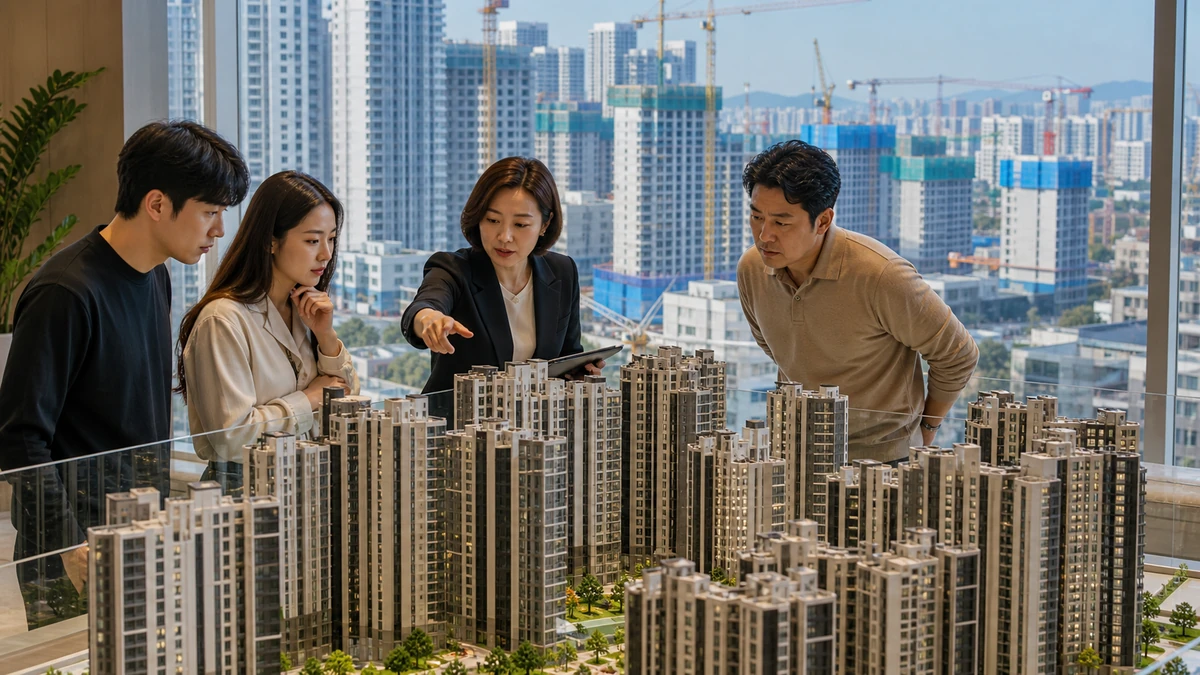
Image to help understand the article
South Korea’s Apartment Market Enters Another Phase of Urban Renewal
South Korea is preparing to launch sales for 3,788 new housing units across five apartment complexes during the third week of August, offering a snapshot of how one of Asia’s most densely populated economies is reshaping its cities. While the number may appear modest compared with the scale of the U.S. housing market, the announcement reveals a uniquely Korean approach to housing supply: a system where new homes are often allocated before completion through a public application process known as “cheongyak,” or apartment subscription.
According to data compiled by real estate information provider Real Estate 114 and reported by Yonhap News Agency, 2,469 of the 3,788 units will be available as general sales. The distinction matters because the total number of apartments in a development does not represent the number available to ordinary buyers. Some units may already be assigned through other housing programs or reserved under different ownership structures.
For international observers, including American readers, South Korea’s housing market can seem unfamiliar. Unlike the typical U.S. model, where buyers often purchase completed homes through real estate agents and mortgage lenders, Korea’s apartment market frequently involves buyers competing for newly built units through regulated subscription systems. These developments are closely tied to government housing policy, urban planning, and efforts to modernize older neighborhoods.
Seoul’s Reconstruction Strategy: Building New Homes Inside an Existing City
The most notable project in this week’s housing schedule is Summit Clavion in Singil-dong, Yeongdeungpo District, Seoul. The project is being developed by Daewoo Engineering & Construction through the reconstruction of the Singil No. 10 Redevelopment Promotion Zone.
This type of project represents a major feature of Seoul’s housing strategy. Unlike American-style suburban expansion, where cities often grow outward through new developments on previously undeveloped land, Seoul has limited space available for expansion. As a result, many new housing projects involve rebuilding older neighborhoods from within the existing city.
The term “redevelopment promotion zone” refers to a Korean urban planning framework designed to transform aging residential areas through large-scale improvements. These projects typically involve replacing older buildings with modern apartment complexes while upgrading surrounding infrastructure. The goal is not simply to add more homes but to reorganize urban space in areas where transportation networks, schools and commercial districts already exist.
For Americans familiar with urban renewal projects in cities such as New York, Boston or San Francisco, the concept may feel somewhat recognizable. However, South Korea’s apartment reconstruction system operates on a much larger scale. Entire neighborhoods can be redesigned around high-rise apartment communities, reflecting Korea’s preference for dense residential development.
Summit Clavion therefore represents more than another apartment launch. It reflects a broader national challenge: how to create more housing in highly competitive metropolitan areas where land is scarce and demand remains concentrated.
From Central Seoul to Bucheon: A Wider Metropolitan Housing Competition
The August housing schedule also includes the Xi Renaisance-style apartment project Chungjeongno Station Xi Renaisance in Jung District, Seoul, and Doosan We've The Zenith Bucheon in Sosa District, Bucheon City, located in neighboring Gyeonggi Province.
The inclusion of both Seoul neighborhoods and a nearby satellite city highlights the importance of the greater Seoul metropolitan area. For many Korean households, housing decisions are not limited to administrative borders. A buyer considering a home in Seoul may also compare options in surrounding cities where transportation connections allow access to the capital’s jobs and cultural centers.
Bucheon, like many cities surrounding Seoul, has become part of a broader metropolitan housing ecosystem. Millions of residents commute between Seoul and surrounding areas, creating demand for new residential developments beyond the capital itself. The competition for housing is therefore not simply a Seoul issue but a regional one.
At the same time, available information about these individual projects does not provide enough detail to determine their future prices, demand levels or investment potential. Factors such as apartment size, transportation access, financing conditions and government regulations typically influence buyer interest in Korea’s housing market.
What can be observed is the pattern: new housing supply is emerging through multiple channels at once. Some projects replace aging urban neighborhoods, while others expand residential choices in nearby cities. Together, they show how South Korea is attempting to balance limited land availability with continued demand for modern housing.
What This Means for the United States: Lessons From Korea’s Housing Model
The developments in Seoul and its surrounding cities offer several points of comparison for the United States, where housing affordability has become a major political and economic issue. American cities from Los Angeles to New York have struggled with limited housing supply, rising prices and debates over how to increase residential construction in established communities.
South Korea’s approach demonstrates one possible response to urban housing pressure: rebuilding existing neighborhoods at higher density. While the American housing market generally relies more heavily on private transactions involving existing homes, Korea’s apartment sector shows how coordinated redevelopment can become a central tool for adding housing in major metropolitan areas.
However, the Korean model also reflects different cultural and economic conditions. Apartment living is far more dominant in South Korea than in many parts of the United States. In cities such as Seoul, high-rise apartment complexes are not viewed simply as compromises caused by limited space; they are often considered desirable communities with shared facilities, security systems and convenient access to urban services.
American companies and investors watching Asian real estate trends may find Korea’s redevelopment experience relevant, particularly as U.S. cities debate transit-oriented development and higher-density housing. The comparison is not a direct blueprint, because American cities have different land policies, zoning systems and consumer preferences. Still, Korea provides a case study in how dense metropolitan areas can attempt to increase housing supply without expanding endlessly outward.
The story also reflects the strength of the U.S.-South Korea relationship beyond traditional areas such as technology, security and trade. Housing, construction technology, smart-city development and urban infrastructure are increasingly connected industries where both countries face similar challenges. American companies involved in architecture, engineering, construction technology and urban planning may continue to watch how Korean firms approach large-scale redevelopment.
Why New Apartments Matter So Much in Korean Society
To understand the importance of apartment launches in South Korea, it is necessary to understand the cultural role of housing. For many Korean families, owning a home is closely associated with financial security, social stability and long-term planning. Apartments, particularly in major metropolitan areas, are often seen as both living spaces and important financial assets.
This has made apartment subscription competitions a significant social event. Prospective buyers carefully monitor announcements, study eligibility rules and compare locations. Government policies frequently adjust these systems in response to concerns about affordability, speculation and unequal access.
The popularity of new apartments is also linked to Korea’s rapid economic transformation. Over several decades, South Korea moved from a largely industrializing economy into a global technology and cultural powerhouse. The transformation of urban neighborhoods has been part of that story, with older districts frequently replaced by modern residential developments.
For global audiences familiar with South Korea through K-pop, Korean films and technology brands, the housing market offers another window into the country’s modern identity. Behind the international image of Seoul as a center of entertainment and innovation is a city constantly rebuilding itself to accommodate millions of residents.
A Housing Trend to Watch Beyond One Week’s Sales Calendar
The 3,788 apartments scheduled for release in August are not large enough to change South Korea’s housing market on their own. Their significance lies in what they represent: the continuing evolution of how a densely populated country creates new homes.
The combination of Seoul redevelopment projects and metropolitan-area construction reflects a broader trend. South Korea is increasingly focused on renewing existing urban areas while expanding housing options around major economic centers.
For buyers, the key issue is not only how many homes are supplied but where those homes are located and how they are created. A newly built apartment in a redeveloped central neighborhood carries a different meaning from a new development on the metropolitan edge.
For international observers, including Americans, South Korea’s apartment market provides a valuable example of the challenges facing modern cities worldwide. As populations concentrate in urban areas and housing affordability becomes a global concern, the question of how to build more homes while preserving livability will remain central.
The latest Korean apartment sales schedule is therefore more than a list of upcoming housing projects. It is a glimpse into the future of urban development in a country where space is limited, demand is high and cities are continuously reinventing themselves.
Comments
Post a Comment