Image to help understand the article
A young champion steps back into the spotlight
South Korean pistol shooter Oh Ye-jin is heading to the next Asian Games with a chance to compete for as many as five medals, an eye-catching number in any sport. But the most revealing part of her latest appearance before reporters was not the medal math. It was the candor.
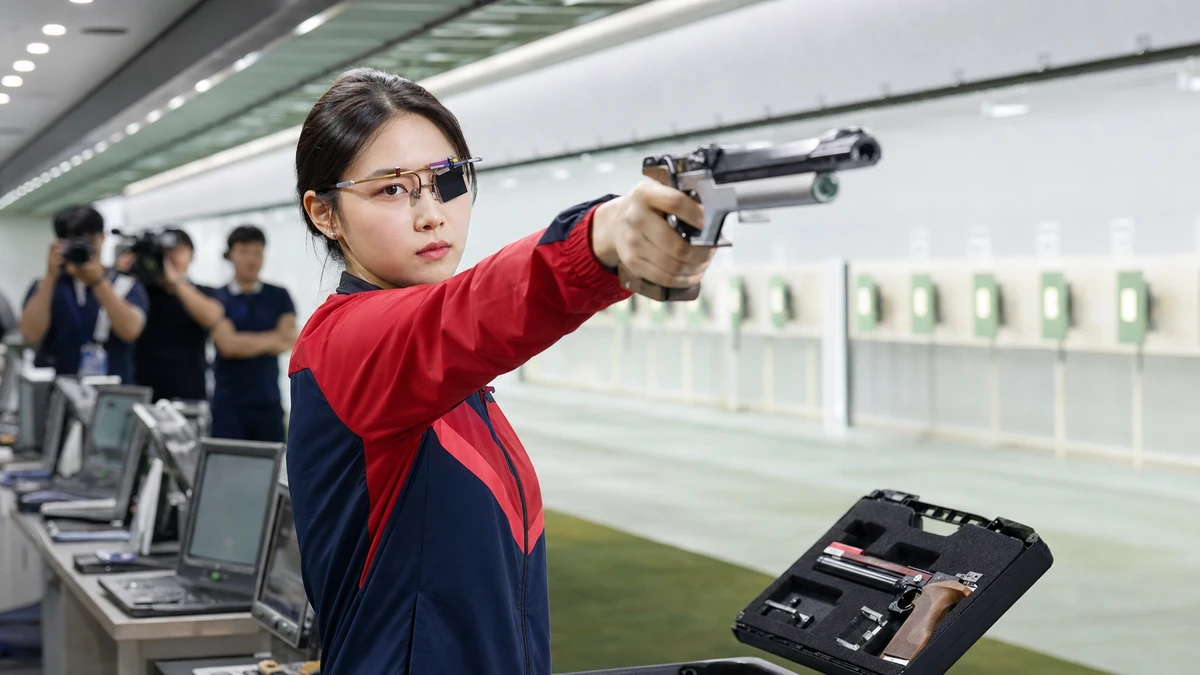
At a national team media event held July 10 at South Korea’s training center in Jincheon, a county south of Seoul that functions much like a centralized Olympic complex, the 21-year-old said she has not fully moved past the pressure that came with winning Olympic gold. She said she is working through it little by little.
That admission matters. In elite sports, especially for athletes who break through at a young age, the public often treats a gold medal as both the finish line and the beginning of a new burden. One title can instantly change how an athlete is seen, how sponsors frame a career and how every future result is judged. A stunning win that should feel liberating can also become the standard that shadows everything after it.
That is the backdrop for Oh’s bid to represent South Korea in both the women’s 10-meter air pistol and 25-meter pistol events at the Aichi-Nagoya Asian Games. She secured spots in both disciplines, giving her opportunities in individual events, team events and a mixed event. On paper, that opens the door to five medals. In reality, it means multiple days of narrow margins, mental strain and the kind of self-control that makes shooting one of the most psychologically demanding sports on the Olympic program.
For American readers more familiar with household Olympic names in swimming, gymnastics or track and field, shooting can look static on television. It is anything but. The drama is internal rather than theatrical. There are no roaring collisions, no stopwatch chases visible to the naked eye and no comeback dunks. Instead, athletes fight tremors, breathing patterns, timing and a scoring system where a fraction of a point can separate first from fifth. If basketball is improvisation and sprinting is pure explosion, shooting is closer to an exam taken under a microscope, where every twitch is magnified.
That is why Oh’s words resonated. She did not pretend the pressure was gone. She did not lean on stock confidence or rehearsed bravado. Instead, she offered something more compelling: the portrait of a champion trying to compete as herself again, not merely as a replay of her greatest moment.
Why the Asian Games matter so much in Asia
To audiences in the United States, the Asian Games may not command the same attention as the Olympics, the NCAA tournament or the Super Bowl. In much of Asia, however, the event carries enormous weight. Often described as the region’s version of the Olympics, the Asian Games bring together athletes from across the continent in a sprawling multi-sport competition that is both deeply competitive and politically symbolic.
For countries such as South Korea, China and Japan, the games are not a secondary exhibition. They are a major proving ground, one where regional rivalries are intense and national expectations run high. A gold medal there can elevate an athlete’s profile dramatically at home. Even making the team is significant, particularly in sports where national depth is strong and qualification is fiercely contested.
The upcoming edition, to be hosted by Japan in Aichi and Nagoya, will carry an additional layer of meaning for South Korean athletes. Japan is one of South Korea’s closest neighbors and also one of its most enduring rivals in sports, culture and geopolitics. Competition between the two countries often draws outsized interest, much as a U.S.-Canada hockey game or a U.S.-Mexico soccer match does in North America, though the regional history in East Asia adds a more complicated undertone.
For Oh, then, this is not simply another stop on the shooting calendar. It is a stage where an Olympic champion will be measured not only against opponents, but against public memory. In South Korea, sports stars often become national symbols quickly, especially after Olympic success. The celebration can be enormous. So can the scrutiny that follows.
That scrutiny is intensified by South Korea’s sports culture, which often places a premium on discipline, national representation and collective pride. Athletes are admired for individual excellence, but they are also seen as carrying the country’s image abroad. That dynamic can produce extraordinary focus and support. It can also make personal pressure feel national in scale.
Oh’s situation captures that tension. She is still young enough to be viewed as the future of the sport, yet accomplished enough to be treated as its present-day standard-bearer. The Asian Games will test not just whether she can win again, but how she handles being expected to win again.
Five medal chances, and five different kinds of pressure
The headline number surrounding Oh is five. Because she qualified in both 10-meter air pistol and 25-meter pistol, she can potentially compete in individual and team events in both disciplines, plus the mixed event in 10-meter air pistol. That creates up to five medal opportunities.
In sports coverage, numbers like that have a way of snowballing into expectation. American fans see it in swimming whenever a star is said to have a path to six or seven medals, or in gymnastics when a top all-around contender is suddenly discussed as a medal favorite on every apparatus. But more events do not simply mean more chances to win. They also mean more emotional resets, more physical preparation and more moments when a single bad series can derail momentum.
That is especially true in shooting, where the events may involve related skills but are not interchangeable. The 10-meter air pistol event demands refined control in a compressed setting, while the 25-meter pistol event introduces a different rhythm, distance and tactical adjustment. Competing well in both requires versatility, not just consistency.
Then there is the challenge of changing formats. Individual events ask an athlete to narrow the world to personal execution. Team events require synchronization of performance and composure within a shared result. Mixed events add another relational layer, where one athlete’s rhythm can affect the overall emotional temperature of the pair. Even for elite competitors, toggling among those roles is not automatic.
That helps explain why Oh’s bright response to a joking question from reporters stood out. When told that winning five gold medals might leave her neck feeling heavy, she answered cheerfully: “Five golds at the Asian Games? Fighting!” The Korean word or expression often rendered in English as “fighting” is not about combat. In Korean everyday speech, it is a common encouragement, roughly meaning “You can do it,” “Let’s go,” or “Hang in there.” It is the sort of thing friends say before exams, coworkers say before a big project and fans shout from the stands.
In context, Oh was not declaring five gold medals a certainty. She was doing something subtler and arguably more mature: refusing to let a big, flashy number become a trap. Rather than rejecting ambition or inflating it, she met it with humor and energy. That may sound small, but for an athlete navigating post-Olympic expectations, it can signal a healthier relationship with pressure.
Fans and media are naturally drawn to medal projections because they make for easy storylines. But in a sport decided by tiny deviations, the more meaningful question may be whether Oh can preserve her rhythm across multiple starts. Five medal opportunities can be a gift. They can also be five separate tests of emotional balance.
The hidden mental battle inside precision shooting
At the same media event, South Korea shooting head coach Jang Gap-seok underscored a reality every elite marksman understands: the sport allows almost no margin for error. In shooting, he said, even a 0.1-point difference matters, and in the end the contest becomes a fight against oneself.
That line is useful for anyone trying to understand why accomplished shooters often talk more about calmness than aggression. In many sports, athletes respond to pressure by becoming more outwardly assertive. In shooting, overtrying can be a problem. A champion must summon intensity without tension, urgency without haste and confidence without forcing the shot.
For an Olympic gold medalist, the mental challenge can become even more layered. Success does not erase vulnerability; it often reorganizes it. Before a breakthrough, an athlete may fear not making the podium. After a breakthrough, the fear can become not living up to the image created by that medal. Every less-than-perfect result risks being interpreted not as part of sport’s normal volatility, but as a sign of decline.
That is one reason Oh’s acknowledgement that she has not completely overcome the burden of her gold medal feels realistic rather than alarming. Elite performance is rarely a straight line. Athletes do not simply level up emotionally and stay there. They revisit pressure in new forms. They learn to carry it, set it down, pick it up again and eventually integrate it into their routine.
In the United States, conversations around mental health in sports have become more visible in recent years, from Simone Biles speaking openly about the psychological toll of competition to tennis players discussing burnout and anxiety. South Korea has had its own ongoing reckoning with pressure in sports and entertainment, though public discussion has often been more reserved. That makes forthright comments from a young national star especially notable.
There is also a misconception that shooters, because they appear still and composed, are somehow insulated from emotion. In truth, the stillness is the product of emotional management, not the absence of feeling. A shooter standing alone on the line may look serene, but underneath that posture can be a swirl of calculation, memory and self-correction. A fractionally rushed trigger, a slightly altered breathing cycle or a moment of intrusive thought can show up immediately on the scoreboard.
For Oh, the task is not to erase the fact that she is an Olympic champion. That title is now part of her career forever. The challenge is to prevent it from becoming the only lens through which she competes. In a sport where accuracy depends on staying in the present, living mentally inside a past triumph can be just as disruptive as dwelling on a past mistake.
A new generation of Korean women shooters is taking shape
Oh is not alone in carrying those expectations. Also present at the Jincheon media event were Yang Ji-in, 23, who competes in 25-meter pistol, and Ban Hyo-jin, 18, who shoots women’s 10-meter air rifle. Together, they form part of a new wave of young South Korean women shooters whose success has broadened the sport’s profile at home.
That matters because shooting, while respected in South Korea, does not always dominate international headlines the way baseball, soccer, figure skating or archery might. Archery, in particular, has long been one of South Korea’s signature Olympic sports, familiar even to many Americans because of the country’s repeated excellence. Shooting occupies a different lane: prestigious, demanding and often followed more intensely during major competitions than in the day-to-day sports conversation.
When young champions emerge in that kind of environment, they do more than collect medals. They change who gets noticed. They attract younger athletes to the sport. They invite broader media attention and make technical events easier for the public to care about because the personalities become recognizable.
Oh, Yang and Ban also represent something culturally significant in South Korea’s sports system: the rise of very young athletes who achieve world-class results early and must then build durable careers under public gaze. This is a familiar story in the United States too, where teenage gymnasts, young swimmers and early-drafted basketball stars are often asked to mature in public. But in South Korea, where hierarchy, deference and public expectation can shape how athletes speak and behave, the balancing act may look a little different.
Oh’s tone suggests a shift that many modern sports fans will recognize. She is respectful without being robotic. Honest without being melodramatic. Ambitious without pretending certainty. That combination can make her especially compelling to international audiences, because it turns a regional sports story into something universal: what happens after the dream comes true, and how a young person learns to keep competing once the defining moment is already behind her.
The fact that these athletes are women also deserves note. South Korea has produced high-profile female athletes across sports, from figure skating to golf to archery, but each new generation still expands the range of what female sports celebrity can look like. In shooting, success rests on fine motor control, training discipline and mental endurance rather than the physical stereotypes that often shape mainstream sports coverage. That creates space for a different narrative, one centered on precision, patience and interior toughness.
Why this story resonates beyond Korea
For readers outside Asia, it may be tempting to frame Oh’s Asian Games campaign mainly as a medal chase. That is certainly part of the story, and a potentially dramatic one. If she strings together strong performances across multiple formats, she could become one of the standout names of the competition.
But the more enduring appeal of this story lies elsewhere. It is about the strange weight of success at a young age. It is about how public triumph can complicate private focus. And it is about an athlete trying to move from the identity of “gold medal winner” back to the more practical identity every competitor needs on game day: someone who can execute the next shot.
American sports audiences understand that arc instinctively. It shows up whenever a rookie sensation is asked to prove the first season was not a fluke, whenever an Olympic breakout star returns four years later under far brighter lights, or whenever a champion must convince the world and themselves that they are still hungry rather than haunted. The details differ from sport to sport, but the emotional grammar is familiar.
What makes Oh’s case especially compelling is that shooting offers almost nowhere to hide. In a team sport, an off night can be absorbed by others. In a race, a poor start can sometimes be salvaged with sheer physical drive. In precision shooting, the scoreboard records composure with brutal honesty. The athlete cannot bully the event into submission. She has to meet it on its own terms.
That may be why her remarks in Jincheon felt more interesting than conventional medal talk. She did not cast herself as invincible. She cast herself as continuing. For a 21-year-old already carrying Olympic gold, that is a meaningful distinction. It suggests growth not as a highlight reel, but as a process.
There is another reason this story travels well internationally: it speaks to the broader maturation of sports culture around vulnerability. Fans still love winners, and media still reward bold predictions. But there is growing appreciation for athletes who can articulate the cost of excellence without collapsing into self-pity. Oh’s comments fit that modern understanding. She is not asking for lowered expectations. She is simply describing, with unusual clarity, what high expectations feel like from the inside.
More than the shadow of a gold medal
As the Asian Games approach, the easiest storyline will remain the most obvious one: How many medals can Oh Ye-jin win? It is a fair question. Five opportunities are rare, and her résumé ensures attention. Yet that question alone risks flattening what is most human in her return.
The better way to watch may be to see whether she can hold onto the version of herself that surfaced at media day: relaxed enough to laugh, self-aware enough to admit the burden and competitive enough to embrace the challenge anyway. In Korean sports culture, where achievement can quickly harden into expectation, that blend is not trivial. It may be the key to longevity.
Past gold medals do not disappear, and they should not. They honor the athlete’s best work. But no medal fires the next shot. In shooting, as in much of life, reputation can open the door and raise the stakes, but it cannot replace presence of mind. The event will still come down to breath, timing, control and the ability to keep one’s inner world from spilling into the score.
Oh’s campaign in Aichi and Nagoya will unfold one event at a time, one series at a time, one narrow margin at a time. The total medal count, however dazzling or modest, will be the ending. The more revealing story is happening now, in the space between a past triumph and a new beginning.
That story starts with a 21-year-old champion stepping back to the line and refusing to be defined only by what she has already done. It continues with an athlete learning that the weight of a gold medal is not just something to bear, but sometimes something to set down. And it may culminate, if she gets it right, not in a perfect reenactment of the past but in something more difficult and more impressive: competing freely in the present.
For South Korean fans, that makes this a meaningful second chapter. For international readers, it offers a reminder that the most compelling sports stories are not always about dominance. Sometimes they are about recalibration. Sometimes they are about the courage to say the pressure is real and to keep aiming anyway.
Comments
Post a Comment