South Korea’s Planned Robotaxi Rollout With Pony.ai Signals a New Phase in Asia’s Self-Driving Race — and Raises Questions for the U.S.
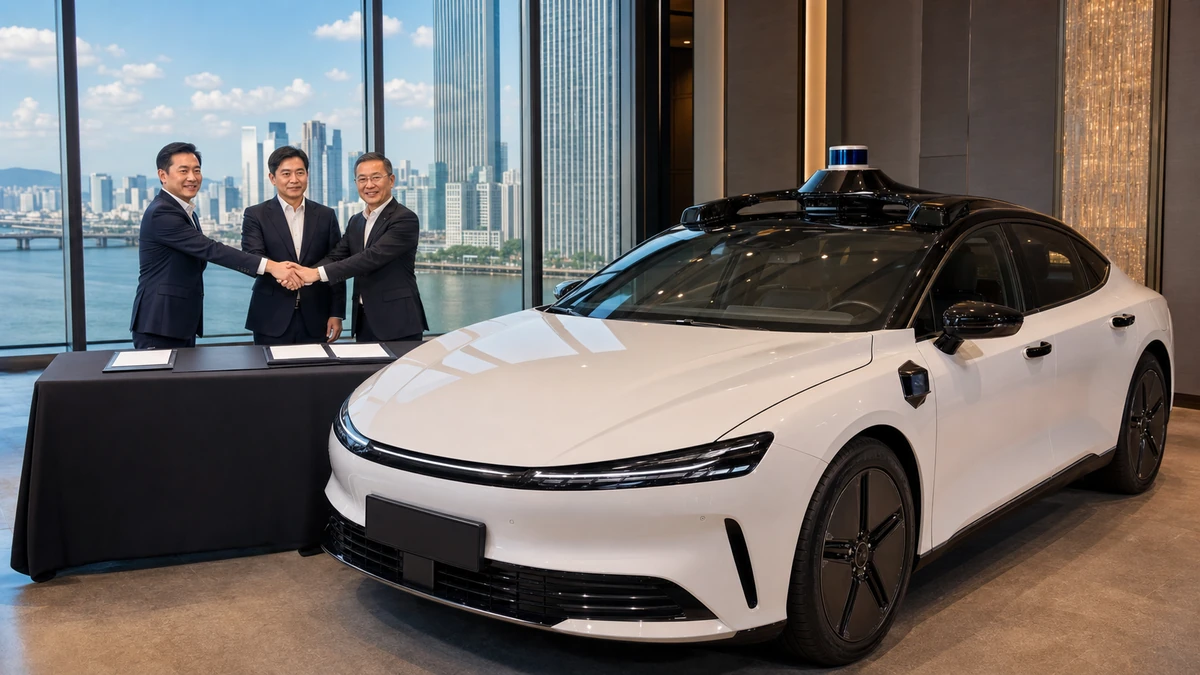
Image to help understand the article
From test loops to a real service
South Korea is preparing for a notable shift in the way autonomous vehicles move from carefully managed demonstrations to something closer to an everyday transportation business. FutureLink, a South Korean autonomous driving operator, said it has signed a strategic partnership with Pony.ai, the Chinese self-driving company, to bring 200 seventh-generation robotaxis into the country for commercial service. The companies say they aim to begin in Seoul around 2028 and then expand to other major Korean cities.
On paper, that number — 200 vehicles — is the obvious headline. In practice, the more important development is what those cars are supposed to represent. This is not just another pilot in which a handful of heavily monitored vehicles circle a designated district while officials and engineers collect data. According to the Korean reporting, the project is meant to convert years of local road testing in Seoul’s Gangnam district into a service regular people can actually hail and ride.
That distinction matters. In the autonomous vehicle business, a successful test is one thing; a dependable transportation service is another. Many companies around the world have shown they can operate self-driving vehicles under selected conditions. Far fewer have shown they can do it at meaningful scale, under local regulations, with public-facing dispatch systems, customer support, maintenance routines and the kind of reliability people expect from a taxi or ride-hailing app.
For American readers, a useful comparison is the gap between seeing a prototype on a conference stage and building a network that can compete with Uber, Lyft or a city cab fleet in daily life. The South Korean project is significant because it suggests Seoul is becoming a proving ground for that next phase — not simply whether autonomous driving works, but whether it can be localized, licensed and operationalized in one of the world’s densest and most technologically wired urban environments.
The agreement was signed in Seoul, and the responsibilities are divided in a way that shows how these cross-border mobility efforts increasingly work. FutureLink is expected to handle vehicle certification in South Korea, market entry and service operations. Pony.ai will supply the autonomous driving technology and support road operations in Korea. The companies are also considering a joint venture, which would give the partnership a longer-term structure if the rollout proceeds.
That structure reflects an increasingly common logic in the self-driving sector: the company with the core software and operational experience may not be the company best positioned to navigate local regulation, public trust and business relationships on the ground. In that sense, Seoul’s robotaxi push is not just about vehicles. It is about who controls the stack — technology, certification, operations and customer access — in the next generation of urban mobility.
Why Gangnam matters more than outsiders may realize
The choice of Gangnam is not incidental. Outside Korea, many Americans know the district mostly through the global afterlife of “Gangnam Style,” the 2012 hit that turned one Seoul neighborhood into pop-culture shorthand. In Korea, though, Gangnam is more than a song reference. It is one of the country’s best-known business and commercial districts, with dense traffic, complicated intersections, high pedestrian volume and the kind of urban intensity that makes it a meaningful test bed for autonomous driving.
FutureLink has been testing vehicles equipped with Pony.ai’s autonomous driving development kit in the Gangnam area since last year, conducting both day and night trials. The company says those vehicles — modified Hyundai Kona Electric SUVs — have logged about 80,000 kilometers, or roughly 50,000 miles, without an accident. That does not by itself settle the broader safety debate around autonomous vehicles. Mileage claims, even when impressive, do not automatically tell the public how a system performs in every edge case, nor do they answer all questions about disengagements, near misses or operating conditions.
But the number does tell us something important: this is not a brand-new relationship built around a press release. The Korean operator and the Chinese technology firm have already been working on localization, the often unglamorous but essential process of adapting self-driving systems to a new road environment. Lane markings differ. Driver behavior differs. Traffic culture differs. Enforcement differs. Even something as basic as how vehicles merge, how motorcycles behave around intersections or how pedestrians assert themselves at crosswalks can change the demands placed on an autonomous system.
That is especially relevant in South Korea, where urban density, aggressive traffic flows and highly networked public expectations create a distinct operating environment. A robotaxi that works in one Chinese city cannot simply be dropped unchanged into Seoul and expected to perform the same way. The companies themselves appear to recognize this. Their pitch is not that Chinese technology can be copied directly into Korea, but that it can be adapted to Korean roads and Korean rules.
For the broader industry, this is one of the key stories to watch. The autonomous driving market has long promised software that can scale rapidly once it is mature enough. Reality has been messier. Expansion across borders often turns out to be less like distributing a smartphone app and more like entering a tightly regulated public utility business, where every city is a new negotiation among software, street design, local law and public consent.
The real bottleneck is not fleet size. It is certification.
If there is one lesson running through this Korean development, it is that regulatory approval matters more than splashy fleet announcements. The planned 200-vehicle deployment gives the project shape and ambition, but the real turning point is certification. Until Korean authorities approve the vehicles and their operating model, the project remains an aspiration rather than a public transportation option.
The companies say they hope fully unmanned autonomous vehicles can operate on Korean roads by around 2028, assuming certification and localization proceed as planned. That is an important caveat. The date is not a guaranteed launch calendar; it is a target dependent on approvals, technical adaptation and operational readiness. James Peng, Pony.ai’s co-founder and CEO, framed certification as the first step toward commercialization, an acknowledgment that no amount of technical confidence can bypass the gatekeeping role of government.
That sounds familiar to anyone who has followed the American self-driving industry. In the United States, robotaxi deployment has often advanced through a patchwork of state and local permissions, with progress shaped as much by politics and public safety scrutiny as by engineering milestones. Companies can raise billions, log millions of miles and still find themselves slowed by a high-profile incident, a skeptical regulator or a mismatch between company claims and public tolerance for risk.
South Korea appears to be confronting that same reality at an earlier stage. The move from demonstration vehicles to citizen-facing service means certification must cover more than whether a car can navigate a route. It must address how the service works in repeated daily use, how remote support is handled, how incidents are managed and what standards govern vehicles operating without a safety driver. In other words, the question is no longer simply whether the car can drive. The question is whether the overall system can function as dependable public infrastructure.
That is why FutureLink’s role is so central. The company is not just importing cars. It is taking responsibility for market entry, local certification and service operations. That positioning suggests South Korea does not want to be merely an end market for foreign autonomous technology. It wants a domestic operator that can translate imported technology into a regulated, Korean-run service. Whether that effort ultimately strengthens Korean autonomy in the sector or leaves local companies dependent on overseas software will depend on how much know-how is actually transferred through the partnership.
A China-Korea partnership with regional implications
Pony.ai brings a particularly interesting profile to this deal. Founded in 2016 and listed on Nasdaq in 2024, the company sits at the intersection of Chinese autonomous vehicle development, international capital markets and a global competition over advanced mobility technology. It already operates fully driverless commercial services in Chinese cities including Beijing, Guangzhou and Shenzhen, according to the Korean summary. That makes South Korea a potential test of whether operating experience built in China can be exported successfully into another advanced Asian market.
This matters beyond the two companies involved. Asia is increasingly becoming the place where the next practical contests over autonomous mobility may unfold — not just in labs or investor decks, but on real city streets. China has scale, engineering ambition and increasingly mature unmanned operations in selected cities. South Korea has a sophisticated urban environment, advanced connectivity, strong manufacturing capabilities and a government that has shown interest in scaling autonomous vehicles. Japan, Singapore and others have their own experiments underway. The result is an emerging regional contest over whose systems can adapt, win trust and become standard.
The Korean reporting hints at a deeper concern beneath the announcement: whether South Korea becomes merely a consumer of completed foreign technology or develops its own strength in localization, operations and certification. That is a familiar anxiety in advanced economies. When a frontier technology arrives from abroad, the immediate benefit is access. The long-term question is control. Who captures the data? Who owns the customer relationship? Who sets technical standards? Who accumulates the operational expertise that becomes valuable in the next market?
In this case, the answer is not yet clear. What is clear is that Seoul could become a high-profile showcase for cross-border autonomous driving deployment. If the partnership succeeds, it may offer a model for how a local operator and a foreign technology provider divide labor in a regulated urban market. If it stumbles, it could reinforce the view that self-driving systems remain stubbornly local, difficult to transplant and more dependent on public policy than many in the industry once hoped.
That makes this story larger than a single city launch. It is part of a broader argument now taking shape across Asia: that the future of autonomous mobility may not belong to the company with the flashiest demo, but to the ecosystem best able to combine technology, regulation, manufacturing and urban operations.
What this means for the United States
For the United States, the Korean-Pony.ai partnership offers a revealing window into how the global robotaxi race is evolving — and where American companies may face sharper competition than they once expected. U.S. readers are used to seeing self-driving stories through a domestic lens, often centered on Silicon Valley, Phoenix, San Francisco or Austin. But this deal suggests that some of the most important next battles may happen abroad, in markets where local operators and governments are willing to work with international technology providers to move beyond pilots.
American companies are not absent from this race. The U.S. remains home to major autonomous vehicle players, world-class AI talent, deep capital markets and a powerful tradition of transportation innovation. Yet the competitive environment is changing. If Chinese firms can show they are capable not only of building robotaxi systems for Chinese cities but also of localizing them for advanced foreign markets such as South Korea, they may strengthen their claim to being global mobility platforms rather than domestic champions.
That matters for U.S. business in several ways. First, it raises the stakes for American firms trying to expand internationally. It is one thing to lead in a few U.S. metros; it is another to prove a system can be adapted across borders and regulatory cultures. Second, it may influence how U.S. investors think about the sector. A company that can combine operating experience in China with expansion into markets such as Korea may look more formidable than one still concentrated in a narrow set of American cities.
Third, this development touches U.S.-South Korea ties in a less obvious but important way. Washington and Seoul already cooperate closely on semiconductors, batteries, defense and advanced manufacturing. Mobility technology is increasingly part of that larger conversation about trusted supply chains and future industrial leadership. If South Korea’s robotaxi market opens in a meaningful way, American companies and suppliers will not want to be left out. Korean automakers, software firms, telecom operators and mapping providers all occupy positions in industries that overlap with U.S. corporate interests.
There is also a consumer dimension. American audiences have become familiar with South Korea as a cultural powerhouse through K-pop, Korean film, television, beauty and food. But Korea is also a technology-intensive society that often acts as a bellwether for how digitally connected consumers adopt new services. If robotaxis become normalized in Seoul, that could shape American perceptions too, especially among younger, globally connected consumers who follow Korean trends well beyond entertainment. In the same way that Seoul has helped popularize everything from smartphone-driven delivery culture to beauty retail trends, it could become an influential showcase for autonomous mobility as part of urban life.
At the policy level, the story may also sharpen American questions about how open the U.S. market should be to autonomous systems with significant Chinese ties. The United States has grown more wary of Chinese involvement in strategically sensitive technologies, from telecom gear to connected vehicles and advanced data systems. A successful Korea rollout will not settle those debates, but it will give them more urgency. If allied markets are moving ahead with cross-border robotaxi partnerships while the U.S. remains cautious, fragmented or politically stuck, American regulators and companies may find themselves balancing security concerns against competitive pressure.
In short, this is not just a Korea story that Americans can file away under “interesting overseas tech news.” It is a preview of the market structure, regulatory tensions and geopolitical questions that are likely to shape autonomous transportation in the years ahead.
Why this looks like a trend, not a one-day announcement
It is tempting to treat every robotaxi announcement as another entry in a familiar cycle of hype. An agreement is signed. A launch year is floated. The companies promise safer streets and frictionless mobility. Skeptics roll their eyes. Sometimes that skepticism is warranted. The autonomous vehicle industry has a long history of overpromising timelines and underestimating the complexity of real streets.
But the South Korean announcement is notable because it reflects a broader maturation in the field. The conversation is moving away from whether autonomous driving is technically imaginable and toward who can run it as a durable business under local rules. The Korean summary points to exactly that shift: years of testing in Gangnam, an emphasis on certification, a division of responsibilities between technology provider and local operator and a plan to expand beyond a single district if the model works.
That is the language of industrialization, not mere experimentation. It suggests that the next phase of autonomous mobility may be less about moonshot branding and more about operational discipline. Which company can maintain fleets? Which partner can handle municipal relationships? Which platform can survive public scrutiny after a service disruption or safety incident? Which regulator can create rules that are strict enough to reassure the public but flexible enough to permit innovation?
There is another reason this looks like a trend. The companies are not framing success as one car driving flawlessly. They are framing success as a repeated service with many cars moving at once. That is a subtle but important change. A single impressive demo proves technical potential. A multi-vehicle service tests logistics, uptime, dispatching, roadside support and the ability to manage risk across an operating network. In transportation, scale changes the problem.
That is also why 2028 is both close and far away. In technology terms, it is near enough to impose real deadlines on certification and deployment. In public infrastructure terms, it is far enough away that much can still go wrong — or right. Regulations can shift. Local sentiment can change. Competing systems can improve. Economic conditions can alter the viability of capital-intensive fleet rollouts. The next few years will show whether Seoul becomes a model city for cross-border robotaxis or another reminder that self-driving adoption takes longer than enthusiasts predict.
What to watch next in Seoul and beyond
The most immediate issue to watch is the certification pathway in South Korea. Without regulatory approval, the rest of the plan remains conceptual. Observers should look for signs of how Korean authorities define safety standards for fully unmanned vehicles, what operating domains they permit and how transparent the process becomes. In the United States, public trust in autonomous vehicles has often hinged on how openly companies and regulators communicate about incidents and system limits. Korea is likely to face the same challenge.
The second issue is whether the localization effort in Gangnam can translate into a service model that works beyond one elite business district. Gangnam is a useful test environment, but scaling to other Korean cities will bring different road layouts, traffic behaviors and local expectations. If the partnership expands successfully, that will strengthen the argument that its system is genuinely adaptable rather than narrowly optimized.
Third, the industry will watch whether a joint venture is actually formed and how responsibilities evolve. If FutureLink remains firmly in control of certification and service operations while Pony.ai provides the underlying technology, that could become a template for other markets. If the balance shifts, it may reveal which side captures the most value in cross-border autonomous services.
Finally, there is the broader strategic question of whether South Korea can use projects like this to build domestic strength rather than dependency. Korean companies have repeatedly shown they can take global technologies, localize them quickly and turn them into powerful commercial ecosystems. The country’s rise in semiconductors, consumer electronics, batteries and cultural exports did not happen by accident. If robotaxis become another area where Korea combines outside technology with strong local execution, Seoul could emerge as one of the world’s most important autonomous mobility laboratories.
For American readers, that is the real takeaway. The future of self-driving transportation will not be written in one country alone. It will be shaped by how technology travels, how cities regulate it and how local operators turn software into public service. Seoul’s planned robotaxi rollout with Pony.ai is one more sign that the contest is entering a more serious stage — and that the U.S. will be watching not from the sidelines, but as a competitor, partner and market deeply affected by what happens next.
Comments
Post a Comment