Image to help understand the article
A quantum competition built around the problem, not the machine
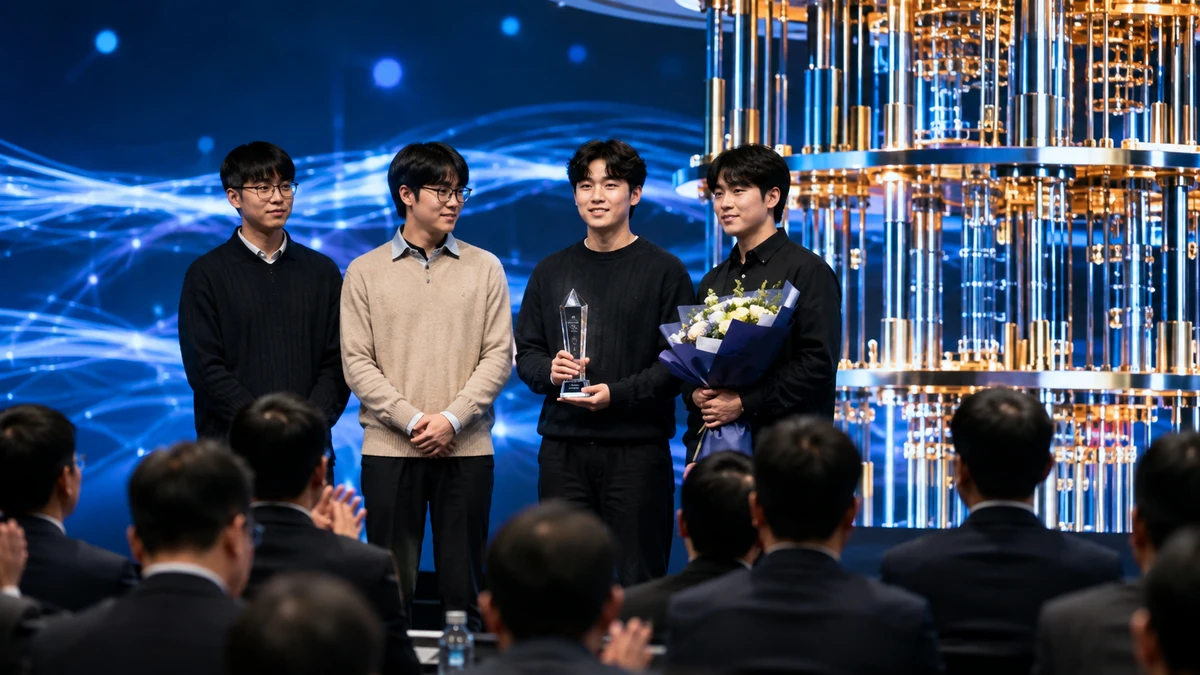
SEOUL — The most revealing part of a South Korean quantum computing competition this week was not the size of the machine waiting in the wings. It was the way participants were asked to rethink the problems that machine might eventually solve. A team from Sungkyunkwan University, competing under the name Quanskkuad, won the grand prize Wednesday at the final of the Quantum Reframing Challenge 2026 in Seoul. The contest brought together 73 teams and 214 participants from its preliminary stage, according to South Korea’s Ministry of Science and ICT. Fifty-four teams submitted proposals addressing industrial or public-sector problems, and 12 advanced to the final round.
For American readers accustomed to hearing quantum computing described through milestones — more qubits, lower error rates, longer coherence times or increasingly powerful processors — the Korean competition offers a different way of looking at the technology. Instead of beginning with the question, “How powerful is the quantum computer?” organizers effectively asked another: “Which real-world problems should we redesign so that a quantum computer has something useful to do?” That distinction explains the word “reframing” in the competition’s name. A conventional computing problem cannot necessarily be transferred unchanged to quantum hardware. Variables, constraints and objectives may have to be expressed differently, and developers must determine which portions of a calculation, if any, are appropriate for quantum processing.
The competition was organized as South Korea prepares to make use of a 100-qubit trapped-ion quantum computer from U.S.-based IonQ that is being established at the Korea Institute of Science and Technology Information, or KISTI. Yet the event was not simply a showcase for a 100-qubit specification. The more consequential experiment was human: Could researchers and developers identify useful problems, formulate them correctly, design algorithms around them and then test those ideas on actual quantum hardware? That is a challenge facing not only South Korea but also the United States and virtually every country investing in quantum technology.
Why “reframing” may matter more than adding another qubit
Quantum computing is frequently presented to the public as the next step after today’s supercomputers, as though a sufficiently large quantum machine would simply perform familiar calculations much faster. That analogy is convenient, but it can also be misleading. Quantum computers operate according to fundamentally different physical and mathematical principles. They are not expected to replace laptops, cloud servers or conventional supercomputers for most everyday workloads. Their potential lies in narrower categories of problems where quantum mechanical effects can be exploited computationally.
That makes problem selection unusually important. Imagine a logistics company trying to determine an efficient route through a huge number of possible schedules, or a scientific team working with a computational model whose complexity grows rapidly. The existence of a difficult calculation does not automatically make it a good quantum computing application. Researchers first have to understand why the conventional approach struggles, identify the mathematical structure of the bottleneck and determine whether a quantum method offers a plausible alternative. Even then, the quantum component may be only one part of a larger workflow that still relies heavily on conventional computing.
The Korean challenge formalized that reasoning process. Final-round problems were divided into two broad categories: computational science and combinatorial optimization. In the first category, teams examined situations in which conventional computational methods encounter limitations and explored whether quantum techniques could address the relevant portion of the calculation. In the optimization category, participants took problems whose large number of possible combinations makes finding an optimal solution difficult and reformulated them into structures suitable for quantum computation.
The important point is what the competition did not assume. It did not treat quantum computing as a universal accelerator. Participants had to identify where a conventional approach reaches its limits and then narrow the role assigned to quantum computation. In an industry where impressive hardware demonstrations can dominate headlines, that emphasis puts attention on a less glamorous but potentially decisive skill: translating an industrial problem into a computational representation that quantum hardware can actually process.
Three kinds of quantum hardware turned theory into an engineering exercise
The 12 finalists were also required to move beyond simulations and presentations. From Aug. 13 through Aug. 25, they conducted implementation and verification work using three types of quantum computing environments: trapped-ion, neutral-atom and photonic systems. Those approaches use different physical mechanisms to represent and manipulate quantum information. Exposing participants to more than one architecture therefore turned the contest into something closer to an engineering exercise than a conventional university idea competition.
That matters because “quantum computer” is an umbrella term rather than a description of one standardized machine. The situation is somewhat analogous to the early stages of other computing eras, when competing architectures and technical approaches developed simultaneously before mature standards and ecosystems emerged. A quantum algorithm that appears promising in theory still has to confront the characteristics and limitations of the hardware on which it runs. Developers need to understand not only mathematical formulations but also how those formulations interact with real machines.
South Korea’s approach is notable because it links infrastructure development with workforce development. KISTI’s planned use of a 100-qubit trapped-ion system provides computing infrastructure. The challenge, meanwhile, attempts to cultivate potential users of that infrastructure and, just as importantly, a pipeline of problems for them to investigate. Instead of acquiring a sophisticated machine and only afterward asking who might use it, the country is trying to develop hardware access, application ideas and technical talent in parallel.
The inclusion of neutral-atom and photonic environments adds another dimension. Participants were not trained around the assumption that one hardware architecture necessarily defines the future of quantum computing. That is a sensible approach at a stage when multiple technologies remain under development globally. For students and engineers, experience moving between architectures can also encourage them to distinguish the underlying computational problem from the characteristics of a particular machine.
What the Korean experiment means for the United States
The American connection is unusually direct. The 100-qubit trapped-ion system being prepared at KISTI comes from IonQ, an American quantum computing company. The Korean competition therefore illustrates one possible downstream effect of U.S. quantum technology exports: The value of a machine abroad is not limited to the hardware transaction itself. It can become part of a local ecosystem involving universities, researchers, public institutions and companies searching for applications.
For U.S. technology companies, that is an important distinction. The long-term quantum market is unlikely to be determined solely by which company can advertise the largest or most technically impressive processor. Hardware companies will also need users capable of generating useful workloads. Software tools, developer education, cloud access, algorithm development and industry-specific expertise can become part of the same ecosystem. A powerful machine with no economically meaningful problems to run is an engineering achievement, but not yet a mature computing market.
There is a familiar precedent in American technology history. The commercial impact of personal computers was not created by processors alone; operating systems and applications turned computing capacity into something businesses and consumers could use. The internet similarly became economically transformative through browsers, websites, search, e-commerce and eventually cloud services. Artificial intelligence offers a more recent parallel. Improvements in chips and foundational models matter enormously, but companies still have to redesign workflows and determine where AI produces measurable value rather than simply adding it to existing processes.
Quantum computing could follow a comparable pattern, although the underlying technology and timeline are very different. The decisive layer may eventually include specialists who understand both an industry and quantum computation well enough to translate between them. An airline, manufacturer, pharmaceutical researcher or government agency does not begin with a quantum circuit. It begins with a business or scientific problem. Someone has to determine whether that problem contains a computational structure suitable for quantum techniques and then convert it into an executable formulation.
That creates opportunities for American companies beyond selling processors. If quantum computing develops into a significant commercial industry, demand could emerge around software platforms, hybrid quantum-classical computing systems, developer tools, consulting, education and specialized algorithms. South Korea’s challenge offers a small-scale demonstration of how that market could form: Give technically capable teams access to hardware, begin with real problems and force them to test whether the proposed connection between the two actually works.
The event also fits into a broader feature of U.S.-South Korea technological ties. The alliance between Washington and Seoul is widely understood through security, but the relationship increasingly operates through advanced technology as well. South Korea brings deep engineering capabilities, globally competitive technology industries and major research institutions, while American companies occupy important positions across software, computing platforms and emerging technologies. Quantum computing provides another field in which technology developed by an American company can become part of a Korean research and training ecosystem.
South Korea is testing an application-first model
South Korea’s technology economy gives the challenge additional context. The country built much of its modern industrial strength by developing dense connections among research, engineering, manufacturing and large-scale commercialization. In quantum computing, however, there is no guarantee that strategies successful in semiconductors, displays or consumer electronics can simply be repeated. Quantum machines remain specialized, technically difficult systems, and their eventual commercial advantages must be demonstrated rather than assumed.
That is why the competition’s structure may be more significant than the prize itself. Starting with 73 teams and narrowing 54 submitted proposals to 12 finalists created a filter before participants reached the implementation stage. Teams first had to explain the structure of the problem they wanted to solve. Only then did selected participants move toward implementation and verification. In other words, access to advanced hardware was treated as the later stage of a reasoning process, not the beginning of it.
This reverses a temptation common in emerging technology markets. When a new technical capability appears, organizations often begin by purchasing or demonstrating the technology and then search for an application. The reframing model starts at the opposite end. Identify a difficult problem. Determine why existing methods struggle. Reformulate the problem. Decide whether a quantum component makes sense. Then test the hypothesis on hardware.
That approach also creates a more realistic standard for evaluating quantum applications. A successful demonstration should not be confused automatically with proof that a quantum computer has achieved a decisive advantage over the best conventional alternative. The information released about the Korean challenge establishes that teams worked on two categories of problems, tested implementations across real quantum environments and competed for awards. It does not establish that the winning project has solved a major industrial problem at commercial scale or demonstrated broad quantum superiority. Those are much higher bars.
The distinction is particularly important because quantum computing is surrounded by expectations that can outrun current capabilities. Competitions like this can be useful precisely when they make participants confront hardware constraints instead of presenting idealized algorithms alone. A failed or limited implementation can be informative if it reveals which assumptions were unrealistic, which formulations need revision or which problems are poorly suited to current machines.
The emerging job: translating real life into quantum language
The Quanskkuad team’s grand prize is therefore interesting beyond the university ranking. Sungkyunkwan University is one of South Korea’s major research universities, and its team competed in an event requiring participants to move through problem definition, algorithm design and hardware implementation. That sequence points toward a category of expertise that could become increasingly valuable if quantum computing matures: people who can translate between domain problems and quantum systems.
Those specialists may not fit neatly into the traditional distinction between theoretical physicist, computer scientist and industry consultant. They may need enough knowledge of an industry to understand its constraints, enough mathematics to formulate the relevant optimization or scientific problem, enough quantum computing expertise to identify an appropriate method and enough engineering experience to recognize the limitations of real hardware.
American universities and companies face the same workforce challenge. Building quantum processors requires highly specialized physics and engineering talent, but commercial adoption will require a much broader group of people who know when not to use a quantum computer as well as when to use one. That judgment may prove particularly valuable during the technology’s transition from research laboratories toward practical experimentation.
The analogy to artificial intelligence is instructive. As generative AI spread through American companies, the conversation quickly moved beyond who could build the largest model. Businesses began asking which workflows should be redesigned, what data models should receive, where humans should remain in the loop and how results should be evaluated. Quantum computing is at a different and earlier stage, but the Korean challenge reflects a similar shift in emphasis from possession of technology toward the architecture of its use.
What to watch as the 100-qubit era approaches
The next meaningful measure of South Korea’s quantum strategy will not be the number of teams entering competitions. It will be whether experiments like this generate repeatable applications, stronger technical talent and sustained collaboration between researchers and organizations with genuine computational problems. The 100-qubit system being established at KISTI can provide infrastructure, but infrastructure alone cannot answer the commercial question.
For American observers, another issue to watch is whether international deployment of U.S.-developed quantum systems creates durable developer ecosystems around American hardware and software. If Korean researchers learn on U.S.-origin systems and build applications around them, the relationship could extend beyond a single machine. Conversely, exposure to several hardware architectures, as in this competition, could produce developers who are more technologically flexible and less tied to any one vendor. Both outcomes would be significant for an emerging global industry.
The most useful lesson from Seoul may ultimately be simple: Quantum computing needs better questions as much as it needs better machines. A 100-qubit processor is easy to place in a headline because the number is concrete. The harder work happens before the machine starts calculating — identifying a problem whose structure justifies quantum treatment, deciding what should remain on conventional computers and translating the relevant portion into a form that quantum hardware can execute.
That is what South Korea’s Quantum Reframing Challenge attempted to practice. The Quanskkuad team left Seoul with the grand prize, but the larger experiment concerns an entire technology ecosystem. As governments and companies spend heavily to advance quantum hardware, South Korea is testing whether prospective users can be trained at the same time to ask the right questions of those machines. For the United States, home to major quantum technology developers and a close technology partner of South Korea, that experiment is worth watching. The next phase of the quantum race may be decided not simply by who owns the most capable computer, but by who figures out what to do with it.
Comments
Post a Comment