South Korea’s Stock Market Hit the Brakes on a Rally. Here’s What a ‘Buy Sidecar’ Means — and Why Global Investors Notice
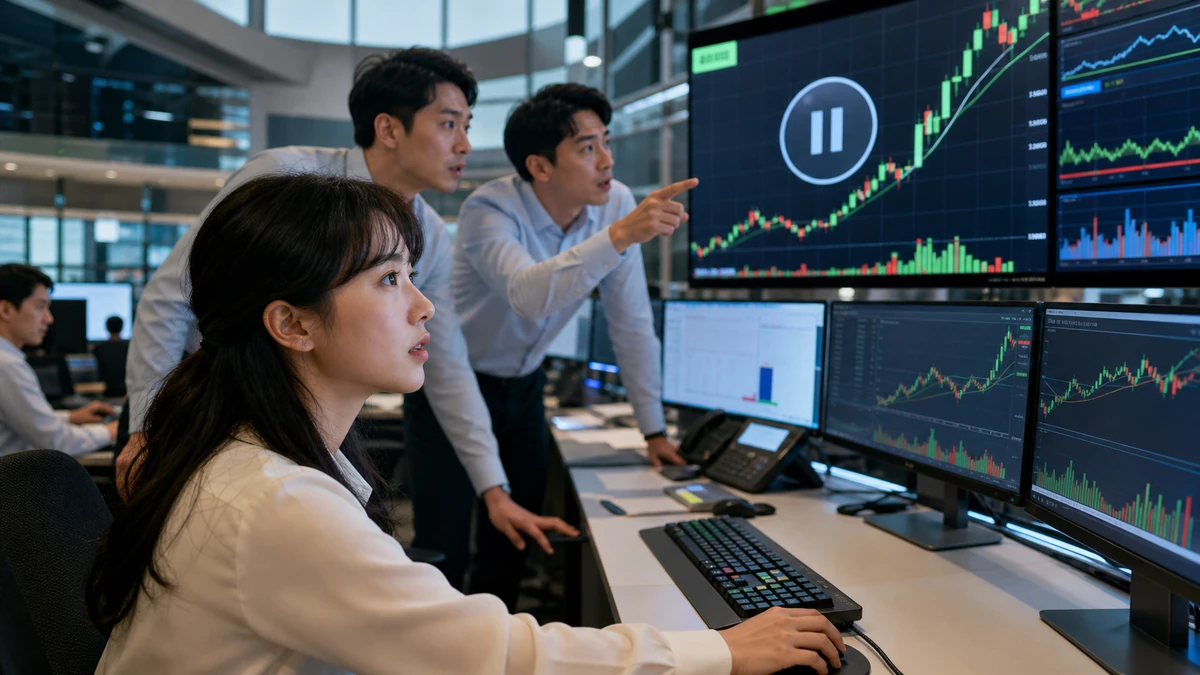
Image to help understand the article
A market safeguard flashes during a surge
South Korea’s stock market did something unusual on Thursday morning: It temporarily hit the brakes not because prices were crashing, but because they were rising too fast.
At about 11:57 a.m. local time, the Korea Exchange triggered what is known as a buy sidecar after the KOSPI 200 futures index jumped 5.13% from the previous session’s close and stayed above the 5% threshold for one full minute, according to local reports. The index was up 50.68 points at 1,037.76 when the mechanism was activated.
For readers more familiar with Wall Street than Seoul, the move can sound dramatic. But this was not a full market shutdown, and it was not a sign that regulators believed the rally itself was unhealthy. Instead, it was a narrowly tailored cooling-off mechanism aimed at one specific part of trading: computerized program buy orders tied to futures prices. Those orders were paused for five minutes.
That distinction matters. South Korea’s market infrastructure is designed not only to manage panic selling, but also to slow down euphoric buying when algorithmic and program-driven orders risk pushing prices faster than investors can properly assess them. In this case, the exchange was responding to speed and concentration of orders, not trying to cap gains.
The episode offered a revealing snapshot of how one of Asia’s most important equity markets handles volatility in the age of automated trading. It also underscored a point global investors increasingly care about: A market’s credibility depends not just on how high its indexes can climb, but on whether its rules are transparent, predictable and enforced in real time when money floods in all at once.
What a sidecar is — in plain English
The term sidecar may sound odd to American readers. It does not refer to a motorcycle attachment in any literal sense, though the metaphor is useful: It is a device attached to the main market meant to stabilize the ride when things get bumpy.
In South Korea, a sidecar is a volatility-control mechanism that kicks in when futures prices move sharply enough to risk spilling disorderly momentum into the underlying stock market. Thursday’s case involved a buy sidecar, which is triggered when KOSPI 200 futures rise 5% or more above a reference level and remain there for at least one minute. Once activated, the effectiveness of program buy orders in the main KOSPI market is suspended for five minutes.
That is an important nuance. Trading in all stocks does not stop. Investors can still buy and sell. What is interrupted is a category of automated or basket-style buying that can quickly transmit a surge in futures prices into the cash equity market.
If this sounds somewhat similar to circuit breakers in the United States, that is because the underlying policy goal is comparable: Reduce the odds that fast, emotionally or mechanically amplified moves overwhelm price discovery. But the Korean sidecar is more targeted. Rather than freezing the entire market, it temporarily restrains a particular channel through which price spikes can cascade.
In practical terms, the sidecar acts less like an emergency stop button and more like a speed governor. The point is not to tell the market which direction it should go. The point is to make sure that when large volumes of orders are fired off in one direction, there is at least a brief window for traders, institutions and risk systems to catch up.
That is why Korean market officials and analysts generally describe sidecars as safeguards for orderly trading rather than judgments about whether prices have risen too much or fallen too far. Thursday’s trigger was mechanical: The threshold was crossed, the one-minute condition was met, and the system responded exactly as designed.
Why rising futures can force a timeout
To understand why this happened, it helps to know how futures and stocks interact.
The KOSPI 200 futures index is tied to the KOSPI 200, a benchmark made up of 200 major South Korean stocks. Futures markets often react quickly to sentiment because they allow investors to place directional bets with leverage and speed. When futures rise sharply, trading programs can automatically execute buy orders in the underlying stocks to exploit price relationships between futures and cash equities.
That kind of activity is not inherently problematic. In fact, it is a routine part of modern market structure. Program trading and arbitrage help link related markets and can improve efficiency under normal conditions. But when futures prices jump abruptly, the same systems can magnify momentum. A burst of buying in futures can trigger waves of stock purchases, which can then reinforce the rally and draw in even more orders.
Thursday’s buy sidecar was designed for exactly that scenario. South Korean officials were not saying the market should not go up. They were saying that if automated buy orders begin propagating too rapidly from futures into stocks, it is worth inserting a brief pause into that pipeline.
Think of it in terms familiar to U.S. investors who have watched markets during big Federal Reserve announcements or blockbuster earnings days. Sometimes the issue is not whether investors are right to be optimistic or pessimistic. The issue is whether the mechanics of trading are accelerating the move so quickly that prices no longer reflect a measured digestion of information. Exchanges cannot control investor sentiment, but they can influence the tempo of execution.
That is especially true in markets where major benchmark names can dominate flows. In South Korea, heavyweight semiconductor stocks such as Samsung Electronics and SK Hynix often exert outsized influence over broader sentiment. Local reports linked Thursday’s sharp move to strong buying interest in semiconductors, with those shares posting sizable gains. When bellwether stocks rally hard, futures markets can heat up quickly, and program-based buying can become part of a self-reinforcing loop.
Why this matters beyond South Korea
For international investors, Thursday’s event was about more than a one-day jump in Seoul. It was a reminder that South Korea is a deeply modern, highly wired market where both opportunity and volatility can appear quickly.
South Korea is home to some of the world’s most important technology and manufacturing companies. It is a crucial node in global semiconductor supply chains, consumer electronics and industrial exports. When Korean equities move sharply, the implications can extend far beyond the country itself, especially for investors tracking chips, AI-related demand, trade cycles and Asian growth.
That is one reason the KOSPI often attracts attention similar to the way U.S. investors watch the Nasdaq for tech signals or the S&P 500 for broad risk sentiment. While the structures are different, the instinct is the same: Large moves in a major benchmark can reflect changing expectations about the economy, corporate earnings and international capital flows.
But global investors do not evaluate markets solely on headline performance. They also ask whether a market’s rules are clear and whether exchanges can execute those rules consistently during stress. In emerging and developed markets alike, confidence depends on predictability.
Thursday’s buy sidecar illustrated that predictability in numerical terms. The trigger was not discretionary. The threshold was 5%. The move reached 5.13%. The condition had to persist for one minute. Once it did, program buy orders were halted for five minutes. There is a transparency to that sequence that matters, especially for overseas institutions that may not know every detail of Korean market custom but do understand the value of rules-based operation.
That transparency can be as important as the rally itself. International funds are more likely to commit capital when they believe the plumbing of a market works — not just on calm days, but when activity spikes and algorithms begin interacting at high speed. In that sense, Thursday’s sidecar was a test of institutional trust as much as a response to a trading surge.
Not a warning sign, but not a forecast either
It would be easy to overread the moment. A buy sidecar can look like a bullish badge of honor, proof of irresistible momentum. It can also be misread as a sign the market has become dangerously overheated. Neither interpretation is fully supported by the facts available so far.
What is known is limited and straightforward. The KOSPI 200 futures index rose fast enough to cross the 5% threshold. It stayed there for one minute. The exchange then suspended the effectiveness of program buy orders for five minutes. Those are the observable facts.
What cannot be concluded from the sidecar alone is whether the rally will continue, whether it will fade, or what specific catalyst ultimately drove buying so aggressively. A volatility-control measure is not a price target, an endorsement or a warning of imminent reversal. It is an operational response.
That distinction is important for readers used to interpreting headlines about trading halts as predictive signals. In the United States, when a stock is paused for volatility or a broad circuit breaker looms during a sell-off, the halt itself often becomes part of the story. In South Korea, too, the symbolism can be powerful. But the mechanism is best understood as a market-quality tool, not a market call.
In that sense, the buy sidecar says more about the intensity of intraday order flow than about the medium-term direction of Korean equities. It tells investors that buying pressure was strong and fast enough to activate a preannounced safeguard. It does not tell them whether that buying was driven by durable fundamentals, a short squeeze, policy expectations, global risk-on sentiment, domestic retail enthusiasm or some combination of all of the above.
That may sound like a modest conclusion, but in financial journalism modesty matters. Markets generate a constant temptation to force every technical event into a larger narrative. Sometimes the cleanest explanation is also the most accurate: The market moved quickly, and the system responded exactly the way it was built to respond.
The bigger picture: speed, automation and trust
There is a broader lesson here, one that reaches beyond Seoul. Modern exchanges around the world are no longer just venues where buyers and sellers meet. They are complex technological systems responsible for maintaining orderly markets under conditions of enormous speed.
As algorithmic and automated trading account for larger shares of volume, exchanges increasingly have to manage not simply direction, but velocity. A market can be fundamentally healthy and still need guardrails if order flow becomes too concentrated in too little time. That is true whether prices are plunging or soaring.
South Korea’s sidecar framework reflects that reality. It recognizes that an upside shock can be just as structurally disruptive as a downside shock if it triggers cascades of mechanized activity. The goal is not to suppress excitement. It is to prevent trading architecture from outrunning human judgment.
For American readers, there is a useful analogy in how U.S. markets have evolved after episodes of extreme volatility, from the 1987 crash to the flash crash in 2010 and the meme-stock era more recently. Each episode raised the same fundamental question: How should markets preserve free price formation while preventing instability caused by speed, leverage and automation?
South Korea’s answer, at least in this instance, is to use a focused intervention with clearly defined conditions. When a linked futures market rises beyond a quantitative threshold and stays there briefly, the exchange pauses one transmission mechanism — program buy orders — rather than shutting everything down. It is a surgical response to a specific risk.
That kind of design reveals a maturing market philosophy. A high-functioning exchange does not try to eliminate volatility; that would be impossible and undesirable. Volatility is often the market’s way of processing new information. What an exchange can do is make sure volatility does not become disorder. Thursday’s sidecar was a small but telling example of that principle in action.
Why investors will keep watching Seoul
South Korea often sits at an interesting intersection for global readers. It is a cultural powerhouse thanks to K-pop, Korean film, television dramas and consumer brands, but it is also a serious financial and industrial market whose movements can signal broader economic currents. For many Americans, Seoul may first register through soft power exports such as BTS, “Parasite” or “Squid Game.” Yet behind that cultural visibility is a sophisticated capital market tightly connected to the world’s technology cycle.
That matters because the forces driving modern Korea are not purely cultural. They include export competitiveness, chip demand, currency shifts, geopolitics, industrial policy and the behavior of domestic and foreign investors. When the KOSPI surges, the story is not just about national pride or headline momentum. It is about how one of Asia’s most strategically important economies is being priced in real time.
Thursday’s buy sidecar captured that dual reality. On one hand, it reflected enthusiasm — enough buying pressure to send KOSPI 200 futures up more than 5%. On the other, it highlighted institutional discipline — a market operator willing and able to apply a preannounced stabilizing mechanism without hesitation.
For professional investors, that combination is worth watching. Strong rallies attract attention, but resilient infrastructure keeps it. If Seoul wants to remain a destination for global capital, episodes like this can reinforce confidence so long as the rules remain consistent and well understood.
In the end, the most notable thing about the sidecar may be how unremarkable it was in procedural terms. The trigger was met. The pause lasted five minutes. The market absorbed it. That kind of routine execution is exactly what exchanges strive for, because the less dramatic the system’s response feels, the more credible the system becomes.
So yes, South Korea’s market briefly hit the brakes during a rally. But the larger story is not that trading was interrupted. It is that the interruption was limited, rules-based and purposeful — a reminder that in today’s fast markets, trust is built not only on gains, but on the mechanisms that keep those gains from turning into disorder.
Comments
Post a Comment