
Image to help understand the article
A surf contest on Korea’s east coast is really a bigger story about culture, tourism and brand Korea
On paper, the event scheduled for June 29 and 30 at Jukdo Beach in Yangyang County looks like a straightforward sports weekend: a surfing festival paired with the president’s cup competition hosted with the Korea Surfing Association. In practice, it says something much larger about where South Korea’s beach culture is headed — and how the country increasingly packages sport, tourism and lifestyle into one exportable experience.
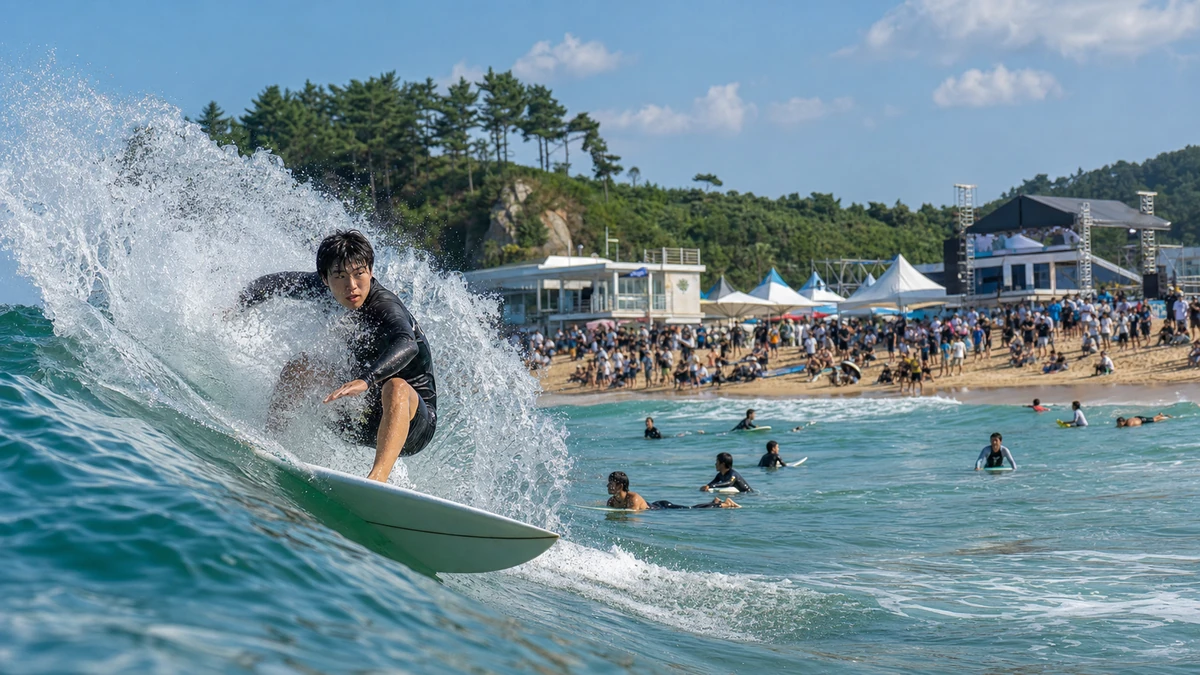
Local officials in Yangyang, a county in Gangwon Province on South Korea’s east coast, say the 2026 Yangyang Surfing Festival and Korea Surfing Association President’s Cup will combine elite competition, beginner participation, live performances and beachside activities in one place. Roughly 130 top domestic surfers are expected to compete in the Korea Open division, where national team selection points are at stake. Another approximately 130 beginner surfers are slated to enter a separate event for newcomers who took up the sport in 2023 or later.
That setup matters. In the United States, surf culture is often associated with places such as Southern California, Hawaii and, increasingly, pockets of Florida or the Northeast. It can be both an industry and an identity — one tied to apparel, travel, fitness and a particular image of coastal life. South Korea is trying to build something similar, though on its own terms: not a copy of Malibu or Oahu, but a Korean version of a modern surf town where competitive sport, tourism and youth culture all reinforce one another.
Yangyang has become the center of that effort. For many Americans, South Korea still calls up images of Seoul’s dense urban skyline, K-pop, Korean dramas and a technology-driven economy. Less familiar is the idea of the country as a surf destination. Yet along the East Sea — what Koreans call the body of water known internationally as the Sea of Japan — Yangyang has spent years building a reputation as the country’s signature surfing getaway, especially for younger travelers from Seoul looking for a weekend escape.
This weekend’s event is best understood not as a one-off local festival, but as a snapshot of a larger transition. South Korea is turning surfing from a niche hobby into a broader consumer and travel ecosystem. That may sound modest compared with the global scale of American surf culture, but it is exactly how lifestyle industries grow: first as local scenes, then as domestic tourism draws, and eventually as internationally legible brands.
Why Yangyang matters in South Korea the way certain beach towns matter in the United States
Americans familiar with the role of Huntington Beach in California, Montauk in New York or smaller surf-centered communities that became bigger lifestyle destinations will recognize the template. A place first becomes known among insiders. Then cafés, rentals, gear shops and social media attention follow. Soon the destination is no longer just for athletes. It becomes part of a wider leisure economy.
Yangyang has been moving along that path. Jukdo Beach, the site of this festival, is one of the best-known surf beaches in the country. Its appeal is not only the waves. It is also accessibility, identity and timing. South Korea is highly urbanized, and a large share of the population lives in or near the Seoul metropolitan area. That creates an audience hungry for short domestic trips that feel distinct from city life but are still logistically manageable over a weekend.
In that sense, Yangyang functions as a release valve for urban Korea. It offers something closer to a curated beach lifestyle than a traditional seaside vacation. That distinction is important. This is not just a county inviting people to watch a sports event. It is a local government, together with local and national surf organizations, presenting an entire mode of travel: come for competition, stay for the performances, try a fitness class, browse used boards, mingle with surfers, and leave with the sense that the beach is a culture rather than a backdrop.
The article from Korea makes this explicit. Organizers are not limiting the event to spectatorship. Visitors who have never surfed can still join the atmosphere through beach experiences, live entertainment and on-site events. Foreign tourists, too, are being imagined as part of the audience. That language reflects a shift in South Korean tourism strategy more broadly. For years, Korea’s global image has been powered by food, beauty, music and television. Increasingly, local governments are asking how those same visitors can be directed beyond Seoul, beyond palace tours and shopping districts, and into regional destinations that feel contemporary and shareable.
Yangyang fits that goal unusually well because surfing is already a global visual language. A beach full of boards, wetsuits and amateur riders trying to stand up on a wave requires little translation. The details may be Korean, but the image is instantly legible to travelers from the United States, Australia or Europe.
The event’s structure shows how South Korea is trying to democratize a once-niche sport
The most revealing detail in the Yangyang festival may be that the beginners’ division is almost as large as the elite competition. About 130 top-level surfers are expected in the Korea Open, and another roughly 130 entrants are expected in the beginner event. Combined, that means around 260 competitors and enthusiasts are formally part of the contest programming.
That is not just a participation statistic. It is evidence of how South Korea wants surfing to grow. Elite sport creates prestige. Beginner competition creates community. Put them together and a local government gets both legitimacy and volume.
The professional competition carries national team selection points, meaning the stakes are meaningfully higher than those of a casual exhibition. For athletes, it is a pathway event. For spectators, it gives the festival the tension of real competition. For the county, it creates institutional credibility: this is not merely a summer party on the sand, but a sanctioned contest with consequences.
The beginner event, meanwhile, is designed for people who started surfing in 2023 or later. They will compete in a long-ride format using 9.2-foot soft boards. That may sound technical, but the idea is accessible. Rather than emphasizing only difficult tricks or short, explosive maneuvers, the format highlights balance, control and the ability to stay on the wave. In plain terms, it is a way of turning early-stage participation into something watchable and celebratory.
For American readers, the equivalent would be a road race weekend that includes both elite runners chasing qualifying times and a large field of newer runners doing a community 5K — except here, both groups are positioned as integral to the same cultural event. That matters because sports become durable not only when stars perform, but when newcomers can imagine themselves entering the scene.
There is also a subtle but important social message in the structure. The beginner surfers are not treated as peripheral fans or as an audience to be marketed to later. They are part of the main event. That approach reflects a broader change in how South Korea often develops leisure industries: not simply by showcasing excellence, but by creating a visible ladder from consumer to participant. In the K-pop business, fans are drawn into elaborate ecosystems of merchandise, fandom rituals and events. In outdoor leisure, a similar logic can be seen in hiking, golf and now surfing. The goal is to make the culture feel enterable.
That may help explain why Yangyang’s organizers are pairing competition with activities off the water. The event includes fitness experiences such as Hyrox and barre, along with a board swap day for used surfboards and equipment. Hyrox, for readers unfamiliar with the term, is a fast-growing fitness race format that blends endurance running with functional workout stations. Barre refers to a studio-style exercise practice inspired by ballet technique, typically emphasizing controlled movement, balance and strength. Neither is inherently part of traditional surf culture, but both make sense in a modern beach festival aimed at a broader lifestyle crowd.
The board swap may be even more significant. Used-gear exchange is not just a practical feature. It signals that a real scene exists. In surf towns in the United States, secondary markets for boards and equipment are part of what makes a sport feel lived-in rather than staged. A board swap shows that the festival is not just selling an image; it is facilitating the circulation of actual gear among actual surfers.
What this means for the United States and the American market
For Americans, this story matters less because of the specific contest results than because it illustrates how South Korea is widening the reach of its cultural economy. The United States has already seen what happens when Korea turns a domestic scene into a global soft-power asset. K-pop was once treated as a niche import; now it is part of the mainstream U.S. music business. Korean skincare moved from specialty shelves to major retailers. Korean food followed a similar trajectory, from urban enclaves and enthusiast circles into supermarket aisles and chain menus.
Surfing is not likely to become Korea’s next K-pop-sized export. But that misses the point. The important question is whether Korea can turn specific places and subcultures into attractive travel and lifestyle products for global consumers, including Americans. Yangyang suggests the answer may be yes, especially for younger travelers who choose destinations through social media visibility as much as through traditional guidebooks.
There are several practical implications for the U.S. market. First, American travel companies, airlines and tourism marketers should pay attention to the way South Korea is diversifying its appeal beyond Seoul. For years, the standard American itinerary in Korea has centered on the capital, perhaps with a stop in Busan or Jeju. If coastal destinations like Yangyang become more legible to foreign visitors, that broadens the map of Korea as a tourism product. Travelers who have already visited Seoul once may be more likely to return if a second trip can feel completely different — more like a beach-and-lifestyle vacation than an urban culture trip.
Second, U.S. brands in sportswear, wellness, hospitality and outdoor equipment may find opportunities in the overlap between Korean domestic demand and international tourism. Whenever a leisure scene matures, it creates demand not only for core sporting goods but for cafés, boutique lodging, athletic apparel, recovery products, fitness programming and content partnerships. American companies have long experience monetizing exactly that kind of ecosystem at home.
Third, American fans of Korean culture may increasingly encounter Korea through place-based identities, not just through celebrities and entertainment. That is a meaningful shift. In the past, much of Korean soft power in the United States has been mediated by screens — music videos, dramas, films, social media. A destination like Yangyang offers a different entry point: Korea as an experience you physically visit and inhabit. For an American audience used to the idea that beach culture can define a region, that may make Korea feel more familiar and more multidimensional.
There is also a symbolic angle in U.S.-Korea relations. The alliance between Washington and Seoul is usually discussed in terms of security, trade, semiconductors and geopolitics. Those issues matter enormously. But alliances are also sustained by public familiarity, tourism, educational exchange and shared consumer culture. The more Americans understand South Korea as not only a strategic partner but a place with varied local identities — including surf towns, outdoor leisure scenes and regional youth cultures — the more textured that relationship becomes.
Comparable cases in the United States show how powerful that can be. Towns such as Aspen, Austin and Nashville all built international recognition by tying a place to a lifestyle as much as to a single attraction. Yangyang is not on that scale. But the strategic logic is similar: if a town can stand for a mood, a scene and a set of shareable experiences, it becomes much easier to market abroad.
From event tourism to lifestyle tourism: the trend line is more important than the weekend itself
The underlying trend here is one American readers should recognize from many industries: consumers increasingly want layered experiences rather than one-dimensional attractions. A beach festival that offers elite sport, beginner participation, fitness classes, used-gear exchange, live performances and local atmosphere is more resilient than a pure competition. It captures multiple kinds of visitors at once.
That is especially important in a country like South Korea, where domestic tourism is competitive and local governments are under pressure to distinguish themselves. A town cannot rely only on scenery. It needs a reason to travel now, a reason to post about the trip and a reason to come back. Surfing offers all three.
The Yangyang model also reflects changes in how sports are consumed. In the United States, the line between sports, wellness and entertainment has blurred for years. Marathons come with expos and concerts. Boutique fitness brands build communities and events. Major competitions are sold as festivals. South Korea is applying a similar formula to surfing, and doing so in a way that fits its own travel patterns and youth culture.
What changed is not merely the existence of surf competitions. It is the packaging. The festival and the association-backed tournament are being explicitly joined, even in the official naming of the event. That tells us organizers see commercial and cultural value in collapsing the boundary between governing-body sport and public leisure. In one space, spectators can watch athletes chase national team points, newer surfers attempt long rides, and non-surfers drift between performances and fitness experiences. The beach becomes both stadium and public square.
That model has advantages. It broadens the audience, gives sponsors more touchpoints and makes the destination itself the star. If weather or contest conditions reduce the appeal of one component, the wider festival can still carry the weekend. It also creates a stronger narrative for regional tourism marketing. A county can promote not just an event date, but an identity: this is what our coast feels like.
For foreign visitors, especially those from the United States who may not know much about Korea’s east coast, that matters. Many travelers do not plan trips around a single sporting bracket or one live show. They plan around a vibe, a neighborhood, a scene. Yangyang’s organizers appear to understand that instinct well.
What to watch next as South Korea turns local scenes into international attractions
The immediate event will last only two days, but the broader question is whether Yangyang can convert episodic attention into enduring recognition. That depends on several things.
One is continuity. Lifestyle destinations are rarely built by one successful weekend. They need recurring events, recognizable visual branding and a steady local business ecosystem that visitors can trust. If Yangyang continues to host competitions with real athletic stakes while also expanding beach culture programming, it strengthens the case that this is South Korea’s definitive surf hub rather than a place temporarily capitalizing on a trend.
Another is accessibility for foreigners. The summary of the event suggests organizers see international tourists as part of the potential audience. If so, the next step is not just promotion, but usability: clear travel information, multilingual event communication and enough surrounding infrastructure for visitors who are curious but not deeply plugged into Korean domestic travel habits. American travelers accustomed to more internationally marketed surf destinations will notice quickly whether the experience feels open to outsiders or primarily designed for locals.
A third question is whether the sport itself deepens institutionally. National team selection points help because they connect Yangyang to the formal development of Korean surfing. That link gives the scene seriousness. If more Korean surfers gain visibility internationally, or if domestic competitions become more prominent in global surf conversations, local festivals like this one could become more meaningful to international audiences.
Finally, there is the issue of storytelling. South Korea has become exceptionally skilled at producing globally recognizable narratives around culture. The challenge for a place like Yangyang is to tell a story that is distinct from the country’s better-known exports. It cannot simply be “Korea, but at the beach.” It has to explain why the east coast offers a particular kind of trip, what kind of traveler it suits and how sport, leisure and local identity come together there.
That is why this festival deserves attention beyond regional event listings. It offers a glimpse of how South Korea’s next phase of cultural influence may work: less through a single blockbuster export, and more through highly specific, highly marketable local experiences that fit into global patterns of travel and lifestyle consumption.
For American readers, Yangyang may still be an unfamiliar name. But the logic behind what is happening there is deeply familiar. A coastal town finds a sport. The sport becomes a scene. The scene becomes a brand. And the brand becomes a reason for the world to pay attention.


0 Comments