Trump’s emergency rhetoric before the midterms puts election trust — and America’s global credibility — back on trial
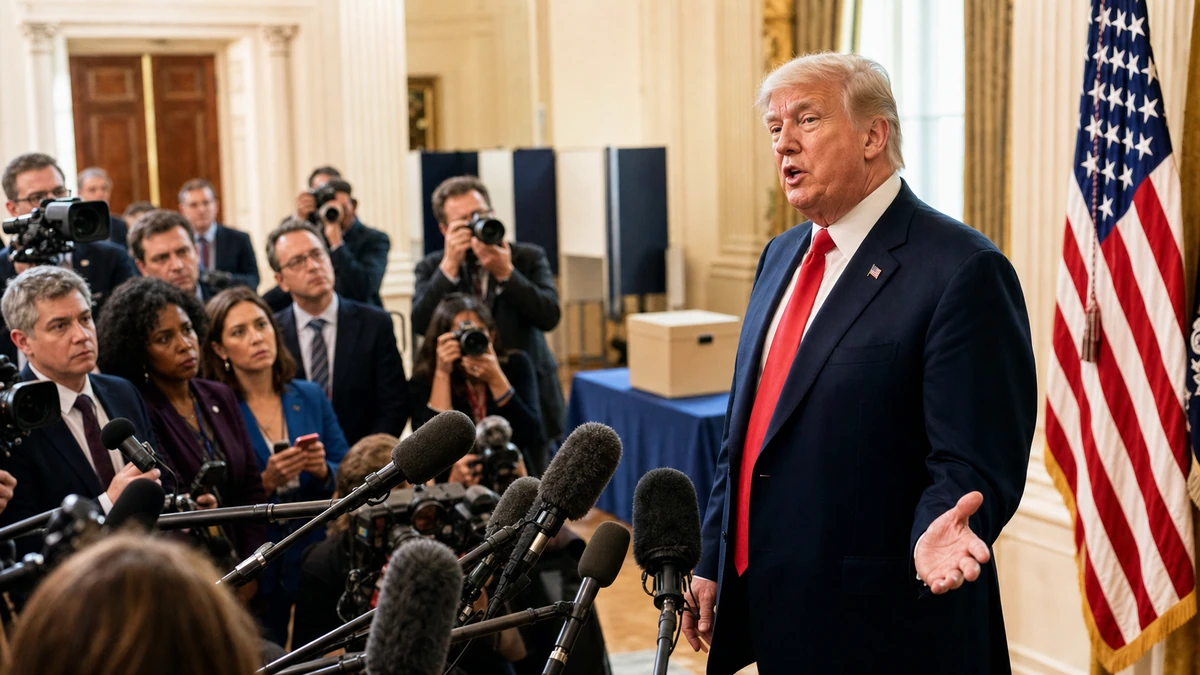
Image to help understand the article
A new flashpoint in America’s long election-trust crisis
Donald Trump’s refusal to clearly rule out a declaration of national emergency ahead of November’s midterm elections is notable not because such a move has been announced, but because the idea has now entered the political bloodstream at all. That distinction matters. There is no confirmed emergency declaration, no public implementation plan and no verified official process underway based on the reporting summarized from the Guardian and Korean coverage of it. But in American politics, especially in the Trump era, rhetoric can become a force of its own long before it becomes policy.
That is why this episode deserves attention beyond the daily churn of campaign-season controversy. A president or presidential figure invoking, or even merely preserving, the possibility of extraordinary executive power during an election season touches one of the most sensitive nerves in a constitutional democracy: whether citizens believe the vote will be administered fairly and whether the rules will remain stable while ballots are being cast and counted.
For many Americans, the phrase “national emergency” carries memories of crises that seem clearly outside ordinary politics — the aftermath of the Sept. 11 attacks, public health breakdowns, natural disasters, war or border-security disputes. Used in the context of an election, however, the phrase feels different. It suggests that normal democratic procedures may be insufficient or suspect, and that exceptional presidential authority might be needed to manage a political process that is supposed to belong to voters, states, courts and independent election officials.
The issue, then, is not simply what Trump may do next. It is what happens when a political leader leaves the door open to extraordinary powers at a moment when trust in the election system is already badly frayed. In a polarized country, ambiguity does political work. Supporters hear resolve. Critics hear warning sirens. And voters in the middle hear one more reason to doubt that the system will function in a predictable, legitimate way.
Why the statement matters even without a formal declaration
One of the easiest mistakes in covering this kind of moment is to swing to either extreme. On one side is alarmism: treating the mere mention of emergency powers as proof that an emergency declaration is imminent. On the other is complacency: dismissing the comment as just another off-the-cuff remark in a media environment saturated with provocative statements. The more serious reading is in between. Trump has not, based on the summary provided, declared an emergency or announced a concrete plan. But he also did not foreclose the option. In democratic politics, that gap is consequential.
American history offers many examples of officials using ambiguity to shape public expectations. Politicians often preserve “options” because doing so can energize supporters, intimidate opponents or dominate the news cycle without requiring immediate action. Trump has long used that style especially effectively. He often speaks in ways that let multiple audiences hear different messages at once: a signal of toughness for loyalists, a provocation for adversaries and a source of endless interpretation for media outlets.
In the setting of an upcoming election, that tactic is especially potent. If people already suspect fraud, corruption or elite manipulation, a suggestion that extraordinary action might be justified can validate those feelings before any evidence is publicly tested. It can also shift the burden of proof. Instead of requiring concrete proof for dramatic claims, the conversation becomes centered on whether the public should prepare for intervention. That is a major change in political terrain.
The timing matters, too. Midterm elections are normally treated as a test of governing performance, public mood and partisan energy. They are often heated, but they are also routine. Americans expect hard-fought campaigns, legal disputes and partisan messaging. They do not expect open-ended talk about emergency powers hovering over the process. Once that kind of language enters the debate, the election stops being just a contest over policies or candidates. It becomes a contest over whether the machinery of democracy itself will be accepted as valid.
How election distrust grows before a single vote is counted
The Korean summary highlights an important point that American voting-rights experts have made for years: the damage of election distrust does not begin on Election Day or after results are announced. It begins much earlier, when citizens are repeatedly told that the system is rigged, that unnamed actors control the count, or that secret evidence exists somewhere just outside public view. By the time votes are cast, many people are no longer evaluating a particular claim. They are operating inside a general atmosphere of suspicion.
That dynamic has become a defining feature of U.S. politics since 2020, but it did not begin there. American elections have always featured allegations of irregularities, machine politics and local disputes. What changed in the modern era is scale, speed and amplification. Social media, partisan video platforms and influencer-driven commentary can take an unverified claim from the margins to millions of people in hours. A suggestion from a powerful political figure does not remain a suggestion for long. It becomes content, then community belief, then political pressure.
This is why the report’s mention of right-wing podcasters and election-fraud activists matters. Their role is not secondary. They are part of the mechanism through which a vague possibility becomes a mobilizing narrative. In today’s information ecosystem, formal policy announcements are not the only way political action gains momentum. Expectations themselves can become political facts. If enough supporters come to believe an emergency declaration is necessary, legitimate or inevitable, that belief can constrain officials, reshape campaign messaging and elevate fringe claims into mainstream talking points.
At the same time, skepticism of election rhetoric does not mean every question about election administration is illegitimate. A healthy democracy should allow scrutiny, audits, court challenges and public debate. But those tools depend on evidence and transparent process. The danger comes when suspicion outruns verification — when “documents” are invoked more as symbols than as substantiated proof, and when the existence of a file, memo or declassification is treated as self-validating. In American law and journalism alike, documents matter only when their contents are authenticated, contextualized and connected to the claims being made about them.
Once that discipline breaks down, politics becomes less about proving what happened than about signaling whom to trust. That is a serious threshold. Elections are sustainable not because everyone agrees on ideology, but because enough people agree on procedures. If those procedures become permanently suspect, then every close race starts to look like a legitimacy crisis waiting to happen.
What emergency-power language means in the American system
To many American readers, the constitutional stakes here are intuitive but still worth spelling out. The United States has a strong presidency, but it is not designed as a system in which the executive branch can casually absorb election authority. Elections in America are highly decentralized. States, counties and local election boards do much of the actual administration. Courts adjudicate disputes. Congress certifies certain federal outcomes. The point of that fragmentation is to prevent exactly the kind of concentrated control that would allow one person to unilaterally rewrite the democratic process.
That does not mean emergency powers are meaningless. Presidents can invoke extraordinary authorities under certain legal frameworks, and the United States has a long history of executive branch expansion during crises. Civil libertarians on the left and right have warned for decades that emergency powers, once normalized, rarely stay confined to the original rationale. The modern debate is not only about legality; it is about precedent. If emergency language becomes an acceptable way to discuss ordinary political conflict, then the threshold for exceptional action keeps dropping.
Americans have seen this tension in other contexts. After 9/11, many emergency and national-security measures were defended as necessary responses to unprecedented danger. During the COVID-19 pandemic, emergency declarations and public-health authorities became major legal and political battlegrounds. Border and migration issues have also prompted clashes over how far emergency rationales can stretch. What makes the election context uniquely volatile is that it touches the mechanism through which political power is transferred and renewed. In other words, the government would be invoking emergency logic around the process that gives the government democratic legitimacy in the first place.
That is why even a hypothetical discussion can feel destabilizing. Americans do not need a full-blown constitutional crisis to experience democratic erosion. Sometimes erosion begins with language that makes exceptional intervention sound normal, prudent or patriotic. In a deeply polarized environment, one camp may welcome that as decisive leadership while another sees it as a warning of executive overreach. Both reactions can intensify at the same time, which is exactly what makes these moments so combustible.
What this means for the United States
For Americans, the most immediate consequence is not abstract constitutional theory. It is whether voters will trust the result enough to live with it. That may sound like a low bar, but it is the foundation of the republic. A democracy can survive bitter campaigns, recounts and lawsuits. It struggles when large blocs of citizens begin treating every unfavorable outcome as presumptively illegitimate.
The practical implications ripple well beyond Washington. Election administrators — many of them local officials with little national profile — must do their jobs under increased scrutiny, harassment and political pressure. Newsrooms have to decide how to cover explosive claims without laundering them. Technology companies face renewed questions about whether they are amplifying disinformation or suppressing political speech. Businesses, from Wall Street firms to small employers, watch for signs of unrest or instability because they affect consumer confidence, hiring and market behavior. America’s civic trust problem is no longer just a campaign issue. It is an economic and institutional issue.
There is also a broader cultural consequence. The United States has long promoted itself, both at home and abroad, as a model of stable constitutional transfer of power, even when its own history has often been more contested and exclusionary than the mythology suggests. If emergency rhetoric becomes part of regular election-season discourse, that self-image becomes harder to sustain. The damage is not merely reputational. It shapes how allies, investors and foreign publics interpret American reliability.
For U.S. media audiences, there is a familiar pattern here that resembles episodes Americans have seen in other institutions. In sports, finance or public health, once confidence in the referee collapses, every call becomes suspect. The same is true in elections. A system can absorb individual mistakes. It cannot easily absorb a sustained narrative that the entire process is fundamentally fraudulent unless extraordinary measures are taken.
That is why the coming weeks matter so much. The next question is not whether online activists or partisan commentators escalate the rhetoric; they almost certainly will. The question is whether verifiable evidence, official procedure and institutional restraint can keep the debate grounded in facts rather than emotional escalation. In the American context, that may be the real test: not whether a dramatic emergency declaration occurs, but whether democratic guardrails hold when the possibility itself is used as political messaging.
Why South Korea — and America’s allies — are watching closely
It may seem unusual to read a Korean news summary about a dispute over U.S. election powers, but from Seoul’s perspective this is not distant political theater. South Korea is one of Washington’s closest treaty allies, and its security environment is more directly shaped by American political stability than that of most countries. The U.S.-South Korea alliance underpins deterrence on the Korean Peninsula, influences diplomacy with North Korea, and affects everything from defense planning to semiconductor investment and currency markets.
That is one reason Korean media often cover American elections with an intensity that can surprise U.S. readers. In South Korea, changes in U.S. leadership or shifts in the legitimacy of U.S. institutions are not merely international headlines. They can have immediate implications for military coordination, trade strategy and confidence in Washington’s long-term commitments. A volatile American election climate, especially one framed through emergency-power rhetoric, raises questions about how much political bandwidth the United States will have for alliance management and global leadership.
There is also a cultural layer. South Koreans know what it means for democratic legitimacy to be fought over in the streets, in courts and through mass media. The country’s modern democratic history includes authoritarian rule, public protests and dramatic constitutional reckonings. Korean audiences therefore tend to be highly attuned to signs that a powerful executive may be testing the limits of institutional restraint. When American politicians flirt with extraordinary powers in an election context, it resonates in a country that has its own living memory of democratic fragility and resilience.
For American readers, that outside attention should be instructive rather than embarrassing. The United States often observes democratic stress in other countries as though it were a lesson for someone else. But close allies are now studying America the same way: as a case study in how misinformation, polarization and executive power can strain even an old democracy. That outside gaze matters because U.S. credibility abroad depends not only on military strength or economic size, but on whether its own democratic procedures still look dependable.
A test of language, institutions and public patience
The most careful conclusion at this stage is also the most disciplined one. There is no confirmed emergency declaration. There is, however, a politically meaningful refusal to rule one out. There are activists and commentators who appear eager for such a move. There are voting-rights experts who fear that broad claims about election fairness, especially when paired with extraordinary rhetoric, can undermine trust before facts are tested. Those are related developments, but they are not the same thing. Responsible reporting has to keep them distinct.
Still, distinctions alone will not calm the political temperature. America has entered a period in which the language surrounding elections may be almost as consequential as the legal actions themselves. Words can prime institutions, supporters and markets for confrontation. They can normalize once-unthinkable scenarios. They can also force everyone else — courts, election officials, journalists, allies and voters — to respond to possibilities that may never formally materialize but still alter the environment.
What happens next will depend on evidence and restraint. If allegations about election integrity are backed by specific, testable facts and handled through transparent procedures, then the system has a chance to demonstrate resilience. If, instead, suspicion continues to spread faster than verification and emergency language remains part of the campaign atmosphere, the result could be a deeper erosion of confidence in the vote itself.
For Americans, that is the real stake. This is not only about Trump, and it is not only about one election cycle. It is about whether the country can preserve a shared baseline reality around how political power is contested and transferred. For South Korea and other allies, it is about whether the United States remains a predictable democratic anchor. And for the wider world, it is a reminder that democratic stress is no longer a story Americans tell about other countries. It is a story others increasingly tell about America.
That is why even an unclosed door matters. In democratic politics, sometimes the most consequential act is not crossing a line. It is making the public wonder whether the line still exists.
Comments
Post a Comment