Image to help understand the article
A U.S. pressure campaign aimed at Iran is quickly becoming a wider test of economic power
The Trump administration’s renewed effort to squeeze Iran is being framed not simply as a policy toward Tehran, but as a broader attempt to disrupt the outside relationships that keep Iran’s economy functioning. That matters because Iran does not operate in isolation. Its ability to sell oil, move goods and absorb sanctions has long depended on a network of trading partners willing to keep doing business even when Washington is trying to shut those channels down.
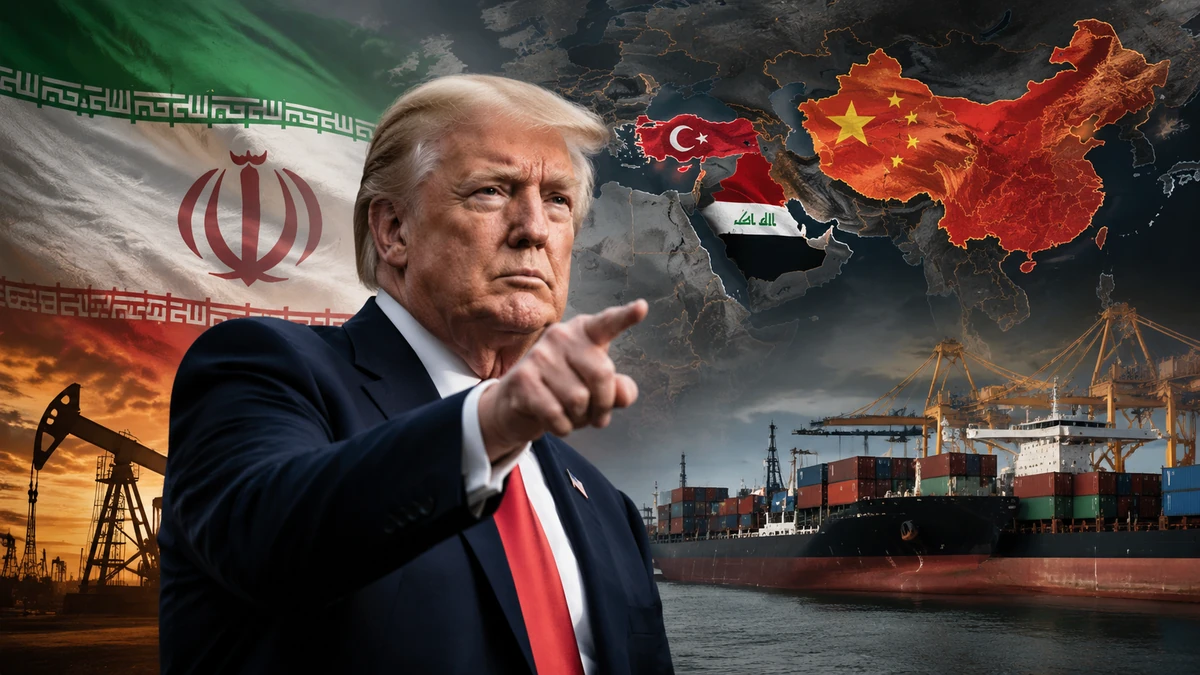
According to the Korean news summary, the administration’s latest move is explicitly designed to pressure the Iranian regime by targeting the economic links that sustain it from abroad. In practical terms, that means the story is no longer only about Iran. It is about China, which is described as Iran’s largest trading partner and a major buyer of Iranian oil, as well as Turkey and Iraq, both identified as important trade counterparts that could also be pulled into Washington’s line of fire.
For American readers, the easiest comparison is to how U.S. sanctions often work in the financial world: the target may be one country or one company, but the real force comes from making everyone else think twice about dealing with that target. The power of the United States in these cases is not just what it bans directly. It is the fear that banks, shipping companies, refiners, insurers and foreign governments will calculate the risk of crossing Washington and decide the transaction is no longer worth it.
That is why this matters far beyond the Persian Gulf. When the United States tries to isolate a country like Iran, it is also testing whether the rest of the world will cooperate, hedge or resist. This latest round of pressure appears to be built on the idea that squeezing Iran’s partners may be more effective than focusing only on Iran itself.
The central question, then, is not merely what Washington announces. It is what China, Turkey and Iraq actually do next.
China is the pivotal player because it keeps Iran connected to the global economy
The Korean summary makes clear that China stands at the center of this strategy. It cites reporting that China has continued trading with Iran through years of Western sanctions and has bought as much as 90% of Iran’s oil exports. Even allowing for the complications that often accompany sanctions-era energy trade, the broad point is unmistakable: China is not a secondary actor here. It is the most important external economic lifeline Iran has.
That creates a structural reality Washington cannot ignore. If one buyer accounts for such a large share of a sanctioned country’s oil exports, that buyer’s decisions can shape the effectiveness of U.S. policy more than almost any speech, designation or warning from Washington. If China keeps purchasing Iranian oil, Iran preserves a critical source of revenue. If China scales back under pressure, the economic shock to Tehran could be severe.
For years, American sanctions policy has relied on a simple but powerful idea: access to the U.S. financial system and the U.S. market is so valuable that many foreign firms will avoid sanctioned actors rather than risk penalties. But China complicates that logic. It is not just another customer. It is the world’s second-largest economy, a geopolitical rival to the United States and a government that may see strategic value in sustaining ties with countries Washington wants isolated.
That is where this stops being only an Iran story and becomes a U.S.-China story as well. The Korean summary notes one interpretation circulating among analysts: that Beijing may see value in maintaining relations with Iran not only for economic reasons, but because Iran remains a persistent challenge for the United States. If that view is correct, Chinese policy would not be driven solely by the commercial math of buying discounted oil or preserving trade. It would also reflect a broader strategic decision about how to counterbalance American influence.
American officials and lawmakers have confronted versions of this problem before. Sanctions are most effective when the target country is small, financially exposed and cut off from major power backing. They become harder to enforce when a rival power decides the target is useful, whether as an energy supplier, a regional foothold or simply a pressure point against the United States. That is one reason China’s role is so consequential here. It is not just helping determine Iran’s room to maneuver. It is also helping define the limits of American coercive power in a more fragmented global economy.
Turkey and Iraq show how sanctions pressure spreads through neighboring states and everyday commerce
China may be the biggest piece of the puzzle, but the inclusion of Turkey and Iraq in the Korean report is significant for another reason: it shows how sanctions pressure radiates outward through geography, trade habits and business networks that are often much messier than headline politics suggests.
Turkey, a NATO member with a complicated relationship with Washington, has long balanced competing regional interests. Iraq, meanwhile, sits in an especially difficult position because of its economic and geographic ties to Iran and its strategic relationship with the United States. Neither country fits neatly into a simple sanctions script. They are not just bystanders. They are states whose governments and companies may have to weigh the benefits of maintaining economic ties with Iran against the risks of inviting greater U.S. scrutiny or penalties.
The Korean summary is careful not to overstate uniformity among these countries, and that caution matters. The volume and nature of trade each has with Iran are not identical. Their domestic politics are different. Their exposure to U.S. pressure is different. Their ability to absorb economic disruption is different. That means Washington’s campaign may not land with the same intensity in every capital or every sector.
Still, the broader dynamic is familiar. Sanctions often work through what might be called preemptive caution. A government does not always need to force every last company to stop a transaction. Sometimes it is enough to create uncertainty. If importers, transport firms, traders and financiers believe the risk profile is changing, they may scale back on their own. Deals become slower, more expensive or more conditional. Credit tightens. Insurance becomes harder to obtain. Routine transactions start requiring extra legal review. Over time, that friction can weaken the targeted economy even before a formal crackdown fully unfolds.
That is why the Korean summary emphasizes that the real test is not the declaration itself but how trading countries and companies interpret the danger. If they turn cautious, the United States may achieve a larger effect than the legal text alone would suggest. If they conclude the risk is manageable and continue operating, the strategy could lose force.
For Turkey and Iraq, the pressure is not abstract. It is a question of how much flexibility they have in dealing with a neighboring country that remains economically relevant to them while also navigating U.S. expectations. Those are not choices made in a vacuum. They are shaped by energy needs, border commerce, domestic politics and regional security concerns.
What this means for the United States: oil markets, sanctions credibility and the U.S.-Korea conversation
For the United States, the stakes go well beyond the administration’s desire to tighten the screws on Iran. This is also a test of American sanctions credibility at a time when Washington is trying to prove that its economic tools still carry decisive weight, even when major rivals and middle powers have more room to maneuver than they did in earlier eras.
The first implication is for the U.S. market and American consumers, even if the effect is indirect. Iran is an oil producer, and any campaign that disrupts oil flows can shape expectations in global energy markets. American drivers do not need to know the details of tanker routing in Asia to feel the consequences if tighter pressure contributes to supply anxiety or market volatility. Oil is priced globally, and geopolitical pressure on a major producer can ripple outward, affecting inflation, shipping costs and business planning in the United States.
The second implication is for American companies. U.S. firms, especially in finance, energy services, shipping compliance and global logistics, watch sanctions policy closely because it changes the risk map. Even when the direct target is overseas, American companies can be affected by shifts in enforcement, customer screening, legal exposure and competitive dynamics. If Washington intensifies efforts to constrain Iran’s trade network, companies doing business in related markets will likely face more compliance scrutiny and more pressure to prove they are not touching sanctioned trade indirectly.
The third implication is strategic. Washington’s campaign will be judged not just by whether it hurts Iran, but by whether it persuades or compels other countries to adjust. If China continues buying heavily and other trade channels remain active, critics in the United States will argue that sanctions without broad cooperation are increasingly blunt instruments. If trade partners pull back meaningfully, the administration will claim that U.S. leverage remains strong despite growing global resistance to American pressure tactics.
There is also a wider U.S.-Asia dimension that matters to American readers. South Korea, where this story was summarized and framed for a domestic audience, is one of Washington’s closest allies and one of the countries that regularly has to track instability in energy markets and shifts in U.S. foreign policy. That reflects a larger truth about the U.S. alliance network in Asia: Middle East policy is not just a Middle East issue. It affects energy-dependent allies, trade routes, manufacturing costs and diplomatic coordination across the Indo-Pacific.
For American audiences familiar with the way Washington has used sanctions against Russia, Venezuela and other adversaries, the pattern is recognizable. The United States is trying to weaponize access: access to markets, access to dollars, access to shipping and access to legitimacy in the formal global economy. The question is whether that model still works as effectively when the target has a giant economic partner prepared to keep at least some channels open.
That question matters to the United States because sanctions have become one of Washington’s preferred tools when military escalation is undesirable and diplomacy is stalled. If their effectiveness erodes, America loses one of the central instruments it uses to project power short of war.
This is part of a larger trend: economic statecraft now targets networks, not just nations
One reason this story deserves attention beyond the day’s headlines is that it illustrates a broader shift in how economic pressure is applied in modern geopolitics. The old sanctions model often centered on the target country itself: ban its exports, freeze its assets, restrict its banks. The newer model increasingly focuses on the network around the target. Who buys its oil? Who processes its payments? Who ships its goods? Which neighboring economies act as buffers or back doors?
That change reflects how globalization actually works. Few economies are self-contained. A sanctioned state can survive longer if it retains buyers, logistics channels and financial workarounds. So policymakers now aim at those supporting links as much as the target itself. In Iran’s case, the Korean summary suggests that Washington understands exactly that. The administration appears to be betting that weakening Iran’s external support system could impose deeper pain than measures aimed only at Iran’s domestic economy.
This network-based strategy has advantages, but it also has limits. It can amplify U.S. influence because it forces third countries and private firms to become part of Washington’s pressure architecture. At the same time, it can generate resentment among allies and neutral states that see themselves being asked to bear costs for an American policy objective. It also creates incentives for rival powers to build alternative systems, whether in trade settlement, shipping arrangements or political coordination, to reduce vulnerability to U.S. pressure in the future.
That is one reason the Iran case matters beyond Iran itself. It is a preview of how major-power competition increasingly intersects with sanctions policy. Every time Washington tries to isolate an adversary, it is also measuring the willingness of others to keep participating in a U.S.-led economic order. Every time Beijing decides whether to sustain ties with a sanctioned state, it is also testing how far it can resist American preferences without paying an unacceptable price.
In that sense, the current pressure campaign is not just about immediate pain for Tehran. It is about the rules of economic power in an era when the United States still has unmatched financial leverage but no longer commands the same uncontested global compliance it once did.
What to watch next: not the rhetoric, but the trade flows
The Korean summary wisely avoids a common trap in sanctions coverage: assuming that declared intent automatically produces real-world results. Washington may say it wants to destabilize the Iranian regime through economic pressure, but the available information here does not establish that such an outcome is likely or imminent. What it does establish is that the administration is trying to raise the costs of doing business with Iran and that the policy’s success depends heavily on how third countries respond.
That means the most important indicators in the coming period will be practical, not rhetorical. Does Chinese purchasing behavior change in any noticeable way? Do Turkish and Iraqi trade patterns tighten, reroute or continue largely as before? Do companies in those countries adopt a more conservative posture out of fear of future penalties? Do shipping and financing channels become more difficult to use? Those are the signals that will reveal whether the pressure campaign is biting.
For American policymakers, another question will be how far they are prepared to go in enforcing this strategy if key partners do not cooperate. It is one thing to announce tougher pressure on Iran. It is another to confront the diplomatic fallout of leaning harder on countries that have their own interests in maintaining economic ties. That is especially delicate when one of those countries is China and others occupy sensitive positions in regional politics.
There is also a political messaging challenge at home. U.S. administrations often present sanctions as a firm response that avoids the costs of military conflict. But sanctions can produce uneven results, take time to work and depend on international behavior that Washington cannot fully control. If the administration promises transformative pressure and the trade network holds, critics will argue that the policy overestimated U.S. leverage. If the network begins to fracture, supporters will say the approach shows that American economic power remains formidable.
Either way, this is a story Americans should read as more than a foreign-policy headline about Iran. It is an example of how Washington uses financial and commercial pressure to pursue strategic goals, how China can complicate that effort and how third countries become battlegrounds in contests between larger powers. In a world where geopolitics increasingly runs through cargoes, payment systems and trade relationships, the countries that connect a sanctioned economy to the outside world may matter as much as the sanctioned economy itself.
That is the central lesson of the current standoff. The real contest is no longer only between Washington and Tehran. It is between Washington’s ability to reshape the choices of everyone around Tehran and those countries’ willingness to keep Iran economically afloat despite the pressure. Whether the Trump administration can alter those choices will determine whether this is a meaningful escalation or just another declaration in a long-running sanctions struggle.
Comments
Post a Comment