U.S.-Canada trade talks collapse, turning a tariff dispute into a test of North American economic trust
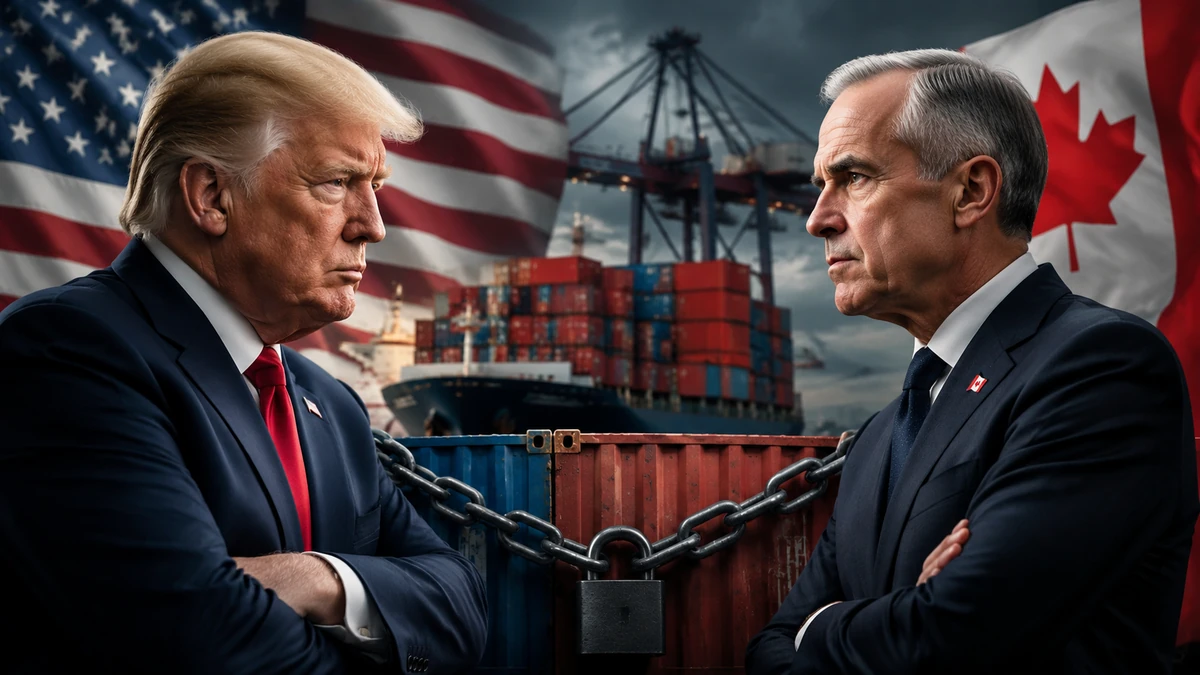
Image to help understand the article
A breakdown between neighbors with one of the world’s closest trade ties
The collapse of trade talks between the United States and Canada, and the resulting move into a 50% tariff regime on Canadian imports, is more than a sharp turn in a bilateral dispute. It is a reminder that even the most integrated economic relationships can be jolted by political brinkmanship, sector-by-sector grievances and the growing use of trade policy as a public show of strength.
According to the Korean news summary, the talks fell apart just three days after President Donald Trump and Canadian Prime Minister Mark Carney spoke directly and temporarily paused the tariff’s implementation. That short reprieve now looks less like a genuine cooling-off period and more like a final test of whether either side was prepared to back down on core demands. Neither was.
The immediate dispute centered on different ideas of what a resolution should look like. Canada reportedly wanted the United States to withdraw tariffs already imposed on automobiles and steel, treating those existing measures as the main obstacle to restoring a normal trading relationship. The United States, by contrast, not only held to its broader complaints about market access and industrial policy but also demanded an end to boycotts of American liquor in some Canadian provinces.
That mismatch matters. One side was focused on removing formal trade barriers already in place. The other brought consumer behavior and political symbolism into the negotiating room. Those are not equivalent issues, and they do not lend themselves to the same kind of bargain. Tariffs can be adjusted by federal policy. A boycott, especially one carried out at the provincial level or through local distribution systems, is harder to control and harder to package into a clean government-to-government deal.
For American readers, the closest comparison may be the way trade fights increasingly spill beyond customs duties into culture, local politics and consumer identity. In the United States, Americans have seen “buy American” campaigns, politically charged boycotts and pressure on state-level procurement become part of larger economic arguments. What appears at first glance to be a dispute over tariff percentages is often really a struggle over leverage, national pride and who gets blamed domestically for a breakdown.
That is what makes this moment significant. The United States and Canada are not distant rivals experimenting with confrontation. They are neighbors whose economies have been built around the assumption that parts, raw materials and finished goods can move across the border with relative predictability. When that assumption weakens, the shock reaches far beyond trade negotiators.
Why a 50% tariff is different from an ordinary trade skirmish
A 50% tariff is not a minor adjustment. It is the kind of measure that forces companies to rethink whether importing a product still makes sense at all. For industries such as automobiles and steel, which were specifically mentioned in the summary, that is especially disruptive because production does not happen in one place from start to finish. It happens through networks.
A North American auto part may cross the U.S.-Canada border multiple times before ending up in a finished vehicle. Steel can be produced, processed, cut, stamped and assembled through a chain that spans both countries. In that environment, a high tariff is not just a tax on one final good sitting at the border. It can affect the cost structure at multiple stages, depending on when the tariff applies and how contracts are written.
That is why the real damage from a trade escalation is often not captured by headline numbers alone. Companies have to decide whether to absorb higher costs, renegotiate prices with suppliers, shift sourcing, delay shipments or pass the increase on to customers. Different firms will make different choices. Some will have enough margin to endure a period of disruption. Others, especially smaller businesses or manufacturers operating on tight schedules, may not.
Just as important is the issue of predictability. The summary describes a policy sequence that moved quickly: a 50% tariff was announced last month, temporarily paused after a leaders’ call on the 18th, and effectively revived after talks failed on the 21st. That kind of rapid reversal is itself a cost. Businesses can adapt to many things, including high tariffs, if they believe the rules will hold long enough to justify a new strategy. What is harder to manage is uncertainty over whether the policy in force today will still be in force next week.
In practical terms, uncertainty changes behavior even before a tariff bill is paid. Importers may stockpile. Manufacturers may slow orders. Transport and warehousing decisions become harder. Legal and compliance teams spend more time gaming out scenarios. Lenders and investors begin to ask whether a company’s North American strategy still makes sense. The burden is not confined to customs paperwork; it becomes a planning problem across the entire business.
That is one reason economists and executives often say that predictability matters almost as much as the tariff rate itself. In a highly integrated regional economy, policy volatility can be as damaging as the duty because it erodes trust in the underlying framework. Once companies start pricing in political risk as a permanent feature of U.S.-Canada trade, the relationship changes even if the two governments later step back from the brink.
How consumer boycotts became part of a state-to-state trade fight
One of the most striking details in the Korean summary is the American demand that Canada stop boycotts of U.S. liquor in some provinces. That detail may sound small compared with tariffs on steel or autos, but it points to a deeper shift in the way trade disputes work.
In theory, a trade negotiation is supposed to focus on formal barriers: tariffs, quotas, subsidies, standards and access rules. In reality, political leaders increasingly treat public sentiment and symbolic retaliation as part of the battlefield. Asking another country to halt a consumer boycott means the dispute is no longer only about trade architecture. It is also about national messaging and public pressure.
For an American audience, it helps to understand a bit of Canadian context. Alcohol distribution in Canada often involves provincial control or regulation to a degree that Americans may find unfamiliar. That means liquor-related actions can sit in a gray area between market activity, public policy and political signaling. A boycott there does not necessarily look like a grassroots social-media campaign in the American mold; it can intersect with institutional systems that are more centralized than many U.S. readers would expect.
That makes the issue difficult in negotiations. Even if Canada wanted to meet the demand in principle, the mechanics of doing so could be complicated. It raises questions about what the federal government can credibly promise, how provinces would respond and what compliance would even look like. A tariff can be set at the federal level. A boycott shaped by provincial action or public sentiment is a different kind of instrument.
The inclusion of liquor boycotts in the dispute also shows how trade conflicts increasingly become domestic political theater. A leader can point to a boycott as evidence of disrespect or discrimination, while the other side can present resistance as a matter of sovereignty or public solidarity. In that sense, trade policy becomes a vehicle for larger stories each country tells itself: about fairness, strength, control and national identity.
Americans have seen versions of this dynamic before. Boycotts, counter-boycotts and pressure campaigns are now common features of commercial disputes worldwide, from consumer brands to entertainment to sports. What is new here is the degree to which such behavior appears to have been elevated into the formal terms of a high-stakes negotiation between two countries whose economies are tightly entwined. That suggests a broader trend: the lines between policy, politics and public sentiment are getting harder to separate.
What this means for the United States
For the United States, the collapse of these talks is not simply a story about what happens to Canadian exporters. It is a story about the reliability of America’s own economic neighborhood and about how far Washington is willing to push disruption in the name of leverage.
Canada is not just another trading partner. It is one of the United States’ most important economic counterparts, linked to American industry through energy, agriculture, manufacturing and retail supply chains. When a 50% tariff enters that relationship, the costs do not stop at the border. American importers pay more. U.S. manufacturers that rely on Canadian inputs face new pressure. American consumers may ultimately see higher prices, depending on how companies distribute the burden.
The sectors mentioned in the summary — autos and steel — are especially important to the U.S. story. American manufacturing has long depended on cross-border production with Canada. That integration is a feature, not a flaw, of the North American model that policymakers have spent decades building. When Washington targets Canadian goods at such a high rate, it risks hitting its own industrial base along with its negotiating target.
There is also a credibility issue for the United States. American officials often argue that the U.S. market is a source of stability, scale and rules-based opportunity. But when major tariff actions are announced, paused and revived within days, businesses may begin to view the U.S. commercial environment less as an anchor and more as a source of political volatility. That does not mean companies will abandon the U.S. market. It does mean they may hedge more aggressively and trust less easily.
For American audiences, one useful comparison is the way tariffs have been debated in the United States across recent administrations: as both an economic tool and a political symbol. Supporters present them as a way to correct unfairness, protect domestic industries and force concessions. Critics counter that tariffs often function like taxes that fall, directly or indirectly, on domestic businesses and consumers while inviting retaliation. The U.S.-Canada dispute fits squarely into that larger American argument.
There is a diplomatic dimension as well. A harsh trade confrontation with Canada sends signals beyond North America, including to allies watching how the United States handles disputes with close partners. If America is willing to escalate sharply with a neighbor whose economy is deeply tied to its own, other countries may conclude that even close alignment with Washington does not guarantee stability in economic relations. That perception could shape future negotiations, investment decisions and alliance politics.
Finally, there is the domestic political angle. Trade fights are often sold to voters as simple contests of strength. The reality is usually more complicated. Benefits, if they arrive, are diffuse and delayed. Costs are immediate and unevenly distributed. An American steel producer may welcome protection, while an American factory that uses imported steel may feel squeezed. A whiskey maker may want stronger export access abroad, while a retailer may simply worry about shrinking choice and rising prices. The United States is not a single economic actor with a single interest, and this episode underscores that fact.
Why this matters beyond North America, including in Asia
The fact that this story is being framed for a Korean audience is itself revealing. Trade disruptions between the United States and Canada are not only bilateral events. They are watched globally because they offer clues about how the world’s largest economy uses coercive economic tools and how quickly trusted trading relationships can become unstable.
For South Korea and other export-driven economies, the lesson is straightforward: policy continuity cannot be taken for granted, even among close partners. Korea’s own industries, especially in autos, steel, batteries, semiconductors and advanced manufacturing, operate within a global system where North American demand and trade policy matter deeply. When the U.S.-Canada corridor becomes less predictable, companies elsewhere pay attention.
There is also a broader pattern here that Asian governments and companies know well. Trade disputes are increasingly about more than tariffs in the narrow sense. They often involve industrial policy, strategic competition, local political signaling and attempts to reshape consumer behavior. In recent years, many countries have had to navigate a world in which economics and politics are less separable than they once were. The U.S.-Canada rupture fits that pattern, even if the players are different.
For American readers interested in the Korean Wave, or Hallyu, this may feel far removed from entertainment and culture. But it is not. Korean pop culture’s success in the United States rests partly on the same foundation that supports broader transnational exchange: functioning logistics, stable regulation, confidence in cross-border business and relatively open consumer markets. When major countries normalize the use of abrupt economic pressure, the consequences can eventually touch everything from industrial goods to cultural products, sponsorships and distribution relationships.
More broadly, allies and partners in Asia often study North American disputes as case studies. They want to know whether economic integration with the United States creates protection from shocks or merely exposes them to a different kind of risk. That question has become more urgent in an era when tariffs, sanctions, export controls and politically charged consumer campaigns are all used more openly as tools of statecraft.
What to watch next in a dispute shaped by politics as much as economics
The immediate question is whether this 50% tariff regime becomes a durable reality or another bargaining chip in a cycle of escalation and delay. The summary suggests the key obstacle is not a technical misunderstanding but a clash over starting conditions. Canada wants the rollback of existing sectoral tariffs, particularly on autos and steel, as part of restoring normal trade. The United States appears to want concessions that reach beyond formal trade barriers, including the end of anti-American liquor boycotts.
If those positions hold, restarting talks will be difficult because the disagreement is structural. It is not just about how much tariff pain each side can bear. It is about what counts as a legitimate negotiating issue and what each government can realistically deliver. That is why a leaders’ phone call was not enough. High-level communication can buy time, but it cannot erase the political and institutional limits underneath the dispute.
Another question is sequencing. Future talks, if they happen, may turn on whether the two sides can separate existing sectoral tariffs from the new 50% measure, or whether they insist on treating everything as one package. They may also need to decide whether politically sensitive side issues, such as provincial liquor boycotts, belong inside a formal trade settlement at all. If not, both governments may need to find a face-saving way to de-emphasize them without appearing to retreat.
Markets and companies will also be watching for signs of duration. A short-lived tariff shock and a prolonged tariff regime produce different business responses. If companies believe the situation will reverse quickly, they may absorb some losses and wait. If they conclude the uncertainty itself is now permanent, they may change sourcing patterns, postpone investment or build more redundancy into supply chains. Those adjustments can outlast the political crisis that triggered them.
There is a final issue worth watching: whether this dispute becomes a template. If Washington increasingly treats tariffs not only as economic measures but as tools to shape allied countries’ domestic political responses, other negotiations could follow a similar path. That would further blur the line between trade policy and coercive diplomacy. If Canada, one of America’s closest economic partners, can be pushed into this kind of confrontation, other countries will ask how easily the same approach could be used elsewhere.
That is why this episode matters beyond the news cycle. It is not only about a failed round of talks. It is about whether North America remains a region where businesses can rely on continuity, whether political symbolism is now a regular ingredient in trade negotiation, and whether the United States is prepared to accept the domestic costs that come with using tariffs as a high-visibility instrument of pressure.
For now, the clearest conclusion is that the breakdown has exposed a deeper problem than a disagreement over percentages. It has revealed an erosion of shared assumptions. The United States and Canada have long operated as if friction could be managed inside a stable framework. When that framework starts to look conditional, every truck crossing the border, every factory order and every pricing decision becomes a referendum on trust.
Comments
Post a Comment