U.S. Carrier Based in Japan Prepares for Middle East Deployment, Raising Questions About America’s Global Military Balance
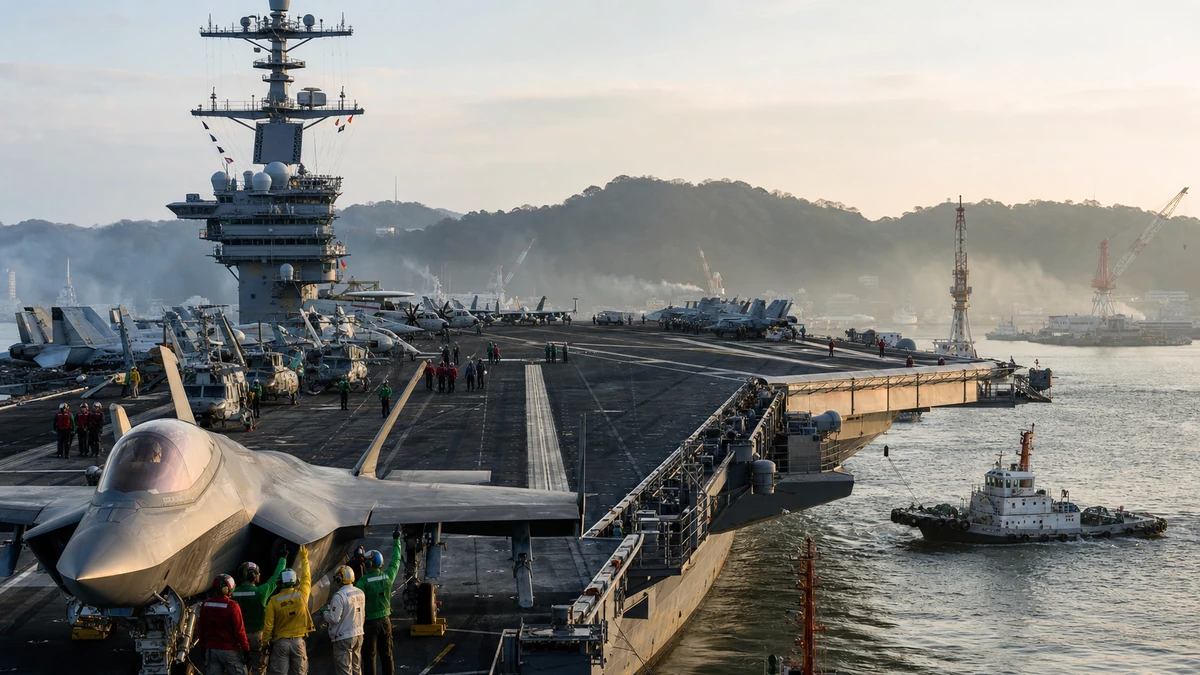
Image to help understand the article
A carrier shift with consequences far beyond one region
The USS George Washington, the U.S. Navy aircraft carrier permanently forward-deployed to Japan, is preparing to head to the Middle East to relieve the USS Abraham Lincoln, according to reports cited in South Korean media and The Wall Street Journal. On paper, the move can be described as a routine carrier rotation. In practice, it is drawing attention for a more consequential reason: it would send the only U.S. aircraft carrier that is normally kept on constant watch in East Asia out of the Indo-Pacific at a moment when tensions remain high from the Korean Peninsula to the Taiwan Strait.
That matters because aircraft carriers are not just warships. They are floating air bases, crisis-response platforms and political signals all at once. When Washington moves a carrier from one theater to another, allies and rivals alike read it as a statement about priorities. In this case, if the George Washington leaves Yokosuka, Japan, for the Middle East, it would suggest the Trump administration believes the conflict involving Iran has become important enough to draw on forces usually reserved for deterring China, reassuring Japan and South Korea, and maintaining a visible American military presence in Asia.
For American readers, a useful comparison is to think of a fire department moving one of its most important ladder trucks from a busy downtown district to a major blaze in another part of the city. The truck may be redeployed as part of a planned shift schedule, but if it is the vehicle residents are used to seeing nearby every day, its absence changes the sense of security in the neighborhood it leaves behind. In military terms, that neighborhood is one of the most strategically sensitive parts of the world.
The Korean report frames the possible deployment not simply as a ship changing assignments, but as evidence that a war in one region can begin to pull on the military architecture of another. That is why the story is getting such close attention in East Asia, where U.S. force posture is watched carefully not only by governments, but also by markets, defense analysts and ordinary citizens living within range of North Korean missiles.
Why the USS George Washington matters in Asia
The George Washington is the sixth Nimitz-class nuclear-powered aircraft carrier in the U.S. fleet. At about 1,092 feet long, with a flight deck spanning roughly the area of three soccer fields, it is less a ship than a mobile military ecosystem. It carries roughly 6,000 sailors and can operate around 80 aircraft, including F-35C stealth fighters, F/A-18 Super Hornets, E-2C Hawkeye early warning aircraft and helicopters used for maritime missions. That mix gives it the ability to launch strikes, monitor airspace, support naval operations and respond quickly across a wide area.
But the most important fact about the George Washington may be where it is based. Unlike carriers homeported on the U.S. mainland, it is stationed in Yokosuka, south of Tokyo, as part of America’s long-standing forward presence in Japan. For readers unfamiliar with the term, “forward-deployed” means the ship is kept close to likely flashpoints rather than having to sail across the Pacific from California or Washington state whenever a crisis erupts. That shortens response time and gives U.S. allies in Asia visible evidence that American commitments are not merely theoretical.
Yokosuka itself is a cornerstone of that posture. The naval base has for decades been one of the most important U.S. military facilities outside the United States. To Japanese and South Korean observers, the presence of a U.S. carrier there is not just about ships and aircraft. It is part of the broader security structure that underpins alliances in the region, much the way NATO bases symbolize American commitment in Europe.
If the George Washington departs for the Middle East, that does not mean East Asia is left undefended. The U.S. military would still have submarines, land-based aircraft, destroyers, Marines and other assets available across the region. Even so, a carrier’s absence is meaningful. A carrier is uniquely flexible: it can move, strike, surveil and deter without depending on host-nation runways. That is why the removal of the Indo-Pacific’s standing carrier is being read as more than administrative fleet management.
In South Korea, where security concerns are shaped by North Korea’s nuclear and missile programs, such a shift is especially sensitive. Seoul and Tokyo both rely heavily on the credibility of the U.S. security umbrella. Any sign that military resources are being stretched between the Middle East and Asia tends to generate intense scrutiny, even when American officials insist the overall deterrent remains strong.
The Lincoln’s long deployment highlights the human cost
The reported timing of the George Washington’s move is closely tied to the extraordinary deployment of the USS Abraham Lincoln. According to the Korean summary, the Lincoln left its homeport in San Diego on Nov. 21 of last year and spent nine months deployed. After stopping in Guam in December while en route to the Middle East, it reportedly remained at sea for 208 straight days until a brief port call in Oman on July 7.
That figure stands out even in a military where long deployments are often treated as part of the job. More than six months away from home is already a heavy burden for many service members and their families. Two hundred eight consecutive days at sea pushes beyond the image many Americans may have of deployment as periodic hardship followed by reset and recovery. It suggests an operational tempo so relentless that questions about endurance become unavoidable.
The Korean report says the Lincoln’s deployment triggered concerns in Washington over sailors’ living conditions and mental health. Reports of multiple suicide attempts aboard the ship, whether fully verified or disputed in detail, have fueled broader anxiety among military families and lawmakers. Sen. Richard Blumenthal, a member of the Senate Armed Services Committee, reportedly sent a letter to Defense Secretary Pete Hegseth and the acting Navy secretary seeking answers about conditions aboard the vessel.
Hegseth, according to Reuters as cited in the Korean report, rejected claims that serious problems had developed aboard the Lincoln, calling such reporting a distortion of the facts. But even official denials have not fully quieted the controversy, in part because the length of the mission itself is difficult to dismiss. Modern carriers project enormous combat power, but they only function because thousands of people can safely and sustainably do grueling work for months at a time.
That human reality often gets lost in Washington debates over strategy. Americans are used to seeing aircraft carriers as symbols of overwhelming U.S. might, especially in Hollywood and cable-news graphics. Yet every launch and recovery depends on deck crews, mechanics, cooks, medical staff and watchstanders working in a high-pressure environment where fatigue accumulates. A deployment that can be sustained mechanically may still become deeply costly psychologically and politically.
In that sense, the Lincoln story is not just about one ship. It is about the limits of military endurance in an era when the United States is expected to manage simultaneous crises around the world. The need to relieve the Lincoln with another carrier underscores that global military presence is not simply a matter of owning expensive platforms. It requires manpower, maintenance cycles, family support and political willingness to bear long campaigns.
A test of priorities between the Middle East and the Indo-Pacific
Strategically, the reported handoff from the Lincoln to the George Washington points to a familiar but increasingly difficult U.S. problem: how to distribute limited high-end forces across multiple theaters at once. American defense planning has spent years emphasizing the Indo-Pacific, where China’s military rise has transformed the region into the central focus of long-term U.S. competition. At the same time, the Middle East continues to demand attention whenever conflict involving Iran threatens to expand or destabilize shipping, energy markets and regional partners.
That competition for resources becomes much more visible when the asset being moved is a carrier. Sending an additional carrier to the Middle East would signal one thing. Pulling an existing carrier from East Asia to sustain Middle East operations signals something else: that the conflict is no longer being handled as a temporary surge, but as a commitment requiring a continuing rotation of top-tier naval power.
The Korean analysis is especially pointed on that issue. It argues that the move suggests the Iran war has lasted long enough to disrupt not only combat operations, but also the normal sequencing and regional balance of U.S. naval deployments. In other words, the question is no longer whether the United States can send power into the Middle East for a crisis. It is whether the war has become prolonged enough that maintaining it begins to affect deterrence elsewhere.
For American readers, the broader context is straightforward: the United States does not have an unlimited number of carriers ready at all times. Maintenance schedules, training requirements and crew fatigue all reduce how many can be deployed simultaneously. Presidents of both parties have long faced the reality that a military superpower still has to make choices. One region’s emergency can become another region’s vulnerability.
That does not mean adversaries will automatically exploit any gap. China is unlikely to base major decisions on a single ship’s location alone, and U.S. allies know that carriers are only one part of a much larger force posture. Still, symbols matter in geopolitics. In East Asia, where demonstrations of resolve can shape calculations in Beijing, Pyongyang and even Moscow, the absence of a Yokosuka-based carrier could be read as evidence that Washington’s attention is being pulled elsewhere.
It also poses a policy challenge for an administration that wants to project strength on multiple fronts. If the George Washington is sent westward to support operations linked to Iran, the administration will have to reassure Asian allies that America’s commitment to regional deterrence remains intact. That means not only military messaging, but also practical adjustments in air, missile-defense and naval deployments throughout the Pacific.
Why this story resonates in South Korea and Japan
To understand why this development is headline news in South Korea, it helps to remember how closely people there track U.S. military movements. The Korean Peninsula remains technically at war, since the 1950-53 conflict ended with an armistice rather than a peace treaty. North Korea’s steady advances in nuclear weapons and long-range missiles have made questions of U.S. readiness more than abstract strategic debates. They are part of everyday political discussion in Seoul, where citizens routinely hear warnings about deterrence, extended nuclear guarantees and alliance credibility.
Japan has a similar stake, though shaped by its own geography and politics. Yokosuka is not just a foreign base on Japanese soil; it is a visible reminder of the U.S.-Japan alliance and Japan’s role in the American-led security order in Asia. Any change involving the base’s carrier draws domestic attention because it touches on regional stability, local base politics and Japan’s own defense planning as it expands military spending in response to China and North Korea.
For American audiences less familiar with that atmosphere, imagine if a key U.S. missile-defense unit protecting a major allied capital were suddenly reassigned to another war zone. Even if Pentagon officials said coverage remained sufficient, the move would still trigger debate about priorities and risk. That is the sort of reaction this reported deployment is likely to generate in Seoul and Tokyo.
There is also a broader symbolic layer. In recent years, Washington has repeatedly told allies that the Indo-Pacific is the priority theater of the 21st century. If the region’s permanently deployed carrier is redirected to the Middle East, critics may argue that old crises continue to pull U.S. strategy back toward familiar conflicts, even as officials insist they are preparing for long-term competition with China.
That tension is particularly important in Asia because credibility is cumulative. Allies notice not only what the United States says, but where it places ships, aircraft and troops. A prolonged absence by the George Washington would therefore be watched not just for its military effect, but for what it implies about American bandwidth in an increasingly crowded global security environment.
The political stakes back home in the United States
The Korean report also notes that public sentiment in the United States has soured over a prolonged war involving Iran and that the Lincoln’s deployment has become a domestic political issue ahead of the November midterm elections. That is a reminder that military deployments are never only about overseas strategy. They also feed back into U.S. politics through family strain, media coverage, congressional oversight and voter fatigue.
Americans have seen versions of this dynamic before, from Iraq and Afghanistan to shorter flare-ups that nonetheless raised questions about mission creep. One of the central lessons of the post-9/11 era is that wars can extend far beyond their initial justifications, while the burden falls unevenly on service members, reservists and military families. When a carrier deployment stretches to extraordinary lengths, that burden becomes visible in a way budget numbers often do not.
That visibility can be politically damaging. Lawmakers may ask whether the mission’s objectives are clear, whether sailors are being asked to absorb too much strain, and whether the administration has a sustainable plan. Even if the White House and Pentagon argue that relieving one carrier with another is standard practice, the surrounding context makes it hard to present the move as routine.
There is also an accountability question. If the George Washington assumes the mission, the issue is not solved so much as transferred. The combat burden that weighed on the Lincoln and its roughly 5,000 sailors would shift to another carrier and another crew of about 6,000. That may keep operations going, but it does not erase the larger problem of how long the United States can sustain a war footing in one region without distorting readiness in another.
For the Trump administration, how it manages that tradeoff could become a significant test. If it leans hard into the Middle East, critics may say it is weakening deterrence in Asia. If it tries to reassure Asia with additional moves, it may face new questions about force strain and strategic overextension. Either way, the carrier rotation becomes more than a military detail. It becomes a measure of how Washington intends to manage competing crises in a world where every commitment carries opportunity costs.
What to watch next
The most important immediate question is whether the George Washington actually departs Yokosuka for the Middle East and, if so, how long it remains away from East Asia. A second question is what substitute posture, if any, the U.S. military adopts in the Indo-Pacific while the carrier is gone. That could include increased bomber rotations, more visible destroyer activity, additional joint exercises with Japan and South Korea, or a heavier reliance on land-based aircraft.
Analysts will also watch how U.S. allies respond publicly and privately. Statements from Seoul and Tokyo may offer clues about whether they view the move as a manageable adjustment or a warning sign about American overstretch. Beijing and Pyongyang, meanwhile, will be assessing whether the redeployment changes the tactical picture or simply the optics.
Ultimately, the significance of this story lies in its chain reaction. A war centered on Iran affects not only the Middle East, but also the distribution of U.S. military power across the Pacific, the daily lives of thousands of sailors, the calculations of allies in Asia and the debate inside American politics. The route of one aircraft carrier becomes, in effect, a map of American global obligations.
That is why the reported movement of the George Washington is drawing attention far beyond naval circles. It is a reminder that in an age of overlapping crises, there is no such thing as a completely local war for a superpower with global commitments. What happens to one carrier in Japan can ripple through security planning from Seoul to Washington — and tell the world a great deal about how the United States intends to balance its power, its promises and its limits.
Comments
Post a Comment