U.S. Pauses Visa Interviews Worldwide as Trump Administration Tightens Screening, Raising Questions for Travelers, Universities and Businesses
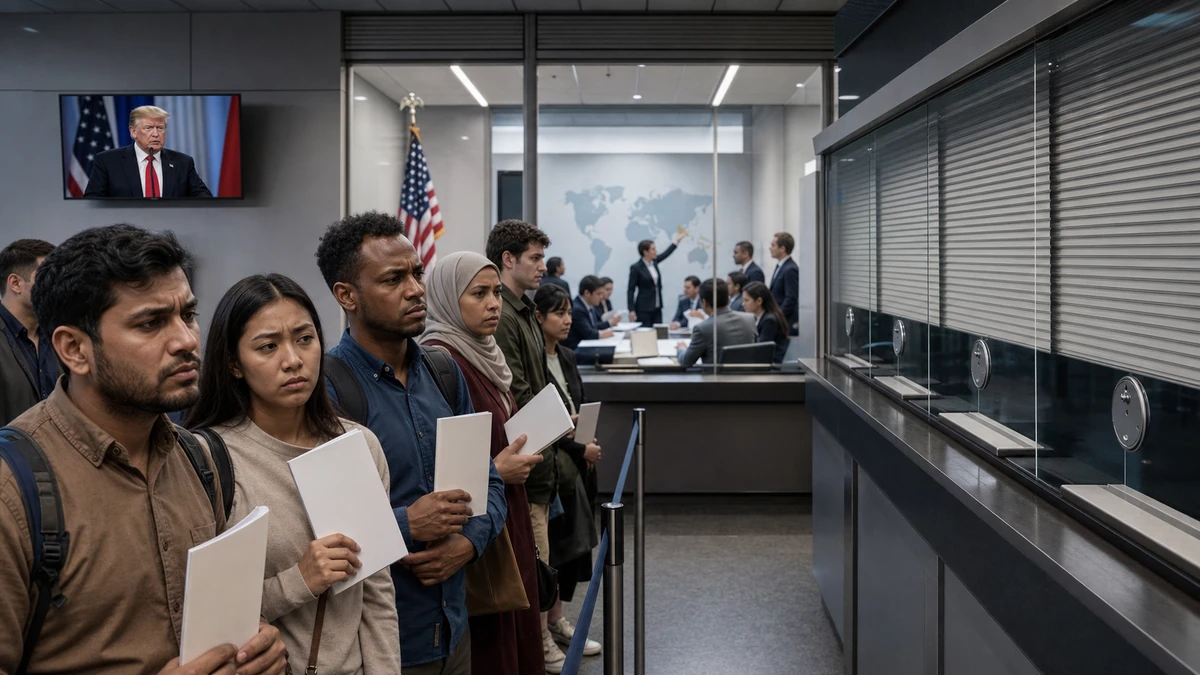
Image to help understand the article
A global visa slowdown with immediate consequences
The Trump administration has temporarily halted visa interviews at U.S. embassies and consulates around the world, a sweeping move that reaches far beyond any single country and immediately injects uncertainty into one of the most important gateways to the United States. According to the Korean news report, which cited Reuters, the State Department ordered a broad rescheduling of visa interviews as it began training consular officers on stricter screening standards.
That distinction matters. The announcement, as described in the report, is not the same as a formal suspension of all visa issuance, nor is it a declared ban targeting a particular nationality. Instead, the administration appears to be pausing the interview stage — a central part of the visa process — while it retrains officers to apply heightened review in a more uniform way across the world. For people planning to study, work, conduct business or visit family in the United States, that is still a major disruption. A consular interview is often the point where travel plans move from tentative to real. When that step stops, entire timelines can collapse with it.
For readers in the United States, the scale is what stands out. Americans are used to hearing about visa policy in the context of border debates, asylum fights or country-specific restrictions. This is different. A worldwide interview pause signals an effort to recalibrate the machinery of immigration screening itself, not just its political messaging. It suggests that Washington is trying to standardize how officers evaluate risk before applicants ever set foot on a plane.
The immediate practical problem is uncertainty. The report says the administration has not specified how long the pause will last, when normal interview operations will resume, or exactly how existing appointments will be handled. Some applicants may see cancellations, others automatic rescheduling, and others instructions to rebook on their own, depending on the embassy or consulate involved. Until each post issues its own guidance, applicants are left checking local notices and trying to guess whether a carefully timed plan — a semester abroad, a business launch, a wedding, a conference or a medical trip — will survive the delay.
In that sense, this is not just a bureaucratic story. It is a story about mobility in a globalized economy. The United States remains one of the world’s most important destinations for education, investment, technology, tourism and cultural exchange. When it slows its visa pipeline across the board, the ripple effects spread quickly through airlines, universities, employers, conference organizers and immigrant families. A procedural pause in Washington can become a missed deadline in Seoul, a deferred job start in Mumbai, a canceled campus arrival in São Paulo or a disrupted product meeting in Berlin.
That is why the episode deserves to be read not only as a policy adjustment, but also as a test of how the U.S. wants to balance national discretion with international predictability. Every country controls its borders. But when the country in question is the United States, changes in consular practice become global events.
What the administration says it is trying to do
The core rationale described in the Korean report is that the State Department is training consular officers to apply tougher review, especially in identifying applicants who might become dependent on U.S. public benefits. That language is familiar to anyone who followed immigration politics during the Trump years. In American policy debates, this is often framed through the idea that immigrants or temporary entrants should not become a financial burden on the state. The broader concept has a long history in U.S. immigration law, even if the practical meaning of it shifts with each administration.
What appears new here is not simply the concern itself, but the attempt to put that concern at the center of a synchronized global training effort. According to the report, the administration also says it wants screening to be “comprehensive and consistent” across all applicants. That phrase sounds technical, but in practice it carries major consequences. Consular officers already make consequential judgments based on documents, interviews and the applicant’s overall profile. Training aimed at consistency suggests the administration believes those judgments have varied too much from one embassy to another, or that existing standards were not being applied as firmly as officials wanted.
For supporters of stricter immigration controls, that kind of standardization may sound overdue. The argument would be straightforward: if the United States has rules, those rules should be enforced evenly whether an applicant is interviewed in Seoul, Paris, Lagos or Mexico City. To many immigration lawyers, universities and multinational employers, however, “comprehensive” screening can also signal broader officer discretion, heavier documentation demands and longer processing times even after interviews resume.
The most important unresolved issue is how officers are supposed to judge the likelihood that an applicant may rely on public assistance. The report notes that the State Department has not publicly detailed what evidence, procedures or thresholds officers will use. That gap is significant. In any system that relies heavily on prediction rather than a bright-line rule, uncertainty grows for both applicants and decision-makers. If the standards are too vague, consistency can become harder, not easier. Two officers can look at similar facts and reach different conclusions, especially when they are asked to assess future financial vulnerability rather than a simple yes-or-no eligibility requirement.
There is also a difference between saying officers should consider an applicant’s overall circumstances and explaining what that means in practice. Will more weight be placed on bank statements, affidavits of support, employment history or family ties? Will students need to show stronger funding? Will short-term visitors face additional questions about how they will pay for emergencies? Will employment-based applicants be screened differently from tourists or exchange visitors? The report does not answer those questions, and that is precisely why the pause matters. The system is being tightened before the public has a clear picture of how the new tightening will work.
That approach fits a broader pattern often seen in immigration policy: the burden of uncertainty falls first on the applicant. Governments can announce a tougher posture quickly, but the exact practical rules often emerge only later, through guidance, local implementation and real-world outcomes. In the meantime, people with the least power in the process must absorb the risk.
Why this matters beyond paperwork
Visa interviews can look minor from a distance — just another appointment in an administrative chain. But in the American immigration system, the interview is frequently the decisive checkpoint. It is where paperwork meets human judgment. Applicants may spend months gathering financial records, school documents, invitation letters and identity materials, only to discover that a rescheduled interview pushes everything beyond a semester start date, a conference opening or a planned family event.
That is especially true because so many modern timelines are tightly choreographed. International students often have fixed academic calendars. Researchers and engineers may have contract start dates. Tour groups and business travelers book around trade shows, conventions and seasonal schedules. Families planning childbirth support, elder care or weddings can rarely move dates indefinitely. If interviews are postponed globally, even briefly, the backlog can outlast the official pause. In immigration systems, delays tend to stack. Once appointments are displaced, they must be redistributed into an already finite calendar.
The administration’s emphasis on stronger review also points to a second-order effect: the pause may end before the disruption does. Even if embassies reopen interview slots soon, applicants may still face longer conversations, additional document requests or slower final adjudication if officers are newly instructed to take a broader view of financial risk. In other words, the bottleneck may shift rather than disappear.
This is where immigration policy intersects with economic competitiveness. The United States has long marketed itself, implicitly and explicitly, as a destination for the world’s best students, entrepreneurs, artists and professionals. Yet the value of that reputation depends not only on American universities and employers, but also on the predictability of the entry process. If lawful applicants come to view the U.S. system as unusually difficult to navigate, some will redirect their plans to Canada, Britain, Australia, Singapore or other countries eager to attract global talent and tuition dollars.
There is also a reputational dimension. In a world where many people share visa experiences online in real time, a global interview pause can quickly produce a narrative that the United States is becoming harder to access, even for people trying to follow the rules. Whether that impression proves durable may depend less on the announcement itself than on what happens next: how quickly appointments resume, whether embassies provide clear instructions and whether the new standards are transparent enough to feel fair.
None of that means governments do not have a right to screen carefully. They do. The question is whether the screening system can be both rigorous and legible. For businesses, schools and travelers, opaque procedure can be almost as damaging as an outright denial because it makes planning nearly impossible. Uncertainty is its own form of cost.
What this means for the United States
For Americans, the most important angle is not only what foreign applicants experience, but what a global visa disruption means at home. The United States depends on legal cross-border movement far more than political rhetoric sometimes acknowledges. Major research universities rely on international students for tuition revenue, laboratory work and graduate programs in science and engineering. Hospitals and companies depend on foreign-trained specialists. Tech firms, manufacturers and financial institutions move employees across borders for training, project launches and client work. Tourism, hospitality and conference industries benefit when visitors can enter the country smoothly and on time.
If interview delays persist, those institutions feel it first. A late-arriving student is not just one person missing orientation; it can mean an empty seat in a graduate seminar, a research assistant unavailable for a lab team or a tuition shortfall for a school balancing its budget. A delayed business visa can postpone meetings, installations, investment due diligence or partnership talks. A slowdown in visitor processing can hit hotels, restaurants and airlines in cities that depend on international arrivals.
This is especially relevant at a moment when the U.S. is competing aggressively for talent while also debating how open it wants to be. American companies want access to global expertise. American universities want the best students. American cultural institutions, from film festivals to museums to music promoters, benefit from international exchange. Yet each of those advantages rests on a visa system that works with enough consistency to be trusted.
The policy also matters for America’s image. U.S. soft power has never come only from military strength or economic scale. It also comes from being a place where ambitious people from around the world want to study, build businesses, perform, collaborate and settle, even temporarily. If the legal entry path grows more uncertain, that soft power can weaken quietly. The loss may not show up immediately in a headline, but over time it can alter where global talent chooses to go and where global publics imagine opportunity exists.
There are obvious comparisons in the U.S. context. Americans have seen how abrupt immigration and travel policy changes can create backlogs, court fights and confusion, from pandemic-era restrictions to earlier Trump-era border and vetting measures. What stands out here is the worldwide scope and the emphasis on retraining officers before continuing interviews. That makes this less like a one-off diplomatic hiccup and more like an administrative reset with potentially broad domestic effects.
For U.S. institutions, the practical lesson is plain: they may need contingency plans. Universities may have to prepare for late arrivals. Employers may need more flexible start dates. Event organizers may need backup programming if international participants cannot get to the U.S. on time. The consular system is overseas, but the consequences land squarely inside the American economy.
Why Korea is paying close attention
The story’s prominence in Korean media is not hard to understand. South Korea is one of the United States’ closest allies, and the relationship goes far beyond military cooperation. The two countries are deeply connected through trade, technology, education and popular culture. Large numbers of Koreans travel to the U.S. for study, business, family visits and entertainment work. At the same time, American demand for Korean products and culture — from semiconductors and electric vehicle batteries to K-pop, Korean dramas and beauty brands — has turned bilateral ties into a daily lived reality for millions of consumers.
That means a change in U.S. visa processing is not an abstract diplomatic issue in Seoul. It can affect students bound for American campuses, executives traveling for investment meetings, startup founders exploring partnerships, performers with schedules to keep and families with personal obligations in the United States. Even for travelers who may not need the same visa categories as applicants elsewhere, any sign of tighter U.S. screening tends to draw attention because it suggests a broader shift in Washington’s posture.
There is also a larger symbolic layer. South Korea is a country where studying or working in the United States still carries significant prestige and practical value. For decades, the U.S. has been a key destination for Korean students, professionals and migrants. So when Washington changes the rules of access — or even temporarily complicates them — Koreans read it not just as an administrative announcement, but as a signal about the direction of American openness.
The Korean coverage, based on the summary provided, also shows a careful effort to separate what is confirmed from what is not. That is important. The confirmed facts are the interview pause, appointment adjustments and training for stricter review. The report explicitly says this should not yet be treated as proof of a permanent shutdown or a blanket nationality-based exclusion. In a media environment where immigration news often sparks panic, that distinction is useful. The immediate issue is disruption and tougher scrutiny, not a formally announced end to visa issuance worldwide.
Still, Korea has reason to watch what comes next. Because the U.S.-Korea relationship is so institutionalized — from corporate investment to education pipelines to cultural exchange — even a modest slowdown in consular processing can echo through multiple sectors quickly. If interview delays stretch on or standards become harder to satisfy in practice, South Korean individuals and companies will not be the only ones affected, but they will certainly be among the attentive audiences measuring the fallout.
The larger trend: harder borders through administrative means
Seen in a wider frame, this episode is part of a familiar modern trend: governments tightening borders not only through headline-grabbing bans or laws, but through administrative procedure. Training protocols, interview standards, evidentiary burdens and scheduling systems may sound dry, but they often shape mobility just as powerfully as legislation does. A state does not always need to rewrite immigration law to make entry more restrictive. Sometimes it only needs to make screening slower, broader or more discretionary.
That is one reason this development deserves attention beyond the immediate travel disruption. The administration’s stated goal, as summarized in the Korean report, is to identify potential public-benefit dependence while enforcing more comprehensive and consistent review. Those goals sound managerial. But management choices can have political effects. They can signal toughness to domestic voters, alter the profile of who feels welcome to apply and change how foreign publics perceive the country.
For analysts, the next phase will matter more than the initial pause. If embassies resume operations quickly and publish clear, practical guidance, the story may ultimately be remembered as a short-term bottleneck during a policy recalibration. If, however, the training leads to longer waits, more document requests and less predictable outcomes across categories, then this could mark a more consequential turn toward stricter gatekeeping by process rather than proclamation.
That distinction is especially important in the digital age. Formal bans trigger immediate outrage and often legal scrutiny. Administrative tightening can spread more quietly, case by case, embassy by embassy, until applicants, schools and businesses realize the system has changed around them. By then, the effects may already be embedded in missed enrollments, abandoned trips and altered business decisions.
There is a lesson here for readers in the U.S. and abroad alike. Immigration policy is not only about who is allowed in. It is also about how a government chooses to exercise uncertainty. The less transparent the standards, the more power shifts to the state’s interpretation and the less confidently applicants can prepare. For a country that attracts people because of its institutions, that tradeoff matters.
For now, the clearest advice remains the simplest: applicants must monitor the guidance from their specific embassy or consulate and avoid assuming that the pause will be brief or that all posts will handle appointments in the same way. But the broader story is already clear enough. By freezing visa interviews worldwide while officers are retrained, the Trump administration has shown that even without announcing a sweeping new ban, Washington can reshape the experience of entering the United States for people around the globe. What happens next will determine whether this is remembered as a temporary administrative reset or as the start of a more durable tightening in America’s front-door policy.
Comments
Post a Comment