Image to help understand the article
A local job fair with a bigger story behind it
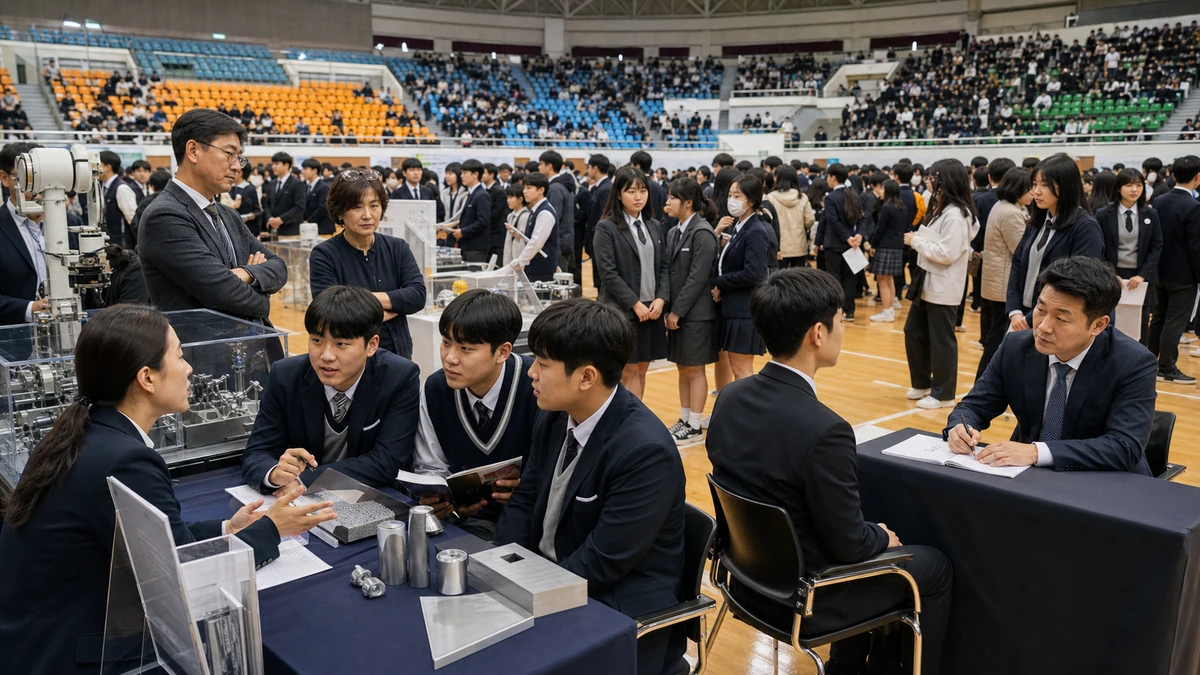
In the South Korean industrial city of Pohang, more than 2,000 students and parents gathered this week at an employment fair that, on its surface, looked like the kind of school-to-work event communities around the world hold every year. Students met recruiters, listened to talks, explored different schools and job tracks, and even took part in mock interviews. But the details of the event — and the kinds of companies in the room — offer a useful window into a much larger story: how South Korea is trying to rebuild the pipeline of skilled technical workers at a time when manufacturing, advanced materials and health technology are becoming strategically important industries again.
The fair, held at an indoor gymnasium in Pohang on Aug. 28, brought together middle school students, high school students and parents with 16 companies and seven vocational high schools in the region. Participating employers included POSCO, the steel giant that helped make Pohang synonymous with modern Korean industry, along with Ecopro Materials and Siemens Healthineers, representing sectors such as battery materials and medical technology. Organizers said the goal was not just to help graduating students look for work, but to give younger teenagers and families an earlier look at how education can connect directly to real jobs in the local economy.
That may sound ordinary to American readers familiar with career fairs, community college recruitment events or apprenticeship expos. Yet in the Korean context, the gathering speaks to a pressure point with national implications. South Korea, like many advanced economies, faces a mismatch between what schools teach, what families expect, and what industries urgently need. In a country where four-year college admission has long carried powerful social weight, vocational education has often struggled against the perception that it is a second-tier route. Events like Pohang’s are part of a wider effort to reframe that path not as a fallback, but as a direct route into stable, technically demanding work in industries that are vital both to Korea’s future and to global supply chains.
What happened in Pohang also matters beyond Korea. When a regional city creates a venue where teenagers can compare steelmaking, advanced materials and medical technology jobs in one place, it is doing more than promoting local employment. It is testing a model for how countries build talent ecosystems around strategic industries. That is a question the United States is also confronting, especially as Washington pushes to revive domestic manufacturing, secure battery supply chains, invest in semiconductors and reduce dependence on geopolitical rivals for key industrial inputs.
In other words, this was not just a one-day event for one city’s students. It was a small but telling example of how an industrial democracy is trying to connect classrooms, families and employers before labor shortages become a deeper economic problem.
Why vocational high schools matter so much in South Korea
To understand why this fair drew attention, it helps to understand the role of vocational high schools in Korea. Known broadly as specialized or vocational high schools, these institutions focus on practical training for specific fields such as manufacturing, shipbuilding, electrical work, software, logistics or marine industries. Some are “Meister” schools, a Korean term borrowed from the German system and used to signal a more elite, industry-linked form of technical education designed to produce highly skilled workers.
For American readers, the closest comparisons might be career and technical education programs, vocational academies, magnet schools focused on trades, or dual-enrollment pathways tied to local employers and community colleges. But the Korean version operates within a society where educational competition is especially intense and where the college track has historically dominated middle-class aspirations. That makes vocational recruitment not just an educational issue, but a cultural one.
The Pohang event reflected that reality by bringing in middle school students and parents, not just seniors preparing to graduate. In practical terms, that meant families could see demonstrations of coursework and student projects from seven local vocational schools, including institutions such as Korea Marine Meister High School and Pohang Heunghae Technical High School. Instead of handing out brochures alone, schools showed what students actually learn and produce. That matters because vocational education tends to be more persuasive when families can see a clear line from classroom training to workplace skills.
The fair also attempted to reduce what labor economists often call an information gap. Students may know that manufacturing exists, but not understand what modern industrial jobs look like. Parents may still imagine dirty, repetitive factory work rather than automated facilities requiring precision, software literacy, maintenance skills and strict safety training. Employers, meanwhile, may complain that schools are not producing job-ready graduates without doing enough to explain what competencies they need in entry-level hires.
By putting schools and companies in one venue, the organizers were effectively trying to compress a long and often disconnected decision-making process into something families could see all at once. A middle school student could look at a school’s curriculum, then walk over and see which companies might hire graduates with that training. A current vocational student could compare job descriptions across employers and test how well his or her training aligns with market demand. A parent could ask the blunt questions families everywhere ask: What kind of work is this? Is it stable? Does it pay? Is there room to grow?
Those are not uniquely Korean questions. But in Korea, where demographic decline is shrinking the youth population and labor shortages are becoming harder to ignore, they carry particular urgency.
Pohang’s industrial identity is evolving beyond steel
Pohang has long been one of the emblematic manufacturing cities of South Korea. Its name is inseparable from POSCO, one of the world’s major steelmakers and one of the companies most associated with Korea’s rapid industrial rise in the late 20th century. For decades, steel was not just one industry in Pohang; it was a civic identity. Like Pittsburgh in its industrial heyday, or Detroit in the era when the auto industry shaped every layer of local life, Pohang’s economy and self-image were built around heavy industry.
But the company roster at this year’s job fair shows how that identity is broadening. POSCO remains central, yet it now shares space with firms linked to advanced materials and medical technology. Ecopro Materials points to the expanding significance of battery and precursor materials, a field closely tied to the electric vehicle transition. Siemens Healthineers, a global medical technology company, represents another branch of high-value technical work that does not fit the older stereotype of local manufacturing as only blast furnaces and assembly lines.
That mix matters. It suggests that local officials and educators are not merely trying to feed one legacy industry. They are presenting students with a portfolio of technical careers connected by a common need for practical skills, but diversified across sectors that are expected to remain globally competitive. That is a smart adaptation for a city navigating economic transition. Industrial resilience today often depends not on betting everything on one sector, but on creating overlap among several related ones: materials, automation, medical devices, energy technology and advanced production systems.
The structure of the event reinforced that point. According to Korean media coverage, the employers did more than advertise their brands. They explained hiring plans, described specific roles, held career consultations and conducted mock interviews modeled on real recruitment processes. That is a meaningful distinction. Too many job fairs, in any country, amount to little more than banner displays and generic networking. A fair that includes simulated hiring interactions gives students a clearer picture of what employers value and helps them practice translating school-based training into workplace language.
That may be especially important in sectors where students know the names of major companies but not the actual shape of entry-level work. Saying “I want to work in manufacturing” is abstract. Understanding whether that means equipment maintenance, process control, quality assurance, materials analysis, logistics coordination or production safety is much more concrete. Events like this turn a vague aspiration into a sequence of choices.
They also send a message about how manufacturing itself is changing. Across developed economies, including the United States, employers and policymakers have spent years trying to persuade younger people that modern industrial work is not identical to the factory labor of a previous generation. In truth, many jobs still involve physical demands and rigid schedules. But they also increasingly require digital fluency, troubleshooting skills, technical certification and the ability to operate in highly regulated, precision-driven environments. The companies that showed up in Pohang appear to understand that recruitment now requires explanation, not just reputation.
What this says about Korea’s talent strategy
The bigger story here is not simply that one city held a successful fair. It is that South Korea appears to be putting more emphasis on what might be called regional talent ecosystems — a coordinated approach in which schools, local governments and employers work together earlier and more systematically to shape career pipelines.
The phrase may sound bureaucratic, but the idea is simple. A region cannot remain competitive in strategic industries if its schools and firms operate in separate worlds. Students need timely information about which skills are in demand. Schools need feedback about whether their curricula reflect actual workplace needs. Companies need a way to identify and influence future talent before students choose other paths. Families need confidence that nontraditional educational routes still offer dignity, security and advancement.
Pohang’s event contained all of those pieces in miniature. There was exposure for younger students still choosing a high school path. There was direct comparison among schools and employers. There was practical coaching through mock interviews. There was a civic message from the city’s mayor, who reportedly framed the city’s future as something that begins in vocational education. And there was a same-day ceremony honoring promising local small and midsize firms, reinforcing that regional economic strategy is not just about attracting giant corporations but about sustaining a broader industrial base.
This matters because labor shortages in technical fields rarely appear overnight. They develop gradually, through social attitudes, demographic trends and educational drift. South Korea’s low birthrate intensifies the challenge. With fewer young people entering the system, the cost of losing students to mismatch or misperception grows higher. A country can invest billions in factories, energy infrastructure or advanced materials production, but those investments are less useful if employers cannot hire technicians, operators, mechanics and line supervisors who can make the systems run.
There is also a political economy angle. Governments often like ribbon-cutting ceremonies for new facilities because capital spending is visible. Talent-building is slower and less glamorous. It requires long-term cooperation, patient public messaging and a willingness to elevate forms of work that societies do not always reward with equal prestige. Korea is hardly alone in struggling with that. But the Pohang fair shows one way local governments are trying to narrow the distance between policy ambition and everyday career decisions made by families.
Seen this way, the fair is less a standalone event than a case study in how industrial regions adapt when they know that equipment alone will not secure the future. The scarce resource is not simply money or land. It is human capability.
What this means for the United States
For American readers, the most relevant lesson from Pohang may be how familiar the underlying problem sounds. The United States has spent the past several years talking about an industrial revival, from semiconductors and clean energy to electric vehicles, batteries and domestic infrastructure. Federal legislation, including the CHIPS and Science Act and the Inflation Reduction Act, has helped accelerate plans for new factories and supply-chain investments. Governors from both parties routinely celebrate plant announcements. But again and again, employers and local officials come back to the same concern: Who is going to do the work?
That is where the Korean example becomes useful. The challenge in the U.S. is not only attracting capital. It is rebuilding social and educational pathways into technical careers after decades in which many communities treated four-year college as the default definition of success. American community colleges, union apprenticeship programs, career academies and regional workforce boards are trying to fill that gap, often with real success. States such as South Carolina, Tennessee, Michigan and Texas have built strong training relationships with manufacturers. German-style apprenticeships have also been adapted in pockets of the U.S. economy. Yet there is still a recurring disconnect between national industrial policy and local talent development.
Pohang’s fair illustrates a notably integrated model. Younger students and parents are brought into the conversation early. Schools display not just promises but outputs. Employers do not merely recruit at the end of the pipeline; they help define what the pipeline should prepare students for. The event treats career exploration, school choice and employer needs as one ecosystem rather than three separate topics. That is the part American policymakers and educators may want to watch most closely.
There is another U.S. angle as well: American companies and consumers are already tied to the sectors represented in Pohang. Korean steel, battery materials and industrial technologies are part of supply chains that intersect with U.S. manufacturing and trade. South Korean firms are major investors in the United States, especially in sectors linked to EV batteries, electronics and advanced manufacturing. When Korea succeeds in training and retaining technically skilled workers, that can strengthen Korean firms that partner with, supply or compete against American companies. When Korea struggles, the effects can ripple outward through pricing, production capacity and strategic industrial competition.
For American audiences interested in the Korean Wave, or Hallyu, this story is also a reminder that South Korea’s global footprint is not just K-pop, TV dramas and beauty products. The same country exporting cultural influence is also deeply embedded in hard industrial sectors that matter to U.S. economic strategy. In Washington policy circles, South Korea is increasingly discussed not only as a treaty ally facing North Korean threats, but as a critical technology and manufacturing partner. A local vocational fair in Pohang may seem far removed from that conversation, but it sits on the same continuum: a technologically advanced ally trying to ensure it has the workforce to support strategic industries.
American readers might think of the comparison this way. Just as a regional event in Ohio, Arizona or Georgia can reveal whether the U.S. is serious about rebuilding industrial labor pipelines, a local fair in Pohang can reveal how seriously Korea is taking the social infrastructure behind industrial policy. Factories make headlines. Workforces determine whether the promises behind those headlines last.
Families, status and the politics of career choice
One of the most revealing details in the Korean report is that parents showed up in large numbers. That matters because career education is never just about students. It is also about family expectations, social status and cultural narratives about what counts as success.
In South Korea, as in many countries, parents often play a decisive role in educational decisions. The pressure surrounding school choices can be intense, particularly because academic credentials have long been tied to mobility and respectability. Vocational education therefore carries baggage that is not simply economic. It can be seen, fairly or unfairly, as narrowing options too early or as signaling lower academic achievement. Policymakers can design technical programs with strong employment outcomes, but if parents remain skeptical, enrollment may lag.
The Pohang fair appears to have been designed with that dynamic in mind. By allowing families to meet major employers directly and see how training maps onto actual jobs, the event effectively turns career education into a public confidence-building exercise. If a parent hears directly from a recognized company about hiring plans, or sees a student participate in a mock interview, vocational education becomes less abstract and less stigmatized. It starts to look less like a detour and more like a structured pathway.
That is a challenge the U.S. knows well. American officials and business leaders have spent years trying to destigmatize trades and technical education. The message has become familiar: not every good job requires a bachelor’s degree; skilled trades can be lucrative; debt-free technical pathways may offer better returns for some students. Yet those arguments still run into entrenched cultural habits and status hierarchies. For many families, the symbolic power of a four-year college remains strong even when labor-market outcomes are mixed.
What makes the Korean case worth watching is the degree to which those debates are being folded into broader economic strategy. When city leaders talk about the future of Pohang beginning in vocational schools, they are not only making an educational point. They are making a civic argument about what kind of economy deserves public respect. In an era when both Korea and the U.S. are trying to rebuild strategic manufacturing capacity, that shift in cultural language may be just as important as subsidies or tax incentives.
What to watch next
The immediate outcomes of one job fair are difficult to measure. A strong turnout does not automatically translate into long-term hiring success. The real test is whether the relationships formed at the event continue after the banners come down. Do schools adjust curricula based on employer feedback? Do employers return with internships, apprenticeships or clearer entry routes? Do more middle school students choose vocational programs because they now understand the options better? Do parents become more supportive once they see where those paths can lead?
Those are the questions worth watching in Pohang and beyond. If this event becomes a repeatable model, it could strengthen the city’s ability to retain young talent and align training with a changing industrial base. If similar models spread, they could help South Korea address a deeper structural issue: how to maintain a globally competitive industrial economy with a shrinking youth population and persistent social bias toward traditional academic routes.
For the United States, the takeaway is not that America should copy Korea wholesale. The educational systems, labor markets and cultural pressures are different. But the core lesson travels well. Industrial strategy succeeds only when talent strategy is built into it from the beginning. That means earlier career exposure, stronger school-employer coordination, visible pathways for families and a willingness to treat technical work as a cornerstone of national competitiveness rather than as an afterthought.
In that sense, the most important image from Pohang may not be the corporate logos or the crowd size. It may be the fact that students, parents, schools and employers were all in the same room, speaking to one another before a career decision was locked in. In both Korea and the United States, that kind of early, concrete alignment may be one of the few reliable ways to close the gap between lofty industrial ambitions and the everyday reality of who is prepared to build the future.
Comments
Post a Comment