
Image to help understand the article
A day in Korean search trends becomes a portrait of a society
What South Koreans searched for on Google on Aug. 30, 2026, offers more than a list of hot topics. It reads like a compressed portrait of a country trying to manage several realities at once: local fights over medical education, worries about nuclear safety abroad and nuclear business at home, fascination with elite sports, attention to a gruesome crime case, and the endless pull of celebrity wellness and lifestyle controversies.
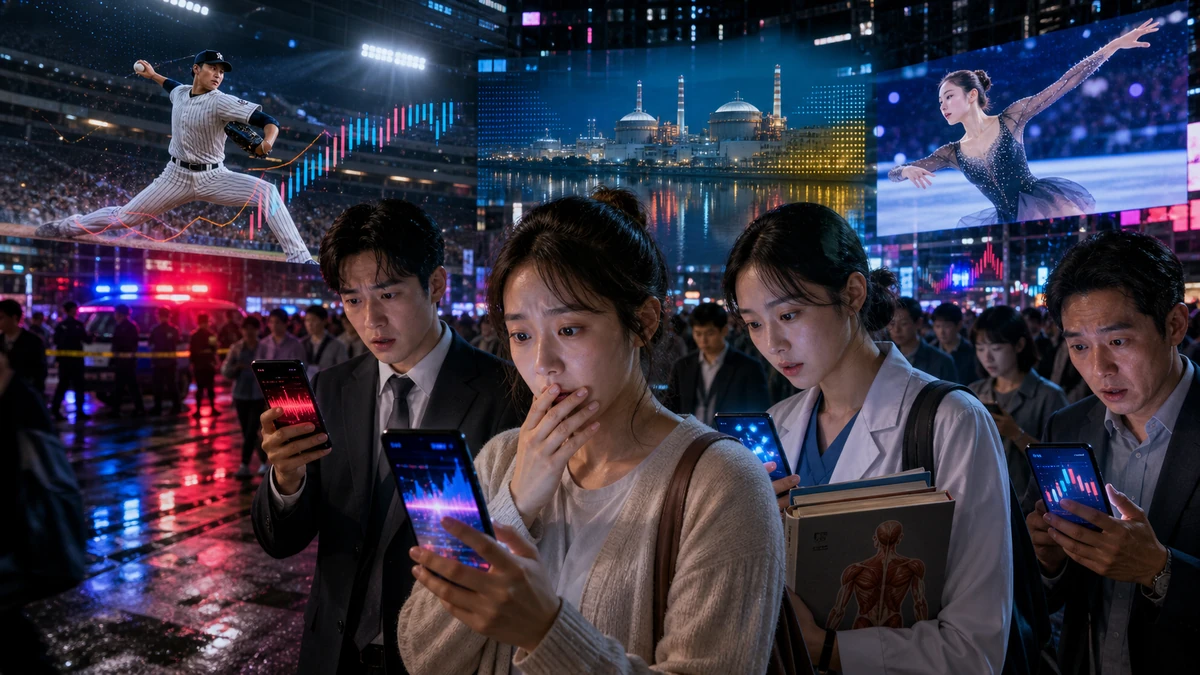
That is the clearest lesson from South Korea’s real-time trending searches for that day. The top terms did not revolve around one blockbuster scandal or one dominant political event. Instead, public attention was widely dispersed. The No. 1 search term, according to Google Trends’ relative estimates, was Suncheon National University, tied to a politically charged decision over a proposed national medical school in the country’s southwest. Other major searches included “pitcher,” linked to Korean professional baseball coverage; “Zaporizhzhia,” tied to renewed fears over the Ukrainian nuclear plant; “murder,” connected to developments in a killing case involving a Chinese international student in Gyeongsan; and “nuclear power plant,” driven in part by news out of Vietnam and possible Korean participation in future reactor work.
For American readers, it may help to think of this not as the Korean equivalent of a celebrity-heavy social media feed, but as something closer to a mix of Google Trends, cable news chyrons, local TV urgency, sports radio buzz and community politics all rolled into one. Search data, especially when built around broad words like “murder” or “pitcher,” cannot tell us exactly what every person cared about or why. It is better read as a snapshot of where public curiosity clustered at a specific moment. Even with those limits, the list is revealing.
In South Korea, where the news cycle moves quickly and digital habits are deeply ingrained, search spikes often reflect the overlap between hard news and practical personal concern. A decision about where to place a medical school is not just education policy; it can quickly become a referendum on regional inequality, health care access and political fairness. A headline about a faraway nuclear plant does not stay far away in a country that debates nuclear energy as both a safety issue and an economic opportunity. A baseball pitching duel can command the same national attention that an NFL quarterback controversy or Major League Baseball pennant race might in the United States.
Seen together, these trending topics suggest a public that is not distracted so much as multidirectional. Korean audiences, like American ones, are moving rapidly between civic alarm, consumer curiosity, sports fandom and international instability. The difference is that South Korea’s smaller size, dense media ecosystem and high level of digital participation can make those shifts feel unusually immediate and tightly packed.
Why a university search topped the list
The top search term, Suncheon National University, may sound obscure outside Korea. Inside the country, it points to one of the most sensitive domestic debates of recent years: how to distribute medical education and medical services more evenly across the country.
South Korea has wrestled with regional disparities for decades, especially the concentration of elite institutions and specialized care in and around Seoul. In American terms, imagine the political heat that would follow a federal or state decision over where to place a new medical school in an underserved region, especially if rival cities believed the decision could shape physician supply, hospital investment and local prestige for years to come. That is roughly the emotional terrain here.
According to the Korean reports summarized in the source material, Suncheon National University was selected as the candidate site for a national medical school serving the Jeonnam-Gwangju area, prompting strong public interest and political reaction from elsewhere in the region, including Mokpo. Even from a distance, the reason for the search surge is easy to understand: decisions about medical infrastructure are never just academic. They are about who gets access, who gets left behind and whether governments are serious about addressing shortages outside major metropolitan centers.
This matters because health care distribution is a live structural issue in South Korea, just as it is in the United States. Americans debate rural hospital closures, doctor shortages and uneven specialist access. Koreans debate different versions of the same imbalance, often through the lens of educational pipelines and university-based training. In both countries, when medical capacity is scarce or uneven, local communities tend to see institutional decisions as existential rather than technical.
That one school name rose to No. 1 on the day’s list shows how deeply local policy can cut through a crowded media environment. It also suggests that, despite South Korea’s global image as a pop-culture powerhouse, domestic bread-and-butter concerns still command serious public attention. Not every trend line points to K-pop, streaming dramas or consumer technology. Sometimes it points to where future doctors may be trained.
Nuclear fears and nuclear business share the same public space
Few pairings on the list are more telling than “Zaporizhzhia” and “nuclear power plant.” One search term reflected anxiety over risk; the other reflected interest in opportunity. Together they capture the two-sided way South Korea talks about nuclear energy in 2026.
Zaporizhzhia, the Ukrainian nuclear plant that has repeatedly alarmed the international community since Russia’s full-scale invasion, was a top Korean search term after reports that external power had been cut for a week and emergency generators could only provide temporary backup. The concern cited in Korean coverage was not that a radiation leak had already occurred, but that a blackout scenario could increase the danger. That distinction is important. Search spikes often follow worst-case framing, but the immediate story here was escalating vulnerability, not confirmed disaster.
For South Koreans, nuclear risk is not an abstract foreign-policy topic. The country operates a significant domestic nuclear fleet and has long debated the balance among energy security, industrial competitiveness and public safety. Americans have their own version of this tension. In the United States, nuclear energy has returned to policy conversations as a low-carbon power source, even as old fears about accidents, waste and plant economics remain potent. Korea’s debate is sharper because the country has fewer natural resources, higher energy import dependence and a strong export interest in reactor technology.
That export interest helps explain why “nuclear power plant” also trended. Korean reports tied the search term partly to Vietnam’s approval of its first nuclear power project and speculation that South Korea could have a chance to win work on a second unit. This is the business side of the same nuclear conversation: reactors are not just controversial infrastructure, but high-value industrial products tied to national strategy.
South Korea has spent years positioning itself as a serious reactor exporter. That makes overseas nuclear developments relevant to Korean investors, policymakers and the general public in a way that might surprise some American readers. A plant decision in Vietnam can become a domestic Korean business story, much as a large foreign defense contract can become a major local story in Washington or Fort Worth because of what it means for U.S. industry.
The search data does not prove that Koreans are becoming more pro-nuclear or more anti-nuclear. It does show that nuclear issues remain live, multifaceted and emotionally legible: safety scares abroad, commercial opportunity in Asia, and strategic competition all land in the same national attention stream.
Crime, sports and celebrity: the familiar architecture of public attention
If one part of the list reflects structural questions about health care and energy, another reflects something more universal: the durable way crime, sports and celebrity compete for attention in every modern media market.
The day’s largest relative search volume among the top 10 was for “murder,” linked in Korean coverage to the recovery of additional remains in the killing of a Chinese international student in Gyeongsan. As always with broad search terms, care is needed. People may search a word because of breaking news, fear, confusion or a desire for updates after earlier reports. What matters here is not voyeurism as such, but the fact that crime reporting still has a gravitational pull that cuts across politics and entertainment. American audiences know this pattern well. A local homicide case can become a national search obsession when new details emerge, especially if the story already contains cross-border, campus or public-safety elements.
Then there is sports. The term “pitcher” trended strongly amid coverage involving Korean baseball arms Kwak Bin and Ahn Woo-jin and the appeal of high-velocity matchups. To Americans, the easiest analogy is the way one exceptional starting-pitching duel can dominate baseball talk even on a day filled with larger national stories. South Korea’s Korea Baseball Organization, or KBO, does not occupy the same economic scale as Major League Baseball, but baseball holds a firmly rooted place in Korean culture, and standout pitchers can become headline magnets quickly.
The same goes for tennis and figure skating. “US Open” appeared on the list as coverage followed Elena Rybakina’s return from injury and Coco Gauff’s response to a request for free tickets. Figure skating trended on the back of a skating event in Sejong that brought together disabled and nondisabled participants. Neither item was a geopolitical earthquake. Both illustrate how broad search ecosystems work: a major international tournament, a human-interest sports event and domestic league coverage can all coexist with crime and policy news without any one category fully crowding out the others.
Celebrity culture also made its expected appearance through actress Ha Ji-won, whose longevity and comments about wellness habits drew attention. In Korea, as in the United States, celebrity self-management stories occupy a hybrid space between entertainment coverage, aspirational lifestyle content and age-defying curiosity. The details here — lemon water, stretching, disciplined practice — are not earthshaking. But they fit neatly into a media environment where stars are often treated not only as performers but as case studies in personal optimization.
What this says about South Korea’s media culture now
The broader pattern is more interesting than any single keyword. South Korea’s trending searches on this day did not reveal a society fixated on one emergency. They revealed a highly networked public moving between scales: local, national, regional and global; practical and symbolic; serious and light.
That matters because Korea is often flattened in international coverage into a handful of exportable images: K-pop, Samsung, North Korea, Oscar-winning films, beauty products, occasionally labor unrest or demographic decline. Those are real parts of the story, but they can obscure the ordinary complexity of a developed democracy with a fast-moving information ecosystem. A list like this recenters that complexity.
It also highlights the degree to which Korean public life is mediated through search and portal behavior. In the United States, media fragmentation has scattered attention across platforms: Google, X, TikTok, YouTube, local television, partisan cable, newsletters and group chats. South Korea is fragmented too, but it also retains a more immediate relationship between headline circulation and public search behavior. When several outlets push updates on the same subject at once, especially through mobile ecosystems, the effect can be swift and measurable.
Another notable feature is the blend of domestic and international topics. Koreans were not only searching their own local disputes. They were following a Ukrainian nuclear threat, a U.S. tennis major, a smoking-facility controversy in Taipei and business implications in Vietnam. That outward-looking attention reflects South Korea’s position as a trade-dependent, globally connected middle power whose citizens are accustomed to monitoring events beyond their borders for practical reasons. Supply chains, exports, travel, military risk and pop culture all internationalize the Korean news diet.
At the same time, there is no reason to romanticize search data. Trending terms are imprecise. They are shaped by headline wording, platform habits and the fact that generic terms can bundle multiple stories at once. The source itself notes this limitation. A word like “pitcher” or “murder” may rise because of one dominant story, several related stories or broad ambient interest. Still, that ambiguity is part of the value. Trends do not tell us what people concluded; they tell us what people felt compelled to look up.
What it means for the United States
For Americans, this snapshot of Korean attention matters for at least three reasons: media, markets and the broader U.S.-South Korea relationship.
First, it is a reminder that South Korea is not simply an exporter of culture to the United States. It is also a sophisticated audience in its own right, consuming and reacting to a mix of domestic priorities and global events. That matters for American companies that increasingly see Korea as a strategic market — from streaming platforms and sports brands to energy firms and investors watching Asian infrastructure. If U.S. executives or media producers still imagine Korean consumers as interested mainly in entertainment and tech trends, they are missing the bigger picture. Korean attention is highly responsive to public policy, industrial strategy and international risk.
Second, the prominence of terms linked to nuclear power should get attention in Washington and in U.S. industry. The United States and South Korea are allies with overlapping interests in energy security, advanced manufacturing and export competition. Korean firms have emerged as serious players in global nuclear construction and related supply chains. American officials and companies have at times viewed Seoul as both a partner and a competitor in strategic sectors. News that points to Korean interest in overseas reactor opportunities is therefore not just a regional business footnote. It is part of a wider contest over who will build the next generation of energy infrastructure in Asia and beyond.
Third, the sports and culture items on the list underscore the two-way nature of influence between the United States and South Korea. The U.S. Open is a Korean search story because American sports properties remain globally powerful. At the same time, Korean baseball, Korean celebrity culture and Korean domestic policy debates increasingly draw attention from diaspora communities, English-language media and niche American fan bases that are more engaged with Korean public life than they were even a decade ago. During the COVID-19 pandemic, for example, the KBO unexpectedly became familiar to many American viewers when ESPN aired games. That did not turn Korean baseball into an American mainstream obsession, but it did create a reference point that helps U.S. audiences understand why a term like “pitcher” can become a national mini-event in Korea.
The local angle is perhaps strongest in health care and regional development. Americans debating doctor shortages, rural care and the political economy of medical education can recognize a kindred problem in the Suncheon story. The institutions differ, but the underlying question is strikingly familiar: how do governments build pipelines for care in places that feel bypassed by elite concentration? Korea’s answer may not translate directly to the United States, but the public reaction shows how politically loaded the issue becomes when education, prestige and access intersect.
For American readers who follow Korea mostly through the lens of K-pop tours, semiconductor investments or North Korea headlines, this search list is a useful corrective. It shows the daily texture of a close ally whose concerns often rhyme with America’s own: public safety, sports obsession, medical inequality, energy strategy and the uneasy marriage of global anxiety with ordinary life.
What to watch next
If there is a forward-looking takeaway, it is that Korean trend data increasingly works best as a signal of converging pressures rather than a scoreboard of isolated stories. The Aug. 30 list suggests at least three developments worth watching.
One is the continued politicization of regional medical infrastructure. If disputes over medical school placement intensify, they could become a bigger proxy fight over regional equity and state capacity. That has implications not only for health care but for local politics, university competition and the legitimacy of central government decision-making.
Another is the persistence of nuclear energy as a dual narrative of fear and ambition. As long as global instability keeps plants like Zaporizhzhia in the headlines while Asian countries continue exploring nuclear development, South Korean audiences are likely to keep engaging with both the risks and the commercial upside. For U.S. policymakers and companies, that means Korea remains central to the wider conversation about energy transitions and infrastructure exports.
The third is the ongoing normalization of mixed-attention news ecosystems. Crime, lifestyle, markets, sports and international affairs no longer take turns in orderly fashion. They arrive all at once, and audiences move between them fluidly. That is true in the United States, and it is clearly true in South Korea. For journalists, the challenge is to resist reducing that complexity to either panic or frivolity. For readers, the challenge is to see a search trend not as a verdict on national priorities, but as evidence of how many priorities modern publics carry at once.
On that front, South Korea may look less like an exception than a preview. It is a wired, globally exposed democracy where local grievances, alliance politics, global markets and pop culture continually collide in public view. A single day of trending searches cannot define the country. But it can reveal something real about its current mood: alert, fragmented, globally aware and still deeply invested in the practical questions of how people live, compete and stay safe.


0 Comments