Why 15 Minutes of Dog Videos at Work Is Getting Serious Attention in South Korea — and What It Could Mean in the U.S.
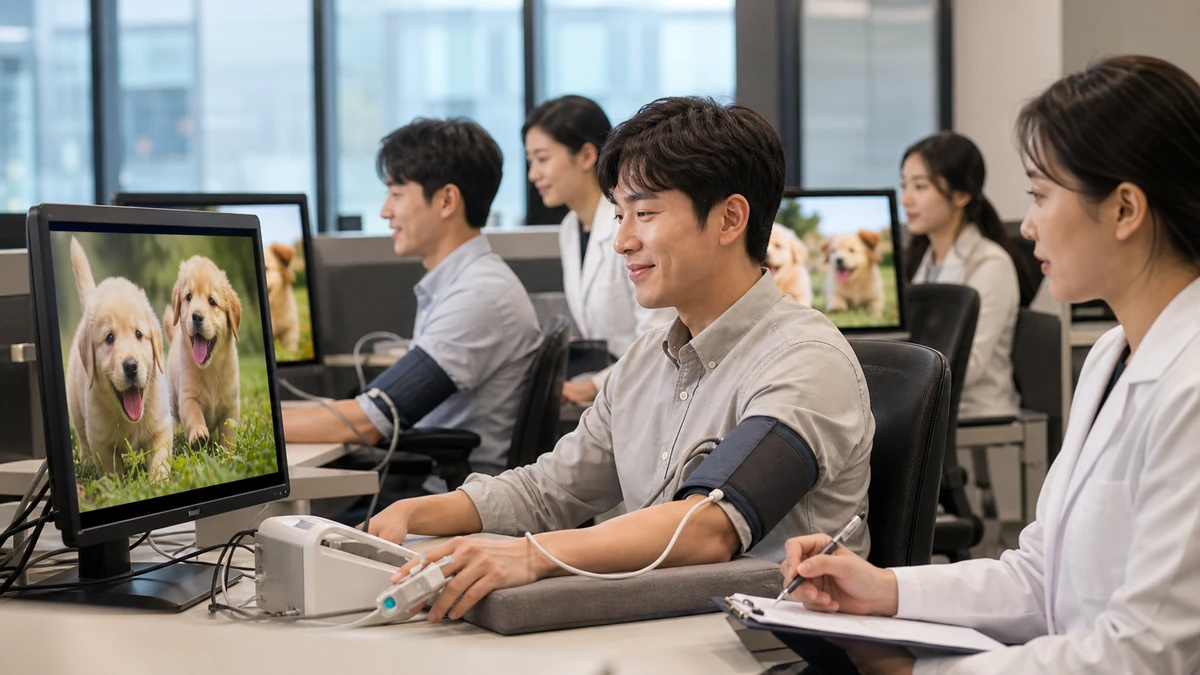
Image to help understand the article
A small Korean study taps into a very modern workplace habit
Anyone who has spent a stressful afternoon at a desk probably recognizes the impulse: open a browser tab, watch a few clips of puppies tumbling across a living room floor, and feel the edge come off the day. In the United States, that instinct is often treated as a joke about internet culture — one more reason people get distracted at work. In South Korea, researchers have now taken that habit seriously enough to measure what happens in the body as well as the mind.
A research team involving Seoul National University Bundang Hospital, Chonbuk National University, Wonkwang University and the media platform Happy Dog TV reported that among 66 office workers, watching 15 minutes of high-quality dog videos was associated with reduced anxiety, less negative mood, and lower blood pressure and pulse. The findings, reported by Yonhap News Agency and published in the latest issue of the international journal Frontiers in Public Health, add a scientific frame to something millions of people already believe from experience: cute animal content can feel calming.
That does not mean dog videos are medicine, and the Korean researchers were careful not to make that claim. The study observed an association between a short viewing session and stress-related indicators. It did not prove that dog videos treat hypertension, cure anxiety disorders or produce long-term health benefits. But even with those caveats, the research matters because it shifts the conversation. Instead of treating digital “cute content” as mindless entertainment, it suggests that certain kinds of screen time may have measurable links to emotional and physiological regulation.
That idea lands at a moment when office culture in both South Korea and the United States is still being renegotiated. Employers talk constantly about burnout, attention fatigue and employee well-being. Workers, meanwhile, are looking for relief that is cheap, quick and easy to fit into a packed day. A 15-minute intervention involving five three-minute dog clips is almost absurdly modest. That is part of what makes the study interesting.
South Korea, one of the world’s most digitally connected societies, is an especially revealing place for that question to emerge. People there are accustomed to consuming short-form video at high speed across platforms, and workplace stress has long been a major social issue. When Korean researchers examine whether something as commonplace as pet videos can slightly change the way workers feel and physically respond to stress, they are also studying a broader feature of modern life: how digital media shapes the nervous system in real time.
What the researchers actually found — and what they did not
According to the summary of the study, the researchers divided participants into a normal blood pressure group and a high blood pressure group. Each participant then watched five dog videos, each about three minutes long, for a total of 15 minutes. Afterward, the team observed a pattern in both groups: anxiety and negative mood eased, while blood pressure and pulse also moved downward.
The design matters because the researchers did not limit themselves to asking a fuzzy question like whether participants felt “better.” They paired subjective responses — mood and anxiety — with physiological markers such as blood pressure and pulse. In plain English, they tried to see whether the familiar sense of “I feel calmer after watching puppies” lined up with measurable changes in the body.
That kind of pairing is important in stress research. Office stress is not only an emotion; it often shows up physically, whether through muscle tension, faster heart rate, sleep disruption or elevated blood pressure. By measuring mood and bodily responses together, the Korean team treated stress the way many workers experience it: as something mental and physical at the same time.
Still, the limitations are just as important as the results. The sample was small, involving 66 office workers. The intervention was brief. The available summary does not establish how long any change lasted, whether one blood pressure group improved more than the other, or whether similar effects would appear across different ages, professions or cultural settings. It also does not show that dog videos are superior to other short breaks, such as quiet breathing, stretching, stepping outside or watching non-animal relaxing imagery.
That restraint matters because wellness claims travel fast online, especially when they are cheerful and easy to share. A headline that says “puppy videos lower blood pressure” can quickly morph into the idea that scrolling animal content is a health treatment. That would be a mistake. What the study offers is narrower and, in some ways, more useful: evidence that a short, accessible and low-cost break involving soothing animal footage may be linked to short-term reductions in stress-related indicators.
In health journalism, those distinctions are not nitpicking. They are the difference between reporting science and turning science into self-help mythology. The Korean study is intriguing because it opens a line of inquiry, not because it closes one.
Why dog videos, specifically, may fit this moment in Korean culture
To American readers, the popularity of dog clips may seem too universal to need explanation. But in South Korea, the social backdrop gives the finding extra resonance. The country has undergone rapid changes in family structure, housing patterns and work culture. Single-person households have grown, pet ownership has expanded, and the idea of companion animals as family members has become increasingly mainstream. At the same time, South Korea’s long-hours work culture has been the subject of national debate for years, with policymakers and employers under pressure to address overwork and quality-of-life concerns.
In that environment, pet content occupies an interesting cultural space. It can stand in for emotional comfort, companionship and a form of what Koreans often call “healing” — a term widely used in Korean media and popular culture to describe experiences that soothe stress or emotional fatigue. The word does not necessarily imply medical treatment. More often, it refers to a restorative feeling, the kind Americans might describe as comforting, grounding or mentally refreshing.
The Korean article summary makes clear that this distinction is important. The researchers are not arguing that people with blood pressure concerns should swap a doctor’s advice for a playlist of puppies. Rather, they are examining whether a familiar “healing” experience from everyday digital culture has measurable correlates beyond mood alone.
That focus on indirect contact also deserves attention. The participants did not pet a dog, walk one or spend time in an animal-assisted therapy program. They simply watched dogs on a screen. That may sound less meaningful than real-life interaction, but from a public health and workplace perspective, it is actually what makes the study practical. Screens are everywhere. Live animal access is not.
South Korea’s digital ecosystem makes it a natural laboratory for this kind of question. The country’s audiences are deeply accustomed to using mobile media in short bursts throughout the day. If a three-minute video can affect the way people feel during a stressful work period, that matters not just for wellness culture but for the design of digital content itself. It suggests that not all screen use is psychologically equivalent. Some content may agitate, overstimulate or trap attention; other content may briefly regulate it.
That does not make “cute content” inherently good. The Korean summary is also careful on that point. The value may lie not in consuming more videos but in using a short, bounded viewing session as a deliberate break from work. In other words, the intervention is not endless scrolling. It is a controlled pause.
What this means for the United States
For American readers, the immediate appeal of this study is obvious. The U.S. workplace is already saturated with burnout language, mental health messaging and productivity advice. Employers promote mindfulness apps. Health insurers incentivize stress management. Tech companies sell digital tools that promise better focus and emotional balance. In that environment, a Korean study suggesting that 15 minutes of dog videos may be associated with lower anxiety, blood pressure and pulse is likely to attract attention far beyond academic circles.
The reason is not just that Americans love dogs, though many do. It is that the U.S. has spent years trying to solve a contradiction of modern work: screens are both the source of strain and the delivery system for relief. Workers sit through video calls, answer Slack messages, monitor dashboards and absorb a constant stream of notifications. Then they are told to use more screens — for meditation apps, digital therapy, sleep tracking and breathing exercises — to recover from the stress those screens helped create.
This Korean research fits squarely into that American dilemma. It suggests that some digital experiences may have a calming association even when they arrive through the same devices that produce overload. That is a useful insight for U.S. employers, app developers, streaming platforms and workplace wellness companies, all of which are searching for credible, low-friction interventions that workers might actually use.
There is also a business angle. The American market already supports a large ecosystem of wellness content, pet media, creator-driven video platforms and employer-sponsored mental health services. If more research follows this Korean study and points in a similar direction, U.S. companies could look more seriously at short-form calming content as part of workplace wellness design. That does not mean corporations will start prescribing golden retriever clips between meetings. But it does mean the line between entertainment content and wellness content may continue to blur.
For American fans of Korean culture, the study is also a reminder that the Korean Wave is not just about K-pop, K-dramas and beauty products. South Korea increasingly exports ideas about lifestyle, digital behavior and emotional culture. Terms like “healing content” may sound foreign at first, but the underlying concept is instantly legible in the United States, where people talk about comfort TV, doomscrolling, self-care and emotional support animals. The vocabulary differs; the behavior is often the same.
And there is a diplomatic subtext, however modest. The U.S.-South Korea relationship is usually discussed through security alliances, semiconductors, batteries and trade. But cultural and scientific exchange also matters. A small Korean public health study can circulate into American media, inform U.S. workplace discussions and shape how global audiences think about digital well-being. That is soft influence in practice: not flashy, but real.
The caution for Americans is the same as it is for Korean audiences. A short-term association in 66 workers is not a national wellness policy. Employers should resist the temptation to turn a nuanced study into a gimmick, like using puppy videos as a substitute for humane workloads, adequate staffing or real mental health support. No one should have to watch a beagle montage to survive a toxic office culture. Structural problems still require structural solutions.
From “cute” to measurable: a bigger shift in health research
One of the most significant things about the Korean study is not the dog videos themselves, but the fact that researchers considered them worthy of formal investigation. For years, much of internet culture has been dismissed as trivial unless it is obviously harmful. Studies often focus on addiction, misinformation, polarization or anxiety linked to social media use. Those concerns are valid. But that emphasis can flatten digital life into a simple story in which screens are bad and offline experience is good.
This study points toward a more layered reality. Digital media can fragment attention, but it can also deliver moments of comfort. It can intensify stress, but it can also interrupt stress. The relevant question may be less about whether screen time is good or bad in the abstract, and more about what kind of content people are consuming, under what conditions, for how long, and to what effect.
That is a more difficult but more useful framework, especially for public health. Consider the difference between aggressive news alerts, high-conflict social media, fast-cut entertainment and a short clip of a sleepy dog sprawled across a couch. All count as screen time. They are not likely to have the same effect on the nervous system.
The Korean researchers also highlight an increasingly important frontier in wellness science: low-cost, scalable interventions that do not depend on specialized equipment or intensive training. Traditional stress reduction tools such as therapy, exercise, medication or guided mindfulness all have their place, but they also require time, money, access or sustained commitment. A 15-minute viewing session of calming animal videos does not replace any of those. But if it offers even a modest short-term benefit for some people, it becomes attractive precisely because it is easy to try.
That logic helps explain why the finding could travel globally. In a world where millions of workers feel overbooked, overnotified and underslept, interventions that ask very little of people have cultural power. They are portable. They can move across borders, offices and platforms quickly. They also fit the language of self-optimization that dominates many professional cultures, including in the United States.
But convenience creates its own risk. The easier a practice is to adopt, the easier it is to oversell. That is why the study’s modesty is important. It is not proof of a cure. It is evidence that a widely available kind of content may deserve a closer look.
What workers and employers should watch next
There are at least three follow-up questions worth watching. First, duration: how long do the observed changes last? If the effect fades almost immediately, then the videos may function mainly as a momentary reset. That could still be useful, but it would be different from a lasting intervention.
Second, comparison: are dog videos uniquely effective, or would other forms of calming content produce similar results? The Korean summary emphasizes high-quality dog footage, but the deeper mechanism may involve emotional warmth, softness, playfulness or low-stimulation imagery more generally. Future research could compare animal clips with nature scenes, music, guided breathing or silent rest.
Third, individual variation: who responds best? The summary notes that not everyone can be assumed to react the same way to animal videos. That is a crucial point. Some people may find them soothing. Others may feel indifferent. Some may become more distracted and lose focus after the break. What works as a reset for one worker may function as procrastination for another.
For employers, the practical lesson is surprisingly old-fashioned: breaks matter, and not all breaks need to be elaborate. The Korean study supports the idea that a deliberate, time-limited pause may help some workers regulate stress during the day. But the operative words are deliberate and time-limited. The research looked at a 15-minute intervention, not an open-ended rabbit hole of autoplay content.
For individual workers, the study offers permission to think more intentionally about digital rest. If calming animal videos help you feel less tense, a short, bounded viewing session could become part of a healthy routine. If they do not, there is no reason to force the trend. The point is not that everyone needs puppy therapy by algorithm. The point is that relief can come in small forms, and those small forms can sometimes be studied rather than dismissed.
In the end, the Korean research says something larger about contemporary life in both South Korea and the United States. People are trying to find manageable ways to feel human inside systems that often ask them to behave like machines. Sometimes the answer is major reform: better working hours, stronger health support, more realistic expectations. Sometimes it is a tiny act, like stepping back for 15 minutes and watching a dog chase a ball across a screen. Science cannot tell us that such moments solve burnout. But it can tell us they may matter more than we assumed.
Comments
Post a Comment