
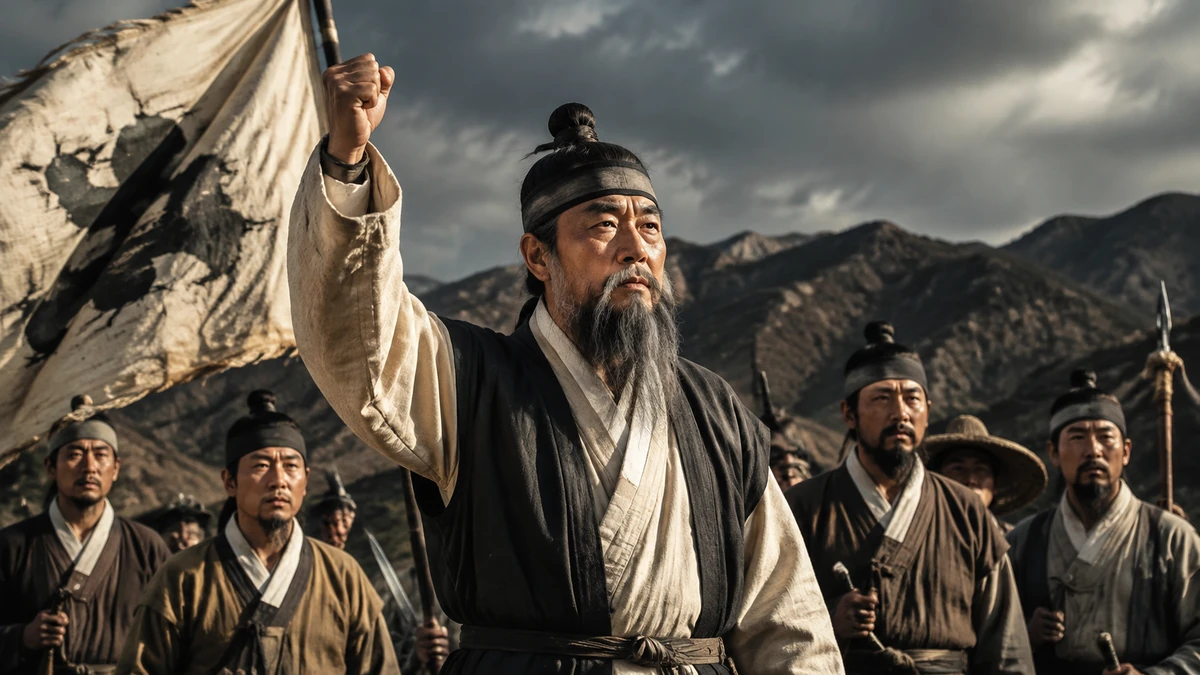
Image to help understand the article
A figure from Korea’s past speaks to a very current debate
In South Korea, public interest in history often surges around anniversaries, school curricula and debates over national identity. The renewed attention to Choe Ik-hyeon, a late-19th-century Confucian scholar-official who became a symbol of resistance to Japanese encroachment, fits squarely into that pattern. To many Americans, Choe is not a household name. But the tensions that defined his life — how a country should respond to outside pressure, whether tradition can coexist with modernization, and when moral protest must give way to direct action — are instantly recognizable.
Choe lived through one of the most turbulent periods in Korean history, when the Joseon Dynasty was being forced into a new international order and Korea’s sovereignty was steadily eroded. Born in 1834 and dying in exile in 1907, he moved from the world of scholarship and official petitions into armed anti-Japanese resistance. That arc is one reason he remains important in South Korea today. He represents not only a strain of conservative Confucian thought, but also a broader Korean determination to preserve national autonomy during an age of imperial pressure.
For American readers, Choe’s story is best understood not as a simple tale of a traditionalist resisting modernity, but as a window into how colonized and threatened societies make choices under duress. In the United States, history classes often present modernization as a largely linear process: countries open up, reform, industrialize and move forward. Korea’s late-19th-century experience was far messier. Reform was not arriving in a neutral environment. It was entangled with unequal treaties, foreign coercion and the growing power of imperial Japan. In that setting, opposition to change could also be a form of resistance to domination.
That does not make every one of Choe’s positions easy to celebrate. He opposed a number of reforms and argued from a deeply Confucian worldview that many modern readers, including many South Koreans, would see as limited or even reactionary. Yet reducing him to a mere opponent of progress misses the historical stakes. He believed Korea’s political independence and moral order were under attack at the same time. In his mind, defending one required defending the other.
That tension — between historical limitation and patriotic resolve — is exactly why Choe remains relevant. He forces modern audiences to confront an uncomfortable question: How should a society judge a figure who resisted foreign domination, but did so with ideas that do not map neatly onto modern liberal values?
Who Choe Ik-hyeon was, and why Koreans remember him
Choe Ik-hyeon emerged from the Confucian scholarly tradition that shaped Korean political and social life for centuries. He studied under the influential scholar Yi Hang-ro, whose teachings stressed loyalty to the ruler, concern for the state and a moral obligation to defend proper order. Those ideas were not abstract for Choe. They became the framework through which he understood nearly every major event of his time.
He entered government service after passing the civil service examination, the traditional route into officialdom in premodern Korea. Like scholar-bureaucrats elsewhere in East Asia, he was expected to serve as both administrator and moral critic. By the standards of the day, he built a reputation for bluntness. He criticized corruption, spoke against what he viewed as misrule and took seriously the Confucian duty of remonstrance — the obligation of officials to challenge kings or powerful regents when policy went astray.
That included criticism of the powerful Daewongun, the father of King Gojong, who acted as regent and pursued sweeping policies in the 1860s and early 1870s. Choe initially supported reform efforts aimed at curbing entrenched political factions. But he later turned against policies he thought imposed too high a burden on ordinary people or disrupted what he regarded as legitimate political order. He opposed the costly reconstruction of Gyeongbok Palace, warning that the project would strain finances and increase hardship. He also criticized the abolition of many Confucian academies, not because he rejected all state reform, but because he believed such measures damaged the intellectual and moral fabric of the nation.
These details matter because they show Choe was not simply rejecting everything new on instinct. He judged policies through a specific moral and political lens rooted in Neo-Confucian thought. He could support change when he believed it restored proper rule and oppose it when he believed it violated the principles that held society together. That consistency helps explain why he later became such a prominent voice against foreign treaties and foreign influence.
In South Korea, Choe is remembered as a scholar who did not remain safely in the study. He wrote, protested, was punished, returned to public life and, eventually, took up leadership in anti-Japanese militia activity. That movement from pen to action is central to his place in Korean historical memory.
From petitions to resistance: the world that made him an anti-Japanese symbol
Choe became nationally known for opposing the 1876 treaty between Korea and Japan, often seen as the beginning of Korea’s forced opening under unequal terms. Japan, fresh from the transformations of the Meiji era, was increasingly assertive abroad. Korea, long governed within a Sinocentric regional order, now faced a new environment in which military power and treaty pressure were redrawing the map of East Asia.
Choe argued that opening Korea under those conditions would threaten the country’s sovereignty. His protest became one of the defining statements of the so-called wijong cheoksa current, often translated roughly as defending orthodoxy and rejecting heterodoxy. For American audiences, that phrase needs unpacking. It did not simply mean cultural conservatism in the narrow sense. It referred to a broader intellectual and political stance among some Korean scholars who believed foreign influence — especially Western and later Japanese encroachment — threatened both the moral basis of society and the survival of the state.
To modern ears, that can sound like nativist retrenchment, and in some respects it was. But in Korea’s case, those fears were not imagined. Foreign powers were indeed forcing their way into East Asia, extracting concessions and reshaping weaker states. Korea’s opening did not take place on equal footing, any more than China’s treaty-port era did. Choe’s resistance, then, was rooted in a real crisis of sovereignty.
After the treaty, he was punished and exiled for opposing expanded relations with Japan. Yet he remained influential. As outside pressure mounted and the Korean court struggled to respond, Choe became a leading representative of a worldview that insisted national dignity could not be preserved by accommodation alone.
The 1890s sharpened that conflict. Domestic upheaval, including the Donghak Peasant Movement, foreign intervention and the reform program known as the Gabo reforms, transformed Korean society. Choe opposed these changes as well, arguing that foreign involvement in Korean internal affairs was unacceptable and that rapid restructuring threatened long-standing moral order. He also protested the topknot-cutting order of 1895, which may sound minor to outsiders but carried enormous symbolic weight. In a Confucian society, hair and body were understood as gifts from one’s parents and not to be altered lightly. Cutting the topknot was therefore not just a grooming change. It was, to many at the time, a state-imposed assault on identity, status and moral custom.
This is where Choe’s life illustrates something larger about colonial-era politics. Cultural policy and sovereignty were intertwined. Dress, hair, ritual and etiquette were not merely private matters. They were battlegrounds over who had the authority to define civilization and govern the body politic. Americans can find echoes in their own history, from efforts to assimilate Native American children through forced haircuts and boarding schools to disputes over language, schooling and patriotic symbols. When states try to refashion identity from above, resistance is rarely only about the surface issue.
The final turn: why his armed struggle carries such emotional weight in Korea
Choe’s transformation from scholar-official into militia leader gave his legacy unusual force. By the early 20th century, Japanese influence over Korea had tightened dramatically. The 1905 protectorate treaty, known in Korea as the Eulsa Treaty and widely viewed there as coerced and illegitimate, stripped the Korean Empire of diplomatic sovereignty. For many Koreans, this marked the point at which resistance could no longer remain merely rhetorical.
Choe responded by openly rallying armed resistance. In 1906 he joined with other figures in Jeolla region to raise a righteous army, or uibyeong, one of the irregular militias that fought in the name of defending the nation and moral order. These forces were not modern national armies in the contemporary sense. They were locally organized, often poorly equipped and grounded in loyalty, regional networks and ethical duty. Yet in Korean memory they occupy an important place as grassroots anti-colonial resistance.
Choe’s uprising was quickly defeated, and he was captured and sent into exile on Tsushima, the Japanese island between Korea and the Japanese mainland. There, according to the historical record summarized in the Korean account, he undertook a hunger strike in protest after demands related to Japanese-style hair cutting. He later ended the fast, but died months afterward, weakened by illness and the aftermath of his protest.
That ending matters deeply in the Korean imagination. It casts Choe not just as an ideologue, but as someone who accepted suffering rather than submit. In a national narrative shaped by colonization, occupation and eventual liberation, such gestures carry symbolic power beyond their immediate military significance. He did not defeat Japan. He did not reverse the protectorate. But he embodied refusal.
This helps explain why South Korea continues to honor figures like Choe even while acknowledging their historical limitations. He is remembered not because every judgment he made was correct, but because he translated principle into sacrifice at a moment when Korean sovereignty was collapsing. That combination — moral absolutism, political defeat and personal endurance — is one of the most durable formulas of nationalist memory anywhere in the world.
What this means in the United States
For the United States, Choe Ik-hyeon’s story matters on several levels, especially as Korean history becomes more visible in American classrooms, museums, streaming culture and policy discussions. The Korean Wave has made American audiences far more familiar with Korean pop culture than with Korean intellectual history. K-pop, K-dramas and Oscar-winning films have traveled widely; 19th-century Korean debates over sovereignty and reform have not. Yet if Americans want to understand South Korea as more than an export powerhouse or entertainment juggernaut, they need a fuller grasp of the historical memory beneath modern Korean politics.
That matters for diplomacy. The U.S.-South Korea alliance is usually discussed in strategic terms: North Korea, semiconductors, supply chains and regional security. But alliances are also shaped by historical consciousness. South Korea’s views of Japan, colonialism and national dignity are not abstract background issues. They influence public opinion, domestic politics and the emotional terrain on which trilateral cooperation among Washington, Seoul and Tokyo must operate. Figures such as Choe are part of that terrain. They help explain why historical disputes involving Japan can resonate so intensely in South Korea, even generations later.
It also matters for American institutions and businesses engaging Korean audiences. U.S. media companies, platforms and cultural organizations increasingly market to consumers who are globally connected but also deeply aware of historical representation. How colonial-era Korea is depicted in documentaries, historical dramas, textbooks or museum exhibits can affect reception in South Korea and among the Korean diaspora in the United States. American companies are used to navigating political sensitivities in China and, to a lesser extent, Japan. Korea’s historical memory deserves the same attention.
There is also an American parallel in the way historical figures are reevaluated. In the United States, debates over founders, Civil War monuments and indigenous history have forced institutions to ask how to remember people who were consequential but morally complicated. Choe presents a Korean version of that question. He is honored as an anti-colonial patriot, yet he also opposed reforms that later generations might see as necessary or unavoidable. For American readers, this is a useful reminder that national heroes are rarely simple, especially in societies confronting existential threats.
Finally, Choe’s legacy highlights a broader trend that Americans should watch: the globalization of memory politics. As Korean culture gains influence in the United States, so do Korean historical narratives. That does not mean Americans need to adopt Korean interpretations wholesale. It does mean that U.S. audiences, educators and cultural gatekeepers will increasingly encounter Korean debates about empire, collaboration, reform and resistance — and will need the context to understand them responsibly.
More than one man: a larger Korean argument about modernity, memory and sovereignty
What makes Choe especially important is that his life captures a broader Korean argument that has never entirely gone away. The central issue is not whether Korea should have modernized. South Korea today is one of the most technologically advanced and globally integrated countries in the world. The more enduring question is who gets to define modernization, under what conditions and at what cost to national autonomy.
In late Joseon Korea, that question arrived under pressure. Reform was tied up with factional struggle, social unrest and foreign coercion. Some Koreans concluded that rapid change was essential to survival. Others, including Choe, feared that change driven by external pressure would hollow out the country from within before it could save it from outside threats. History would show that neither simple resistance nor piecemeal reform was enough to prevent colonization.
That tragic outcome is one reason Choe can be both criticized and revered. His worldview did not provide Korea with a workable path to power in a brutal imperial age. Yet the alternative paths available at the time were themselves constrained, compromised or overtaken by events. In that sense, Choe’s life is not just the story of a conservative scholar. It is the story of a state running out of choices.
South Korea’s remembrance of him also reflects how nations build continuity through moments of defeat. Anti-colonial history often turns to figures who lost in the short term but preserved a moral claim for the future. In Ireland, India, Poland and elsewhere, later nation-states elevated people whose immediate political programs did not succeed because their resistance expressed a collective refusal to accept subjugation. Choe occupies a similar place in Korea’s historical imagination.
That has contemporary implications. In a region still shaped by great-power rivalry, memory of lost sovereignty remains potent. South Korea is now a democracy, an economic power and a key U.S. ally. But the emotional force of its modern identity still draws heavily from the experience of having once been too weak to prevent outside domination. Choe’s legacy endures because he symbolizes the insistence that weakness should never be confused with consent.
What to watch next as Korean historical memory travels globally
As Korean culture continues to expand internationally, historical figures like Choe are likely to become more visible outside Korea, though probably not through textbooks alone. Historical dramas, museum collaborations, university courses and digital archives are all helping bring more of Korea’s pre-20th-century and colonial-era history into global circulation. That process can deepen understanding, but it can also flatten complexity if audiences encounter heroes and villains without context.
The challenge for English-language media is to avoid two easy mistakes. One is romanticizing resistance without acknowledging the limitations of the people who led it. The other is treating conservative anti-colonial figures as backward simply because their language of duty, hierarchy and moral order sounds foreign to contemporary Western ears. Choe’s historical significance lies precisely in the friction between those two truths.
For American readers, his story offers a useful corrective to the way Asia is often covered: as economics, strategy or pop culture, with history serving only as background scenery. In Korea, history is not background. It is active terrain, shaping how people understand citizenship, identity, foreign relations and national pride. A figure like Choe Ik-hyeon becomes legible only when that is taken seriously.
He was a man of his time, and in some respects trapped by it. He defended a moral and political order that was already under enormous strain. He opposed reforms that later generations might see differently. But he also recognized, earlier than many, that foreign pressure presented not just a diplomatic challenge but a threat to Korea’s capacity to define itself. In the end, he chose resistance, paid for it with exile and became part of the long lineage of Koreans remembered for refusing to yield.
That is why his story still resonates in South Korea, and why it deserves attention in the United States. In an era when alliances are tested, history is politicized and questions of national identity are once again fiercely contested, Choe’s life reminds us that the struggle over sovereignty is never only about borders. It is also about memory, legitimacy and the values a society believes are worth defending when the world around it is changing faster than it can control.


0 Comments