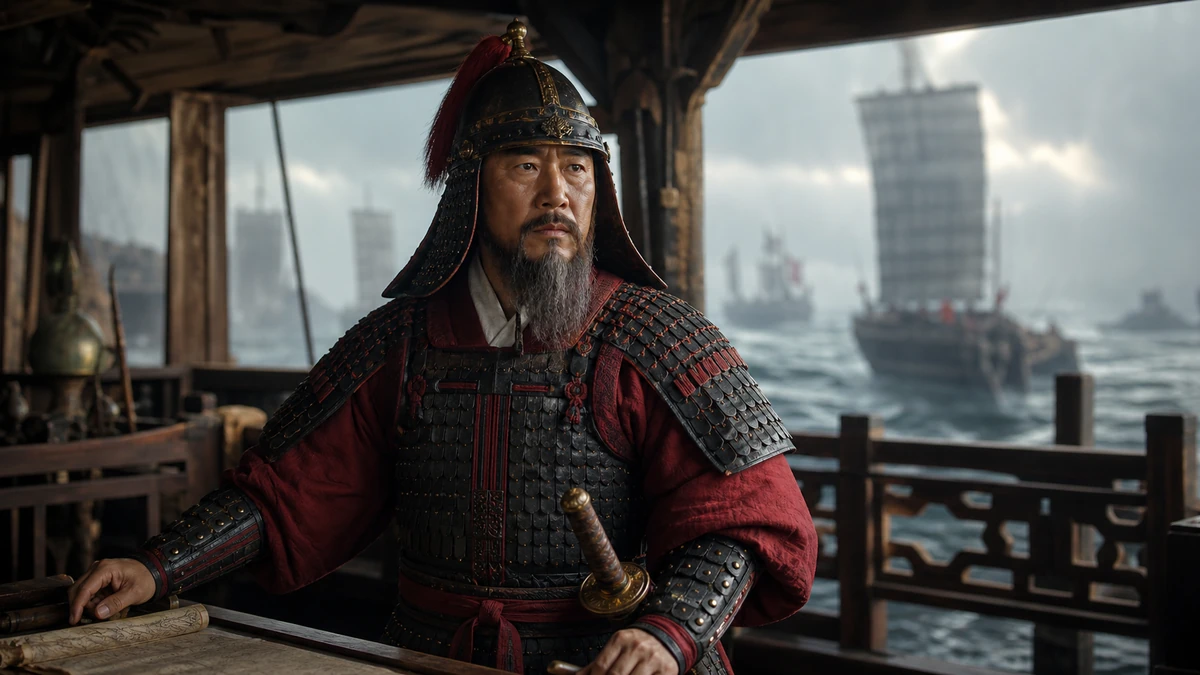
Image to help understand the article
A national hero forged long before his most famous battle
For many Americans, the name Yi Sun-sin comes up, if at all, in the context of one astonishing military feat: a Korean admiral who, according to widely repeated accounts, faced a vastly larger Japanese fleet and helped save his country. In South Korea, though, Yi is not remembered simply as the commander who won the Battle of Myeongnyang in 1597. He occupies a place closer to a blend of George Washington, Ulysses S. Grant and Horatio Nelson — a figure whose military brilliance matters, but whose moral reputation may matter even more.
The Korean account summarized here traces that reputation back to the beginning. Yi was born in 1545 in what was then Hanseong, the capital of the Joseon Dynasty and the city that would become modern Seoul. His birthplace is now part of central Seoul, a dense urban landscape of office buildings and traffic rather than royal compounds and military posts. He came from an established family with a strong tradition in civil service, the scholarly-bureaucratic path that carried enormous prestige in premodern Korea. Yet Yi chose the military track instead, a notable decision in a Confucian society that often ranked civil officials above soldiers.
That choice is central to how Koreans understand him today. Yi is revered not only because he defeated enemies at sea, but because he appears in historical memory as a man who rejected convenience, patronage and self-interest in favor of discipline and public duty. In an American context, that helps explain why his legacy remains so durable. He is not treated simply as a battlefield celebrity. He is held up as an example of leadership under pressure, institutional integrity and competence in a moment when the state itself seemed at risk.
The story also helps illuminate a broader point about Korean history for international readers. The Joseon Dynasty, which lasted from 1392 to 1897, was governed through a highly structured bureaucracy, with advancement often shaped by exams, lineage and official rank. Yi’s rise through that system was not smooth or inevitable. His later glory is often so overwhelming that it can obscure the years of middling posts, setbacks and regional assignments that came first. The summary restores that missing middle and shows how the legend was built, in Korean memory, not by a single miracle at sea but by a career marked by persistence and principle.
That matters because historical heroes are often simplified for mass audiences. In the United States, popular memory can flatten Abraham Lincoln into the Great Emancipator or Dwight Eisenhower into the D-Day general, leaving out the long, formative stretches that made those roles possible. Yi’s life invites a similar correction. His triumph at Myeongnyang did not emerge from nowhere. It came after years of testing, frustration, field command and bureaucratic struggle — the kinds of experiences that often separate resilient leaders from symbolic ones.
The making of Yi: ambition, setbacks and a reputation for principle
One of the striking features of Yi’s early life is how familiar parts of it sound across cultures. He was said to have shown unusual determination as a child, playing war games, carving wooden arrows and cultivating an intense, disciplined personality. Such stories are common in the making of national heroes, and they function partly as character sketches handed down through later generations. In Yi’s case, they were reinforced by the recollections of Yu Seong-ryong, a major Joseon statesman who later became one of the most important chroniclers of the Japanese invasions of Korea.
As an adult, Yi did not glide into office. He initially failed the military examination after a fall from his horse injured his leg. The account says he wrapped the injury with willow bark and completed the test anyway, an episode that reads almost too neatly as legend but has endured because it captures the image Koreans associate with him: stoic, physically tough and unwilling to quit. Four years later, at age 32, he passed the military exam and began official service.
For American readers, it is worth pausing on the exam system itself. In Joseon Korea, advancement through examinations was a defining feature of elite governance, though the system was not meritocratic in the modern democratic sense. Family status still mattered. Even so, success required persistence and skill, and failure could delay or derail a career. Yi’s eventual passage into office, after disappointment and injury, gave his story a dimension that many modern audiences still find compelling: talent validated not by inherited privilege alone, but by endurance.
His early postings also reveal the traits that would later define him. He refused requests that looked like favoritism. He declined to misuse state property for a superior’s personal purpose. He resisted the pull of powerful connections. At one point, according to the summary, he refused a proposal that would have tied him more closely to an influential family, saying in effect that he would not entangle himself in that kind of arrangement. Whether viewed through the lens of Joseon administration or modern public ethics, the pattern is clear. Yi built a reputation as an officer who understood office as obligation.
That reputation did not protect him from internal politics. On the contrary, it seems to have sharpened tensions with superiors and colleagues. Evaluations could be manipulated. Reports could be withheld or reframed. Promotions could trigger backlash. Anyone familiar with military or civil-service institutions — in the United States or elsewhere — will recognize the pattern. Bureaucracies reward performance unevenly, and people who insist on rules can become as vulnerable as they are admirable. Yi’s biography, as preserved in Korean historical tradition, is therefore not just a tale of personal virtue. It is also a reminder that institutions under strain often fail to recognize their best people until crisis makes them impossible to ignore.
Before the legend: why the northern frontier mattered
Another important part of the story unfolds far from the naval battles that made Yi famous. Before he became the commander Americans are most likely to know from documentaries or Korean historical dramas, he served in difficult posts associated with the northern frontier, where Joseon forces confronted Jurchen groups. These assignments involved both defense and administration, including the management of agricultural settlements tied to military supply.
The summary describes a particularly revealing episode at Nokdun-do, where Yi anticipated the possibility of attack and repeatedly asked for reinforcements. Those requests went unanswered. When a raid came during harvest operations, Joseon forces suffered serious losses and captives were taken. Yi remained in the field and helped mount resistance and rescue efforts, but higher authorities blamed him and another officer for the disaster. A harsher punishment was proposed, yet the king decided execution would be excessive and instead ordered corporal punishment and service as a common soldier, giving Yi a chance to redeem himself through later merit.
For modern readers, especially in the United States, the episode sounds like a familiar institutional tragedy: a warning ignored, a predictable failure, then blame pushed downward after the fact. It is a pattern visible in military history, corporate history and political history alike. But the Korean importance of this moment lies in what came next. Yi returned, fought again and was restored after helping capture an enemy leader in a later campaign. In other words, the future admiral’s story passed through humiliation before it passed into glory.
That sequence matters because it deepens the meaning of his later victories. He was not simply a brilliant commander waiting for the right stage. He was an officer shaped by firsthand experience with weak support, imperfect intelligence, fractured chains of command and the consequences of strategic neglect. By the time he emerged as a leading naval figure in the south, he had already seen what institutional failure looked like from below.
This is one reason Yi resonates so strongly in South Korea’s historical culture. He symbolizes more than courage under fire. He embodies competent leadership in spite of politics, and national survival in spite of official misjudgment. That message has broad appeal in any society that worries about whether its institutions can rise to a crisis. In Korea’s case, where external invasions and great-power pressures have repeatedly shaped the peninsula’s past, the symbolism is particularly potent.
From provincial command to the Battle of Myeongnyang
Yi’s rise to major command came quickly in the early 1590s. He held local office, won praise for governance and was recommended by influential figures, including Yu Seong-ryong. After a rapid series of appointments, he became the naval commander of the Left Jeolla Fleet in 1591. Soon afterward came the Japanese invasions of Korea, known in Korean history as the Imjin War, which began in 1592 and became one of East Asia’s defining conflicts of the era.
The summary notes that Yi did not merely win one famous battle and disappear into the record. He became the central naval commander for Joseon and repeatedly defeated Japanese forces through a combination of leadership, strategic planning and tactical skill. For Americans unfamiliar with the details, the larger significance is straightforward: keeping control of the sea lanes mattered enormously. Naval resistance disrupted Japan’s ability to sustain its invasion and helped prevent total collapse on the Korean side.
Then came the dramatic reversal that fixed Yi in global imagination. In 1597, after being arrested and questioned for allegedly disobeying royal orders, he was removed from command. That same year, another Korean naval commander, Won Gyun, suffered a catastrophic defeat at Chilcheollyang. The Joseon court reinstated Yi and handed him what looked like an impossible mission: rebuild a shattered fleet and face a much stronger enemy.
What followed at Myeongnyang has become the defining episode of his life. With just 13 ships, according to the account, Yi confronted 133 Japanese vessels and destroyed 31 of them. The numbers are part of why the battle has become so iconic. But even beyond the arithmetic, the symbolism is powerful. Here was a commander returning from disgrace, inheriting ruin and somehow reversing the tide through discipline, terrain, timing and psychological control.
In American culture, there is a ready analogy in the way certain battles become shorthand for a nation’s self-understanding. Think of Washington crossing the Delaware, or the stand at Midway, or the language of “against all odds” that still attaches to underdog victories. Myeongnyang serves that role in Korea. It is not merely a military success. It is a national parable about recovery when defeat appears final.
That helps explain why Yi remains so present in South Korean public life. His image stands in central Seoul. Schoolchildren learn his story. Films, television dramas, books and museum exhibitions revisit his campaigns. And the focus is often not just on heroic action but on restoration: how a broken force was reorganized, how morale was rebuilt and how command authority was reclaimed after institutional chaos. In an era when many countries are preoccupied with resilience, that theme has fresh relevance far beyond Korean history.
What Yi means in Korea now: memory, identity and the politics of competence
Historical figures become national symbols because they answer present-day needs, not just because they mattered in their own time. Yi’s continued prominence in South Korea reflects a society that values technological sophistication, collective endurance and effective organization, but that also carries deep memories of invasion, division and geopolitical vulnerability. He stands at the intersection of all three.
In Korean culture, public admiration for Yi often centers on a set of linked virtues: loyalty, incorruptibility, strategic intelligence and willingness to shoulder responsibility. Those values are not unique to Korea, but the Korean framing is distinctive because Yi’s story is so tightly tied to the idea of safeguarding the nation under existential pressure. He is celebrated not only as a warrior, but as a public servant who remained disciplined when the state around him faltered.
That has made him useful across generations and political contexts. Conservatives can embrace him as a defender of the nation. Liberals can point to his resistance to corruption and favoritism. Military institutions can cite him as a model of command. Popular culture can turn him into a cinematic hero. The result is a remarkably broad consensus figure in a country where modern politics can be deeply polarized.
There is also a cultural point American audiences may miss without explanation. Korean historical commemoration often places heavy emphasis on moral character as part of public legacy. Yi’s achievements are inseparable from stories about how he behaved when tempted, criticized or demoted. In that sense, his memory is not just military; it is ethical. The tales of refusing improper favors or protecting public resources do not function as side notes. They are essential to why he is still trusted in the national imagination.
That makes Yi especially resonant in moments when publics question whether leaders deserve confidence. Americans know this dynamic too. The endurance of figures such as Washington or Lincoln owes something to battlefield or political success, but also to a larger narrative about character. Korea’s attachment to Yi works in a comparable way. He is remembered not simply for winning, but for seeming to deserve victory.
Why this matters in the United States
For American readers, Yi’s story is not only an entry point into Korean history. It is also a window into the cultural and strategic relationship between the United States and South Korea in the 21st century. South Korea is one of America’s closest allies in Asia, a major trading partner and a cultural powerhouse whose influence now reaches deep into U.S. life through music, film, television, food, beauty and technology. Understanding a foundational Korean historical figure is part of understanding the country Americans increasingly encounter not as a distant ally, but as a daily presence in the marketplace and popular culture.
That matters because Korean cultural exports often travel with limited historical context. American audiences may know K-pop groups, Oscar-winning films, hit streaming series and Korean skincare brands while having only a vague sense of the historical narratives that shape modern Korean identity. Yi is one of those narratives. He helps explain why themes of survival, discipline, sacrifice and national resilience recur so often in Korean storytelling, from prestige historical dramas to modern thrillers about state failure and social pressure.
There is also a business angle. U.S. media companies, streaming platforms and publishers have invested heavily in Korean content because they recognize that global audiences respond to it. Historical subjects once considered too local are now international products. A figure like Yi therefore matters not just to historians but to American entertainment executives, distributors and cultural gatekeepers trying to understand what stories resonate across borders. The success of Korean period films and dramas in overseas markets suggests that audiences are increasingly willing to engage with history that is not their own, provided it is framed clearly and told with emotional force.
At a strategic level, Yi’s legacy also arrives at a moment when maritime security and alliance coordination are once again central to U.S. policy in Asia. It would be inappropriate to draw simplistic lines from a 16th-century admiral to modern defense planning. Still, the enduring Korean admiration for a commander who protected sea routes and held the line against a powerful aggressor says something about the historical memory that underpins South Korea’s contemporary worldview. Nations do not approach alliance, deterrence and defense in an emotional vacuum. They do so through stories they tell about past peril and survival.
For American audiences, there is a final point of comparison. The U.S. also canonizes military figures, but public debate often centers on whether those figures can survive modern scrutiny. Yi presents a somewhat different case. In South Korea, his reputation remains unusually robust because the historical tradition emphasizes not only victory but ethical conduct. That helps make him legible to Americans looking for a Korean equivalent to the rare national hero whose competence and character reinforce each other rather than compete.
What to watch next: from one battle to a broader trend
The larger lesson in revisiting Yi is not simply that Korea had a brilliant admiral in the 1500s. It is that global audiences, especially in the United States, are increasingly being asked to engage Korea on Korean terms rather than through Cold War shorthand or consumer trends alone. That means taking seriously the historical figures, traumas and values that continue to shape the country’s public culture.
In that sense, the renewed attention to Yi fits a broader shift. As Korean culture expands its reach, its historical memory is becoming exportable too. International audiences who first arrived through K-pop or Korean television are moving outward into literature, history podcasts, museums and serious nonfiction. The demand is no longer only for catchy songs or prestige dramas; it is for context. Figures such as Yi offer that context because they connect the emotional power of national storytelling with real historical stakes.
For journalists and readers in the United States, that creates both an opportunity and a responsibility. The opportunity is to cover Korea with greater depth, recognizing that the country’s global influence is not just commercial but civilizational in the broadest sense. The responsibility is to avoid reducing Korean history to inspirational slogans or simplistic East-versus-West analogies. Yi’s life deserves more than the headline-friendly version of a commander who won against impossible odds. It deserves to be seen as part of a larger history of bureaucracy, war, social hierarchy, political conflict and national memory.
The summary of Yi’s life does exactly that. It starts with a boy from central Seoul who chose the military path over the more prestigious civil one. It follows him through injury, examination failure, provincial service, principled refusals, frontier combat, unjust punishment, restoration, promotion and finally the command crisis that produced Myeongnyang. The through line is not just heroism. It is preparation.
That may be the most useful takeaway for American readers. Nations often remember the dramatic moment — the victory, the speech, the turning point. But the real story usually lies in the long buildup: the habits formed early, the pressure absorbed over time, the credibility earned before anyone outside the system notices. Yi Sun-sin remains one of Korea’s most revered figures because his most famous battle confirmed what the broader arc of his life had already suggested. When the state faltered, he did not.
Comments
Post a Comment