Why Ahn Jung-geun Still Matters: The Korean Independence Figure Whose Life Explains East Asia’s Unfinished History
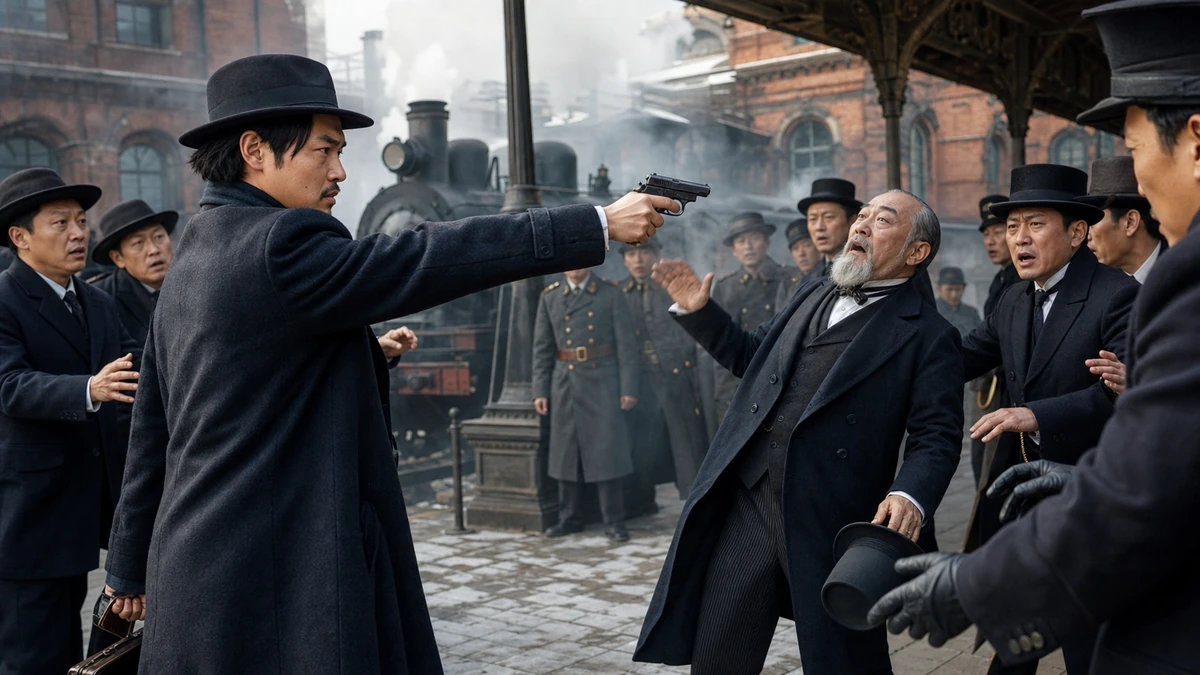
Image to help understand the article
A Korean historical figure Americans often hear about only in passing
For many Americans, Korean history tends to come into focus through a few familiar entry points: the Korean War, the division of the peninsula, the rise of Samsung and Hyundai, and more recently the global spread of K-pop, Korean film and television, and Korean food. But in Korea itself, some of the most emotionally powerful national figures come from an earlier era, when the country was fighting for survival under intensifying foreign pressure. Among them, few loom larger than Ahn Jung-geun.
Ahn is best known for the 1909 killing of Japanese statesman Ito Hirobumi at the Harbin railway station in what is now northeastern China, an act Koreans widely remember not simply as an assassination but as a declaration of anti-colonial resistance. To understand why his name still resonates across South Korea today, it helps to look beyond that single dramatic moment. His life, as described in Korean historical accounts, traces the path of a man shaped by privilege, political upheaval, Catholic faith, education reform, civic activism and, ultimately, armed struggle.
That arc matters because it captures something larger than one biography. Ahn’s story reflects a turning point in Korean history, when efforts to protect national sovereignty moved from reform and education to guerrilla warfare and symbolic violence. In American terms, he occupies a place somewhere between a resistance icon, a political martyr and a fiercely contested revolutionary figure whose meaning depends heavily on historical perspective. He is not easily reduced to a single category, and that is precisely why he remains so important.
The renewed attention to Ahn in Korean public history is not just about commemorating a patriot from the distant past. It is also about explaining how Korea remembers empire, collaboration, resistance and national identity in the present. For American readers trying to make sense of modern South Korea — one of the United States’ closest allies in Asia and one of its most culturally influential partners — Ahn’s life offers a revealing window into the historical memory that still shapes politics, diplomacy and popular culture.
From a wealthy provincial family to a life shaped by unrest
Ahn Jung-geun was born in 1879 in Haeju, in what is now North Korea, into a family that was comfortable enough to shield him from early hardship. Korean historical accounts describe him as the eldest son of Ahn Tae-hun and Jo Maria, and note the kind of birth legend that often attaches itself to major historical figures: he was said to have been born with seven dark marks on his back, leading to the childhood nickname Eung-chil, a reference to the Big Dipper. He reportedly continued using that name during some of his later activities abroad.
For American readers, details like these can sound like the makings of folklore, but they are important in Korean historical storytelling. As in many national traditions, the biographies of revered figures often blend documentary evidence with symbolic narrative, linking a person’s early life to a sense of destiny. That does not make the history less serious; it shows how public memory works. Ahn is not remembered in Korea as a dry figure from a textbook but as someone whose life has been woven into the country’s moral imagination.
His family background also mattered. His grandfather had accumulated substantial wealth as a landholder and grain merchant, giving the young Ahn a relatively stable upbringing. Yet the record also suggests a family in transition: one that had risen in status through military service, local influence and education. This is significant because it places Ahn inside a part of late Joseon society that had resources, ambition and a strong stake in the fate of the Korean state.
He was not, in other words, born on the margins. He came from a household with enough standing to think seriously about public life, education and social position. That makes his later radicalization more striking. American readers familiar with anti-colonial leaders elsewhere will recognize the pattern. Many of the men and women who became symbols of resistance did not begin as outcasts. They often emerged from families close enough to power to see a system failing in real time.
Ahn’s childhood also combined scholarly training with a more rugged side. He is described as loving horseback riding, archery and hunting, and as developing a reputation as an excellent marksman while also neglecting some of his traditional studies. That combination — partial classical education, martial skill and exposure to political instability — would later define his public image. He was not a cloistered intellectual, nor simply a fighter. He was a product of a society where old elite norms were colliding with modern crisis.
Faith, schooling and the idea that a nation could be rebuilt
Before he became associated with armed resistance, Ahn appears to have believed that Korea’s survival depended on moral and educational renewal. That is one of the most revealing aspects of his life and one that often gets lost when he is remembered only for Harbin. According to the Korean account, his family was deeply involved in Catholic life, and Ahn entered a Catholic school in 1895 before formally joining the church in 1897. He received the baptismal name Thomas from a French missionary priest.
For Americans, the Catholic dimension is especially worth noting. Christianity in Korea is sometimes assumed to be a modern or purely Westernizing influence, but in the late 19th and early 20th centuries it could also serve as a network for education, social organization and moral reform. In Ahn’s case, Catholicism appears to have been part of a broader framework through which he thought about personal duty and national responsibility. The story is not one of simple Westernization. It is one of selective adaptation during a period of national emergency.
He also moved through the kinds of institutional spaces that mattered to Korea’s reformers: schools, local associations and financial cooperatives. The summary describes him taking on responsibilities in church-related circles and later managing pooled funds. That might sound minor beside the grander episodes of his life, but it helps show that he was engaged in civic organization, not just political outrage. He seems to have understood that national strength required infrastructure: educated people, functioning institutions and coordinated action.
That understanding became even more explicit after Japan tightened its grip on Korea in the years following the 1905 protectorate treaty that stripped the Korean Empire of diplomatic authority. Ahn went to Shanghai seeking support for the restoration of Korean sovereignty but was rebuffed. After a period in business, he turned his resources toward founding and supporting schools, including Samheung School and another Catholic-affiliated school he helped run himself.
This phase of his life deserves more attention because it places him within a broader Korean enlightenment movement. He was not starting from the assumption that violence was the only answer. Like many reform-minded Koreans of his era, he appears to have believed that education could awaken the public and prepare the country to defend itself. If Americans want a useful comparison, this is less the story of a man who leaped directly into militancy than of someone who moved through civic nationalism first — closer to a reformer who concluded that institutions alone could no longer answer an imperial crisis.
When reform gave way to armed resistance
The key shift in Ahn’s life came as Korea’s political situation deteriorated rapidly. The forced abdication of Emperor Gojong in 1907, the further expansion of Japanese control and the disbanding of the Korean military helped trigger a wave of righteous army, or guerrilla resistance, across the country. In Korean, these irregular forces are often called uibyeong, a term that carries a strong moral and patriotic charge. It suggests not merely insurgency but a volunteer struggle undertaken in defense of a violated political order.
Ahn’s path into that world appears to have grown out of accumulated disillusionment. The summary presents him as someone who had backed education and economic self-strengthening, including the national debt repayment campaign, before concluding that an independence war had to be prepared. He joined anti-Japanese militia activity, fought alongside resistance forces in Hwanghae Province and later crossed to Vladivostok, where Korean activists and exiles were organizing beyond Japan’s immediate reach.
There he took on a military role, eventually leading around 100 men in an attack on a Japanese garrison after crossing the Tumen River. The operation initially succeeded, but the campaign later ended in defeat. One especially telling episode involved Ahn’s reported decision to release Japanese prisoners in accordance with international law, despite objections from fellow fighters. According to the account, that decision helped lead to a later ambush and damaged his standing among other guerrillas.
This is a remarkable detail because it complicates any simple myth. Ahn is often remembered as a man of action, but here he appears as someone trying to situate a guerrilla struggle within a framework of law and legitimacy. For American readers, that tension may sound familiar. Resistance movements are often judged not only by what they fight against, but by whether they can claim moral discipline while fighting. Ahn seems to have wanted both military effectiveness and legal principle — a combination that is admirable, but often difficult to sustain in asymmetrical war.
The collapse of his unit did not end his anti-Japanese activism. Instead, it marked another turning point. The failure of reform, the limits of guerrilla organization and the deepening loss of Korean sovereignty all pushed him toward the act for which he would become famous. If the earlier stages of his life show a man trying schoolbuilding, civic finance and militia warfare, Harbin would become the moment when all those strands fused into one highly symbolic deed.
Harbin and the making of a transnational anti-colonial symbol
In 1909, Ahn joined like-minded comrades in an organization known as the Dongui Danjihoe, often translated as a kind of patriotic oath society, and continued efforts tied to the independence struggle. On Oct. 26 of that year, he shot Ito Hirobumi in Harbin. In Korean memory, the event is typically treated as a defining act of anti-imperial resistance, one that announced to the world that Koreans would not quietly accept foreign domination.
To American audiences, the place of Harbin is itself significant. This was not a local act confined to the Korean Peninsula. It took place in a city shaped by Russian, Chinese, Japanese and Korean interests, at a railway hub in a region where empires overlapped. In that sense, Ahn’s action belonged to a wider age of global imperial competition. Korea’s fate was being contested not only in Seoul but across East Asia, and Ahn’s intervention reflected that larger geopolitical reality.
It also helps explain why Ahn remains such a powerful figure in Korea but can be less legible abroad. In the United States, political violence is usually filtered through a modern framework that asks first whether the act was terrorism, assassination or resistance. Koreans certainly debate history too, but Ahn is broadly honored in South Korea as a patriot who acted against colonial aggression. The moral frame is shaped by Japan’s subsequent annexation of Korea in 1910 and the decades of colonial rule that followed.
That does not mean Ahn is remembered only as a gunman. On the contrary, the Korean account emphasizes the evolution of his thinking: from local upbringing and family privilege to faith, schooling, civic reform, debt relief activism, militia warfare and finally the Harbin attack. In that telling, Harbin is the endpoint of political transformation, not an isolated outburst. It is important to understand that sequence if one wants to understand why his reputation has endured for more than a century.
More broadly, Ahn’s life illustrates how anti-colonial icons are made. They are rarely remembered for biography alone. They become vessels for unresolved historical questions: When is violence justified? What happens when reform fails? Can a stateless people claim international legitimacy? Who gets to write history after empire ends? Those questions continue to resonate far beyond Korea. They are part of why Ahn can be taught not just as a Korean patriot but as a figure in the global history of resistance.
What this means in the United States
For the United States, Ahn Jung-geun’s legacy matters on several levels, even if his name is less familiar here than in Korea. First, it matters because South Korea is one of America’s most important allies in Asia, and historical memory is not a side issue in that relationship. The United States works closely with Seoul on security, trade, technology, higher education and cultural exchange. Understanding which historical figures South Koreans revere — and why — is part of understanding how the country sees itself.
Second, Ahn’s story arrives at a moment when American audiences are more engaged with Korean culture than ever before. Millions of Americans encounter Korea through streaming dramas, Oscar-winning films, stadium tours, skincare brands and Korean restaurants in cities and suburbs across the country. That cultural familiarity, however, can create an illusion of historical familiarity. It is entirely possible for an American consumer to know the biggest K-pop groups and still know little about the colonial trauma that shaped modern Korean nationalism. Ahn’s prominence is a reminder that today’s Korean soft power sits atop a much longer and often painful historical foundation.
Third, Ahn’s legacy has implications for American institutions and companies that operate in the Korea space. Museums, universities, media outlets, streaming platforms and publishers increasingly present Korean stories to English-speaking audiences. When they do, figures like Ahn raise a challenge familiar in the United States as well: how to present national heroes whose lives include political violence without flattening them into either saints or villains. American culture has its own contested memory figures, from revolutionaries and labor militants to civil rights activists once denounced as dangerous by the establishment. The comparison is not exact, but the interpretive problem is recognizable.
There is also a diplomatic dimension. U.S. policymakers have long encouraged closer cooperation between South Korea and Japan, especially as Washington seeks stronger trilateral coordination in Northeast Asia. But disputes rooted in colonial memory do not disappear because they are inconvenient to present-day strategy. Ahn’s continued visibility in Korean public life is a reminder that the history of Japanese rule is not background noise. It remains central to how many South Koreans understand sovereignty, justice and regional order. Any American attempt to interpret Korea without that context risks misunderstanding both the ally and the alliance.
Finally, the American public conversation about empire, race and historical memory has become more intense over the past decade. Debates over monuments, textbooks and national heroes have shown that the United States is hardly alone in wrestling with the past. That makes Ahn’s story newly legible to American readers. His legacy is not just “foreign history.” It belongs to a broader, globally familiar argument over how nations remember resistance, whether violence can be part of liberation, and how public memory turns historical actors into symbols.
More than one man: a window into how Korea remembers itself
The strongest reason to revisit Ahn Jung-geun now is that his life helps explain a wider trend in South Korea: the sustained effort to connect national identity to anti-colonial memory in a way that is morally vivid, emotionally accessible and internationally legible. He was born into a family with means, came of age amid political disorder, invested in schools and civic causes, joined armed struggle and carried out an act that transformed him into a symbol. That is not just the story of an individual. It is a compressed history of a society moving from old order to imperial crisis.
For Americans, there can be a temptation to view Korean historical commemoration as either excessively nationalist or too distant to matter. That would be a mistake. Historical memory in South Korea is not frozen in the past; it is part of how the country explains modern democracy, sovereignty and survival. It shapes classrooms, museums, films, public ceremonies and diplomatic language. It also informs how many Koreans distinguish their own national story from those of their larger neighbors.
Ahn’s case is especially powerful because it sits at the intersection of so many themes that still matter: Christianity and nationalism, education and modernization, empire and resistance, legality and violence, local grievance and international politics. Those themes do not belong to Korea alone. They are part of the modern global story, and they help explain why Ahn continues to speak to audiences outside Korea when his life is properly contextualized.
What to watch next is not a new development in his biography, but the continued expansion of Korean history into global conversation. As Korean culture becomes a more permanent part of American life, more of the country’s historical vocabulary is likely to travel with it. That means U.S. audiences will encounter not only stars and brands, but also the contested memory of empire, liberation and identity. Ahn Jung-geun stands near the center of that conversation.
If his name still carries force more than a century after Harbin, it is because Koreans do not remember him only for the shot he fired. They remember the path that led there: the family world that formed him, the schooling he embraced, the reforms he attempted, the defeats he suffered and the conviction that Korea’s struggle had to be seen by the world. In that sense, his story remains startlingly contemporary. It asks a question that many nations, including the United States, still struggle to answer: how should a people remember those who believed freedom required more than patience?
Comments
Post a Comment