Why Christopher Nolan’s ‘Odyssey’ Is Striking a Chord in South Korea — and What That Says About Global Moviegoing
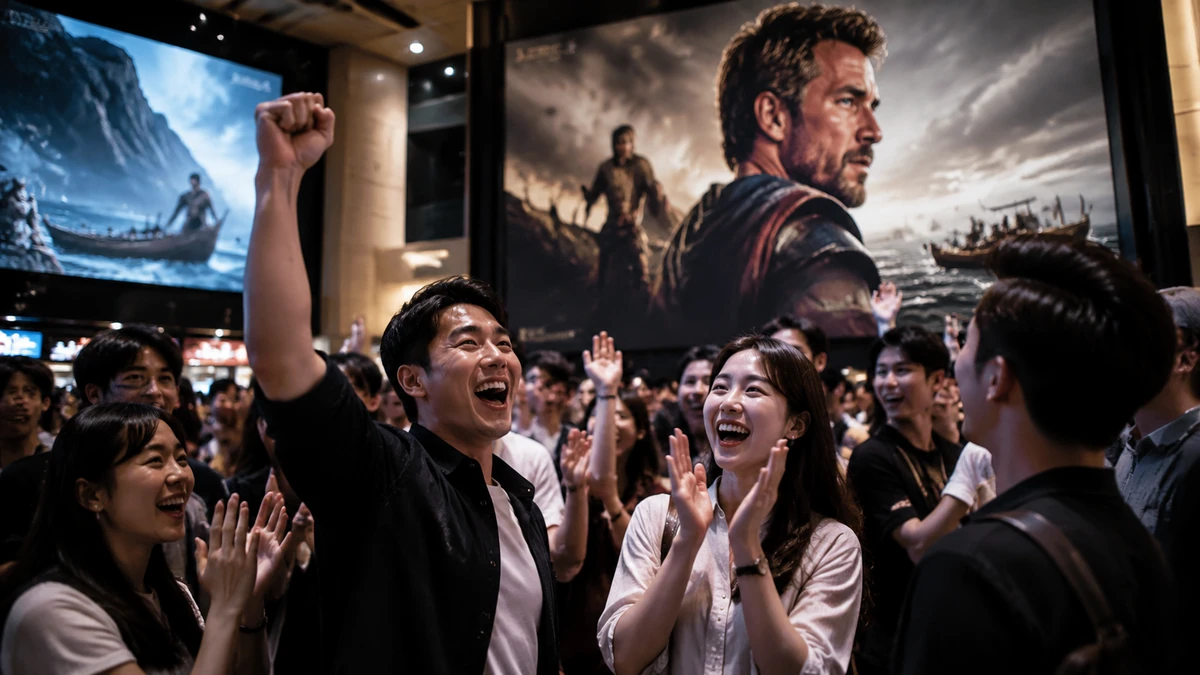
Image to help understand the article
A Hollywood epic finds one of its strongest audiences in South Korea
Christopher Nolan’s “Odyssey” has crossed 6 million admissions in South Korea just 17 days after its release, a milestone that says as much about the Korean movie market as it does about the film itself. According to distributor Universal Pictures, the movie reached the mark on its 17th day in theaters after opening on Aug. 5, making it one of the country’s biggest theatrical hits of the year and pushing it into the No. 3 spot on Korea’s annual box-office chart.
On paper, the achievement might sound like just another blockbuster statistic. In practice, it is more revealing. South Korea is one of the world’s most sophisticated moviegoing markets, with urban audiences, dense theater infrastructure and a long-established appetite for both local films and major Hollywood releases. A movie that sustains momentum into its third weekend there is not simply riding opening-weekend hype. It is demonstrating repeat interest, strong word of mouth and a level of cultural penetration that goes beyond fan-driven curiosity.
That matters because “Odyssey” is not a superhero sequel or a familiar franchise extension. It is a large-scale adaptation of Homer’s “Odyssey,” one of the foundational works of Western literature. The story follows Odysseus, played here by Matt Damon, on his long journey home after the Trojan War. The source material is ancient, the setting remote from contemporary life, and the scale deliberately monumental. Yet Korean audiences have embraced it as a mass-market event.
That result underscores an important point for anyone watching the global entertainment business: audiences are not rejecting ambitious, adult-oriented spectacle. They are rejecting movies that do not give them a compelling reason to leave home. “Odyssey,” as described by its Korean distributors and reflected in its reception, appears to have offered exactly that reason — a vast story, a recognizable star, a marquee director and a premium-format theatrical experience designed to feel larger than ordinary screen entertainment.
In the United States, conversations about theatrical decline often center on streaming competition, shorter attention spans and the supposed death of the original blockbuster. South Korea offers a useful corrective. When a film provides scale, urgency and a sense of communal viewing, audiences still show up in huge numbers. The Korean performance of “Odyssey” is not merely a local success story. It is evidence that under the right conditions, theatrical moviegoing remains a vibrant global habit.
Why this old story feels newly accessible
One of the more striking aspects of “Odyssey’s” Korean run is that it has turned a text many people know by reputation into a broadly popular commercial film. Homer’s “Odyssey” is canonical in the West, but “canonical” does not automatically mean commercially inviting. In any market, a story associated with school reading lists or classical civilization can feel distant, dutiful or intimidating.
What seems to have made the difference in South Korea is not simply the prestige of the source material but the clarity of the emotional hook. At the center of the film is a simple, universal objective: a man trying to get home. That through-line gives structure to a sprawling mythological world. Even for viewers with limited familiarity with Greek epics, the emotional logic is straightforward. The scale may be grand, but the desire is intimate.
That combination of the mythic and the personal has long been one of the most reliable formulas in mass storytelling. American audiences can recognize it from films as different as “The Lord of the Rings,” “Gladiator,” “Interstellar” and even “Saving Private Ryan” — stories in which vast historical or fantastical settings are anchored by one immediate human mission. The journey itself may involve gods, monsters, war or cosmic wonder, but what keeps viewers attached is a relatable emotional destination.
For Korean audiences, that accessibility appears to have mattered. The summary of the film’s reception in Korea suggests that the hero’s homecoming functions as a key entry point into a story world that might otherwise feel culturally remote. That should not be surprising. South Korea has one of the world’s most globally connected entertainment cultures, but it also rewards emotional legibility. Whether in Korean dramas, melodramas, thrillers or historical blockbusters, viewers tend to respond strongly to stories with a clear emotional motor, especially when family, loyalty, endurance and return are involved.
There is also a broader cultural point here. The success of “Odyssey” suggests that stories do not have to originate inside a local tradition to resonate deeply in Korea. They do, however, need to be translated into emotionally graspable terms. In that sense, the film’s appeal is less about classical education than about narrative architecture. The Greek setting may be ancient, but the emotional engine is entirely contemporary: survival, longing and the stubborn pull of home.
The IMAX factor and the return of the must-see theater movie
If there is one detail that may best explain why “Odyssey” became more than a literary adaptation, it is the way it was made and marketed as an event for the biggest screen possible. The film was shot entirely with IMAX film cameras, an approach described as a first in movie history. That is not just a technical bragging point. It is a statement about how the movie expects to be watched.
In an era when audiences routinely ask whether they can wait a few weeks and stream something at home, format has become part of the story. Premium large-format exhibition — IMAX, Dolby Cinema and similar experiences — now plays a role that roadshow prestige once did in an earlier Hollywood era. It signals importance. It reassures viewers that they are paying for something materially different from what their living room can deliver.
South Korea is especially well positioned for that proposition. It has a highly developed theater culture, modern multiplex chains and audiences accustomed to treating cinema as a social outing rather than just content consumption. When a film’s image and sound design are not incidental but central to its appeal, Korean audiences often respond quickly. The country has repeatedly shown a willingness to reward films that feel like genuine theatrical events, whether they are local titles or imported studio productions.
That is one reason the “Odyssey” numbers matter beyond simple admissions. The movie did not just benefit from Nolan’s brand name or Damon’s star power. It appears to have benefited from a very specific value proposition: this is something you are meant to experience, not merely watch. The giant scale of the visuals and the immersive sound were not marketed as accessories to the story but as part of the story’s meaning. The grandeur of the ancient world was to be felt physically, not just understood intellectually.
That strategy has contemporary relevance far beyond Korea. American studios have spent years wondering how to preserve the theatrical window in a marketplace remade by streaming. One answer, increasingly, is not just bigger intellectual property but more differentiated presentation. Movies that feel interchangeable across devices struggle. Movies that promise sensory immersion have a better chance of cutting through audience hesitation.
Nolan, more than almost any working director, has built a career on that logic. In the U.S., his releases routinely draw audiences who see the format itself as part of the artistic experience. South Korea’s response to “Odyssey” suggests that the same dynamic travels well internationally when the material matches the ambition. The lesson is straightforward: event cinema still works, but only when it is treated as an event in more than marketing language.
What the Korean box office is saying about audience taste in 2025
There is another reason the film’s rise is significant: it comes in a market that has not put all of its attention into one kind of movie. The Korean summary compares “Odyssey” with this year’s other major hits, including “Spider-Man: Brand New Day,” which reached 6 million faster, and “The King and the Living Man,” which took longer to hit the same mark but ultimately drew more than 16 million admissions. “Odyssey” also moved past Yeon Sang-ho’s “Colony,” which had reached roughly 5.95 million.
Those comparisons matter because they show that Korea’s box office is not moving in lockstep around a single dominant formula. Superhero entertainment, local commercial filmmaking and large-scale literary adaptation are all competing for audience attention. “Odyssey” did not win by replacing those other modes. It won by proving it could belong alongside them.
That suggests a healthier and more varied theatrical ecosystem than some industry narratives allow. In the U.S., it has become common to describe audiences as fragmented and difficult to mobilize unless a film comes pre-sold through franchise logic. South Korea’s market often tells a more nuanced story. Viewers there can be highly selective, but they are not necessarily narrow in taste. They will turn out for very different kinds of movies if each offers a clear reason to go.
In that sense, the success of “Odyssey” may be better understood as part of a broader trend: the audience has not become less adventurous, but it has become more discriminating. Big-screen movies have to justify themselves with concept, craft or cultural conversation. Korean viewers are not simply consuming whatever Hollywood exports. They are curating their own event calendar.
The speed of “Odyssey’s” rise is particularly interesting because it points to durability, not just front-loaded fandom. A strong opening can be manufactured through marketing. A sustained third-week run usually requires wider buy-in, extending beyond early adopters. That implies that the movie crossed demographic boundaries more effectively than some might have expected for a Greek epic.
It also reinforces a point long understood by Korean exhibitors and distributors: spectacle alone is not enough. Films need a core emotional or narrative promise that broad audiences can grasp quickly. In “Odyssey,” that promise appears to have been a combination of clear storytelling, a recognizable lead performance and a format-driven sense of necessity. The result is a useful case study in how old material becomes current popular culture again.
What this means for the United States
For American readers, the Korean success of “Odyssey” is not just an interesting overseas anecdote. It offers a window into the global strength of a certain kind of U.S.-backed filmmaking at a time when Hollywood is still recalibrating its business model. Universal Pictures is distributing the film, Christopher Nolan remains one of the most internationally bankable American-facing directors in the market, and Matt Damon is a star with longstanding recognition across borders. When a movie built around that combination performs strongly in South Korea, the implications reach directly back to the U.S. industry.
First, it is a reminder that American studios still have meaningful leverage abroad when they deliver prestige spectacle rather than assembly-line franchise maintenance. South Korea is not a passive consumer of U.S. culture. It is one of America’s most important entertainment partners and one of the most discerning foreign markets for Hollywood product. If Korean audiences turn a film into a hit, it often means the title has connected on more than brand familiarity. That kind of validation matters for studios making decisions about scale, release strategy and premium-format investment.
Second, the film’s performance reinforces the value of the U.S.-Korea entertainment relationship. Americans often encounter South Korea through K-pop, Korean dramas and Oscar-winning titles like “Parasite,” but the exchange is not one-directional. Korea is also a crucial overseas market for Hollywood, a country where American films can still become major cultural events. In an era of geopolitical uncertainty and shifting trade patterns, that soft-power relationship remains significant. Popular culture is one of the most visible ways the two countries continue to influence each other.
Third, there is a lesson here for American theater chains and format providers. If “Odyssey” is drawing Korean crowds in part because it promises a premium-screen experience, U.S. exhibitors have a strong argument for continuing to invest in presentation rather than simply seat count. Theaters in the United States have spent years searching for ways to differentiate themselves from streaming. Korea’s response suggests that audience appetite for premium exhibition remains real when the movie earns it.
There is also a subtler cultural lesson for American media companies. U.S. executives often divide global audiences into presumed taste silos: one set wants superheroes, another wants horror, another wants local-language content. The Korean case complicates that model. A three-thousand-year-old Greek story, directed by a British filmmaker working within the Hollywood system and fronted by an American actor, can still become a contemporary mass hit in Asia if the packaging and execution are right. That should encourage studios to think less mechanically about what “travels.”
Finally, the U.S. audience itself may want to pay attention to what Korean moviegoers are signaling. South Korea frequently acts as an early indicator of larger shifts in global media consumption because its audiences are digitally sophisticated yet still deeply engaged with out-of-home entertainment. When Korean viewers reward theatrical ambition, they are effectively offering a market-tested answer to one of Hollywood’s biggest questions: What will people still leave the couch for? The answer, at least in this case, appears to be craft, scale and a story with timeless emotional stakes.
Why this matters beyond one film
It would be easy to treat “Odyssey” crossing 6 million admissions as a single triumph for Nolan or as another box-office brag for a major studio. But the more interesting interpretation is broader. The film’s Korean success points to a durable global appetite for big-screen storytelling that combines recognizable talent, technical distinction and emotional clarity. That formula is not new, but in the streaming era it has taken on renewed importance.
For decades, Hollywood’s biggest export advantage was scale. What has changed is that scale alone no longer guarantees turnout. Audiences have become adept at waiting, filtering and skipping. They are less impressed by marketing volume and more responsive to genuine differentiation. In that environment, “Odyssey” looks less like a throwback and more like a blueprint.
The blueprint is not “make everything expensive” or “adapt old books.” It is more specific: build films that justify public, theatrical attention. Give audiences something that feels communal, sensorial and emotionally legible. Respect the intelligence of viewers without making them do all the work of entering the world. Use stars and technology not as substitutes for story but as pathways into it.
That is what makes the Korean response so notable. South Korea is not rewarding the film out of obligation to a famous director or deference to Western literary prestige. It is rewarding a package that translates ancient material into a contemporary event. The audience, in effect, is saying that old stories can still feel urgent if the filmmaking makes them immediate.
There is a wider irony here. At a moment when global entertainment is often obsessed with novelty, one of the year’s major theatrical stories in Korea is a film based on one of the oldest narratives in circulation. But perhaps that is the point. In unstable times, audiences often return to elemental themes: endurance, homecoming, identity, the test of character under pressure. Those are the raw materials of myth, and they remain commercially potent when handled with conviction.
What to watch next is not simply whether “Odyssey” climbs higher on Korea’s annual chart. It is whether studios and exhibitors absorb the more important lesson from its performance. Theatrical moviegoing is not saved by nostalgia or brand management alone. It is saved, when it is saved, by movies that restore a sense of occasion. South Korea’s embrace of “Odyssey” suggests that occasion still has extraordinary value — for Korea, for Hollywood and for any market trying to figure out what cinema can still mean in the age of infinite home entertainment.
Comments
Post a Comment