Image to help understand the article
A K-pop idol steps into a different kind of spotlight
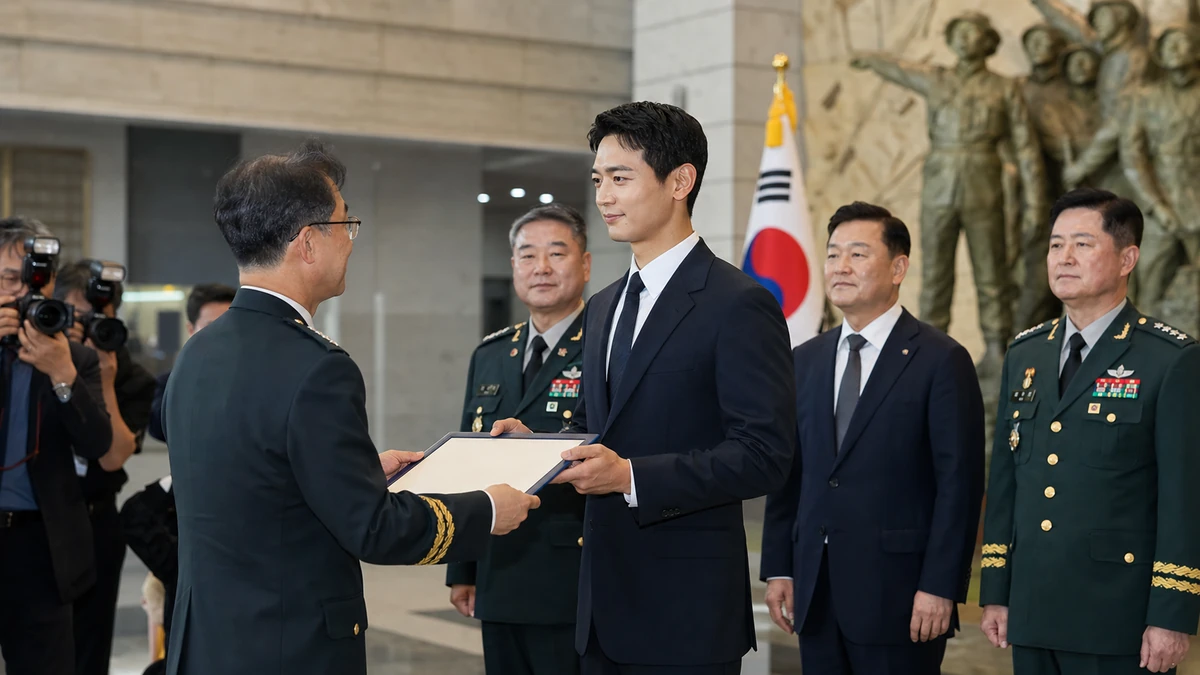
Minho of the veteran K-pop group SHINee is taking on a role far removed from concert stages, music shows and glossy brand campaigns. On Thursday, South Korea’s Ministry of National Defense formally appointed the singer as the new public ambassador for its recovery and identification unit for service members killed in the Korean War, the 1950-53 conflict known in South Korea simply as the "6.25 War," a reference to the date it began: June 25, 1950.
According to South Korean media reports, including Yonhap News Agency, Minho attended the appointment ceremony at the Seoul National Cemetery, one of the country’s most important national memorial sites. He paid respects at the memorial tower and visited an identification center, where he was briefed on the ongoing effort to recover the remains of soldiers who died in the war but have not yet been returned to their families.
In one sense, celebrity ambassador roles are familiar in South Korea, where government agencies, tourism boards and public campaigns often enlist famous actors, athletes and pop stars to broaden their reach. But this appointment carries a heavier moral and historical weight than a standard promotional partnership. The unit Minho now represents is tasked with one of the most solemn projects in modern Korea: finding, identifying and repatriating the remains of those who died in a war that still shapes the peninsula’s politics, identity and national memory.
That makes this more than a feel-good celebrity headline. It is also a window into how South Korea increasingly uses the global power of K-pop not just to sell culture, but to explain history. For many international fans, a familiar face like Minho may become the first point of contact with a painful chapter of Korean history that Americans often know only in the vaguest terms, if they know it at all.
Minho’s image helps explain why the appointment has drawn attention. For years, he has been known in Korean entertainment for his intensity, discipline and upbeat competitiveness, a reputation built through music, television appearances and his public persona. In this case, South Korea is not simply borrowing star power. It is pairing a trusted public figure with a national mission rooted in remembrance, military service and unresolved loss.
The message is clear: remembrance in Korea is not only the work of historians, veterans’ groups or government officials. It is also becoming part of mainstream cultural communication, and K-pop stars can serve as interpreters between official institutions and younger, global audiences.
Why military service matters so much in Korean celebrity culture
To American readers, one important piece of context may not be obvious. In South Korea, military service is not a distant abstraction for male celebrities; it is often a defining part of their public lives. Most able-bodied South Korean men are required to serve, a reality shaped by the fact that the Korean War ended not with a peace treaty, but with an armistice. Technically, the two Koreas are still at war.
That helps explain why Minho’s service record matters here. He volunteered for the Republic of Korea Marine Corps in 2019, a branch that carries a distinct reputation in South Korea for toughness and esprit de corps, much as the Marines do in the United States. South Korean coverage at the time highlighted his decision to participate in military training rather than simply coast through the end of his service period. That choice reinforced an image of him as diligent and sincere, and it appears to have shaped the credibility he now brings to this ambassador role.
In remarks at the appointment ceremony, Minho said he gained positive energy and mental toughness through his military service and that those experiences remain good memories. He also said he feels both pride and a strong sense of responsibility in joining a project devoted to bringing home those who sacrificed their lives for the country. That emphasis on responsibility matters. In South Korea, audiences can be skeptical of ceremonial roles that appear superficial. By framing the job not as an honor alone but as an obligation, Minho signaled that he understands the gravity of the assignment.
This is also where American and Korean celebrity systems diverge in revealing ways. In the United States, stars often attach themselves to causes through philanthropy, advocacy or nonprofit campaigns, but military service is not a routine rite of passage for entertainers. In South Korea, however, military service can be central to a male celebrity’s public legitimacy. It shapes fan expectations, media narratives and even how institutions assess whether a star can speak credibly on issues involving national service or historical memory.
That does not mean every entertainer who serves automatically becomes an ideal messenger for a public campaign. What sets Minho apart, at least in the public framing of this appointment, is the continuity between his service record and his public image. South Korean officials appear to be betting that fans will see this role not as a random assignment but as a natural extension of how he has long been perceived: energetic, serious and committed.
For overseas fans unfamiliar with Korean norms, that context is essential. This story is not just about a famous singer lending his name to a government cause. It is about how service, celebrity and national memory intersect in a country where the past is never entirely past.
The Korean War is not over in memory — or in many families
The recovery of war remains can sound bureaucratic in translation, but the work itself is deeply personal. At its core, the project is about restoring names, identities and family connections to those lost in the chaos of war. South Korea’s remains recovery and identification unit is searching for soldiers who died in the Korean War and have not yet been returned home, an effort that combines field excavation, forensic analysis and historical research.
For Americans, there is a useful comparison in the work done by the Defense POW/MIA Accounting Agency, the U.S. government entity that recovers and identifies missing American service members from past conflicts. The emotional logic is similar: no matter how many decades pass, states and families continue to pursue accountability for the missing. The dead are not treated as anonymous symbols, but as individuals with names, histories and relatives still waiting for answers.
That is especially significant in Korea because the Korean War remains both foundational and strangely underexplained in much of the outside world. In the United States, it is often called the "Forgotten War," overshadowed in public memory by World War II and Vietnam. Yet for South Korea, it is not forgotten at all. It is the event that devastated the peninsula, divided families, hardened the border and set the conditions for the South Korea that eventually became a democratic and cultural powerhouse.
Minho’s visit to the memorial tower and the identification center matters symbolically for that reason. Before promoting the work publicly, he was shown the places and processes tied to it. That step suggests the role is meant to be grounded in understanding rather than mere branding. If he is to speak to fans about the mission, the state appears to want him to speak from direct exposure to its reality.
The source material around the appointment also points to a broader interpretive shift: war remembrance is being framed not only as abstract patriotism, but as the recovery of a person’s life story. That distinction matters. When remains recovery is presented solely through state symbolism, younger audiences may tune out. But when it is presented as the effort to return a son, brother or father to his family, the emotional stakes become easier to grasp across generations and across borders.
In that sense, Minho’s involvement may help translate a solemn historical mission into a language global audiences can understand. Not by diluting its seriousness, but by providing a familiar bridge into it. For fans who first encountered him through K-pop, the appointment may prompt an unexpected question: What exactly happened in Korea, and why are people still searching for the missing more than 70 years later?
K-pop as a guide to history, not just entertainment
South Korea has spent the last two decades proving that popular culture can be one of its most effective forms of global influence. K-pop, Korean dramas, film, food and beauty brands have reshaped how millions of people imagine the country. But the Minho appointment points to another phase of that evolution: using star power not merely to export entertainment, but to introduce the world to Korean history and public values.
This is not entirely new. The defense ministry’s recovery unit has previously appointed a range of public ambassadors, including professor Seo Kyung-duk in 2016, actor Park Ha-sun in 2018, veteran actor Shin Goo in 2020, broadcaster Song Hae in 2021, BTS member RM in 2023 and Korean history instructor Choi Tae-sung in 2024. The lineup is notable because it spans academia, acting, broadcasting, K-pop and historical education. In other words, the institution has long understood that different kinds of public trust can bring different audiences to the same mission.
RM’s earlier role was especially telling, given BTS’ enormous international reach and the group’s ability to shape cultural conversation well beyond music. Minho now follows in that path, but with his own distinct credentials. Where RM brought intellectual and global cultural capital, Minho arrives with a public reputation closely tied to military service and personal discipline. South Korean coverage has emphasized exactly that difference.
There is a wider trend here worth noticing. Korean celebrities are increasingly expected not only to entertain but also to function as cultural interpreters. Sometimes that means representing tourism or exports. At other times, it means connecting audiences to social causes, historical anniversaries or public institutions. In the United States, celebrity activism is often polarizing, especially when it enters electoral politics. In South Korea, the model is somewhat different. Public roles are often framed less as ideological advocacy and more as civic participation, national representation or educational outreach.
That does not remove the risks. Any effort to pair celebrity culture with state memory can appear calculated if the messenger seems uninformed or opportunistic. The success of such campaigns depends less on fame itself than on authenticity, consistency and the public’s sense that the celebrity truly understands the mission. That is likely why Minho’s statement about duty and his documented military service are so central to the story. They provide the scaffolding for credibility.
There is also something larger happening in the global K-pop economy. As the industry matures, its stars are no longer confined to albums, tours and fashion campaigns. They are becoming ambassadors for museums, language, historical education and national identity. That expansion reflects both the strength of fandom and the sophistication of Korea’s broader cultural ecosystem. Fans do not just buy songs; they often follow an artist into adjacent worlds of meaning, from philanthropy to public remembrance.
Seen that way, Minho’s appointment is less an isolated event than part of a broader trend in which K-pop becomes a channel for transmitting civic narratives, including difficult ones. The question is not whether entertainment and history should mix. They already do. The more important question is whether stars can help audiences approach history with curiosity and respect rather than reducing it to another promotional cycle.
What this means in the United States
For American audiences, the immediate temptation may be to file this under international celebrity news and move on. That would miss the bigger picture. The United States is not just a distant observer of the Korean War’s legacy. It was a principal combatant in the conflict, and the war remains a cornerstone of the U.S.-South Korea alliance, one of Washington’s most important security relationships in Asia.
That historical connection gives Minho’s appointment a relevance that extends beyond K-pop fandom. The United States still stations tens of thousands of troops in South Korea. American officials routinely cite the alliance as central to deterrence on the Korean Peninsula and to the broader U.S. role in the Indo-Pacific. Yet many Americans have only a limited understanding of how deeply the Korean War continues to shape South Korean society. When a K-pop star becomes a public messenger for war-remains recovery, it offers a revealing glimpse into the lived cultural afterlife of an alliance Americans often discuss only in strategic terms.
There is also a market dimension. K-pop is now firmly embedded in the U.S. entertainment landscape, from sold-out arena tours to chart success, brand partnerships and fan conventions. American companies, promoters, streamers and media organizations all profit from the global popularity of Korean stars. As those stars become involved in public memory projects, American audiences are likely to encounter a fuller, more complicated version of Korean identity than the one conveyed by music videos alone.
That matters because K-pop’s U.S. presence has matured. Early mainstream coverage often treated it as a novelty or niche youth trend. Today, it is part of the cultural establishment. With that shift comes greater room for stories about what Korean pop culture carries with it: language, history, civic norms and memories of war and division. Minho’s appointment is one example of how a global entertainment figure can redirect attention from consumption to context.
The United States has its own parallels. American celebrities have long lent visibility to veterans’ causes, military charities, memorial initiatives and historical commemorations. But there is a notable difference in tone. In the U.S., those efforts often sit within a sprawling nonprofit and advocacy landscape. In South Korea, where the state, military service and unresolved war memory are more tightly interwoven, such appointments can feel more directly connected to national identity itself.
For American fans, this may also deepen understanding of why military service carries such emotional and symbolic force in Korea. That understanding is increasingly important as U.S. audiences consume more Korean cultural products and form stronger attachments to Korean artists. Fandom without context can flatten a society into aesthetics. Context restores depth. Minho’s new role, in that sense, is not just about public relations inside Korea. It is also a subtle lesson for the global marketplace that now consumes Korean culture at scale.
And for the broader U.S.-Korea relationship, there is a quieter diplomatic significance. Soft power works best when it broadens empathy, not just attention. If a well-known artist encourages overseas audiences to think about Korean War sacrifice in human terms, that does something government white papers and alliance briefings rarely can. It humanizes history.
What to watch next as fandom meets public memory
The real test of Minho’s appointment will come after the ceremony. South Korean reports say he will participate in key events connected to the recovery project and contribute his talent in a public-service capacity to raise awareness. That suggests the role is meant to be active rather than decorative. The question is how effectively that activity can translate public interest into sustained attention.
There are reasons to think it could. Fan communities are highly organized, digitally fluent and often eager to support causes their favorite artists care about. In recent years, K-pop fandoms around the world have shown they can mobilize quickly for charitable donations, social campaigns and memorial projects. If Minho consistently speaks about the mission in ways that are respectful, informative and personal, some portion of that attention may shift toward learning about the Korean War, military remembrance and the ongoing work of identifying the missing.
Still, the balance will matter. This is a solemn state project, not a fan event. The challenge is to use celebrity visibility without letting celebrity overshadow the dead themselves. The most effective outcome would be one in which Minho acts as a guide — an entry point, not the center of the story. The institution’s mission is to recover those who never made it home, and any successful public campaign will keep that purpose in focus.
There is also a generational dimension worth watching. Younger Koreans and international fans are often far removed from the war in lived experience. As the conflict recedes further into history, the methods of remembrance inevitably change. Institutions increasingly need translators who can connect solemn historical work to audiences raised in a digital, entertainment-saturated world. Minho’s appointment suggests South Korea understands that reality and is adapting to it.
For Americans, that adaptation may feel familiar in some ways and surprising in others. The United States also grapples with how to keep historical memory alive once direct witnesses fade. Museums, documentaries, public figures and cultural institutions all compete for attention in a crowded media environment. South Korea’s answer, at least in part, is to enlist one of the country’s most recognizable cultural assets: the credibility and reach of K-pop.
If the effort succeeds, the significance will extend beyond one singer or one ministry office. It will show how a global pop industry can help carry national memory across borders, and how fandom can evolve from admiration into a more thoughtful engagement with history. In a media ecosystem built for speed and spectacle, that would be no small achievement.
Minho’s appointment begins with a ceremony, but its meaning lies elsewhere. It lies in whether fans pause to ask what the Korean War still means to the people who live with its legacy every day. It lies in whether a star known for charisma and energy can help audiences approach a painful past with seriousness and care. And it lies in a larger truth about Korean culture in 2025: its global influence is no longer just about what the world watches, streams or buys. It is increasingly about what the world is invited to remember.
Comments
Post a Comment