Image to help understand the article
A Snapshot of Modern Korea, Told Through Search
If you want to understand what a country is worried about, excited by or trying to figure out in real time, you could do worse than look at what people are typing into Google. In South Korea on Aug. 27, 2026, one word towered over the day’s other trending searches: inheritance.
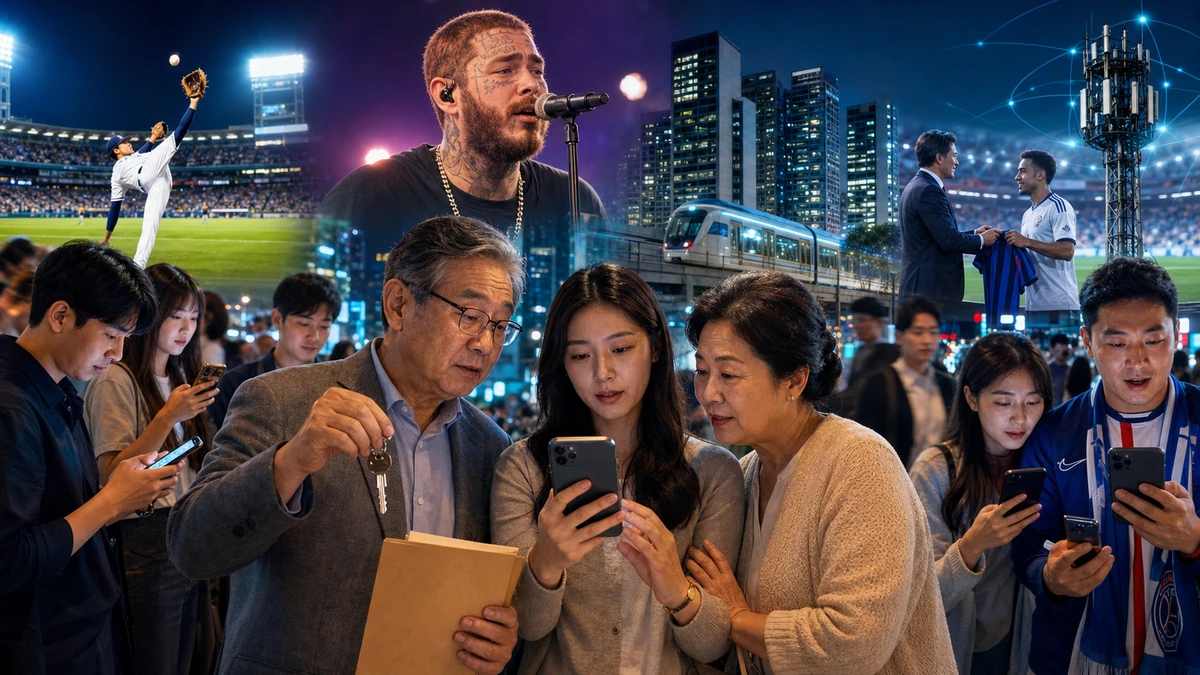
That may sound dry next to celebrity names, baseball positions and a global pop star. But the day’s trending list in Korea offered a revealing cross-section of the country’s public mood: anxiety over how wealth passes from one generation to the next, confusion over the future of older mobile networks, disappointment over a delayed concert by Post Malone, and the usual churn of sports news from Korean baseball and European soccer.
The list, compiled from Google Trends’ real-time rising searches in Korea, included actor Kim Eui-sung, baseball player Song Chan-eui, broadcaster Han Moo-young, model and actor Jung Ho-yeon, the term center fielder, Manchester City FC, Post Malone, inheritance, Gimpo City and third-generation mobile communications, or 3G. The numbers attached to those terms are approximate search-volume markers supplied by Google, not exact audience counts. Still, one pattern was unmistakable: inheritance, at roughly 10,000-plus, far outpaced the rest.
That matters because search trends are not simply a reflection of pop culture. They are often a measure of friction. People search when they feel uncertainty, urgency or a need to act. A concert delay prompts ticket holders to look up refunds. A transfer rumor sends sports fans chasing confirmation. A changing telecom landscape raises questions about whether an older phone or service plan will still work. And inheritance, especially in a country where real estate prices and family wealth have become politically charged issues, can quickly move from abstract policy debate to kitchen-table concern.
Just as important, not every trending keyword comes with a perfectly clear explanation. The Korean summary notes that some linked headlines do not always directly account for why a term is surging. That is particularly true for Gimpo City, where the available related headlines focused more broadly on housing supply and transportation than on the city itself. So the day’s trend list is best understood not as a set of settled conclusions, but as a live map of what drew public attention and why Koreans felt compelled to look for answers.
For American readers, there is a familiar rhythm here. Think of a day when U.S. search traffic jumps between Taylor Swift ticket news, a Yankees roster move, Social Security questions and the shutdown of an aging wireless standard. The subjects do not neatly belong together, but the underlying force does: people respond fastest to stories that affect money, access, entertainment and identity.
That is what made Korea’s trending list so revealing. It was not just a bundle of random search spikes. It was a portrait of a highly connected society moving between celebrity culture, sports obsession and practical economic stress in the span of a single day.
Why “Inheritance” Dominated the Conversation
The day’s biggest Korean search term was not an entertainer or an athlete. It was inheritance, a sign that practical financial concerns were outweighing lighter distractions, at least online.
The related headlines cited in Korea focused on whether parents should transfer assets through inheritance or through gifts during their lifetime, as well as why tax authorities are paying close attention to transfers of wealth among older generations. Another article highlighted a particularly sensitive issue in Korea’s overheated housing market: surviving family members may end up selling inherited homes to cover inheritance taxes.
Even without detailed tax tables or confirmed legal changes in the available source material, the public interest is easy to understand. In South Korea, as in the United States, wealth is often tied up in housing. But in Korea, where urban real estate in and around Seoul has become a central source of intergenerational inequality, the question of how property is transferred can feel especially urgent. A family apartment is not just shelter. It can be a store of wealth, a measure of class mobility and, for some heirs, a tax burden waiting to come due.
That makes inheritance more than a legal term. It becomes a symbol of broader social pressure: an aging population, rising concentrations of wealth, and the growing gap between those who can inherit assets and those who cannot. South Korea has one of the world’s fastest-aging societies, and debates over succession, elder finances and tax fairness have become increasingly prominent as the country grapples with demographic decline and slower long-term growth.
For readers in the United States, the closest comparison may be the way Americans search around estate planning, capital gains, probate or family-home transfers when the housing market is under strain. These are not usually glamorous topics, but they become urgent when ordinary households feel that a lifetime’s savings could be diluted by taxes, legal complexity or forced sales. The difference in Korea is that these questions are landing in a society where home ownership, education and family support systems are intensely interconnected.
There is also a cultural layer Americans may miss at first glance. In Korea, family obligation remains a strong social norm, even as family structures modernize and individual lifestyles change. Questions about inheritance are not only about tax efficiency. They are also about parental duty, fairness among children and the preservation of family assets in a country where economic mobility feels harder than it once did.
That helps explain why the term spiked so dramatically. People were not necessarily searching for a single policy update. They were searching for clarity in a system where finances, family expectations and housing insecurity can collide all at once.
From Post Malone to Korean Baseball, Culture Still Moves Fast
If inheritance reflected financial anxiety, the rest of the trending list showed the speed of Korea’s entertainment and sports ecosystem. Post Malone ranked among the day’s top searches after reports that his planned October concert in Korea had been delayed, with full refunds to be issued. Some headlines used the word canceled while others used postponed, underscoring the uncertainty that often surrounds live-event updates in the first hours after an announcement.
For fans, the surge in searches was less about celebrity gossip than consumer logistics. Anyone who has held tickets for a delayed show in the U.S. understands the reflex: check whether the event is still happening, whether tickets remain valid, how refunds will be processed and whether a new date has been set. The Korean audience response appears to have followed that same script.
The story also says something about the place Western artists now hold in Korea’s entertainment market. South Korea is no longer a peripheral stop on global touring schedules. It is an important live-music market with digitally savvy fans, strong ticket demand and high expectations around event management. A major schedule change involving an artist like Post Malone will immediately ripple across local search traffic because fans expect timely information and quick remedies.
Sports showed a similar pattern. The term center fielder climbed sharply, seemingly tied to commentary on whether the Hanwha Eagles might sign a free-agent player for that position. Even for readers unfamiliar with Korean baseball, the dynamic is recognizable. KBO fandom can be as granular and emotional as anything in Major League Baseball, and positional debates often become stand-ins for bigger arguments about team-building, front-office judgment and whether a club is buying high and selling low.
Song Chan-eui, another trending term, rose on the back of strong recent form. Korean reports described him as riding an eight-game hitting streak, with three home runs over his previous four games, while also highlighting comments he made in interviews and his gratitude toward veteran teammates. That combination matters. In Korea, as in the United States, athletes trend not only because of box scores but because fans want a fuller narrative: the breakout, the clubhouse support, the mindset and the signs that a hot streak might be real.
Then there was Manchester City FC, linked to reports surrounding Nico Gonzalez’s move to Newcastle United. European soccer has a huge and active audience in South Korea, where Premier League clubs command attention comparable to major U.S. franchises among devoted fans. Transfer news often functions like a stock ticker for sports loyalty: constant, speculative and emotionally loaded. Once an official announcement lands, search traffic spikes again as fans move from rumor to confirmation.
Taken together, these culture and sports trends show how Korean search behavior mirrors broader global patterns. People look things up not just to be entertained, but to resolve uncertainty quickly. Did the concert change? Is the transfer official? Is the player really starting? The common thread is the same one that drove the inheritance spike: not passive interest, but active information seeking.
What This Means in the United States
For Americans, Korea’s trending list is not merely a curiosity from overseas. It offers a useful window into how deeply the Korean and American consumer, entertainment and technology markets are now intertwined.
Start with live entertainment. A postponed Post Malone concert in Korea matters because American artists increasingly depend on Asia, including South Korea, not just for prestige but for revenue. Touring economics have changed. International stops are central to how major acts monetize fandom, and Korea’s concertgoers are among the most online, organized and responsive audiences in the world. When a U.S. performer’s scheduling problem becomes a Korean trending topic, it is also a reminder that American pop culture now operates in a global feedback loop. A disruption in Seoul can become a reputational issue for an American artist’s broader brand.
There is a similar bilateral dynamic in sports media. South Korean fans closely follow the Premier League and other overseas leagues, just as Americans increasingly consume Korean baseball highlights, Korean soccer coverage and Korean athlete content through streaming and social platforms. That does not mean the markets are symmetrical, but it does mean fan ecosystems are more connected than they were a decade ago. American broadcasters, streamers and sports marketers have a growing interest in how Korean audiences respond to roster news, player narratives and international competitions.
The inheritance trend also resonates in the U.S., especially as both countries wrestle with aging populations, expensive housing and generational wealth transfer. America is entering what financial analysts often call the great wealth transfer, with trillions of dollars expected to pass from older Americans to younger generations over time. Korea faces the same broad question under different legal and social conditions: who inherits what, how much gets taxed, and whether property can remain in the family without forcing a sale.
That makes Korea a useful comparison point for U.S. policymakers, financial firms and housing analysts. When inheritance becomes one of the biggest search topics in a highly urbanized, asset-conscious society, it suggests the public sees estate transfer not as a niche legal matter but as a mainstream economic concern. American banks, wealth managers and real estate analysts are watching similar anxieties build at home, even if the tax structures differ.
Technology is another obvious area of overlap. The Korean rise in searches around 3G reflects the messy tail end of telecom modernization, including questions about older subscribers and legacy devices. Americans have already lived through parts of this transition as wireless carriers phased out older networks, affecting everything from old cellphones to connected devices and vehicle services. Korean consumers confronting a 3G sunset are asking the same basic questions Americans asked: Will my device still work? Do I have to switch plans? Who bears the cost of upgrading?
For U.S. companies, especially those in telecom, consumer electronics and content distribution, the Korean market often functions as both a leading indicator and a proving ground. Korea is one of the world’s most connected societies and frequently adopts tech changes quickly. When Korean users flood search engines over a practical issue, it can signal broader consumer friction points that multinational companies should pay attention to elsewhere.
Finally, there is the audience angle. American fascination with the Korean Wave often focuses on K-pop, hit dramas and beauty products. But the real story of U.S.-Korea ties is bigger. Americans are now consuming Korea not just as entertainment but as a case study in how a digitally advanced democracy handles aging, housing, platform culture and globalization. This search list, odd as it may seem at first glance, underscores that connection.
The Telecom and Housing Undercurrent Behind the Headlines
Two of the most revealing items on the list were not glamorous at all: inheritance and 3G. Both point to the same underlying truth about modern Korea: public attention can swing quickly toward systemic issues when daily life is at stake.
The 3G search spike was linked to Korean reports about the phaseout of third-generation mobile service, a halt to new SK Telecom sign-ups tied to that older standard, and disputes involving so-called invincible chips, a colloquial reference to legacy SIM-related arrangements that some users appear to want carried over to LTE or 5G service. The available source material does not establish a full timetable or resolve the claims, but it clearly shows a burst of public interest around what happens when an old communications system is retired.
That may sound technical, yet the social implications are broad. Transitions in network standards tend to hit the least digitally flexible users the hardest: older customers, people hanging on to aging devices, or users whose service habits were built around plans and hardware that no longer fit the industry’s direction. In Korea, a country often praised for technological sophistication, this is a reminder that even advanced infrastructure changes create winners and losers.
The housing and regional development theme visible around Gimpo City works in a similar way. The summary notes that the direct link between the keyword and the related headlines was not entirely clear. But the surrounding coverage involved housing supply, new-town development and transportation networks, especially in the Seoul metropolitan region. For Koreans, those are perennial pressure points. New rail lines, planned communities and commuting access can transform property values and reshape everyday life.
American readers can think of this as a hybrid of suburban housing policy, commuter rail politics and regional growth strategy. The details differ, but the stakes are familiar: where homes get built, how people get to work and whether infrastructure keeps pace with housing demand. In both Korea and the U.S., these questions quickly become proxies for affordability, quality of life and who gets left behind by development.
Seen this way, the trend list was not only about celebrities and sports. It was also about systems under transition: wealth transfer, telecom modernization, housing expansion and regional planning. Those are the kinds of issues that stay in the background until something nudges them to the front of public consciousness. On Aug. 27, that nudge happened online.
How to Read Korea’s Trend Data Without Overreading It
There is a temptation, especially in the age of dashboards and viral metrics, to treat trending-search data as a direct measure of national priorities. That would be a mistake. Search spikes are directional, not definitive. They tell us what people wanted to know more about, not necessarily what they believed or what mattered most in a lasting sense.
That caution is especially important in this case because the Korean summary explicitly notes that some of the linked article headlines do not cleanly explain the rise of each keyword. A term can trend because of one article, multiple social posts, a rumor, a fan community reaction or a news item that develops too fast for the associated links to fully capture. Gimpo City appears to be one such case where public attention was evident but the precise trigger was less clear from the cited material alone.
Even so, trend data remains useful when read carefully. It highlights where uncertainty is concentrated. It captures the collision of elite news and everyday concerns. And in a country as digitally saturated as South Korea, it offers a rapid signal of what people feel they need to verify, solve or discuss.
The broader trend worth watching is not whether Post Malone or Manchester City FC appears on a Korean search list on any given day. It is that practical concerns are increasingly competing with entertainment for top billing in the attention economy. When inheritance outranks celebrities by a wide margin, it suggests a public mood shaped less by diversion than by financial and structural stress.
That does not mean Koreans are abandoning pop culture. Far from it. It means their online behavior reflects a society where personal finance, family obligation, mobility and access to services are becoming more urgent topics alongside the entertainment exports for which the country is famous abroad.
For American readers used to seeing South Korea through the lens of K-pop, Oscar-winning films, hit Netflix series and Samsung devices, that is a useful corrective. Korea is also a place where people worry about estate taxes, telecom transitions, commuter infrastructure and whether a baseball front office is making a foolish roster move. In other words, it is a society with the same mix of spectacle and stress that defines public life in the United States.
That may be the most telling takeaway from this one day of search traffic. The story is not that Koreans searched for unusual things. It is that the pattern feels increasingly familiar: global entertainment, local sports, economic anxiety and technology change all competing for attention at once. If that sounds like modern America, it is because the two countries, for all their differences, are living through many of the same pressures in parallel.
Comments
Post a Comment