Image to help understand the article
A sharp turn in Seoul offers a window into global tech nerves
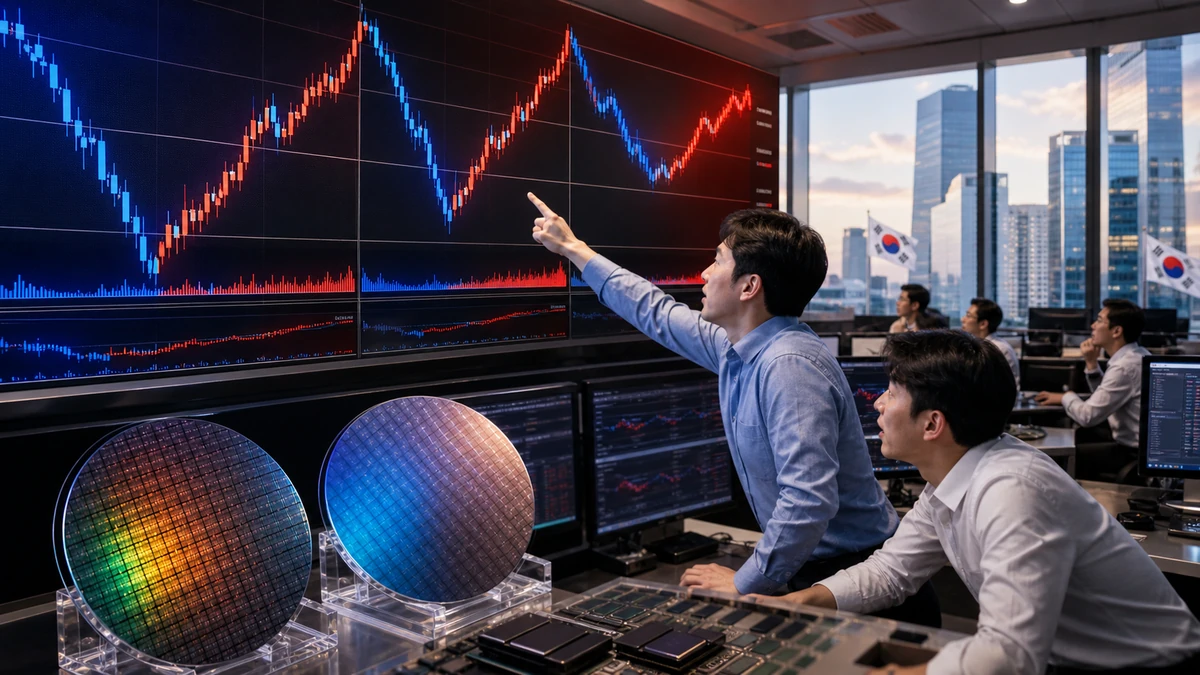
South Korea’s stock market staged the kind of intraday reversal that investors in New York, London and Tokyo watch closely, not because one afternoon in Seoul decides the fate of the global economy, but because it can reveal how confidence is shifting around one of the world’s most important technology supply chains. After opening sharply lower on July 25, South Korea’s benchmark KOSPI index clawed back its losses and turned positive in afternoon trading, rising 0.59% by 2:34 p.m. local time. The tech-heavy KOSDAQ index also reversed course and moved into the green.
The most telling part of the comeback was not simply that the headline indexes recovered. It was that Samsung Electronics and SK hynix, two companies that sit at the center of the global semiconductor business, also rebounded after falling 3% to 4% earlier in the session. By the afternoon, both had turned slightly higher. That kind of synchronized reversal matters because South Korea’s market is unusually concentrated around a handful of globally significant exporters, and few sectors matter more than chips.
For American readers, the easiest comparison is to imagine a bad morning on Wall Street in which the Nasdaq opens under pressure, Nvidia and Intel both drop hard at the bell, and then buyers step in, pushing the index and the sector leaders back into positive territory by midday. Even if the final closing numbers remain important, the more revealing story can be the shift in psychology: investors looked at the sell-off and decided the lower prices were worth buying.
That appears to be the central takeaway from the trading session in Seoul. According to the Korean reports, the market’s early weakness did not translate into a lasting collapse in sentiment. Instead, money returned not just to isolated stocks but to the broader market, including major semiconductor names and the growth-oriented KOSDAQ. In a market like South Korea’s, where semiconductor heavyweights often act as a barometer for the country’s industrial outlook, that reversal is about more than one day’s volatility. It suggests that investors are still willing to bet on Korea’s role in the global technology economy, even after a rough start to the session.
That does not mean the day erased all uncertainty. The figures reported were intraday, not final closing results, and market swings can reverse again before the bell. But the path of the trading day still matters. It showed that early fear did not dominate for long and that investors were prepared to step back into Korean equities once prices fell. In a year when global markets have repeatedly swung on expectations about artificial intelligence, chip demand, consumer electronics and interest rates, that kind of resilience is worth watching.
Why Samsung Electronics and SK hynix loom so large
To understand why this market move drew attention, it helps to understand the outsized role of Samsung Electronics and SK hynix in both South Korea and the wider global economy. In the United States, corporate giants like Apple, Microsoft and Nvidia can shape entire indexes. In South Korea, Samsung in particular plays a similarly oversized role in the national market and the country’s industrial identity. SK hynix, while smaller, is also a major force in memory chips, an area where South Korea remains one of the world’s dominant players.
Semiconductors are not just another export for South Korea. They are one of the country’s defining industries, much the way aerospace matters to Washington state or energy matters to Texas. Korea’s biggest chipmakers supply memory products that sit inside data centers, smartphones, laptops, cars and servers that power cloud computing and AI workloads. Their performance influences how investors think about everything from global consumer demand to the pace of AI infrastructure spending.
That is why the rebound in Samsung and SK hynix carried symbolic weight. Both stocks reportedly fell 3% to 4% early in the day, creating significant downward pressure on the KOSPI. When both later turned positive, the index followed. That sequence underscored a structural truth about the Korean market: when global investors or domestic buyers reassess the value of Korea’s chip giants, the whole market often moves with them.
There is also a deeper message here about how markets interpret short-term selling pressure. A steep early decline in these names could have signaled a broader loss of faith in Korea’s semiconductor sector. But the recovery suggests investors did not view the morning sell-off as a definitive verdict on those companies’ prospects. Instead, buyers appeared willing to treat the drop as an opportunity. In market terms, that is a sign that conviction in the sector has weakened less than the opening decline might have implied.
For international observers, Samsung and SK hynix serve as especially useful indicators because they are global companies with global customer exposure. When investors buy or sell them, they are often expressing a view not only on Korea, but also on memory-chip pricing, AI server demand, consumer electronics recovery, and the broader health of the technology cycle. In that sense, the turnaround in Seoul was not just a local story. It was another reminder that Korean stocks can act as an early readout on sentiment toward the technology backbone of the modern economy.
What wealthy Korean investors are signaling about the market’s direction
The intraday rebound also fits into a broader trend described in the Korean coverage: affluent investors in South Korea have been increasing their exposure to semiconductor stocks this year. Data released by Kiwoom Securities, based on clients with deposited assets of 1 billion won or more and 3 billion won or more, showed that SK hynix gained ground in the portfolios of wealthy investors. Among investors with at least 1 billion won in assets, Samsung Electronics remained the top holding, while SK hynix rose to second place, overtaking Naver compared with a year earlier.
For readers outside Korea, those figures matter because they suggest this is not merely a story of fleeting day traders chasing momentum. Wealthier investors often are not infallible, but their portfolios can indicate where longer-term conviction is building. In this case, the ranking of holdings suggests Korea’s richest market participants are leaning more heavily into the country’s semiconductor champions, even as market volatility continues.
That shift becomes more notable when set against the broader composition of those top holdings. Alongside Samsung and SK hynix, Hyundai Motor also appeared among the leading stocks, reflecting continued confidence in globally competitive Korean manufacturers. The pattern suggests that investors with substantial assets are concentrating on companies they see as national champions with real international pricing power, strong export profiles or strategic importance in future-facing industries.
This is an important distinction. A market can rally because money floods into speculative names on hype alone. But the picture described in the Korean reports is more grounded: the biggest beneficiaries of wealthy investors’ interest are established firms that sit at the core of global supply chains. That does not make them risk-free. It does, however, imply that at least one segment of the Korean investor class is making a deliberate bet on industrial competitiveness, not just short-term market excitement.
For Americans, there is a familiar parallel. In the United States, large institutional investors and high-net-worth individuals have increasingly crowded into a relatively small group of technology and industrial winners, particularly companies tied to AI, cloud computing, advanced manufacturing and electrification. Korea appears to be showing a version of the same phenomenon. Investors are not spreading their confidence evenly across the market. They are making selective bets on the companies they believe are best positioned to benefit from global economic and technological shifts.
That concentration can be a source of strength or vulnerability. On the one hand, when conviction holds, it can help stabilize the market during turbulent trading sessions, as seemed to happen on July 25. On the other hand, a market heavily dependent on a few flagship names can become more sensitive to any change in outlook for those companies. That is one reason the rebound in Samsung and SK hynix mattered so much: it helped demonstrate that the investor base supporting Korean semiconductor leaders remains intact, at least for now.
What this means for the United States
For the United States, a rebound in South Korea’s semiconductor-heavy market is not a distant regional curiosity. It is directly connected to American business interests, supply-chain planning, consumer technology prices and the increasingly strategic nature of the U.S.-South Korea relationship. Samsung and SK hynix are not simply Korean success stories. They are key players in an industry that American policymakers now treat as central to economic security and national security.
Both companies are deeply intertwined with the U.S. market. American tech firms rely on advanced memory chips for everything from AI servers to smartphones. U.S. consumers buy products that depend on components made by Korean manufacturers. U.S. industrial policy, especially since the passage of the CHIPS and Science Act, has also sought to attract more semiconductor investment onto American soil, including from allies such as South Korea. Samsung has major semiconductor investments in Texas, and SK hynix has advanced ambitions in the U.S. chip ecosystem as Washington works to reduce strategic vulnerabilities in supply chains.
That means sentiment around Korean chip companies can ripple into U.S. boardrooms and policy debates. If investors remain confident in Samsung and SK hynix, it reinforces the idea that Korea will continue to be a cornerstone of the allied semiconductor network that Washington wants to strengthen. If sentiment were to deteriorate sharply and persistently, that could raise broader questions about memory-chip demand, capital spending and the durability of the AI-related boom that has powered much of the global tech trade.
There is also a market angle Americans can readily understand. U.S. investors have become accustomed to tracking Taiwan Semiconductor Manufacturing Co., Nvidia and ASML as key names in the global chip story. Samsung and SK hynix belong in that conversation. Their stock moves can provide clues about a part of the semiconductor ecosystem that does not always command as much attention in U.S. mainstream coverage as logic chips or AI accelerators, but is still essential: memory. As AI systems become more data-hungry, the role of advanced memory becomes harder to ignore, which in turn increases the importance of Korea’s leading chipmakers to American investors and companies.
The cultural and commercial ties also matter. Korean brands have become increasingly familiar to American audiences not only through K-pop and Korean dramas, but through phones, TVs, appliances, batteries, cars and semiconductors embedded in everyday devices. South Korea’s rise in popular culture has made the country more visible in the United States, but the deeper economic relationship may prove even more consequential. A trading day like this highlights that Korea’s global influence extends far beyond entertainment. It is embedded in the hardware and manufacturing systems that underlie modern life in the U.S.
In that sense, the rebound in Seoul offered a modest but useful signal to Americans: even after a sharp drop at the opening bell, investors were not ready to abandon the Korean companies at the heart of a critical allied industry. For U.S. businesses, consumers and policymakers, that resilience is not abstract. It is part of the broader question of whether the semiconductor partnership between Washington and Seoul can remain steady in a volatile global economy.
More than a trading bounce, this is a story about resilience and concentration
The temptation in market coverage is always to focus on the number: up or down, green or red, gain or loss. But the more interesting story in South Korea’s session is the mechanism of the rebound. The KOSPI and KOSDAQ both opened weak and then recovered. Samsung and SK hynix did the same. That pattern suggests the market’s internal support came from more than a narrow technical fluke in a single stock. Buying interest appeared broad enough to change the direction of both major indexes.
That matters because financial markets are often tests of confidence under stress. A calm market tells you little. A market that opens in fear and then steadies itself can tell you much more. Here, investors seemed to absorb early selling and decide that Korean equities, particularly core semiconductor names, were worth owning at lower prices. This is what market resilience looks like in practice: not the absence of volatility, but the ability to withstand it.
Still, resilience should not be confused with invulnerability. South Korea’s market remains highly exposed to swings in global trade, technology demand and investor sentiment toward a relatively small number of giant exporters. When a country’s benchmark index leans heavily on companies like Samsung and SK hynix, concentration becomes both an advantage and a risk. Strong performance from those firms can lift the whole market. But any sustained downturn in chips can do the opposite.
That concentration is not unique to Korea. The U.S. has its own version, with a handful of mega-cap technology stocks exerting enormous influence on major indexes. The difference is that Korea’s dependence on semiconductors as a national industrial pillar is even more explicit. That makes movements in Samsung and SK hynix not just stock stories but shorthand for larger judgments about the country’s economic position in the world.
Seen this way, the July 25 turnaround fits into a larger trend: markets are trying to determine whether the next phase of the global economy will continue to reward companies tied to AI infrastructure, advanced manufacturing and export competitiveness. Korea’s wealthy investors appear to be answering yes, at least through their portfolio choices. The market’s midday rebound suggests a broader pool of buyers may be leaning the same way, even if near-term volatility remains intense.
What to watch next in Korea and beyond
The first thing to watch is whether the intraday rebound holds up over time. Because the reported figures came before the close, the final result matters, and so do the trading sessions that follow. A one-day comeback can be meaningful, but repeated recoveries would offer stronger evidence that investors are consistently willing to defend Korean semiconductor stocks during periods of weakness.
The second question is whether support for Samsung and SK hynix continues to broaden or becomes more selective. If both companies keep attracting buyers during market stress, that would reinforce the view that investors see Korea’s memory-chip leaders as durable winners in the next phase of tech demand. If, however, one begins to lag or if rallies narrow, it could indicate a more fragile market beneath the surface.
Third, investors in both Korea and the U.S. will be watching whether this confidence in semiconductors spills into related sectors. Korea’s market includes major exporters in autos, batteries, displays and internet services. The appearance of Hyundai Motor among the top holdings of wealthy investors suggests some of that broadening may already be underway. A durable market recovery would likely require more than semiconductors alone, even if chips remain the main engine.
For Americans, another crucial issue is how this fits into the longer arc of U.S.-Korea economic ties. Washington increasingly views allied manufacturing strength as part of its strategic toolbox, especially in technology sectors where overdependence on any one geography is seen as a risk. South Korea’s market resilience, especially in chip leaders, can therefore be read not only as a financial signal but as evidence of the continued importance of a key U.S. partner in the global industrial order.
Finally, there is the broader lesson that a lot of investors have learned in the AI era: chip markets are now central to the way the world prices growth, power and technological leadership. That is true in Silicon Valley, in Washington, and in Seoul. When Korean semiconductor stocks plunge and then recover in the span of a single trading day, the move may look local on the surface. In reality, it is part of a much bigger conversation about who will supply the infrastructure of the digital economy, which countries will dominate it, and how much faith investors still have in the companies carrying that burden.
On July 25, the answer from Seoul, at least by midafternoon, was that faith had not broken. It had been tested, and then, just as quickly, put back to work.
Comments
Post a Comment