
Image to help understand the article
Korea moves from backdrop to main character
For years, South Korea has been one of the world’s most influential cultural exporters, sending K-pop, TV dramas, films and beauty brands deep into the American mainstream. Now one of the biggest U.S.-owned entertainment franchises appears to be making a similar shift in games: not just borrowing Korean imagery, but placing Korea at the center of the action.
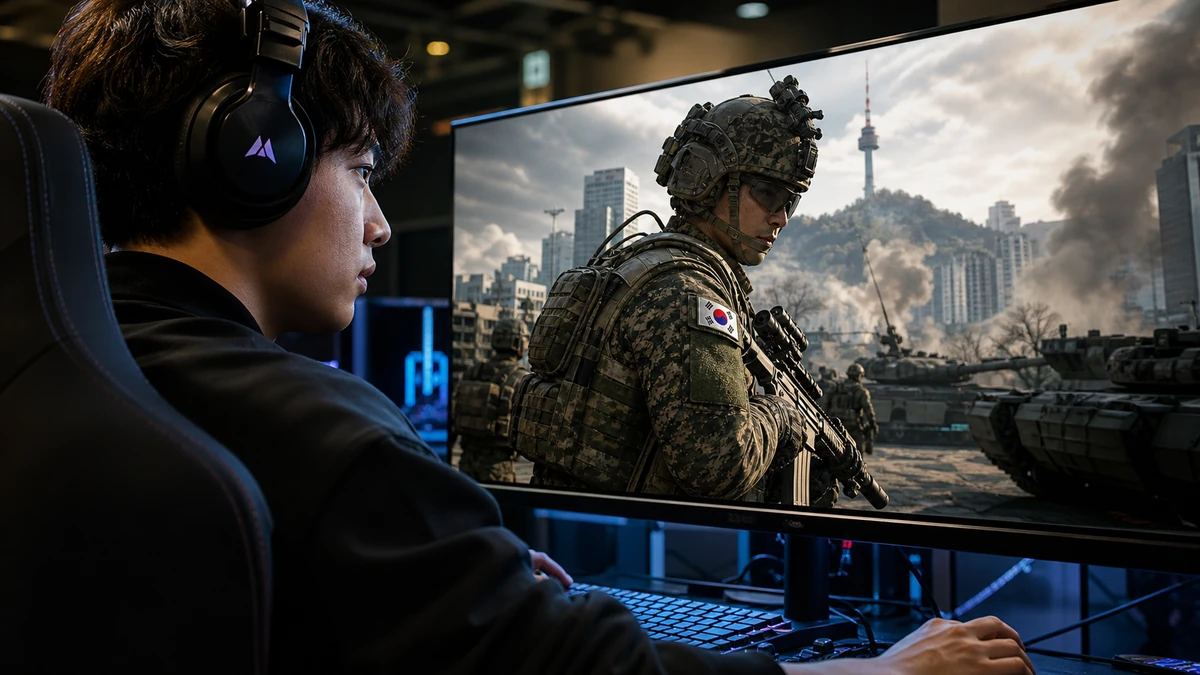
Activision, the Microsoft-owned publisher behind the blockbuster “Call of Duty” series, began a beta test on Sept. 22 for pre-order customers of “Call of Duty: Modern Warfare 4,” according to the Korean news summary provided. What immediately drew attention in South Korea was not simply that the game includes Korean scenery. It was that the beta reportedly presented central Seoul in striking detail, showcased South Korean military equipment and, more notably, offered part of a single-player campaign starring a South Korean Marine.
That distinction matters. In global entertainment, there is a major difference between using a country as visual seasoning and treating it as a narrative point of view. Seoul has appeared in Hollywood movies, streaming thrillers and games before, often as a neon-lit shorthand for “future Asia” or as a high-tech urban battleground. But when a Korean character becomes the player’s entry point into a major military franchise, Korea is no longer just the place where events happen. It becomes part of who the story belongs to.
That is why this beta matters beyond gaming forums. “Call of Duty” is not a niche title. It is one of the most commercially powerful entertainment properties created in the United States, with a history of shaping how millions of players imagine modern warfare, geopolitics and military identity. If this installment is indeed centering the Korean Peninsula and a Korean protagonist, then the franchise is doing more than changing maps. It is testing whether a global audience will accept a more locally grounded, less purely American point of view in one of America’s signature gaming brands.
For South Korean players, the appeal is obvious: the thrill of recognizing familiar urban landscapes, military hardware and cultural specifics in a game built for a worldwide audience. For players elsewhere, including in the United States, the appeal is different but just as significant. Korea is becoming legible as a fully realized setting rather than a distant headline or abstract security issue.
Why the Korean Peninsula is such a sensitive setting
The choice of the Korean Peninsula as a central backdrop is not politically neutral. Any fictional story built around armed conflict between North and South Korea touches one of the most heavily militarized and emotionally charged fault lines in the world. The Korean War never formally ended with a peace treaty, and the Demilitarized Zone remains one of the most fortified borders on Earth. For Americans, Korea can sometimes register mainly through periodic missile headlines, U.S. troop deployments or summit diplomacy. For Koreans, however, the division of the peninsula is not an abstract policy debate. It is a lived national reality, tied to family histories, military service, national identity and persistent security anxiety.
That is one reason the reported presentation in the beta is noteworthy. The Korean summary suggests the emphasis was less on sensationalizing conflict itself and more on rendering Seoul’s urban environment, South Korean military equipment and a Korean Marine protagonist with specificity. That does not eliminate the sensitivity. But it suggests a potentially meaningful difference in how a Western blockbuster is approaching Korea.
In older action entertainment, especially in the post-Cold War and post-9/11 eras, foreign settings were often reduced to danger zones built for spectacle. The local population might appear as victims, villains or background extras, while American or Western protagonists remained the central moral and narrative agents. A game can feature a country heavily and still flatten it. The question is not only whether the right street signs, uniforms and skylines are present. It is whose fear, duty, confusion and decision-making the audience is asked to inhabit.
That is why the reported inclusion of part of the single-player campaign in the beta matters more than a simple multiplayer reveal would have. Multiplayer maps can tell players what a place looks like; a campaign tells them whose eyes they are supposed to see through. If players are stepping into the boots of a South Korean Marine, even briefly, the game is making a claim about narrative ownership. It is saying that Korea is not only a strategic zone to be observed from afar, but a society with its own actors at the center of events.
Whether the final game handles that responsibility well is another question. A detailed skyline or accurate vehicle model can impress players quickly. Building a persuasive Korean protagonist, and portraying a divided peninsula without collapsing into caricature, is much harder. As with any entertainment product dealing in real geopolitical tension, authenticity is not just technical. It is cultural and narrative.
What this says about the next phase of Korean representation
The larger story here is not just about one beta test. It is about a broader evolution in how Korea is represented in global media. Over the past decade, American audiences have become more accustomed to consuming Korean culture on its own terms. “Parasite” won the Academy Award for best picture. “Squid Game” became a streaming phenomenon. BTS helped turn Korean-language pop into a fully mainstream U.S. commercial force. Korean food, from kimchi to Korean fried chicken, has moved from specialty interest to ordinary urban American dining culture.
Games, however, have often lagged behind film and television in that kind of cultural shift. Even in globally successful titles, non-Western settings can remain ornamental, functioning as atmospheric variety rather than as the source of character perspective or thematic depth. What appears to be happening with “Modern Warfare 4,” if the beta accurately reflects the final creative direction, is a sign that major publishers increasingly see local specificity as a global asset.
That may sound counterintuitive to an older entertainment logic, which assumed that the broadest audience required the most generic setting. But the streaming era and the platform era have repeatedly shown the opposite. Viewers and players do not necessarily want every story to take place in a culturally neutral nowhere. They often respond more strongly when a world feels concrete, rooted and unmistakably itself. The popularity of location-rich games and TV series, whether set in feudal Japan, small-town America or dystopian Seoul, has reinforced that lesson.
The Korean summary’s emphasis on “verification,” or careful research and recreation, points to this same trend. For local audiences, accurate details are a sign of respect and seriousness. For global audiences, they are part of what makes a fictional world memorable. A realistic Seoul is not only fan service for Korean players. It is brand differentiation in a crowded global market.
There is also a business logic behind that approach. South Korea is not just a source of cultural cachet. It is one of the world’s most sophisticated gaming markets, with deeply engaged players and a long history of online and competitive gaming. A major Western franchise has strong incentives to win over Korean consumers not only as customers, but as tastemakers whose reactions can influence global discourse around authenticity and quality.
In that sense, this beta looks less like a one-off novelty and more like a test case for how global entertainment companies localize prestige. Not through superficial references, but through the kind of detail that invites scrutiny.
What it means in the United States
For American audiences and the U.S. games business, the Seoul-centered beta carries at least three important implications.
First, it reflects how deeply Korea has entered the American cultural imagination. Ten or 15 years ago, a Korea-focused storyline in a major U.S. blockbuster game might have been treated primarily as a military or diplomatic angle. Today, it also lands in a cultural context shaped by Korean popular entertainment’s success in the United States. American players are more likely than before to arrive with preexisting associations: Seoul as a vibrant global city, Korean creators as major pop-cultural forces and South Korea as more than a security flashpoint. That broader familiarity changes the audience baseline for a game like this.
Second, it puts pressure on U.S. publishers to raise their standards for representation. American companies have long profited from global settings, but audiences are increasingly quick to notice when a foreign culture is used as set dressing without care. In the film industry, conversations about authenticity, casting and perspective have become routine. Games are under similar pressure now, especially when the subject is a close U.S. ally with a highly networked and vocal fan base. If Activision is foregrounding Korean military identity and Seoul’s cityscape, American players will not be the only ones judging whether it feels credible. Korean players, diaspora audiences and bilingual fans will be evaluating every detail in real time online.
Third, the project highlights the business importance of Asia to U.S. entertainment giants. Microsoft’s ownership of Activision means one of America’s biggest technology companies now has a direct stake in how one of gaming’s largest franchises performs across Asian markets. That does not mean every creative decision is dictated by international sales, nor should it be. But it does underscore a reality of the modern entertainment economy: culturally specific storytelling can be central to global growth, not a sideline to it.
There is also a more subtle American angle here. U.S. audiences are used to seeing the American military perspective dominate big-budget war fiction. A “Call of Duty” campaign led, even in part, by a South Korean Marine complicates that pattern. It does not erase American framing from a franchise built in the United States, but it does open room for a more allied, multipolar storytelling model. In an era when Washington talks constantly about alliances in the Indo-Pacific, that kind of narrative shift is notable. Pop culture does not determine foreign policy, but it often reflects and reinforces the ways Americans understand their place in the world.
The line between realism and entertainment
None of this should obscure the central tension in the project: turning a real and unresolved military confrontation into mass-market entertainment. That tension is familiar in the United States as well. American movies and games have long dramatized recent wars, terror threats and domestic trauma, often prompting debates over whether realism becomes exploitation when commercial spectacle is involved.
South Korea’s situation carries its own weight. Mandatory military service remains a defining institution for many Korean men. Civil defense consciousness is higher than many Americans may realize. The threat posed by North Korea is not constant in day-to-day life in the way foreign coverage can sometimes imply, but it is embedded in institutions, politics and public memory. A game that uses inter-Korean conflict as its dramatic engine is inevitably drawing on that reality.
That is why the quality of depiction matters so much. A city like Seoul is not only a battlefield-ready visual asset. It is a dense, lived metropolis of roughly 10 million people in the city proper, and a wider metropolitan area that ranks among the world’s largest. To reduce it to an exotic combat arena would feel dated and shallow. To portray it with detail, while placing Korean actors within the story as decision-makers rather than scenery, suggests a more contemporary approach.
Still, accuracy in architecture or weapons design is only one layer of realism. The harder test will be tone. Does the game treat Korea as a place of people and institutions, or merely as a credible war sandbox? Does the Korean protagonist read as a person shaped by local context, or as a generic action hero wearing national markers? Those questions will likely define the conversation once more of the campaign is seen.
For American readers, there is a recognizable parallel in how U.S. audiences respond when foreign creators use New York, Los Angeles or Washington as shorthand symbols without understanding the life inside them. Spectacle can impress, but point of view is what determines whether representation feels hollow or alive.
What to watch before release
The beta has created interest because it offers only part of the answer. The most consequential judgments will depend on what the full campaign actually does with the peninsula, the South Korean military and its Korean protagonist.
One thing to watch is whether the final game maintains the same balance implied in the beta: detailed local setting, recognizable military specificity and a Korean point of view that is more than token inclusion. If those elements hold together, the game could become a benchmark for how Western blockbusters incorporate Korean settings without relegating them to decoration.
Another is how Korean and international audiences diverge in their reactions. American players may focus on novelty, gameplay and production value. Korean players may pay closer attention to whether Seoul’s geography feels right, whether military equipment is credibly represented and whether the story’s framing respects the peninsula’s political sensitivities. Those responses will not necessarily align, and the gap between them may reveal a lot about how global publishers still balance local authenticity with worldwide accessibility.
A third issue is whether the game’s portrayal influences future titles. If a major franchise finds success by leaning into Korean detail and Korean narrative centrality, other publishers will notice. That could mean more games set in Seoul, Busan or other Korean locales, and more titles willing to let Korean characters drive the story rather than orbit around Western protagonists. In the best case, that would broaden the range of how Korea appears in international gaming. In the worst case, it could trigger imitation without depth, producing a wave of superficially Korean-branded content.
And finally, there is the question of how this fits into the broader U.S.-Korea relationship in popular culture. The alliance between Washington and Seoul is usually discussed through defense, trade, semiconductors and diplomacy. But culture increasingly shapes how those ties are felt by ordinary people. When an American-owned game places Seoul and a South Korean Marine at the center of one of the world’s biggest shooter franchises, it is participating in that relationship too. Not through treaties or troop numbers, but through imagination.
That may be the most important takeaway. Korea is no longer just a place the American entertainment industry references when it needs an overseas flashpoint. It is becoming a place audiences expect to see rendered with detail, agency and consequence. If “Modern Warfare 4” follows through on what its beta appears to promise, it will say as much about where global culture is heading as it does about where a virtual war happens to begin.


0 Comments