Why South Korea’s Export Bank Is Courting Bill Gates’ TerraPower — and Why the U.S. Nuclear Industry Is Paying Attention
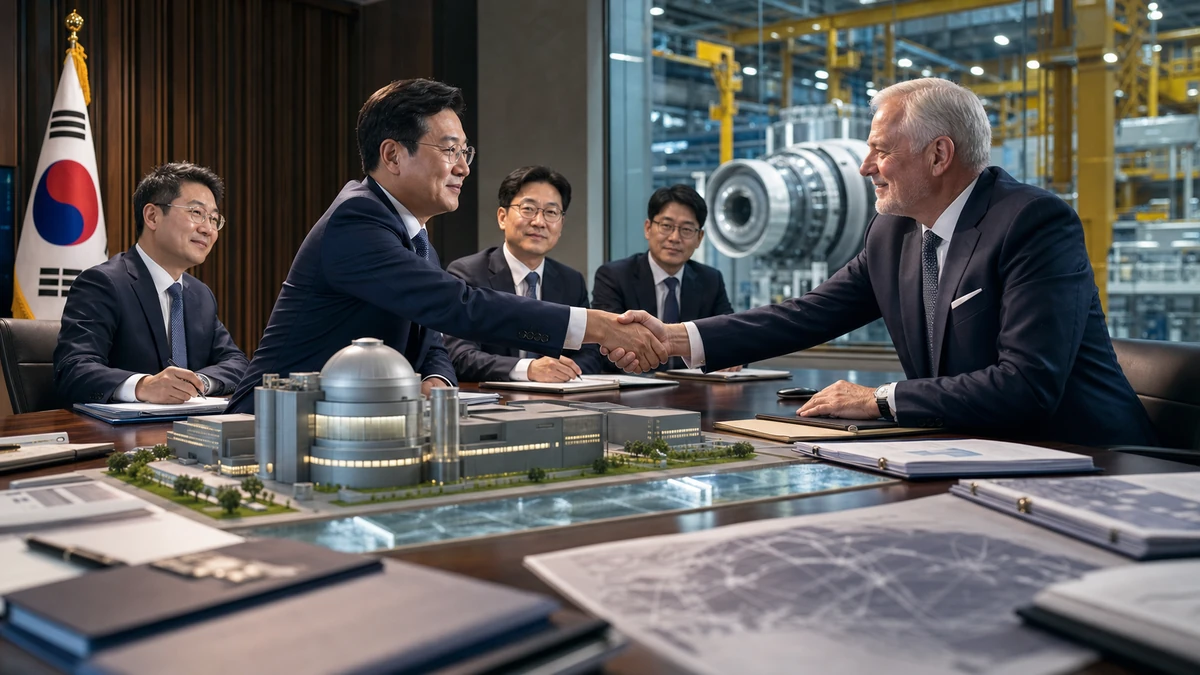
Image to help understand the article
A financing meeting with implications far beyond one reactor company
A meeting in South Korea between the head of the state-run Export-Import Bank of Korea and Bill Gates, the chairman of TerraPower, might sound at first like a narrow conversation about project finance. In reality, it points to a much bigger shift in the global nuclear business — one that matters not only for South Korea, but also for the United States, where policymakers, utilities and clean-energy investors are searching for ways to bring the next generation of reactors to market.
According to the Korean account, Korea Eximbank and TerraPower discussed ways to cooperate financially on the commercialization of small modular reactors, often shortened to SMRs, and on expansion into global markets. The central idea is straightforward but significant: combine Korean companies’ manufacturing and construction strengths in nuclear energy with export financing tools such as loans and guarantees, so that future projects are easier to build, fund and sell abroad.
That may sound technical, but in the nuclear industry, financing is often the difference between a promising design and a real power plant. Advanced nuclear projects do not move forward on engineering alone. They require factory capacity, specialized parts, experienced builders, long planning timelines, regulatory patience and large pools of capital willing to wait years for returns. In that sense, the Korean side’s interest in designing tailored financial packages is not a side issue. It is part of the product.
The discussion also underscores something that American audiences sometimes miss when following the clean-energy race. New energy technologies are rarely commercialized by inventors alone. They are brought to market by coalitions: technology firms, manufacturers, construction companies, government lenders, export-credit agencies and diplomatic partners. What South Korea appears to be offering TerraPower is not just a supplier relationship, but a system-level partnership — one that links industrial capability to public finance in support of projects in the U.S. and potentially in third-country markets.
That makes this more than a one-day corporate meeting. It is a sign of how advanced nuclear power may actually spread in the 2020s and 2030s: not through isolated breakthroughs, but through cross-border industrial alliances that reduce risk and make difficult projects bankable.
Why small modular reactors attract so much attention
For American readers, SMRs are often presented as the next big thing in nuclear energy: smaller, potentially faster to build and better suited to a grid that increasingly relies on intermittent renewable power such as wind and solar. The promise is that these reactors can provide around-the-clock electricity without the carbon emissions associated with coal or natural gas, while avoiding some of the massive cost overruns and construction delays that have plagued traditional large nuclear plants.
That promise remains just that — a promise, not a settled reality. Many advanced reactor designs have generated excitement, but fewer have made it to commercial deployment. The industry has spent years trying to prove that smaller reactor designs can be manufactured more efficiently, assembled more predictably and financed more realistically than the giant nuclear plants of the past. Skeptics note that “smaller” does not automatically mean “cheaper,” especially when first-of-a-kind projects still require regulatory review, specialized labor and custom engineering.
TerraPower is one of the most closely watched companies in this space, in part because of Gates’ role and in part because it represents a broader U.S. ambition: to remain a technological leader in advanced nuclear energy while China, Russia and other countries compete aggressively in reactor exports and supply chains. In Washington, advanced nuclear has drawn support from people across the political spectrum for different reasons. Climate hawks see it as a source of low-carbon baseload electricity. Energy security advocates see it as a way to reduce dependence on geopolitical rivals. Industrial policy supporters see it as an area where the U.S. can still shape standards, supply chains and export markets.
But the economic challenge is formidable. Building even a small reactor involves a long list of expensive steps before a project produces a single watt of electricity. That is why export-credit support and state-backed financing matter so much. Just as the aviation and shipbuilding industries have long relied on national export-finance ecosystems, advanced nuclear increasingly appears headed in the same direction. The country that can package technology, manufacturing and financing together may have a real advantage over the country that can offer only the design on paper.
The Korean report captures that logic well. It suggests that TerraPower’s interest is not limited to Korean components in a narrow sense. Instead, what appears valuable is the broader Korean nuclear supply chain — especially the ability to manufacture and construct at scale — combined with financing structures that could help a project get from concept to execution. In a sector defined by long timelines and high upfront risk, that combination is difficult to ignore.
What South Korea brings to the table
South Korea has spent decades building a reputation as one of the world’s most capable nuclear construction and manufacturing countries. In Korea, the term “K-nuclear” or “K-원전” refers not to a single company, but to the country’s broader nuclear power ecosystem — reactor makers, engineering firms, construction specialists, heavy-industry manufacturers and supporting institutions. The phrase is somewhat analogous to how “K-pop” became shorthand for a Korean entertainment ecosystem rather than a lone act, though in this case the subject is industrial policy, not pop culture.
That ecosystem matters because nuclear power is ultimately a supply-chain business. Reactors require highly specialized steel forgings, turbines, valves, pumps, instrumentation, safety systems and on-site construction expertise. Countries that can coordinate those pieces efficiently hold an advantage, especially when projects must meet strict safety standards and endure intense scrutiny from regulators and financiers. The Korean summary emphasizes that TerraPower specifically highlighted Korean strengths in manufacturing and construction, which suggests the appeal lies in execution capacity as much as in technical cooperation.
That distinction is important. Many countries can claim engineering talent. Far fewer can point to recent experience delivering large industrial projects under demanding conditions. In energy, there is a big difference between inventing a technology and proving that hundreds of suppliers, contractors and financiers can align around it. South Korea’s value proposition appears to be that it can help close that gap.
Korea Eximbank’s role adds another layer. Export-import banks are not ordinary commercial lenders. They are policy finance institutions designed to support national economic goals, often by helping domestic companies win overseas business. In the American context, the closest comparison would be the U.S. Export-Import Bank, which supports exports by offering loans, guarantees and insurance when private financing is insufficient or unavailable. These institutions are often controversial in political debates, but in sectors like infrastructure, aerospace and energy, they can be pivotal because they help absorb risks that private capital alone may not want to take.
In the Korean case, the reported discussion of a “tailored financial package” that combines loans and guarantees is especially notable. That language suggests a willingness to structure support around the practical needs of specific nuclear projects rather than offering generic financial backing. For Korean companies, that could mean a stronger position when bidding on overseas work. For TerraPower, it could mean access to a partner ecosystem that brings not just parts and builders, but financing credibility as well.
None of that means deals are done or projects are guaranteed. The Korean summary is careful on that point, and it should be. There is no indication here that a specific contract has been finalized. But the direction of travel is clear: South Korea is seeking to move up the value chain from supplier to strategic enabler, helping shape whether and how SMR projects get built around the world.
What this means for the United States
For the United States, the implications are substantial. American advanced nuclear firms have world-class ideas and political support, but they still face the same obstacle that has frustrated clean-energy innovators for years: commercialization is expensive, slow and vulnerable to supply-chain bottlenecks. If South Korea can provide the manufacturing depth and financing support that U.S. companies need, that could accelerate American reactor deployment in ways domestic policy alone has struggled to achieve.
This is also where the alliance dimension comes into focus. Washington and Seoul already cooperate closely on defense, semiconductors, batteries and broader supply-chain resilience. Nuclear energy is increasingly part of that conversation. In recent years, the U.S. and South Korea have had to balance cooperation with competition in overseas reactor markets. At times, companies from the two countries have pursued overlapping opportunities. At other moments, they have recognized that collaboration may be more effective than rivalry, especially when competing against state-backed players from countries with aggressive export strategies.
From an American perspective, a TerraPower-Korea Eximbank alignment suggests a model in which U.S. innovation is reinforced by allied industrial capacity. That is a familiar pattern in other sectors. Apple, for example, may define products in California, but global manufacturing networks determine whether those products can be scaled. Boeing and Airbus do not succeed on engineering alone; they depend on intricate financing and supplier structures. Advanced nuclear may be moving toward the same logic. If that happens, the U.S. will need not just breakthrough designs, but durable industrial partnerships.
There is also a more immediate lesson for U.S. policymakers. Washington has spent the past several years rediscovering industrial policy, whether through semiconductor subsidies, clean-energy incentives or infrastructure spending. But in nuclear energy, the hardest challenge may be creating the connective tissue between innovation, manufacturing, project finance and export strategy. South Korea’s reported approach — treating finance as part of competitiveness rather than as an afterthought — offers a contrast to the more fragmented way the U.S. often supports commercialization.
For American utilities and energy-intensive industries, the question is practical: who can actually deliver reliable carbon-free power at a predictable cost? If U.S. reactor developers increasingly rely on Korean partners for fabrication, construction know-how or financial structuring, then South Korea could become an even more important player in America’s clean-energy buildout. That would deepen bilateral ties, but it could also spark debate at home about domestic manufacturing, local jobs and how much of the nuclear supply chain the U.S. should control itself.
American investors and fans of advanced nuclear should watch this closely for another reason. The story here is not just about one Korean bank or one famous billionaire. It is about whether allied countries can form a credible counterweight in a global market where scale, state backing and long-term coordination often decide winners. If they can, the U.S. may benefit enormously. If they cannot, advanced nuclear could remain stuck in the familiar gap between ambition and deployment.
From one project to a global export model
One of the most revealing parts of the Korean summary is the emphasis on “third-country” expansion. In diplomatic and business language, that means markets beyond the two parties directly involved — not just South Korea or the United States, but other countries that may buy nuclear technology, contract for construction or seek financing for new power infrastructure. That matters because the global competition around SMRs is not just about who builds first at home. It is also about who becomes the preferred partner for emerging markets and middle-income economies trying to add stable, low-carbon electricity.
Exporting nuclear technology is unlike exporting consumer electronics or automobiles. Projects are politically sensitive, heavily regulated and financially complex. Buyers want proof that a reactor design can be built safely, on time and with a stable supply chain for decades. They also want confidence that financing will be available and that the vendor country will remain politically committed over the life of the project. In that environment, an alliance between a U.S. technology company and Korean industrial and financial institutions could be attractive because it distributes risk across multiple credible actors.
The Korean article rightly frames this as a broader industrial signal rather than a final commercial result. The real takeaway is that the unit of competition may be changing. Instead of individual firms competing solely on reactor design, integrated national ecosystems may compete on a bundle of capabilities: technology, parts, construction, financing and diplomatic support. That is how large-scale infrastructure often works, and nuclear may increasingly follow the same pattern.
This shift also helps explain why state-backed finance can be so influential. A company may have a sophisticated reactor concept, but if it cannot show governments and utilities how a project will be financed over many years, the concept may stall. Conversely, a strong financing package can make a technically complex project appear more feasible by reducing perceived risk. In that sense, loans and guarantees are not just accounting tools. They are instruments of industrial strategy.
For South Korean companies, that opens a path into the clean-energy economy that goes beyond being subcontractors. If their manufacturing and construction capabilities are paired with public financial support, they can present themselves as core partners in the commercialization of advanced reactors. For TerraPower, that could mean access to a deeper execution platform. For potential customers abroad, it could mean a more complete offering. And for rivals, it raises the competitive bar.
What to watch next in the U.S.-Korea nuclear relationship
The next phase will depend less on rhetoric than on structure. The key question is whether the financing concepts discussed between Korea Eximbank and TerraPower can be translated into concrete support for actual projects, with clear roles for Korean suppliers and builders. That would require the usual hard work of project development: procurement plans, risk-sharing arrangements, financing terms, schedules, regulatory coordination and market demand. Nuclear projects are rarely derailed by headlines; they are derailed by unresolved details.
Another issue to watch is whether this cooperation remains focused on a limited set of projects or evolves into a broader framework for U.S.-Korea advanced nuclear collaboration. If Korean public finance becomes a recurring feature of projects involving Korean nuclear companies and U.S. reactor developers, that could institutionalize a new model for bilateral industrial cooperation. Over time, it could affect where factories are built, which suppliers win contracts and how allied countries divide labor in the advanced nuclear economy.
There is also the question of credibility with global customers. The more often U.S. and Korean partners can show a working model — technology matched with proven manufacturing and reliable financing — the stronger their export case becomes. That does not guarantee dominance. Competitors will continue to court governments with their own financing packages, and each market has its own political and regulatory constraints. But demonstrating an alliance-based delivery model would still be a meaningful advantage.
For American readers, perhaps the clearest takeaway is that the future of advanced nuclear will not be determined in laboratories alone. It will be shaped in meetings like this one, where bankers, industrial partners and technology companies decide whether bold ideas can survive contact with the real world of supply chains and capital markets. The Korean summary captures that point well. It portrays South Korea not simply as a place with capable manufacturers, but as a country trying to fuse industrial strength and public finance into an export strategy.
That is why this development deserves attention in the U.S. It suggests that one path to making advanced nuclear real may run through deeper cooperation with allies that can help solve the unglamorous but essential problems of fabrication, construction and finance. For a country that wants clean, reliable power and wants to compete in the industries of the future, those are not secondary concerns. They are the main event.
If this effort succeeds, it could become a case study in how the energy transition actually happens: not through a lone technological miracle, but through a coalition capable of building, funding and exporting at scale. And if it fails, that too will teach a lesson — that even the most promising climate technologies need more than vision and star power. They need institutions that know how to turn possibility into infrastructure.
Comments
Post a Comment