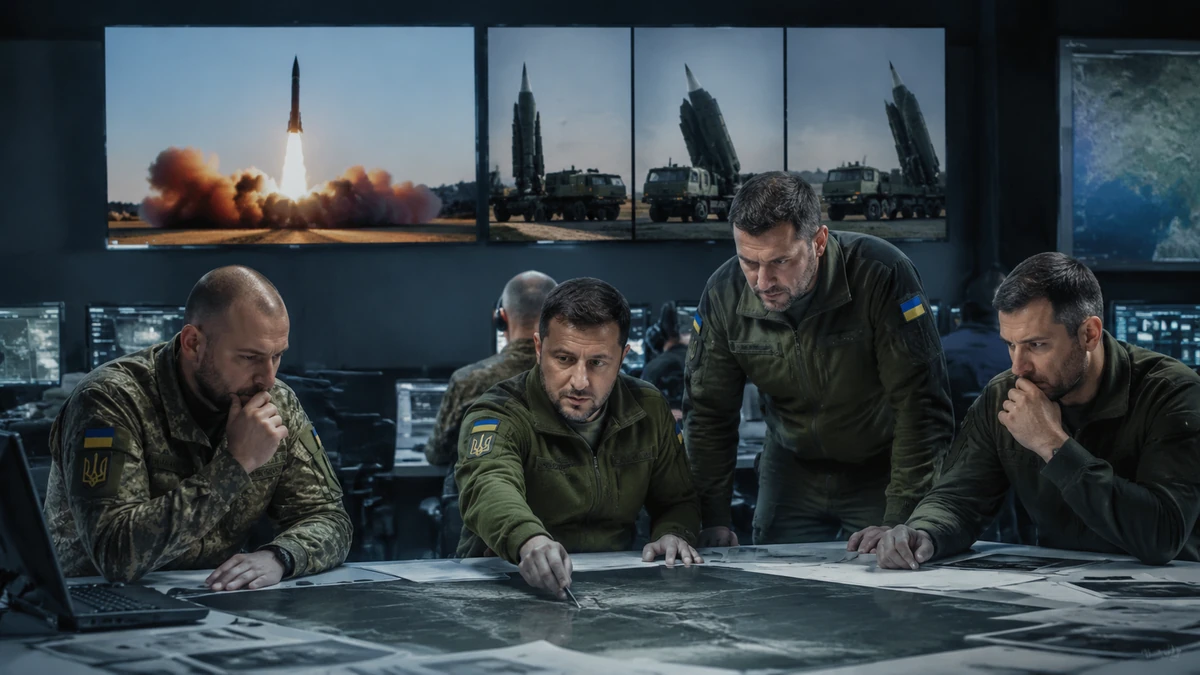
Image to help understand the article
A new estimate points to a deeper North Korea-Russia military pipeline
Ukraine’s military intelligence agency has offered a striking new snapshot of the war’s next phase: Russia, it says, still has about 50 North Korean ballistic missiles in its inventory, including KN-23 variants as well as systems identified as KN-24 and KN-30. In a separate estimate, Ukrainian officials also said Russia retains about 50 Kinzhal air-launched ballistic missiles. Taken together, the figures suggest Moscow may still have a meaningful reserve of hard-to-intercept strike weapons even after more than two years of war.
That matters not simply because of the raw number. In modern warfare, a missile inventory is not just a pile of hardware. It is a measure of strategic endurance, industrial resilience and outside support. The broader significance of Ukraine’s assessment is that it points to a Russia that is not relying on a single missile family or a single source of supply. Instead, it appears to be managing a mixed arsenal that includes both domestically fielded systems and foreign-supplied ballistic missiles from North Korea.
There are important caveats. These are wartime intelligence estimates, not audited stockpile records. Ukrainian officials are piecing together a picture under combat conditions, where production, transport, storage losses, maintenance problems and launch rates are difficult for outsiders to verify in real time. Even so, the estimate is important because it goes beyond a vague warning about Russian capabilities and attempts to categorize what remains by missile type. That alone gives analysts a clearer, if still incomplete, way to think about the war’s trajectory.
For American readers, the story can sound distant at first — another battlefield update from Eastern Europe, another set of missile names in a war already crowded with acronyms. But the bigger issue is familiar: a U.S. adversary is learning to sustain a long war with help from another heavily sanctioned state. Washington has spent years trying to isolate both Russia and North Korea. If the two are now helping each other preserve military options under wartime pressure, that has implications not just for Ukraine but for the broader U.S.-led security order.
It also underscores an uncomfortable truth about the war in Ukraine. Long after initial assumptions that sanctions, losses and attrition would steadily narrow Russia’s options, the conflict has evolved into a contest of replenishment. What matters is not only what Russia had at the start, but what it can still source, store and launch now.
What the numbers do — and do not — tell us
The estimate carries one especially notable detail: the explicit appearance of KN-30 in the reported Russian inventory. Ukrainian and regional military reporting has described KN-30 as an enlarged variant of the KN-23, also referred to in some reporting as a Hwasong-series system. The public information cited in the Korean summary does not provide reliable details on range, payload or accuracy, nor does it break down how many of the roughly 50 remaining North Korean missiles belong to each subtype.
That means caution is essential. It would be premature to present KN-30 as a fully understood game-changer or to assign it a precise battlefield role without firmer public evidence. But there is still significance in the fact that Ukrainian intelligence identified it at all. The implication is not necessarily that Russia suddenly possesses a radically superior missile. Rather, it suggests that the transfer relationship may include not only previously discussed North Korean models but also modified or expanded variants. In arms-tracking terms, that widens the picture.
The math surrounding the reported stockpile is revealing, even if it remains imperfect. Ukrainian officials have previously assessed that North Korea supplied Russia with about 150 missiles from late 2023 through August of last year. If Russia now holds about 50 North Korean ballistic missiles, that leaves a gap of roughly 100 compared with the earlier supply estimate. But it would be misleading to treat that gap as a simple count of missiles already fired at Ukraine. Some may have been used in testing or training. Some could have been damaged, degraded in storage or rendered unavailable through maintenance issues. Additional transfers after the period cited by Ukraine may also have occurred, though the summary provides no evidence one way or the other.
Still, one conclusion is hard to avoid: these weapons were not a one-off shipment dropped into a warehouse and forgotten. The estimate suggests a continuing operational cycle linking supply, storage and battlefield use. For military planners, that continuity matters more than any single headline number. A stockpile of 50 can mean very different things depending on how fast it is being consumed, how often it is replenished and how commanders choose to reserve it — for short, intense barrages or for a slower campaign of sustained pressure.
That uncertainty is itself part of the story. In conflicts like this, the most consequential question is often not, “How many missiles exist?” but, “What tempo of attacks can they support?” Ukraine’s estimate does not answer that. But it does indicate that Russia’s ballistic missile toolkit remains varied enough to complicate defense planning.
Why a mixed missile inventory changes the military equation
One of the most telling aspects of the Ukrainian assessment is that it separates two categories: about 50 Kinzhal missiles and about 50 North Korean missiles in the KN family. The numbers are similar, but the strategic meaning is not identical. The point is not merely that Russia has around 100 ballistic missiles of different types. It is that Ukrainian officials believe Russia retains parallel strike options drawn from different design lineages and, crucially, different supply channels.
For the side under attack, that matters because missile defense is never just about totals. It is about anticipating profiles, launch methods, trajectories, timing and likely targets. A force confronting multiple missile families must account for different operational patterns and different contingencies. That complicates detection, interception and resource allocation. It can also create uncertainty about what Russia is trying to conserve and what it is willing to spend.
In plain American terms, think of it less as a football team having one reliable quarterback and more as a team with several different offensive packages it can rotate depending on the defense. Even if the total number of plays is limited, the variety can force the opponent to prepare for several scenarios at once. That makes the defensive job harder.
The Kinzhal, because of its profile and the attention it has received in Russian messaging, tends to attract headlines. But the North Korean missiles may be just as important strategically because they speak to Russia’s ability to keep diversifying under pressure. Moscow does not need every imported missile to outperform its domestic systems. It only needs those missiles to preserve strike capacity, impose costs on Ukrainian air defenses and extend the war’s logic of attrition.
That is why the reported presence of KN-24 and KN-30 alongside KN-23 is so significant even without a full technical dossier. The more diverse the imported inventory becomes, the more the war begins to look like a case study in how sanctioned states can help each other absorb pressure. That is not just a battlefield story. It is a sanctions-enforcement story, an alliance-management story and a proliferation story all at once.
North Korea is not just supplying shells. It may be gaining something more valuable.
North Korea’s role in the Ukraine war has often been discussed in terms of volume: artillery shells, rockets and the sheer scale of support it can provide to a Russia consuming enormous amounts of ammunition. The missile estimate suggests a more consequential dimension. If North Korean ballistic missile families are being transferred, tracked and potentially used in combat over time, Pyongyang may be gaining a rare opportunity to see how its systems perform in an active war.
That should command attention well beyond Europe. North Korea has spent years developing a wide range of missiles, and the United States, South Korea and Japan have spent those same years studying them, deterring them and building layered defenses against them. Any evidence that North Korean systems are entering prolonged wartime use gives analysts another lens on reliability, deployment patterns and practical military value.
To be clear, public reporting in wartime rarely produces a neat before-and-after laboratory test. Much remains uncertain, and not every battlefield report translates into a verified technical lesson. But even limited operational use can matter. Missiles are not simply political symbols in military parades. Once employed in real conflict, they become part of a feedback loop: design, launch, observe, adapt. If North Korea is connected to that loop through Russia’s war, the implications go beyond the immediate attacks on Ukraine.
There is also a political dimension. North Korea has long sought relevance on the world stage, often through weapons development and strategic brinkmanship. A deepening defense relationship with Russia offers more than economic or diplomatic benefits. It can confer status. It can signal that Pyongyang is not as isolated as Washington and its allies would like. And it can give North Korea leverage in dealings with China, Russia and the West alike.
That is one reason this story fits a broader trend rather than a single day’s event. The key development is not just that Ukraine named a number this week. It is that the Russia-North Korea relationship increasingly looks like a functioning military pipeline, one that may endure as long as both sides see value in it.
What this means for the United States
For the United States, this is not a remote regional issue. It sits at the intersection of two major American security priorities: helping Ukraine resist Russia’s invasion and deterring North Korea in Northeast Asia. If Russian forces are using or retaining meaningful stocks of North Korean ballistic missiles, Washington is confronting a more connected threat environment than many policymakers hoped to avoid.
First, the estimate reinforces the argument that the war in Ukraine has become a test of whether U.S. alliances and sanctions can constrain adversarial cooperation. American officials have repeatedly warned that security challenges in Europe and Asia are increasingly linked. This is a concrete example of what that linkage looks like. A war in Europe may now be helping shape the future of a missile threat long central to U.S. planning in Asia.
Second, the report matters for American missile-defense thinking and for the U.S. security commitments to South Korea and Japan. The United States has tens of thousands of troops stationed in South Korea and Japan and has built much of its regional posture around deterrence against North Korean missile and nuclear threats. If North Korean missile variants are being used, sustained or refined through association with Russia’s war effort, U.S. and allied planners will want to study every possible lesson carefully.
Third, there is an industrial lesson for Washington. The Ukraine war has exposed how modern conflict rewards countries that can produce or obtain munitions at scale over long periods. American defense debates increasingly revolve around stockpiles, production lines and surge capacity — issues that can sound abstract until a war shows how quickly missiles and interceptors are consumed. Russia’s apparent ability to preserve a mixed missile inventory through outside assistance is the kind of development U.S. planners cite when arguing for larger and more resilient defense production.
There is also an audience dimension inside the United States. For many Americans, support for Ukraine is often debated in terms of dollars, domestic priorities and the fatigue of an extended conflict. But this missile story offers a different frame: the war is also a live demonstration of how adversarial states collaborate under pressure. That is relevant to U.S. national security whether or not the public follows each shift on the battlefield. If Russia can lean on North Korea for ballistic missiles, it suggests that American rivals are not operating in separate silos. They are learning from each other, supplying each other and potentially helping each other outlast Western political calendars.
That does not mean every estimate from Ukraine should be treated as settled fact. It does mean the United States has reason to treat this as more than a niche intelligence update. It is a warning that two of Washington’s most persistent security problems may be becoming more mutually reinforcing.
For South Korea and the wider region, the symbolism is almost as important as the hardware
Although this story has direct implications for Washington, it also resonates powerfully in Seoul and across Northeast Asia. South Korea has lived for decades under the shadow of North Korean missile development. Every new North Korean system is not just a weapons program on paper but part of a long-running contest over deterrence, alliance credibility and civil defense.
That is why the mention of KN-30 stands out. Even without publicly verified performance details, the fact that a newer or modified North Korean missile type is being discussed in connection with Russia’s war adds to a sense that Pyongyang’s missile ecosystem is becoming broader and less theoretical. For South Koreans, that is not an abstract geopolitical debate. It feeds directly into questions about missile defense, alliance coordination with the United States and how aggressively North Korea may continue to develop its arsenal.
Japan, too, is likely to watch these reports closely. Tokyo has steadily strengthened its defense posture in response to North Korean missile launches and a deteriorating regional security climate. A battlefield abroad can shape threat perception at home, especially when it involves systems already central to regional military planning.
The wider symbolism is this: North Korea is no longer only a state that tests weapons for deterrent signaling on the Korean Peninsula. It is increasingly discussed as a potential supplier in a broader war economy. That changes how many governments may think about sanctions, interdiction and the urgency of monitoring transfers. Once a weapons producer becomes a wartime supplier to a major conflict, its role in the international system looks different.
What to watch next
The most important question now is not whether the exact number is 50. It is whether the pattern continues. Analysts will be watching for signs of additional North Korean transfers, more evidence tying specific missile debris to particular variants, and any indication that Russia is preserving these stocks for selective high-value strikes rather than routine use. If future battlefield evidence supports the current estimates, confidence in the broader picture will rise.
Another key variable is composition. Ukrainian officials say the roughly 50 remaining North Korean missiles include KN-24 and KN-30 alongside KN-23, but the public summary does not say in what proportions. That matters because a stockpile dominated by one subtype could imply a different supply or deployment logic than a more evenly mixed inventory. Without that breakdown, observers can identify the trend but not fully map its operational meaning.
There is also a timing question. Ukrainian officials have identified a supply period running from late 2023 through August of last year. What happened after that period remains crucial and unresolved in the public account summarized here. If the reported remaining stock is part of a closed inventory with no new replenishment, the threat may gradually narrow. If it is part of a continuing pipeline, the problem is more durable and potentially more serious.
Finally, policymakers in Washington and allied capitals will need to decide what lesson to draw. One option is to view this as yet another example of a brutal war grinding on with no dramatic turning point. The more accurate reading may be that the war is demonstrating how the global security map is changing: supply chains matter as much as speeches, sanctioned states can still find each other, and weapons once associated mainly with one regional flashpoint can show up in another.
That is why this intelligence estimate deserves attention despite its uncertainties. The story is not just that Russia may still hold around 50 North Korean ballistic missiles. It is that a war in Europe is increasingly shaped by a weapons relationship rooted in East Asia — and that this relationship could affect how the United States, its allies and its adversaries prepare for the next phase of an already interconnected world.
Comments
Post a Comment