Why Yasukuni Still Strains U.S. Allies: South Korea’s Protest to Japan Shows How History Keeps Shaping East Asia
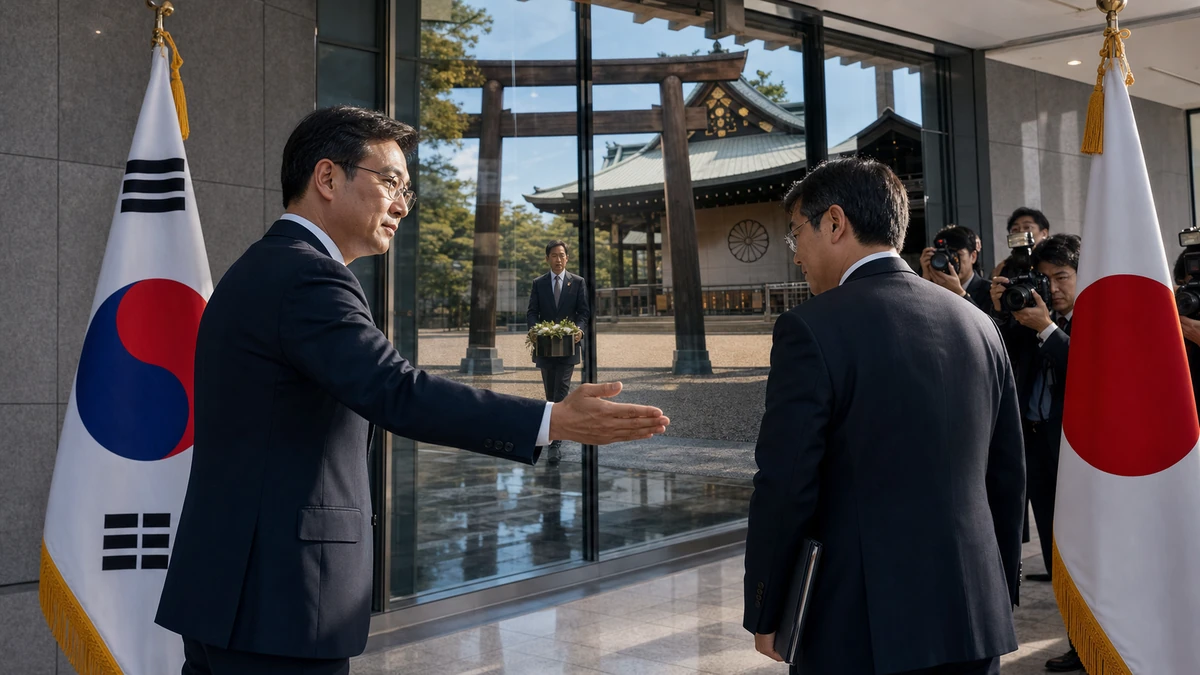
Image to help understand the article
A shrine visit that landed in the middle of a diplomatic fault line
South Korea’s government used one of its strongest routine diplomatic tools this week to protest actions by Japanese political leaders tied to Yasukuni Shrine, a Tokyo memorial that has for decades stood at the center of some of East Asia’s most painful disputes over war memory. Seoul publicly criticized offerings and visits made by Japanese politicians and summoned a Japanese official to lodge a formal complaint after Japanese Defense Minister Shinjiro Koizumi visited the shrine on Aug. 15.
The date matters as much as the visit. In South Korea, Aug. 15 is Liberation Day, the anniversary of the end of Japan’s colonial rule over the Korean Peninsula in 1945. In Japan, the same date marks the country’s defeat in World War II. That one day carries two very different national memories: for Koreans, emancipation from colonial occupation; for many Japanese, mourning the war dead and reflecting on national loss. When a Japanese cabinet-level official visits Yasukuni on that date, South Korea does not see a private act of remembrance. It sees a message, whether intended or not, about how Japan’s leaders understand the imperial past.
That is why the latest dispute is bigger than a symbolic flare-up. The South Korean Foreign Ministry said Yasukuni is not simply a religious site but a place associated with Japan’s past wars of aggression and with the enshrinement of convicted war criminals. In Seoul’s view, the issue is not memorialization in the abstract. It is the way memorialization can blur accountability for colonial rule and wartime violence. By summoning a Japanese official in addition to issuing a public statement, South Korea signaled that this was not merely a matter of rhetoric for domestic audiences. It treated the episode as a direct test of diplomatic trust between two neighbors whose ties remain strategically important but historically fragile.
For American readers, the closest comparison is not exact, but imagine how differently a wartime memorial would be perceived if it honored both ordinary soldiers and leaders convicted of major war crimes, and if sitting cabinet officials repeatedly chose to appear there during politically charged anniversaries. The dispute would not be only about religion or remembrance. It would be about whether the state was signaling repentance, revisionism or something strategically ambiguous in between.
Why Yasukuni is so controversial in South Korea and beyond
To understand the intensity of South Korea’s response, Americans need some cultural and historical context. Yasukuni Shrine was established in the 19th century to commemorate Japan’s war dead. Over time, however, it became inseparable from Japan’s imperial expansion and the militarism that culminated in World War II. Most controversially, it enshrines Class-A war criminals alongside other dead, which is why visits by elected leaders are often interpreted in neighboring countries not as neutral mourning but as an implicit endorsement, or at least sanitization, of Japan’s wartime conduct.
That sensitivity is especially acute in South Korea because Japan colonized Korea from 1910 to 1945. The legacy of that period still shapes politics, education, public memory and identity on both sides of the Korea Strait. Issues such as forced labor, military sexual slavery, wartime mobilization and the treatment of colonial subjects remain unresolved in public consciousness even when governments try to move forward diplomatically. In that context, disputes over shrines, textbooks and commemorative language can be as politically potent as trade policy or military exercises.
South Korea’s latest protest reflects a longstanding principle in Seoul’s diplomacy: historical accountability is not a side issue that can be compartmentalized indefinitely from present-day cooperation. The government’s statement reportedly described these acts as anachronistic and lamentable, language that underscores a broader Korean argument that East Asia’s future security order depends in part on whether Japan’s leaders demonstrate a consistent, responsible understanding of the past.
This is an important point for international audiences. South Korea is not objecting to mourning the war dead in general. Its complaint is more specific: that state-linked acts of remembrance become problematic when they appear tied to narratives that minimize aggression or soften the moral clarity around war crimes. Seoul’s response therefore aims to draw a line between remembrance and revisionism, even if Japan’s domestic debate often frames shrine visits in very different terms.
Why the defense minister’s visit carried extra weight
The most immediate trigger for Seoul’s formal protest was not just any politician’s gesture but the reported visit by Japan’s sitting defense minister. In diplomatic terms, rank matters. A defense minister is not a backbench lawmaker freelancing on ideology; he is the official responsible for national defense policy, civil-military leadership and security messaging. For South Korea, that makes the symbolism much heavier.
In most countries, senior defense officials are read closely by neighboring states because their statements and appearances carry implications about strategic intent. When the official in charge of defense pays respects at a site deeply associated abroad with militarism and wartime aggression, neighboring governments are likely to treat that act as more than personal belief. That appears to be exactly how South Korea approached this case.
By summoning a Japanese official, Seoul used a standard diplomatic mechanism to register both its objection and the seriousness of its concern. A summons, in foreign ministry practice, is not the most severe measure available, but it is more formal and pointed than a simple public comment. It ensures that the protest is delivered directly, on the record and at a level the other government cannot plausibly ignore. In practical terms, it allows South Korea to say two things at once: we are angry, and we are still handling this through institutions rather than through uncontrolled escalation.
That dual message matters because South Korea and Japan are not adversaries in the conventional sense. They are democratic U.S. allies facing overlapping security challenges, particularly from North Korea’s advancing missile and nuclear programs, as well as broader uncertainty about China’s regional ambitions. But alignment on security does not erase distrust rooted in history. Instead, it creates a recurring paradox: the more strategically necessary bilateral cooperation becomes, the more costly these symbolic ruptures can be.
That is part of why the defense minister’s appearance resonated so strongly. It touched the one portfolio where historical memory and current power most obviously intersect. If a country’s top defense official seems casual about symbols linked in neighboring memory to past aggression, those neighbors are less likely to read present-day assurances at face value. In that sense, the controversy is not only about 1945. It is also about credibility in 2025 and beyond.
The prime minister stayed away, but that did not solve the problem
One reason these episodes are so difficult to defuse is that they often involve mixed signals. Japanese Prime Minister Sanae Takaichi did not personally visit Yasukuni on the anniversary, attending a ceremony for the war dead instead. On paper, that could be read as an attempt to avoid inflaming tensions. But according to the Korean account, her speech did not include explicit reflection or remorse regarding the victims of Japan’s imperial rule. From Seoul’s perspective, that omission limited the diplomatic value of her restraint.
This highlights a broader truth about memory politics in East Asia: in many cases, what leaders say matters as much as where they go. Avoiding the shrine may reduce the immediate optics of provocation, but if accompanying language fails to acknowledge the suffering experienced by neighboring countries, the underlying concern remains. South Korea’s response suggests that it is watching for consistency between action and message. If one leader stays away while others send offerings or visit, and if official commemorations avoid direct language of responsibility, neighboring states may conclude that Tokyo is still unwilling or unable to send a stable signal about historical accountability.
In other words, diplomacy is not only about avoiding the worst-case gesture. It is about constructing a coherent narrative that other countries can trust. Japan’s domestic politics make that difficult. Conservative politicians often view Yasukuni-related criticism as foreign interference in mourning practices or national dignity. Many South Koreans, by contrast, see the issue as a basic test of whether Japan’s elite understands why symbols of empire remain painful across the region. Both positions are deeply embedded in each country’s political culture, which helps explain why these disputes recur despite periodic efforts at rapprochement.
For U.S. readers, this is a reminder that alliance management in Asia involves more than troop deployments and summit photos. Historical narrative is part of the strategic environment. A government can make real progress on intelligence sharing, trade and trilateral coordination with Washington and still find that a shrine visit or a carefully worded commemorative speech throws public trust into reverse.
What this means for the United States
For the United States, the Yasukuni dispute is not a distant cultural quarrel. It directly affects Washington’s two most important treaty allies in Northeast Asia, both of which are central to U.S. strategy on North Korea, regional deterrence, advanced manufacturing and supply-chain resilience. American administrations of both parties have spent years encouraging closer cooperation between Seoul and Tokyo, not because historical reconciliation is a sentimental project but because practical coordination is harder when the political atmosphere between the two capitals sours.
The stakes are concrete. The U.S., South Korea and Japan have expanded trilateral security coordination in recent years in response to missile threats from North Korea and broader instability in the Indo-Pacific. That cooperation depends not only on leaders’ willingness to meet but on domestic public support inside both Asian democracies. When historical controversies flare, they make intelligence sharing, military exercises and diplomatic trust more politically vulnerable, especially in South Korea, where public opinion on Japan can turn quickly when symbols of colonial memory resurface.
There is also an economic angle that matters to Americans. South Korea and Japan are deeply embedded in supply chains that affect U.S. consumers and companies, from semiconductors and batteries to autos, displays and advanced materials. Washington has increasingly tried to build resilient production networks with close allies, particularly as U.S.-China competition intensifies. Friction between Seoul and Tokyo does not automatically derail that agenda, but it can complicate coordination among governments and firms that the U.S. wants aligned.
The cultural dimension should not be underestimated either. Korean pop culture, television, film and food now occupy a mainstream place in American life, and Japanese cultural influence has long been deeply rooted in the United States as well. That means historical disputes once treated in the U.S. as niche foreign-policy matters now land in a different media environment. American audiences are more familiar than ever with Korean perspectives, particularly younger consumers of K-pop, K-drama and Korean cinema. At the same time, U.S. businesses from entertainment distributors to tech companies increasingly operate in a trans-Pacific landscape where public sentiment matters. When historical tensions spike, they shape not just diplomacy but the broader climate surrounding cultural and commercial ties.
Washington typically avoids taking sides in symbolic memory disputes between allies. But it cannot ignore the effect those disputes have on alliance cohesion. The long-term American interest is not to referee every argument over history; it is to encourage conditions under which Seoul and Tokyo can sustain cooperation without requiring amnesia. That is a delicate balance, and episodes like this show how easily it can be upset.
This is less a one-day controversy than a recurring regional pattern
It would be a mistake to see the latest protest as an isolated blowup caused by one anniversary. The deeper story is the persistence of unresolved historical memory as a structural feature of East Asian politics. Every few years, sometimes every few months, a familiar cycle returns: a shrine visit, a textbook revision, a court ruling, a speech that omits apology, a diplomatic protest, and renewed debate over whether the region has truly moved on from the 20th century. The specific trigger changes, but the pattern remains remarkably durable.
What has changed is the context around it. Northeast Asia today is more strategically compressed than at almost any point since the Cold War. North Korea’s weapons programs are more advanced. U.S.-China rivalry is sharper. Taiwan has become a more sensitive security issue. Global supply chains have become a matter of national security policy. In that environment, historical symbolism has not become less relevant. If anything, it has become more consequential because mistrust now spills more quickly into areas that Washington and regional capitals consider vital.
South Korea’s handling of this episode reflects that reality. Seoul chose a combination of public criticism and formal diplomatic procedure rather than rhetorical maximalism. That suggests the government wants to defend a principle without triggering uncontrolled damage to the broader relationship. It is, in effect, trying to say that sustainable cooperation requires boundaries. Historical reflection is not the enemy of future partnership, in this view; it is one of its prerequisites.
That framing is likely to resonate beyond Korea. Across democracies, public memory has become a live political issue, whether in debates over Confederate monuments in the United States, colonial-era memorials in Europe or school curricula everywhere. The details are different, and the analogies should not be pushed too far, but the core question is familiar: how should modern states commemorate the dead without laundering the violence, exclusion or injustice tied to the systems those people served? East Asia’s version of that question is sharper because it sits inside ongoing geopolitical rivalry.
What to watch next in Seoul, Tokyo and Washington
The immediate diplomatic damage from this episode may prove manageable. South Korea and Japan have strong incentives to keep working together, and neither side benefits from a total freeze in relations. But the longer-term significance lies in whether Japan’s leaders continue to send mixed messages on war memory and whether South Korea’s public concludes that recent improvements in bilateral ties rest on unstable ground.
Three things are worth watching. First, whether Japanese leaders double down on domestically popular symbolic gestures or seek a more consistent line that avoids provoking neighbors while preserving room for national commemoration. Second, whether South Korea keeps channeling its objections through formal diplomatic procedure, which suggests a strategy of controlled pressure rather than relationship rupture. Third, whether the United States quietly intensifies behind-the-scenes efforts to keep historical disputes from undermining broader trilateral cooperation.
The central lesson is that history in East Asia is not inert background. It is active political material. A shrine visit by a defense minister on a date sacred to Korean national memory is not likely to be filed away as a mere misunderstanding. It becomes a signal, contested and interpreted across borders, about how power, responsibility and remembrance fit together in the present.
For Americans, that should matter not simply because South Korea and Japan are important allies, but because U.S. strategy in Asia increasingly depends on partnerships that are emotionally and historically complex. Washington can encourage coordination, but it cannot manufacture trust where symbols keep reopening old wounds. As long as Yasukuni remains a site where mourning, nationalism and historical accountability collide, every visit by a senior Japanese official will carry meaning far beyond the shrine grounds.
And that is the real story here. South Korea’s protest is not just about an annual controversy. It is a reminder that in one of the world’s most strategically important regions, the past is still negotiating with the present — and often has a louder voice than policymakers would like.
Comments
Post a Comment