Image to help understand the article
A mountaintop discovery with a political story
A bronze seal bearing a character meaning “king” is drawing attention to a mountain fortress in southwestern South Korea. But the most consequential discovery may not be evidence of royalty. It is evidence of government: a place where officials may have exercised authority over a coastal region more than a millennium ago.
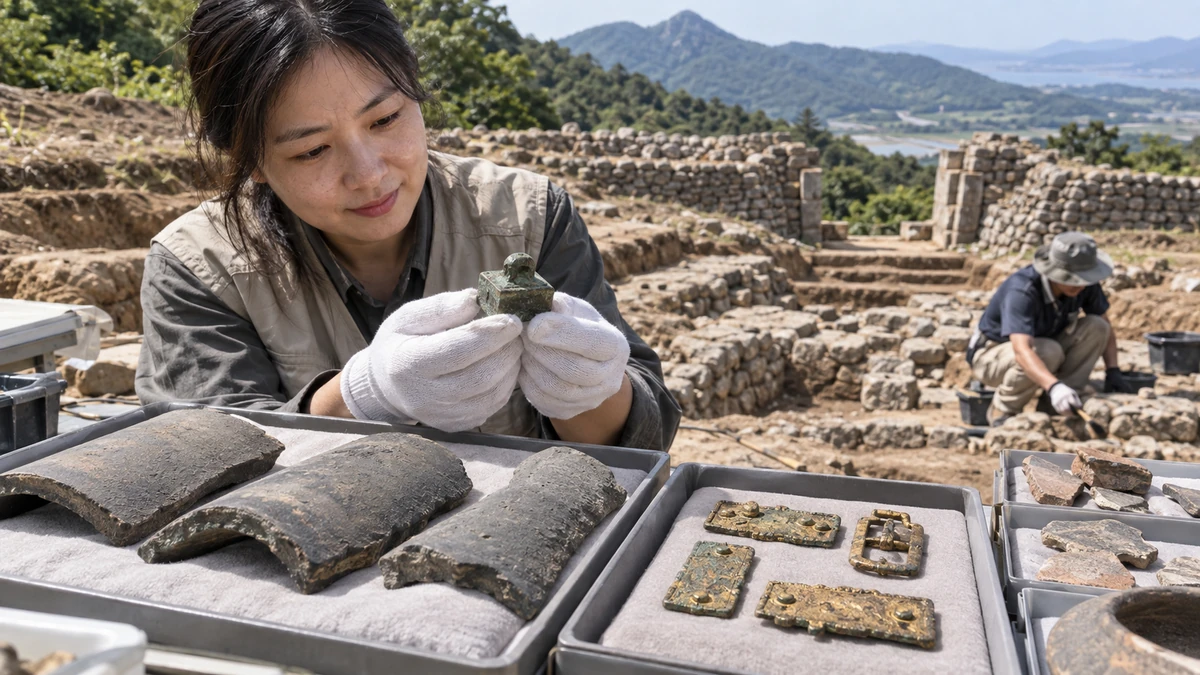
The first excavation at Goda Mountain Fortress, in Haenam County, recovered about 100 artifacts, including the seal, an inscribed roof tile and a gilt-bronze belt in a style associated with China’s Tang dynasty. According to the county’s account, the three-month investigation began in June. The supplied account does not specify a calendar year.
Together with surviving walls and gateways, the objects support an interpretation of the fortress as a regional political and administrative center during the Unified Silla period, rather than simply a refuge or military lookout. The distinction matters: A fortified government seat would have helped connect a distant community to the kingdom’s central authority.
For American readers encountering Korean history through television dramas, museum exhibitions or travel, the finds offer something less theatrical than a royal tomb but potentially just as revealing. They shift the focus from who occupied the throne to how power operated beyond the capital — through official objects, buildings, transportation routes and a defensible seat of administration.
Where the fortress fits in Korean history
Goda Mountain Fortress stands in Hyeonsan, an area of Haenam near the southwestern end of the Korean Peninsula. Its elevated position provides views of maritime transportation routes along the southwest coast and approaches by land. That combination would have made it useful not only for detecting threats but also for overseeing movement through the surrounding landscape.
The stone fortress is attributed to Unified Silla, the kingdom that emerged after Silla defeated its rivals Baekje and Goguryeo in the seventh century with Tang assistance. Historians commonly date the Unified Silla period from 668 to 935. Despite the name, Silla did not rule all the territory associated with the earlier kingdoms; the northern state of Balhae also became a major regional power.
For a rough chronological reference, this was the era of the early medieval kingdoms of Europe, spanning the centuries around Charlemagne and the Viking age. On the Korean Peninsula, it was also a period of sophisticated government, Buddhist institutions and extensive engagement with neighboring societies.
Southwestern Korea had previously belonged to Baekje. Establishing Silla authority there therefore involved governing territory with its own political history and local institutions. The Haenam discoveries raise questions about how that transition took physical form: where officials worked, how they displayed rank and whether older administrative locations remained important under new rulers.
A “king” inscription is not proof of a royal owner
The bronze seal carries 王, a Chinese character read as “wang” in Korean and commonly translated as “king.” Chinese characters served as an important written medium in Korean government and elite culture long before the creation of the Korean alphabet, Hangul, in the 15th century. Finding such a character on a Korean artifact is therefore not, by itself, evidence that the object came from China.
The county’s account suggests the seal may have been used on administrative documents. That is a proposed function, not an established account of a particular transaction or owner. The reported inscription does not demonstrate that a king visited the fortress, lived there or personally used the seal.
For Americans, an official seal offers a useful comparison: It can authenticate authority without implying that the highest officeholder handled every document bearing its impression. The analogy helps explain why an archaeologist might find the object politically significant while stopping short of calling it a monarch’s possession.
The gilt-bronze belt adds another clue. Its Tang-style design places it within a broader East Asian vocabulary of elite dress and status. Gilt bronze is bronze covered with a layer of gold, not solid gold. The excavation account treats the belt and seal as prestigious objects associated with the highest ranks, exceeding what might be expected at an ordinary local office. Their presence strengthens the case for a high-status administrative site, but it does not identify a specific official or establish the belt’s place of manufacture.
A roof tile may help connect the site to an older map
Less immediately eye-catching than the seal is a roof tile inscribed with 塞琴官, rendered in Korean as “Saegeumgwan.” The excavation account connects that inscription to a Baekje-era administrative place name preserved in written records. Such a find can help researchers test whether a historical name corresponds to a particular location on the ground.
Hyeonsan is thought to have contained the administrative seats of Saegeum County under Baekje, Chimmyeong County under Unified Silla and Haenam County under the later Goryeo dynasty. These remain proposed identifications in the supplied account. The inscribed tile contributes evidence to that discussion; it does not automatically settle every question about the succession of offices.
This is where a small architectural fragment can carry unusual weight. Historical texts may preserve names while leaving uncertainty about exact locations. Excavation can provide a physical setting, but objects must still be interpreted in relation to the layers and buildings in which they were found.
The tile also directs attention toward the fortress’s buildings, not just its perimeter. A defended administrative compound would require spaces in which officials and other personnel conducted their activities. The current account does not provide a complete building plan or identify particular rooms. It does, however, report additional roof tiles, including decorative eave-end tiles, alongside weapons, agricultural tools and ritual vessels — a range suggesting activities broader than standing watch.
Why government belonged behind walls
In Korean, a mountain fortress is a “sanseong.” Unlike the image of a European castle dominated by a single imposing keep, a Korean mountain fortress can use the terrain itself as a central element of defense. Goda has a summit-enclosing layout, known as “taemoe,” with walls surrounding the upper part of the mountain.
The excavation supports identifying it as a “chiso-seong”: a fortified administrative seat. For an American audience, the closest conceptual comparison is not simply a battlefield fort, but a protected government center. Military security and civil administration could occupy the same place rather than belonging to the separate institutions modern visitors might expect.
At Goda, the view over both sea routes and land approaches helps explain the location’s potential value. An authority seeking to govern a coastal district would benefit from understanding who and what moved nearby. That geography supports questions about regional oversight, although the supplied evidence does not establish specific customs duties, tax collections or cargo inspections.
The walls themselves offer another line of inquiry. On the northern wall, investigators identified an exterior built with successive courses set inward. Inside, the construction combined a compacted-earth foundation with vertically laid stonework. The county describes these methods as characteristic of Unified Silla fortifications. Those structural details provide evidence about construction practices separately from the interpretation of the high-status artifacts.
Several eras occupy the same hillside
The site’s history does not begin or end with Unified Silla. Excavators identified three cultural layers, including remains and artifacts associated with Mahan beneath the fortress walls. Mahan was a grouping of communities and small polities in the southwestern peninsula during the early centuries of Korean history, before Baekje’s expansion consolidated power across much of that region.
The earlier material matters because it shows that the mountain’s use preceded the stone fortress now associated with Silla. It does not mean the same institution operated there continuously. A strategically useful location can attract different communities and governments for different purposes over many generations.
The eastern gate also records change. Investigators dated its initial installation to Unified Silla and identified later stepped alterations or repairs during the Goryeo and Joseon periods. Goryeo ruled from 918 to 1392, followed by Joseon from 1392 to 1910. The reported repair range is broad, so the account should not be read as assigning the alterations to a specific ruler or decade.
For visitors accustomed to seeing a historic site labeled with one date, this layered history is important. What survives above ground may represent several construction campaigns, while the soil beneath contains traces of earlier activity. At Goda, the task is to distinguish those episodes and establish their relationships, not compress them into a single uninterrupted story.
What the discovery means for American audiences
The direct American connection is cultural and educational, not a newly announced commercial partnership. The supplied account identifies no U.S. excavation team, corporate sponsor, museum loan or tourism agreement. Its relevance to the United States lies in how Americans encounter Korea — and how cultural institutions and entertainment companies explain a past that is often unfamiliar to their audiences.
The Korean Wave, commonly called “Hallyu,” describes the international spread of South Korean popular culture, including music, television and film. For American fans, historical dramas can be an introduction to royal courts, official dress and struggles over status. Archaeological discoveries offer an opportunity to move beyond those portrayals and ask which details are supported by physical evidence.
That creates an editorial responsibility for U.S. streaming platforms, publishers, museums and travel media when they cover finds such as these. A seal marked “king” makes an appealing headline, but presenting it as a king’s personal seal would go beyond the reported evidence. Likewise, a Tang-style belt can illuminate cultural connections without proving it was imported from China.
American public history offers a useful comparison. At sites such as Colonial Williamsburg, objects and buildings help explain government and daily life beyond the biographies of famous leaders. Goda invites a similar shift in emphasis: away from treating Korean history exclusively as a sequence of kings and toward understanding institutions, regional communities and the material signs of authority. The societies were very different, but the interpretive challenge is recognizable.
The discovery also broadens the cultural dimension of U.S.-South Korea ties. The two countries’ relationship is frequently discussed through security, trade and contemporary entertainment. This excavation supplies material for a different kind of engagement: learning how Korean society developed long before the modern alliance. Any eventual American exhibition or research collaboration would require a separate announcement; none is established here.
What to watch as the evidence develops
The immediate significance of the first excavation is the convergence of different types of evidence. Prestigious objects suggest elevated status. An inscribed tile points toward administrative geography. Walls and gates establish a fortified setting, while weapons, farming implements and ritual vessels indicate a wider range of activity. No single object has to carry the entire interpretation.
The next important questions concern context. Where exactly were the seal and belt recovered? Did they come from securely dated deposits? How do those deposits relate to buildings, gates and earlier occupation layers? Detailed findings on those points would help determine how closely the objects can be tied to a particular phase of government activity.
Researchers will also need to distinguish stylistic influence from production and movement. A belt made in a Tang style could reflect several possible relationships with contemporary Chinese material culture. Establishing where it was produced or how it arrived would require evidence beyond resemblance alone. The same caution applies to reconstructing the seal’s use from its inscription.
Haenam County undertook the excavation as part of a historical and cultural heritage development initiative. The first investigation has supplied a stronger basis for interpreting the site, but the provided account does not announce a second excavation, an exhibition schedule or new visitor facilities.
For now, Goda’s most compelling story is not that a royal treasure has emerged from the earth. It is that a mountain once understood in defensive terms appears to have played a larger role in governing its region. For readers in Korea and the United States alike, that is a reminder of what archaeology can do best: use modest fragments and remarkable objects together to make the workings of an unfamiliar society more visible.
Comments
Post a Comment