A Gunfight Between Ukraine’s Own Spy Agencies Raises New Questions About Wartime Control — and What It Means for the U.S.
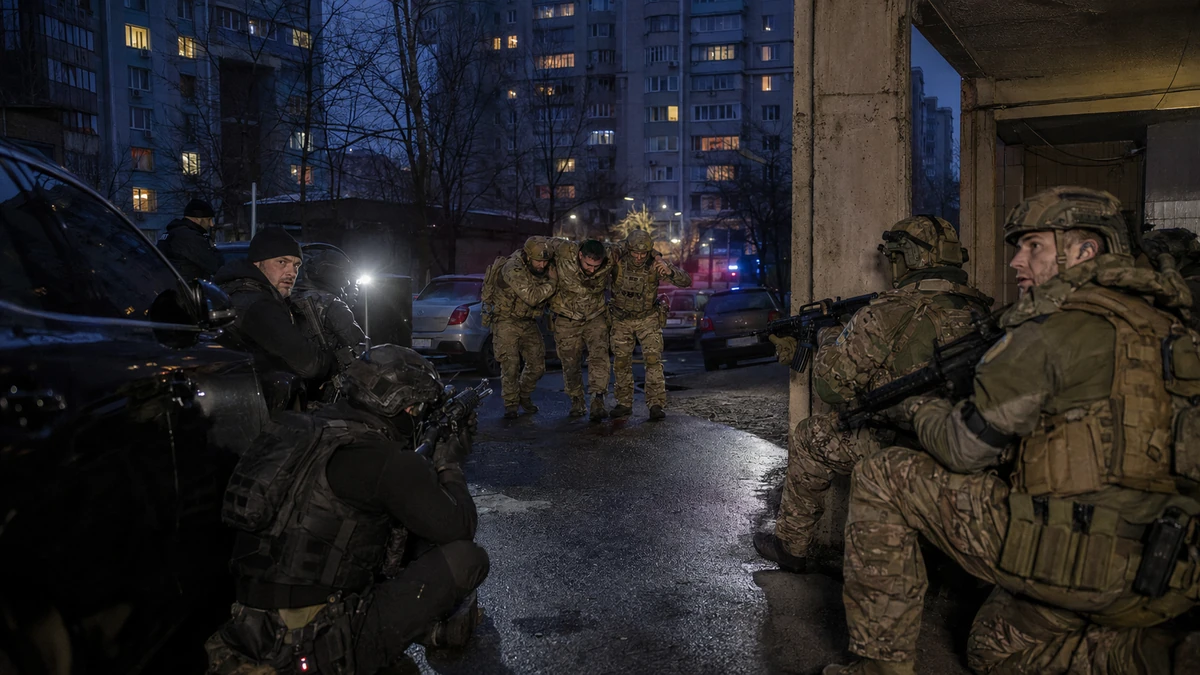
Image to help understand the article
Ukraine’s war effort faces a different kind of battlefield
In a country fighting for survival against Russia, one of the most alarming recent clashes did not involve Russian troops at all. According to reporting cited by The Wall Street Journal and described in Korean media coverage, armed units tied to two of Ukraine’s most important security institutions — the Security Service of Ukraine, known as the SBU, and the Defense Ministry’s Main Intelligence Directorate, or HUR — confronted each other in central Kyiv and exchanged gunfire. Three HUR special forces members were reported wounded.
That bare fact is striking enough. Kyiv is not just Ukraine’s capital; it is the command center of a nation in a grinding, high-stakes war. And the SBU and HUR are not obscure bureaucracies. They are central players in Ukraine’s wartime security apparatus, the kinds of institutions responsible for counterintelligence, sabotage, covert operations and some of the most sensitive missions tied to Russia and Russian-occupied territory. When organizations like that point weapons at each other in a residential apartment complex rather than coordinating against a common enemy, the episode becomes more than a local security incident. It raises questions about chain of command, internal trust and whether wartime power centers are beginning to collide in ways that could weaken the state from within.
For outside audiences, especially in the United States, the instinct may be to view this as an internal drama far from the front lines. That would be a mistake. Ukraine’s ability to sustain the war has always depended on more than artillery shells, air defense interceptors and troop numbers. It also depends on whether the state can keep its security services under a coherent command structure while still allowing them the flexibility needed for intelligence work. This incident suggests that balance may be under strain.
The symbolism is also hard to ignore. Residents reportedly posted footage to social media showing blood outside the apartment building where the confrontation unfolded. The setting matters. This was not a firefight at a military base or in a remote combat zone. It happened in a civilian living area in the middle of the capital, underscoring how a conflict between elite institutions spilled into everyday urban life. In wartime, states ask citizens to endure extraordinary disruption. But when armed agencies of the same government bring their rivalry into residential neighborhoods, the issue becomes not simply battlefield efficiency but public confidence in the state’s basic control over force.
What reportedly happened in Kyiv
The immediate trigger, according to the account summarized in the Korean article, was the detention by the SBU of a Russian national who had been fighting on Ukraine’s side under HUR’s command. The fighter was identified as Stepan Kalpunov, deputy commander of a Russian volunteer formation associated with the Timur special unit, a HUR-linked force reportedly made up of thousands of experienced personnel. The precise allegations against Kalpunov were not publicly disclosed, even after the shooting.
That lack of clarity is not a minor detail. In normal democratic systems, the legal basis for detaining an armed figure tied to a state-backed unit would be central to judging whether an operation was legitimate, excessive or politically motivated. In wartime, governments often keep investigations secret for security reasons. But secrecy can also deepen mistrust, especially when rival institutions are involved and when the detained person is later released.
According to the version relayed through Kalpunov’s lawyer, an SBU special unit known as Alpha brought Kalpunov to an apartment rented by the Timur unit on the night of Sept. 1 and attempted to conduct a search as part of a criminal investigation. Members of the Timur unit at the scene blocked the effort. Negotiations failed. Reinforcements arrived. The standoff escalated into gunfire that continued into the early hours of Sept. 2.
The SBU, for its part, said its personnel investigating Russian terrorist acts were attacked by armed individuals and that special forces were deployed to protect its officers, leading to the exchange of fire. Kalpunov was later released. Taken together, those facts leave a number of unresolved questions: Who authorized the search? Was there prior coordination between agencies? Who fired first? Why was a suspect tied to a sensitive intelligence-linked unit detained for about a week and then freed without public clarification? And perhaps most important, why did two elite security organizations fail to activate any shared deconfliction procedure before the situation spiraled into violence?
Even without definitive answers, the reported sequence points to a basic institutional failure. In countries with multiple armed federal agencies, frictions happen. The United States has had its own history of interagency competition, whether between the FBI and CIA, the Pentagon and civilian intelligence services, or local and federal tactical teams. But precisely because such friction is predictable, systems are built to manage it: notification protocols, command hierarchies, legal channels, and clear rules on who has jurisdiction over whom. What appears to have happened in Kyiv suggests those safeguards either did not exist, did not function, or were overridden.
Why the SBU-HUR rivalry matters beyond one night’s violence
At one level, this can be read as a confrontation over one detained fighter and one disputed search. At a deeper level, it looks like something else: a visible eruption of longer-running competition over authority, resources and wartime influence.
The SBU and HUR occupy different formal lanes, but in a war against Russia those lanes can blur. Both have been tied to sensitive operations involving Russia, Russian officers and occupied territory. Both operate in a world where secrecy is the norm, where attribution is often murky, and where results can translate directly into political capital inside the government. In peacetime, interagency overlap might produce bureaucratic infighting, turf wars and legal disputes. In wartime, when heavily armed units, covert missions and intense personal loyalties are involved, the same overlap can become far more dangerous.
That is one reason the Kyiv incident deserves to be seen as a warning sign rather than an isolated misunderstanding. If two institutions with overlapping missions are competing not only over jurisdiction but also over prestige and proximity to national leadership, then disputes can quickly take on a harder edge. The use of force in such a setting is not merely a breakdown in communication. It can reflect a deeper erosion of confidence that rules, rather than power, will settle conflicts.
The Korean summary also points to another important factor: leadership transition inside HUR. Its longtime chief, Kyrylo Budanov, reportedly moved to the presidential office, and Oleh Ivashchenko became the new HUR head in January. Yet members of the Timur special unit are said to retain strong loyalty to Budanov. That matters because intelligence and special operations organizations often run not just on formal hierarchy but on personal trust, wartime reputation and shared risk. When a leadership change occurs on paper but operational loyalties remain attached to a previous figure, the result can be a split between official command and lived command.
Americans can understand this through a familiar lens: any large security institution depends not only on organization charts but on who people believe really speaks with authority. In the military, law enforcement and intelligence world, morale and discipline often flow through personal chains of trust. If those become misaligned with formal leadership, confusion follows. In a country at war, confusion inside elite armed units is not just a management problem. It is a national security risk.
None of this proves a broad collapse of control inside Ukraine’s state. It would be reckless to overstate one incident. But it does suggest that the pressures of a long war are extending beyond the trenches. The longer a war continues, the more likely it is that institutions built for urgent flexibility begin colliding with institutions built for legal authority. The Kyiv gunfight appears to sit exactly at that fault line.
Why this is especially troubling in a wartime capital
The location of the confrontation may be as important as the confrontation itself. Reports indicate that the standoff unfolded at an apartment leased by a HUR-affiliated unit, not at a restricted military site. That means dozens of armed personnel reportedly converged in a residential complex where civilians live, sleep and expect at least some degree of separation from the machinery of the war.
That blurring of spaces is deeply unsettling. Ukraine has, for good reason, militarized aspects of civilian life during Russia’s invasion. Air raid sirens, checkpoints, blackouts and visible security measures have become part of normal existence. But there is still a crucial distinction between a society enduring war and a state allowing internal armed disputes to unfold in residential settings. One reflects external attack. The other hints at weakening internal discipline.
For Ukrainian leaders, the danger is not only operational but political. Public resilience is one of the country’s greatest strategic assets. Ukrainians have shown remarkable endurance under bombardment and hardship. Yet social resilience depends in part on the belief that however severe the outside threat may be, the state remains fundamentally coherent on the inside. A public gunfight between domestic security arms threatens that perception.
There is also the issue of accountability. The details now in public do not establish who bears primary blame for the shooting itself. But the available facts already show a breakdown somewhere in the system. Either a high-risk operation was launched without adequate interagency coordination, or a lawful operation was blocked by another state-linked armed unit, or both institutions escalated in ways their superiors should have prevented. None of those possibilities is reassuring.
Wartime governments often ask for broad discretion from citizens and foreign partners. In return, they are expected to maintain disciplined control over armed power. If responsibility for this incident is not credibly established, and if procedural changes do not follow, the message to insiders could be that elite units can test boundaries without consequence. In any state, that is dangerous. In a state fighting a larger invading power, it is potentially destabilizing.
What this means for the United States
For Americans, the immediate temptation is to classify this as one more dramatic episode in a distant war. But the United States is not a bystander in any meaningful sense. Washington has committed tens of billions of dollars in military, financial and humanitarian support to Ukraine since Russia’s full-scale invasion. U.S. officials, lawmakers, defense firms and intelligence professionals all have a stake in whether Ukraine’s institutions remain effective, disciplined and politically manageable.
That does not mean one incident should trigger sweeping conclusions about the viability of support. It does mean the episode will likely reinforce a concern already present in parts of Washington: aid is not only about equipment delivery, but about institutional reliability. Members of Congress who are skeptical of additional support to Ukraine often look for examples of dysfunction, fragmentation or opacity inside the Ukrainian state. A reported armed clash between two security agencies in central Kyiv is the kind of episode that can feed those arguments, regardless of the broader context.
For the Biden administration and for any future administration, the policy challenge is more nuanced. Ukraine’s security services are indispensable to the war effort. Agencies like the SBU and HUR help defend against Russian infiltration, sabotage and covert violence. They also contribute to the offensive pressure Ukraine has sought to maintain through intelligence-driven operations. In other words, Washington wants these institutions to be aggressive and capable. But it also wants them to be coordinated and under civilian control. The Kyiv incident illustrates the tension between those goals.
There is a familiar American parallel here, though not an exact one. The United States has long wrestled with interagency rivalry in national security, from post-9/11 intelligence reforms to disputes over who leads counterterrorism, cyber operations or foreign intelligence collection. The lesson Washington has repeatedly drawn is that capability without coordination creates strategic risk. That lesson is relevant to Ukraine not because the systems are identical, but because wartime improvisation can magnify the costs of overlap and personal power struggles.
The implications also extend to the American public. Support for Ukraine in the U.S. has never been based solely on sympathy. It has also rested on a practical argument: that helping Ukraine resist Russia serves American interests by deterring aggression in Europe and protecting the credibility of U.S.-led alliances. Incidents that suggest internal disorder can complicate that case, especially in a polarized political environment where foreign aid is closely scrutinized.
None of this means the U.S. relationship with Ukraine is suddenly in jeopardy. But it does mean American officials and audiences are likely to watch more closely for signs of how Ukraine manages its internal security institutions during a long war. The question is not whether frictions exist; every wartime state has them. The question is whether those frictions are contained by rules and command authority, or whether they are becoming armed contests in their own right.
A longer war changes institutions as much as it changes battlefields
One of the most important ways to understand the Kyiv shooting is as part of a broader wartime pattern. Long wars do not simply exhaust ammunition stocks and military budgets. They also reshape institutions. Agencies that gain prestige through daring operations accumulate influence. Command relationships that begin as practical wartime shortcuts can harden into semi-independent power networks. Personal loyalty can become as important as formal rank. And legal gray zones, tolerated for reasons of survival, can become difficult to reverse.
That is why the reported release of Kalpunov after the incident is so significant. If the original detention had a strong legal and intelligence basis, the public has not yet seen it. If it did not, then the decision to detain him in the first place becomes harder to justify. Either way, the mismatch between dramatic enforcement action and incomplete explanation leaves room for speculation that the underlying conflict was about more than criminal procedure. It leaves open the possibility that this was a test of power between institutions that no longer fully trust each other’s motives.
There is a broader lesson here for allies of Ukraine. Western governments often focus on measurable military inputs: missiles delivered, training cycles completed, defense production increased. Those metrics matter enormously. But war endurance also depends on the health of invisible systems — intelligence coordination, legal authority, personnel discipline and political oversight. A state can have brave soldiers and still struggle if its elite security bodies begin acting at cross-purposes.
That is especially true in a conflict where covert operations and internal security play such an outsized role. Ukraine is not only fighting a conventional war. It is also dealing with sabotage, espionage, collaboration networks and operations connected to occupied territories and Russian soil. In that environment, agencies like the SBU and HUR are essential. But because they are essential, rivalry between them is more dangerous than an ordinary bureaucratic feud. It can distort priorities, complicate command decisions and weaken confidence among both citizens and foreign backers.
What to watch next
The most important unanswered question is not simply who pulled the trigger first, though that matters. The larger test is whether Ukrainian authorities can establish a credible account of what happened and use it to tighten procedures between the security services. That means clarifying the legal basis for the original detention, determining whether proper coordination channels were followed, and identifying who authorized the buildup of armed personnel at the residential site.
It also means looking beyond the immediate incident to the structural issues underneath it. How are responsibilities divided between the SBU and HUR when investigations intersect with active units tied to intelligence operations? What mechanisms exist to prevent tactical teams from confronting one another in the field? How much effective control does current HUR leadership exercise over units reportedly still loyal to former leaders? Those are the questions that will reveal whether this was a one-off breakdown or a symptom of a larger wartime governance problem.
For the United States and other allies, the right response is not panic, and not denial. It is close attention. Support for Ukraine has always involved managing complexity, and this is part of that complexity. A resilient partner is not one that never experiences internal conflict; it is one that can expose, contain and correct it before it becomes systemic.
The Kyiv gunfight is unsettling precisely because it compresses so many wartime pressures into one episode: secretive institutions, overlapping authority, personal loyalty, armed force and public uncertainty. In a war that is often measured in maps and munitions, it is a reminder that state cohesion is also a battlefield. Ukraine’s capacity to keep fighting Russia depends not only on what happens at the front, but on whether its most powerful security organs can remain under one command, one legal framework and one national purpose.
Comments
Post a Comment