Image to help understand the article
A Decade of Waiting Ends With a Journey to South Korea
A 14-year-old boy from the Philippines who spent more than a decade living with an untreated congenital heart condition has returned to a new chapter of his life after receiving surgery in South Korea.
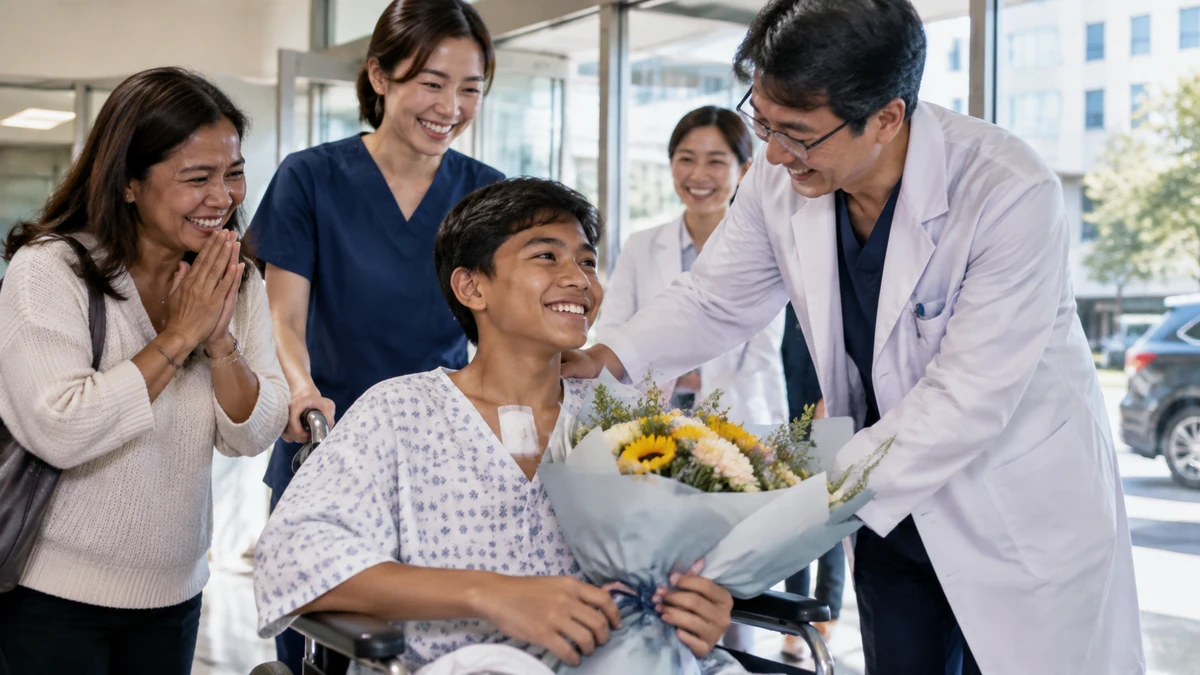
Vincent Valente, a teenager from Cebu in the Philippines, was discharged from Seoul National University Bundang Hospital after doctors repaired his heart condition. His case highlights both the medical challenges faced by children in regions with limited access to specialized care and the growing role of South Korea as a destination for advanced medical treatment and international health cooperation.
Vincent was diagnosed as an infant with atrial septal defect, commonly known as ASD. The condition occurs when there is a hole in the wall separating the heart's two upper chambers, allowing abnormal blood flow between them. While some small defects may close naturally or require monitoring, larger untreated defects can place long-term strain on the heart and lungs.
For Vincent, the diagnosis came when he was only 11 months old. A German doctor visiting the Philippines recommended further testing after noticing health concerns, and an echocardiogram revealed the heart defect. But a diagnosis did not immediately lead to treatment.
The hospital capable of providing specialized heart care was about five hours away from his home, and his family's financial circumstances made continued treatment difficult. Vincent grew up managing symptoms that affected his daily life, including shortness of breath and fatigue. Activities that many teenagers take for granted could become exhausting challenges.
His experience reflects a broader global health issue: medical knowledge may exist, but access to treatment can depend on geography, income and healthcare infrastructure.
A Medical Mission Connects Vincent With Korean Specialists
Vincent's opportunity for treatment came through an international health initiative involving South Korean medical professionals. In 2025, the Lee Jong-wook Global Medicine Center at Seoul National University College of Medicine conducted health screenings for low-income youth in the Philippines and identified Vincent as a patient who needed specialized care.
The center determined that Vincent required treatment in South Korea and helped arrange his medical evaluation. He was admitted to Seoul National University Bundang Hospital earlier this month, where doctors conducted detailed examinations including echocardiography and cardiac computed tomography scans.
The additional testing revealed that Vincent's condition was more complicated than originally known. Doctors discovered partial anomalous pulmonary venous return, a congenital condition in which some pulmonary veins connect incorrectly and send blood flow to the wrong location.
The combination of the two heart conditions had placed continued stress on Vincent's cardiovascular system for years. Medical staff found that his heart had become significantly enlarged and that blood vessels connected to the lungs had also expanded due to the long-term strain.
For doctors, the case represented not only a surgical challenge but also a reminder of how delayed treatment can affect children with congenital diseases. Early diagnosis and intervention are often critical in preventing complications and improving quality of life.
A Successful Operation and a New Future
Vincent underwent surgery on Sept. 4. The operation was performed by a team including cardiac surgeon Professor Lim Jae-hong of the Department of Cardiovascular and Thoracic Surgery and pediatric specialist Professor Lee Joo-won.
The recovery progressed quickly. The day after surgery, Vincent was able to breathe independently after being removed from a ventilator. Doctors determined that his condition improved enough for discharge on Sept. 9.
His discharge did not mark the immediate end of medical supervision. Vincent remained in South Korea for follow-up appointments before returning to the Philippines, and the Lee Jong-wook Global Medicine Center will continue monitoring his condition after his return home.
Vincent expressed gratitude for receiving treatment that he once thought might never be possible. He said that knowing he had a heart problem but having no way to receive treatment in the Philippines had been painful, and he was happy that he would now be able to run and play like other children.
Professor Lim said the medical team felt deep concern for a child who had been unable to receive treatment for more than 10 years. He added that support from multiple organizations helped Vincent receive accurate diagnosis and appropriate care.
The case demonstrates how cooperation between hospitals, nonprofit organizations and international medical programs can create opportunities for patients who might otherwise remain untreated.
What Vincent's Story Means for the United States and Global Healthcare
Vincent's journey also offers a perspective relevant to American audiences. The United States has one of the world's most advanced healthcare systems, with leading pediatric heart centers and medical research institutions. Yet access to specialized treatment remains a global challenge, including in parts of the U.S. where distance, cost and insurance barriers can affect patients' ability to receive care.
The situation also connects to a broader pattern in international medicine. American hospitals and medical organizations have long participated in global health programs, from training partnerships to humanitarian surgeries. South Korea's growing involvement in similar efforts reflects how healthcare cooperation is becoming an important part of international relations.
South Korea is widely recognized by Americans for its technology sector, entertainment exports and automotive industry, but its medical capabilities have become another area of global attention. Korean hospitals have invested heavily in advanced surgical techniques, digital healthcare systems and international patient services.
For U.S. observers, Vincent's case is not simply a story about one successful operation. It is part of a larger conversation about how countries share expertise and resources across borders. Medical diplomacy, where healthcare cooperation strengthens relationships between nations, has become increasingly important as countries respond to global health inequalities.
The United States and South Korea have maintained a close alliance for decades, built on security cooperation and expanding into areas such as technology, education, business and healthcare. Cases involving international patients show another dimension of that relationship: the exchange of knowledge that can directly affect individual lives.
American healthcare companies, research institutions and nonprofit organizations continue to look for ways to address healthcare access challenges worldwide. Vincent's experience illustrates why partnerships that combine medical expertise with community support can be essential.
South Korea's Growing Role in Medical Tourism and Health Cooperation
South Korea has become increasingly known internationally for medical services, particularly in areas such as cancer treatment, cosmetic procedures, organ transplantation and complex surgeries. International patients are drawn by advanced facilities, highly trained specialists and the country's reputation for technological innovation.
Medical tourism is not only about attracting foreign patients who can afford treatment. Another important aspect is humanitarian healthcare cooperation, where medical teams assist patients who lack access to necessary procedures in their home countries.
Programs involving children from lower-income communities have particular emotional and social significance. A successful surgery can change not only a patient's health outcome but also their ability to attend school, participate in activities and contribute to their community.
Vincent's story also reflects the importance of early detection. Congenital heart diseases are often treatable, but delays can create additional medical complications. International screening programs can help identify patients who may otherwise remain invisible within healthcare systems.
For countries across Asia, including the Philippines, partnerships with foreign medical institutions can provide additional pathways for patients requiring highly specialized care. These efforts do not replace the need to strengthen local healthcare systems, but they can provide critical support for complex cases.
A Personal Recovery That Reflects a Global Challenge
Behind the medical terms and international cooperation is the story of a teenager who wanted something simple: the ability to live like other children his age.
For years, Vincent carried a condition that limited his physical activity and created uncertainty about his future. After surgery in South Korea, he now faces a different future, one with the possibility of greater independence and a more active life.
His case is also a reminder that healthcare access remains uneven around the world. Advances in medicine can save lives, but only when patients are able to reach the doctors, facilities and resources they need.
As countries including the United States and South Korea continue to expand international cooperation, stories like Vincent's show the human impact of those partnerships. Behind every medical agreement or health initiative are individual patients whose lives can be transformed by timely care.
For Vincent Valente, a journey that began with years of waiting ended with a successful operation, a hospital discharge and the hope of finally running freely with his friends.
Comments
Post a Comment